WHAT TO EAT IN FRANCE: CAMEMBERT

Published by Thursday, May 28, 2015 Permalink 0

Unspeakably Awesome / Foter / CC BY-NC 

CAMEMBERT, THE FAVORITE CHEESE OF THE FRENCH

by Jonell Galloway

Sometimes I think I’m liquefying like an old Camembert.–Gustave Flaubert

History of Camembert

The legend goes that Marie Harel invented Camembert in 1791 in the village of Vimoutiers in Normandy, a froward priest giving her the instructions, which she guarded preciously hidden away. Camembert is not taken lightly in France. In 1928, Alexandre Millerand, former president of France, inaugurated a statue in Vimoutiers in honor of Harel’s great “achievement.”

The legend lives on, despite the fact that the family name Harel has never appeared on the list of cheesemakers or business people in the Camembert region, and that the first historical recording of the cheese was in 1708, well before Harel supposedly lived.

How Camembert is Made

Camembert is made from unpasteurized whole milk, abiding by specific requirements if it is to be labeled “Camembert de Normandie.”  The milk is first skimmed, then the lactobacillus bacteria is added as a starter. The milk is left at 12° C to coagulate for several hours and is then heated to around 30° C.

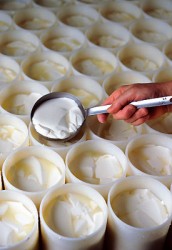
These curds are then sliced vertically and ladled into perforated cheese moulds. This manual operation is repeated four or five times over the space of 40 minutes, allowing the curds to drain off all excess water. After about 12 hours, the cheese is turned over and a stainless steel plate is placed on it, putting pressure on it so that it continues to drain overnight.

how camembert is made in Normandy


The next day, the cheese is removed from the moulds and salted. It is left for a week in a curing room with 100% humidity, where it is turned regularly. Thanks to the Pénicillium candidum in the atmosphere of the room, a natural crust is formed. (Some modern facilities spray the cheese with Pénicillium candidum to start the process.) French regulations require that it then be placed in a curing room with 50% humidity for a week.

The Camembert de Normandie A.O.C./A.O.P. is then ready for packaging. It is wrapped in plastic and then enclosed in a thin, round poplar box.

There are numerous variations on this process, depending on the manufacturer, but all makers more or less follow these steps, whether on a farm or in a larger establishment.

How to Choose a Camembert

Labeling

The first thing to look for is the origin. It will probably be Camembert de Normandie or Camembert fabriqué en Normandie. Only Camembert de Normandie is made from raw milk and and has the legal right to bear the A.O.C. or A.O.P. label. This category includes some 500 milk producers and 9 or 10 cheese makers. In any case, Camembert de Normandie is always hand-made and the dairy cattle have been let out to pasture for a minimum of 6 months. It should always be marked moulé à la louche, indicating that it is hand-made using a ladle.

This name has been protected since 1983, and only represents 4.2% of all Camembert made in France. Look for all these indications on the packaging. Labeling can often be deceptive. Study the images in this article so you’ll be able to tell whether it’s real Camembert and to get a picture of the deceptive practices used. In any case, it should bear this label:
camembert in ladle


Camembert fabriqué en Normandie simply means it’s made in Normandy. There are no regulations controlling how it is made, so it will most likely be made in a factory, but there are certainly some artisanal cheese makers who for one reason or another don’t qualify for the strict Camembert de Normandie label, but whose cheese is of a high quality.

Then there are manufacturers from other parts of the country who make what they call Camembert. This is usually made with pasteurized milk and most often in factories. We have no way of knowing whether it is made according to the rules of the trade or whether it is good except by tasting. It might even be made with milk from another country.

Appearance

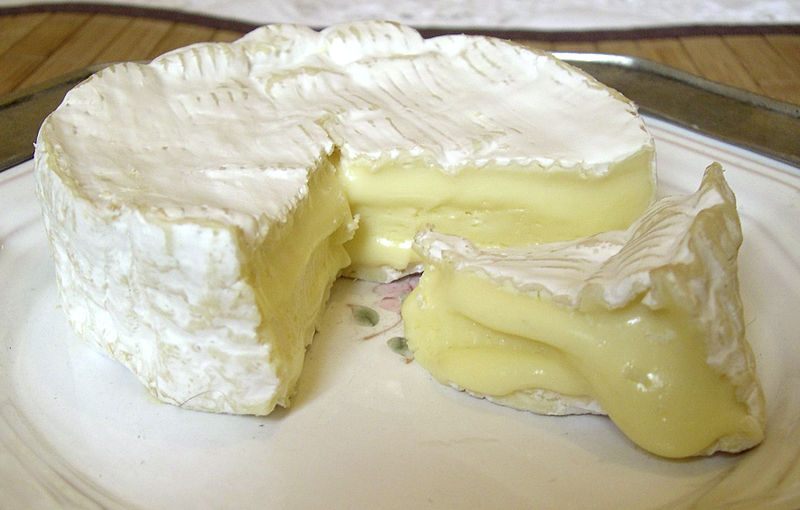
Camembert should be perfectly round and flat. The crust should be white, but slightly brownish, and should not be cracked. The brownish spotting is the result of healthy mould and ripening. The entire surface should be the smooth and even. The edges should be slightly yellow.

Smell the Camembert. Any whiff of ammonia indicates that it is too ripe. It should smell fruity and ripe like you’d like it to taste, but not overwhelming.

Touch the edges, then press the middle.  It should be neither too hard nor too soft.

When you cut into the cheese, it should be light yellow in color and creamy in texture.

Note: raw milk Camembert is best in the spring and autumn.

How to Eat Camembert

The French eat their cheese after the main course, either with or after a green salad. It is eaten as is, at room temperature, with bread, and followed by dessert. Some nicer restaurants will serve dried fruit, jam or nuts with the cheese course.


Never miss a post
Name: 
Your email address:*
Please enter all required fields
Correct invalid entries

FRENCH RECIPES: POT-AU-FEU OR PETITE MARMITE

Published by Saturday, May 23, 2015 Permalink 1

Emmanuel Ménétrier / Foter / CC BY-NC-SA

ESCOFFIER’S RECIPE FOR POT-AU-FEU OR PETITE MARMITE

Pot-au-feu and petite marmite in today’s vocabulary are the same thing. Until the nineteenth century, the term pot-au-feu simply referred to a family soup to which was added different ingredients every day, usually with beef and chicken added on Sunday. The regional variations were endless, depending on availability and season and depending on the cook.

In 1829, the French etymology dictionary defined  pot-pourri  as “the name our fathers gave to the pot-au-feu.” In the nineteenth century, the recipe started to take on its modern ingredients of beef, root vegetables and a veal bone, but it still included chicken, which many people, including my French butcher’s wife, leave out these days.

Escoffier, who codified French cuisine in the late nineteenth century and early twentieth century, set down the recipe in Le Guide Culinaire in 1902, still calling it petite marmite. The regional variations started to disappear, and the recipe has now been simplified by most home cooks to contain only beef, no chicken. Escoffier insisted on the importance of the chicken, but today, one rarely finds a pot-au-feu with mutton, veal, pork, chicken, duck or turkey. The other name, petite marmite, has pretty much gone out of usage.

Continue Reading…

Never miss a post
Name: 
Your email address:*
Please enter all required fields
Correct invalid entries

WHAT TO EAT IN FRANCE: HOW TO EAT FOIE GRAS

Published by Thursday, May 21, 2015 Permalink 0

WHAT TO EAT WITH FOIE GRAS

by Jonell Galloway

I tell you it will be more tolerable for the Fejee that salted down a lean missionary in his cellar against a coming famine; it will be more tolerable for that provident Fejee, I say, in the day of judgment, than for thee, civilized and enlightened gourmand, who nailest geese to the ground and feastest on their bloated livers in thy pate-de-foie-gras.”–Herman Melville, Moby Dick (1851)

In What to Eat in France: Foie Gras, we talked about how foie gras is made and the different legal classifications, which determine both the quality and price. Let’s move on to the fun part now. We’ve bought our high-quality foie gras and we want to eat it in the best way possible. Here are some ideas, both traditional and inventive.

Cooked Foie Gras

So you’ve bought a foie gras entier, a foie gras, or a bloc de foie gras. You’ll be eating pure or fairly pure foie gras, but how do you eat it and with what?

There is no one way to eat it. The Romans soaked it in honey and milk to fatten it still more before cooking. The first recipe on record comes from Apicius in his fourth century De re culinaria: Thinly slice the foie gras with a reed. Soak in garum. Crush some pepper, lovage and two bay leaves. Wrap in a caul. Grill and serve.

Today we eat it differently. Cold foie gras is most often eaten with something acidic to help digest the fat. This traditionally includes cold, sweet garnishes such as apple, rhubarb, fresh or dried figs, grapes, or pears, and toast, but contemporary chefs venture outside these limits, serving it with dried fruit and nuts and toasted brioche or raisin-fruit bread. More contemporary garnitures are onion jam or caramelized onions, Balsamic vinegar, port or Sauternes jelly, chutney, cassis berries, raspberries, blueberries or coarse sea salt.

Some people simply eat it with green salad, although I find that salad dressing deadens the natural depth of flavor. It’s also possible to eat it with cornichons and pickled onions. like one does with regular pâté, but once again, the vinegar is likely to overpower the delicate flavor.

Cooked foie gras should never be reheated. It should be eaten just colder than room temperature, so take it out of the refrigerator about 45 minutes before serving. Slice it with a knife while it is still cold. It is usually served with cold garnishes, most often as a starter.

Continue Reading…

Never miss a post
Name: 
Your email address:*
Please enter all required fields
Correct invalid entries

WHAT TO EAT IN FRANCE: FOIE GRAS

Published by Tuesday, May 19, 2015 Permalink 0

WHAT IS FOIE GRAS? READ THE FINE PRINT!

by Jonell Galloway

The French eat 90% of the foie gras they make themselves. That’s how much they like it, but they didn’t invent it. Although the Egyptians might have force-fed their birds, we’re not sure that they ate foie gras. The Greeks probably did, since the 4th-century Greek poet Archestratus wrote about it in his Gastronomy. The liver is the soul of the goose, he said.

Foie gras is made using a process called gavage, which consists of force-feeding ducks or geese through a feeding tube to fatten them. The Romans stuffed dried figs down their throats. In Latin, the word for liver even comes from fig, ficus. Scipio Metellus, a Roman chef, had the idea of soaking still warm livers in honey and milk to swell them even more before cooking.

Apart from the region of Béarn in the southwest, this practice disappeared in medieval France, coming back to life in the southwest and Alsace during the Renaissance.

French foie gras is made by force-feeding corn to geese and ducks, and still, occasionally, figs, which swells the livers.


Goose foie gras has traditionally been the most cherished because it is fattier, but it cannot be produced year round. Duck liver is less fatty, and can be produced year round and industrially, meeting the ever-increasing demand.

The fattened liver can be made into terrine, pâté, mousse, parfait, and a host of other things, and, in more recent times, there is a trend of cutting fresh foie gras into thin slices and pan-searing it. It can be eaten fresh or preserved in glass jars, and can be seasoned with truffles, port, Armagnac or Sauternes. Southwesterners prefer a simple, less perfumed foie gras, while Alsacians like to add flavor.

When purchasing, there are legal distinctions in names that indicate the purity and therefore determine the price:

  1. Foie gras entier means that it contains the actual lobes of the liver. The only legally allowed addition is truffles. As it’s solid, you cut it with a knife, just like you do extra-tender beef filet.
  2. Foie gras consists of pieces of liver that are put back together and pressed.
  3. Bloc de foie gras is reconstituted liver combined with other ingredients, but containing at least 50% foie gras for goose, and 30% for duck .
  4. Parfaits are preparations containing 75% foie gras and made by mechanical means, to which regular, unfattened liver is added.
  5. Médaillon or pâte de foie de canard or d’oie contains 50% duck or goose foie gras or bloc de foie gras in the middle, surrounded by forcemeat.
  6. Galantine is a butcher’s mixture of meats and other forcemeats, with no defined percentage of foie gras.
  7. Mousse contains 50% foie gras mixed with forcemeat, giving it the texture of foie gras.

Terrine is pure foie gras pressed into pâté shape.

Forcemeat can consist of one or several ingredients, including pork, veal or chicken fat; pork or chicken liver; scraps from deveining; poaching fat; eggs; milk; lactoproteins; flour, and starch.

Foie gras comes in a jar, plastic package or can or fresh from the butcher. When purchasing, be aware of the different cooking preparations, since the temperature at which it is cooked and the method of cooking change the flavor and shelf-life. Generally speaking, fresh is better.

It is important to make sure you are being sold what you ask for in both restaurants and shops. As a consumer, you have a legal right.

The French don’t eat foie gras every day. Traditionally, it is for special occasions and holiday meals, especially Christmas and New Year’s celebrations.

Coming soon: What to Eat with Foie Gras

Continue Reading…

Never miss a post
Name: 
Your email address:*
Please enter all required fields
Correct invalid entries

About

Published by Monday, July 28, 2014 Permalink 0

The Rambling Epicure was founded by Jonell Galloway in 2009. From its inception, it has showcased professional and high quality food writing and photography.

Jonell grew up on Wendell Berry and food straight from a backyard Kentucky garden. She attended Le Cordon Bleu and La Varenne cooking schools in Paris as well as the Academie du Vin. She ran a cooking school in France, and owned a farm-to-table restaurant, The Three Sisters’ Café, with her two sisters in the U.S. Jonell is a freelance writer who has worked for the GaultMillau guides The Best of France and The Best of Paris and for CityGuides, amongst others. She has collaborated on many projects including Le tour du monde en 80 pains with Jean-Philippe de Tonnac in France, At the Table: Food and Family around the World with Ken Albala, Ma Cuisine Méditerranéenne with Christophe Certain, André Raboud: Sculptures 2002-2008, and the biography of Pierre Gagnaire.


Never miss a post
Name: 
Your email address:*
Please enter all required fields
Correct invalid entries

What to do with the last apricots of the season: jam, coulis, baked, purée

Published by Friday, August 9, 2013 Permalink 0

Jonell Galloway, Spontaneous Cuisine, Mindful Eating, Slow Food, Editor of The Rambling EpicureWhat to do with the last apricots of the season: jam, coulis, baked, purée

by Jonell Galloway

From the archives

How to Choose Apricots

apricots_valais_tree_switzerland_suisse_geneva

Photo courtesy of Ellen Wallace.


The first and most important thing is to buy tree-ripened apricots. By definition, this means local ones, since ripe apricots are soft to the touch and do not travel well.

If you plan to eat them fresh, they should be soft, but not blemished or bruised. The riper they are, the more flavorful they are.

If you are using them for cooking, the riper the better, and you can even get by with blemishes as long as they are not rotten-looking. As a general rule, the softer the sweeter.

You will often see crates of extra-ripe apricots discounted in farmers markets. Look them over, and if there are not too many black or rotting ones, they are actually the best for cooking purposes, especially for jams, cakes and sauces.

Recipe Ideas for Apricots

Note: With all apricot recipes, the amount of sugar used depends on the acidity of the apricots. The acidity depends on the ripeness, origin and variety. With so many factors coming into play, taste tests are indispensable and the quantity of sugar should be determined by taste, using the quantities given here as a guideline.

Apricot Jam Recipe

The basic formula is 900 grams/2 lbs of sugar for every 2 kilograms/4 1/2 lbs of fruit used. This holds true for apricots, apples, cherries, nectarines and plums. If you like your jam really sweet, you can put equal weights of fruit and sugar.

Use cane sugar for more taste. I often halve the quantity of sugar in dessert recipes, but with jams this can be tricky, since sugar is what makes the jam set. It also serves as a preservative. If your fruit is extra-sweet, you might try cutting the quantity of sugar a tad.

apricot_raspberry_jam_valais-switzerland_suisse_recipe_geneva
Photo courtesy of Ellen Wallace.


Wash and rub apricots until perfectly clean. Remove any rotten spots with a paring knife. Dry well. Cut in half and remove stones. Save about half of the stones for later use.

Place apricots in a copper confiturier or a large stock pot. Add sugar. Let it sit overnight.

If the apricots are not ripe enough, they will not render any natural juices. If there are no juices, add 500 ml/1 pint of water to the pan.

Slowly bring to a boil on low heat, stirring constantly with a wooden spoon. This can take anywhere from 1 hour to 2 1/2 hours, depending on the water content of the apricots and the type of pan and stove or cooker you are using. Scrape the sides of the pan from time to time so that the mixture doesn’t crystallize.

The jam is set when you can dip a wooden spoon in it and it completely coats the spoon. Let jam settle for about 15 minutes before putting it into jars.

Pour jam into sterilized glass jars. Leave to cool. If you see the jam hasn’t set properly, you can put it back into the pan and boil it again, adding a little lemon juice.

Add two stones to each jar. Cool. Seal jars.

Apricot Purée or Coulis

Once again, the amount of sugar you use depends on whether you want it to have a tart flavor or a sweet flavor. If you’re going to pour it onto a very sweet cake or pie, opt for a more acidic taste. If you’re eating with something that is itself a little acidic, you might want to make your sauce sweeter. And once again, the sweetness will always depend on the ripeness of your apricots, so you’ll have to do a taste test in any case.

Wash apricots. Remove stones.

Put 300 grams/10 ounces of cane sugar (labeled sucre de canne roux or cassonade in Swiss and French supermarkets) and a vanilla bean (cut open in the lengthwise direction) into a saucepan. Slowly bring to a boil over medium heat until it begins to thicken and sugar has completely dissolved, i.e. until it forms a syrup.

Put 500 grams/18 ounces of apricots into a food processor, or run them through a food mill or chinois. Add apricots to the liquid sugar mixture and mix with a wooden spoon. Heat mixture until it is thick enough to completely coat a wooden spoon.

This apricot sauce can be eaten warm or cold, depending on what you are using it with. It keeps for several days in the refrigerator.

Apricot coulis is a perfect accompaniment to a dark chocolate cake, but can be used to make ice cream sundaes or parfaits just as easily.

It can also be used in savory dishes, for example with cold chicken breasts or cold pork roast. In this case, you would of course considerably reduce the amount of sugar.

Roasted Apricots

Preheat oven to 250° C or French mark 8. Wash apricots. Cut in half. Remove stone.

Lay apricot halves out on a roasting tin or broiler pan, or in a large casserole dish. Sprinkle lightly with brown cane sugar and just a tad of butter, distributed evenly in small bits, so that it will form a natural sauce.  (This can also be done on a barbecue grill, but you’d lose the juices.) Put in oven, and immediately turn temperature down to 220° C or French mark 7. Turn when top side is browned. If butter starts to burn, add a few drops of water.

When soft and slightly browned and caramelized, remove from oven or grill.

Distribute on individual plates. Serve with a scoop of salt caramel, coffee or walnut ice cream. Lightly sprinkle with vanilla powder (labeled poudre vanille or vanille en poudre in supermarket; easy to find in France, but difficult to find in Switzerland), cinnamon and a high-quality chocolate or cocoa powder. Drizzle a little maple syrup over it. It is now ready to serve.

Sugar-free Apricot Purée or Coulis

The great French chef Michel Guérard, who started the Cuisine Minceur movement in 1974, has a recipe for a sugar-free version of a coulis. This is adapted from the 1976 edition of Michel Guérard’s Cuisine Minceur, now out of print:

Wash, halve and pit 12 ripe fresh apricots. In a saucepan, add apricots, 1/2 cup of water, 1 vanilla bean (cut open in the lengthwise direction, down the middle) and artificial sweetener to taste, the equivalent of about 3 tablespoons of granulated sugar. Simmer for 10 or 15 minutes, until mixture is reduced by about one third.

Remove vanilla bean. Put mixture in a food processor to make a purée.

This sugar-free sauce can be served in the same manner as the traditional apricot purée or coulis recipe above.


Related articles

This article was originally published on GenevaLunch.

Never miss a post
Name: 
Your email address:*
Please enter all required fields
Correct invalid entries

Mediterranean Food Connection: Frita, or Sweet Pepper & Tomato Compote

Published by Wednesday, July 31, 2013 Permalink 0

Mediterranean Food Connection: Frita, or Sweet Pepper & Tomato Compote

Recipe translated from the French and adapted by Jonell Galloway (from the archives)

Original recipe by Christophe Certain

Cliquez ici pour la version française


Mediterranean countries each have their own version of sweet pepper and tomato compote. In France, they call it piperade. The Pieds-Noirs — French colonials born in Algeria — call their version of this Mediterranean classic “frita”. Unlike piperade, frita contains no garlic.

Frita is a wonderful thing to have in the fridge, because it can be used in many ways. You can eat it warm as a starter, or cold as a starter. It’s a perfect dish to make ahead for those dinner parties where you’re short on time.

You can also use frita to make bruschetta, or use it as a pizza topping or to make empanadas. If it’s still warm in the pan, you can put eggs on it, cover it and cook over low heat until the eggs are poached.

Algerians often eat frita as a side dish with merguez sausage or grilled meat and fish, such as grilled meat on a skewer or tuna à la plancha.

To make a pizza: Put a layer of frita on a pizza crust. Sprinkle with grated cheese, anchovies in oil and black olives. Bake at 450° to 500° F / 250° C until crust is cooked and well browned.

Recipe

Click here for metric-Imperial recipe conversions.

Ingredients

400 g crushed tomatoes (fresh or canned)
3 red and green bell peppers
3 onions
1 lump of sugar
2 to 3 tablespoons olive oil
Salt and pepper to taste

Instructions

  1. Cut onions and peppers into think slices.
  2. Heat olive oil in heavy frying pan. Add onions and peppers.
  3. Cook over low heat until onions start to brown.
  4. Add tomatoes and sugar. Salt and pepper to taste.
  5. Simmer over low heat for about 30 minutes, or until all the vegetables are soft and form a jam-like substance.
  6. Taste. Adjust seasoning if necessary.
Never miss a post
Name: 
Your email address:*
Please enter all required fields
Correct invalid entries

Switzerland: Swiss Food: Rhubarb Cream Recipe

Published by Monday, May 27, 2013 Permalink 0

by Jonell Galloway

Cherry-Rhubarb Fool

When you talk about rhubarb cream in Switzerland, you mean rhubarb cream, not pudding or custard. This naughty dessert is one of the easiest rhubarb desserts around, and is so thoroughly Swiss.

Recipe for Rhubarb Cream

Ingredients

Photo courtesy of Robin Stewart


1 lb. / 500 g rhubarb
3/4 cup / 200 g cane sugar
 2 egg yolks
 Cinnamon or lemon juice, according to which taste you prefer
3/4 cup / 0.2 l whipping cream

Directions

  1. Scrape or cut off any hard outer surface of rhubarb.
  2. Dice rhubarb and put into saucepan. Add sugar. Cover with water. Cook until tender but firm, 5 to 10 minutes.
  3. While rhubarb is cooking, beat the yolks until smooth.
  4. Run cooked rhubarb through food processor or chinois to purée.
  5. Add hot rhubarb purée to beaten egg yolks. Beat until thoroughly blended and eggs start to cool.
  6. Mix in cinnamon or lemon juice. Set aside to cool.
  7. Beat whipping cream. When it starts to form hard peaks, fold in cooled rhubarb and egg mixture.
  8. Cool in refrigerator, either in individual serving dishes or in a large bowl.
  9. Serve cool.


Never miss a post
Name: 
Your email address:*
Please enter all required fields
Correct invalid entries

Switzerland: Cucumber and Tarragon Salad Recipe

Published by Monday, July 16, 2012 Permalink 0

Jonell Galloway, Editor, The Rambling EpicureSwitzerland: Cucumber and Tarragon Salad Recipe

by Jonell Galloway

Spontaneous Cuisine: A Swiss Recipe

When the days are hot and sultry, few things can be as refreshing as a cold cucumber salad, especially this classic cucumber and tarragon salad. In Switzerland, we make it with sour cream and tarragon, while in France they cook the cucumbers slightly and then add crème fraîche and chives.

This salad goes perfectly with a grilled chicken breast or any white fish. It also goes perfectly with smoked or natural salmon, in which case you might want to replace the tarragon with fresh dill or dill seeds.


Continue Reading…

Never miss a post
Name: 
Your email address:*
Please enter all required fields
Correct invalid entries

Spontaneous Cuisine: Lacquered Pork Tenderloin, Roast Potatoes, Ramp/Ramson Recipe

Published by Tuesday, April 17, 2012 Permalink 0

From the archives

Lacquered Pork Tenderloin, Roast Potatoes & Ramson Recipe

by Jonell Galloway

Ramson and wild garlic leaves, as we call them in Switzerland, are in season, so now is the perfect time to make this recipe. The season doesn’t last long, so don’t tarry. If you don’t have ramson, or Allium ursinum,  in your area, try ramps or Allium tricoccum, which will produce a similar taste.

The sweetness of the lacquer and the tart acidity of the ramps give this recipe a lovely balance of opposing flavors. The roast potatoes serve as a neutral taste that makes the contrasts less shocking.


Spontaneous Cuisine: Lacquered Pork Tenderloin, Roast potatoes & Ramps Recipe

Continue Reading…

Never miss a post
Name: 
Your email address:*
Please enter all required fields
Correct invalid entries

UA-21892701-1