Switzerland: Swiss-style Knepfle Pasta

Published by Thursday, June 13, 2013 Permalink 0

by Jonell Galloway

Switzerland: Swiss-style Knepfle Pasta

Knepfle is originally from Alsace in France, but it is also eaten in Switzerland, in particular in the Jura region, which borders Alsace.

You can buy them at the supermarket, but they’re much better when you make them at  home.

Swiss-style Knepfle Recipe

Ingredients

3 1/3 to 4 1/10th cups unbleached white flour
3 eggs
2 cups milk
About 1/2 cup water
3 large pinches of salt
1 oz. butter
Large pan of water for boiling knepfles
Coarse sieve with large holes

Instructions

  1. Put eggs into a bowl. Add milk, water and a pinch of salt. Beat with wire whip.
  2. Little by little, use wire whip to add flour until a heavy dough is formed. The dough should fall naturally off the whip.
  3. Let dough rest for 30 to 60 min.
  4. When time is almost up, bring  large saucepan of water to boil. Add 2 pinches of salt.
  5. Heat an oven dish large enough to hold all the knepfles.
  6. NOTE: The hard part: Real pros push the dough through a coarse sieve, but this can be a bit tricky. If this is your first time making knepfles, I suggest that you drop the dough by teaspoons the first time, and try using a sieve the next time. Make sure you have a sieve with large holes before trying this.
  7. Leave water to boil gently and start dropping teaspoons of dough into water, in several goes.
  8. Let knepfles poach until they rise to the surface. This should take about 15 minutes.
  9. Use a slotted spoon to remove them. Do this carefully so they don’t fall apart. Drain well. Place in heated oven dish.
  10. Do this in steps, until all the dough is used up.
  11. To serve, over medium to medium high heat, melt butter in a frying pan (butter should be sizzling).
  12. When hot, add dry knepfles and brown, carefully turning them from time to time. Cook until browned, about 15 minutes.
  13. Serving: There are many ways to serve knepfles: plain, with cream or bacon bits, or with other sauces.


Never miss a post
Name: 
Your email address:*
Please enter all required fields
Correct invalid entries

Simple Sustenance: Summer Indulgence — Cardamom-Infused Mango Milkshake

Published by Monday, June 10, 2013 Permalink 0


Profile photo, Renu Chhabra, Simple Sustenance (C) ALL RIGHTS RESERVED.by Renu Chhabra

Ponder well on this point: the pleasant hours of our life are all connected by a more or less tangible link, with some memory of the table.–Charles Pierre Monselet

Mango milkshake by Renu Chhabra, all rights reserved (R)

Summer afternoon and a glass of cold milkshake! Mango milkshake. Something I am always ready for. Why wouldn’t I be? It brings back memories of my childhood — fun and comforting memories.

Growing up in India, summer meant boxes of mangoes showing up in our house throughout the season. Not just one or two varieties, but several of them. Different sizes, tastes, and textures to relish, and we all had our own favorite.

 Mango for mango milkshake by Renu Chhabra, all rights reserved (R)

It was the summer fruit to indulge in — messy but syrupy sweet and wonderfully juicy. Most of all, it was fun to sit around the table; and enjoy this tropical fruit and celebrate the season.

 Mango for mango milkshake by Renu Chhabra, all rights reserved (R)

And with such abundance pouring in, we were treated with mango ice cream, mango custard, mango salad, and not to forget mango milkshake, the simplest of all for warm summer days. Simple because it can be put together in no time.

Its creamy texture and sunshine yellow color always lifts my spirits. Simply said, it’s a happy reminder of my childhood. Little moments that enable us to travel miles away!

 Mango and milk for mango milkshake by Renu Chhabra, all rights reserved (R)

I have accented the mango shake with cardamom in this recipe. Cardamom, as I call the soul of Indian desserts. Just a hint of it makes the recipe sing fragrant notes. A little goes a long way; otherwise it gets bitter. Like we say, “Too much of a good thing can be bad.”

I used honey as sweetener, but you can use sugar or agave to taste. The amount will also depend on the sweetness of the mango.

Mango milkshake by Renu Chhabra, all rights reserved (R)

Continue Reading…

Never miss a post
Name: 
Your email address:*
Please enter all required fields
Correct invalid entries

Food Art: Italian Food Rambling, a food photography exhibition by Alessandro Boscolo Agostini

Published by Monday, May 27, 2013 Permalink 0


Bio of Alessandro Boscolo Agostini

Bilingual English/Italiano

My first love for photography started with a little theft: as a little boy I stole my father’s Vöiglander and I started taking pictures on my own, just using my instinct. At that time my father’s camera seemed to me the best camera possible in the whole world, until I reached junior high school and I gave it up for a Bencini all my own. But my little theft came all back to me; my girlfriend to whom I had lent my camera never gave it back to me: that can be considered petty theft, no?

Growing up, I robbed again: in high school I stole time I might have devoted to photography and dedicated myself to my other passion, music. I studied drums and played jazz music. But it was just an infatuation, because I went back to my first love and never left it again. And as a pledge of love, I gave up my history studies in college, causing great distress to many people, but not to myself.

Continue Reading…

Never miss a post
Name: 
Your email address:*
Please enter all required fields
Correct invalid entries

Switzerland: Easy Egg-Free Quark Chocolate Mousse Recipe

Published by Friday, May 24, 2013 Permalink 0

by Jonell Galloway

This egg-free quark chocolate mousse recipe was developed by Maison Cupcake, but the use of quark cheese is so incredibly Swiss, I thought I should list it as a “Swiss recipe”. Next week Maison Cupcake will be developing a rhubarb mousse using quark, so keep your eye on this site.


Click here for recipe.


Never miss a post
Name: 
Your email address:*
Please enter all required fields
Correct invalid entries

Food Vocabulary: What’s a Femivore?

Published by Monday, May 13, 2013 Permalink 0

by The Femivore’s Dilemma

Are you a Grist? This word was recently added to the Urban Dictionary.


Origin of the Term “Femivore”

The word was coined by Peggy Orenstein in her essay “The Femivore’s Dilemma” for today’s New York Times Magazine, says Natural News, and is obviously inspired by the term “locavore.”

Educated career women, or “femivores”, all over the U.S. are choosing to give up their careers and go back to the farm (sometimes an urban farm) and back to the kitchen — often the same women who refused to take anything even vaguely similar to a Home Economics class, much less a class in agriculture. DIY, raising chickens and gardening are back, and there is an abundance resources available on the Internet for those who are new at it offering detailed how-to’s and recipes for all of it, with popular DIY sites such as Mother Earth News, Middleground Farm, and Mother Earth News. Femivores often reach out from their newly chosen isolation through blogs and social networks, and share their discoveries, successes and failures with other femivores, such as writer Esmaa Self on Middleground Farm or “backyard eggs”.

This became the subject of a heated debate a few weeks ago when Michael Pollan’s book came out. On Is Michael Pollan a sexist pig? Emily Matchar questioned whether Pollan was a “sexist pig” in saying “we need to get back in the kitchen,” since “American women cook 78 percent of dinners, make 93 percent of the food purchases, and spend three times as many hours in the kitchen as men.”


Never miss a post
Name: 
Your email address:*
Please enter all required fields
Correct invalid entries

Simon de Swaan of Simon Says is Back! Daily Food Quote, May 6, 2013

Published by Monday, May 6, 2013 Permalink 0

Simon de Swaan of Simon Says is Back! Daily Food Quote, May 6, 2013

by Simón de Swaan

Bad French cuisine is perhaps the most unfortunate on earth.–Craig Claiborne


Craig Claiborne was an American restaurant critic, food journalist and book author. A long-time food editor and restaurant critic for The New York Times, he was also the author of numerous cookbooks, including New York Times Cookbook, a great American classic.  Click here to listen to an audio interview with him.


Related articles

Never miss a post
Name: 
Your email address:*
Please enter all required fields
Correct invalid entries

Simple Sustenance: Roasted Acorn Squash with Fennel Seeds

Published by Tuesday, March 5, 2013 Permalink 0

by Renu Chhabra


Food is capable of feeding far more than a rumbling stomach.–Anthony Beal

IMG_6838

I have seen this acorn squash change from deep green to light golden on my kitchen counter over the last two weeks. Waiting for my much needed attention, it endured the neglect. I had a new idea about how to cook it every time I looked at it, so I would set it aside for yet another day. I loved seeing it sitting there turning into this beautiful objet d’art with a new stroke of color every day.

I enjoyed the the entire process, from start to finish, just as Monet enjoyed painting the same haystacks and façades day after day, in different lights.

Who would have thought a simple experience like this could also bring such curiosity? Every time I looked at it, I wondered if it would survive another day. Or would another stroke of green be lost. I touched it, inspected it, and set it aside, saying to myself, “I will make something tomorrow. Definitely.”

And it waited patiently for me, just like the Rouen Cathedral waited for Monet, looking more beautiful each day, and maintaining its freshness!

IMG_6751

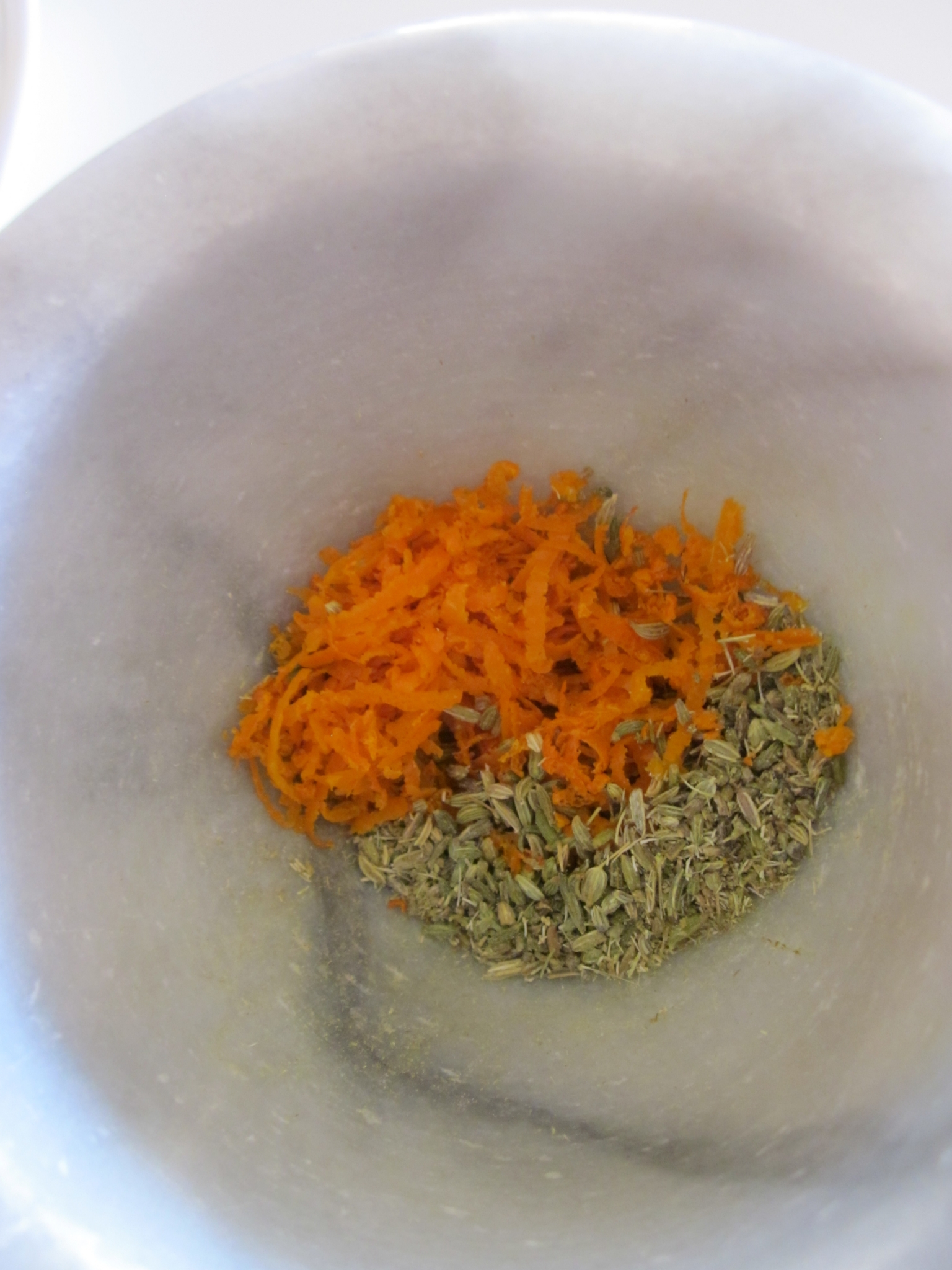
With half a dozen ideas in my mind about how to cook it, I settled for a simple recipe of roasting it and flavoring with some sweet and fragrant flavors like orange zest and toasted fennel seeds. I then combined the two with sweet paprika and sea salt to make a spice blend to toss into after roasting. Another wonderful spice blend with citrus!  My new year started with spice blends.

After tossing the roasted squash, I finished it with a garnish of freshly ground cumin and parsley and a squeeze of lemon (optional). Simple and flavorful, this recipe takes very little time to make. If you have any left over, use it in your favorite grain or salad.

Herbs and spices are good for our health. Fennel seeds have wonderful healing qualities. They help digestion and have antioxidant properties. Fennel is also chewed as mouth freshener. I sometimes make fennel tea that is quite relaxing. Have it with a little honey. It’s delicious and calming.

IMG_6768IMG_6781

IMG_6794IMG_6805

IMG_6808IMG_6811

Continue Reading…

Never miss a post
Name: 
Your email address:*
Please enter all required fields
Correct invalid entries

Food Art: Lamb Pumpkin & Apricot Tagine, by Meeta Khurana Wolff

Published by Wednesday, February 20, 2013 Permalink 0

Meeta K. Wolff is a freelance food photographer, stylist and writer, currently living in the culturally rich city of Weimar in Germany with her German husband and their 8-year-old son, where she enjoys preparing multicultural, home-cooked meals using fresh organic ingredients. When she is not styling, photographing or writing about food, Meeta loves to travel the world, exploring new cultures and capturing it all on camera. The unique mood that Meeta creates in her food photography is also found in her travel, still life and landscape photography.

Born in India, Meeta was brought up in and went on to train in some of the world’s finest hotels, where food was always an important part of her life. Her love for food photography stems from her passion for food itself, and she combines her two greatest enthusiasms on her multifaceted, award-winning blog, What’s For Lunch, Honey? The recipes she develops and creates are documented by her powerful, yet refreshing, food photography and styling.

See more food photo compositions at Meeta K. Wolff.

Never miss a post
Name: 
Your email address:*
Please enter all required fields
Correct invalid entries

What to Eat in Switzerland: A Geneva Christmas: Longeole Sausage

Published by Friday, December 21, 2012 Permalink 0

by Jonell Galloway

From the archives

Christmas traditions in Switzerland

One should never think that everybody in Switzerland eats the same thing for Christmas dinner. With four languages and a multitude of “mini-cultures” tucked away its various mountain niches, and with a huge international population, Switzerland may well have more Christmas menus than any other country in the world.

In the French-speaking part of Switzerland, Geneva’s traditions are quite apart from the Vaud, for example, due to the late date Geneva finally decided to become part of Switzerland. Geneva traditions are often more influenced by their Savoyard and French neighbors, since they share about 100 km of border with them and only 5 km with canton Vaud.

What’s so special about a Longeole?

Many Genevois eat a sausage specific to Geneva called longeole. Every region and many villages have their own sausage recipes, but the longeole is quite apart from the others for several reasons.


Longeole sausage and potatoes cooked in
white wine, a Geneva Christmas specialty.


For one thing, it contains not only ground pork but also ground pork rind. This keeps it from drying out and gives it fuller flavor. The other, and quite major, difference is that that it is speckled with fennel seeds, probably a Savoyard influence.

Any good local butcher makes his own longeole. If not, it is advisable to find one who does. It’s Christmas, so you want to be certain it’s of good quality.

Cooking Longeole

Longeole is easy to cook, but you must allow yourself enough time. It takes longer to cook than other cooking sausages because of the addition of the pork rind, which is harder than simple ground pork.

Use a soup pot tall enough to hold your sausage. Fill with water and bring water to boil. Add a touch of salt. Drop in sausage, lower heat, and let it simmer for 2 hours 45 minutes or 3 hours. The water should be just on the verge of boiling during the whole cooking time. It is then ready to slice and eat.

Some cooks prick the Longeole with a fork before cooking, but purist that I am, I think you risk losing some of the juices, which would take away from the flavor and make the sausage less succulent in the mouth. It is also important not to let it boil, because this too will dry it out.

What do Genevois eat with Longeole?

Like everywhere, different families have different traditions, different favorites, but the most common accompaniments are potatoes cooked in white wine, lentil stew and cardoon gratin, all Geneva specialties as well.

Continue Reading…

Never miss a post
Name: 
Your email address:*
Please enter all required fields
Correct invalid entries

What to Eat in Switzerland: A Geneva Christmas: White Wine Potatoes

Published by Friday, December 21, 2012 Permalink 0

A Geneva Christmas: White Wine Potatoes Recipe

by Jonell Galloway

From the archives

English: Jet d'Eau, Geneva

In A Geneva Christmas: Longeole sausage, I think I got your mouth watering talking about longeole, or fennel seed sausage. But did you see the potatoes in the photo? That’s THE essential side dish: potatoes cooked in broth and white wine.

I translated and adapted this recipe from A la mode de chez nous, Plaisirs de la table romande, a book on cooking in French-speaking Switzerland, by M. Vidoudez and J. Grangier.

Recipe

A Geneva Christmas-white wine potatoes-Longeole-recipe-Switzerland-the rambling epicure-jonell galloway-genevalunch-traditional dish

Longeole sausage served with
potatoes cooked in white wine and broth

Ingredients

1 kg / 2.2 lbs type 2 all-purpose potatoes
Olive oil, just enough to lightly coat potatoes
1 tablespoon spelt flour (farine d’épeautre), or otherwise whole wheat
240 ml / 1 cup chicken broth
1 onion, diced
1 laurel leaf
3 whole cloves
300 ml / 1 1/4 cup dry white wine
1 bouquet garni
Fresh parsley, chopped
Salt and pepper to taste

Instructions

Fennel-flavored Longeole sausages for Christmas, made by Jacky Bula butcher in Geneva


  1. Scrub potatoes. If you really don’t like potato peels, or your potatoes have lots of black spots on them, peel them. Just remember: all the fiber and vitamins are in the peel.
  2. Chop potatoes into large cubes. Put potatoes in a large saucepan. Coat lightly with olive oil and mix well.
  3. Sautée for 2 or 3 minutes, stirring constantly.
  4. Heat broth. Pour hot broth over potatoes. Add chopped onion, laurel, cloves, salt, pepper and bouquet garni. Bring to a boil. Cover, then lower heat and let it boil gently.
  5. Cook until potatoes are soft, about 15 or 20 minutes, depending on the kind of potato and the kind of pan.
  6. While the potatoes are cooking, mix flour and olive oil in a small utility bowl, until it becomes a smooth paste. Add a couple tablespoons of the hot broth from the potatoes to paste, and beat with wire whip until smooth.
  7. Add paste to potatoes, and beat gently with a wire whip. When smooth, add white wine.
  8. Continue cooking, stirring often so that it doesn’t stick, and gently boiling until the sauce starts to thicken.
  9. Taste. Add salt and pepper if required.
  10. Sprinkle with chopped parsley when serving. Traditionally, in Geneva this is served with longeole sausage at Christmas, but it goes well with many dishes, for example a smoked cooking sausage from the canton of Vaud.

Cooking notes:  I use a Kuhn Rikon Durotherm to maintain the vitamins and decrease cooking time. This also allows you to use less liquid, which gives a more intense flavor. In this case, you would use just enough broth to cover the potatoes.

Continue Reading…

Never miss a post
Name: 
Your email address:*
Please enter all required fields
Correct invalid entries

UA-21892701-1