by
With summer on its way, you may just want to have pulled pork for smaller family weekends, before all the big summer festivals start. Here’s an easy video recipe from Melissa Clark at Pulled Pork, for Crowds Large or Small.
|
|

A Literary Culinary Journal
by
With summer on its way, you may just want to have pulled pork for smaller family weekends, before all the big summer festivals start. Here’s an easy video recipe from Melissa Clark at Pulled Pork, for Crowds Large or Small.
|
|
Meeta Khurana Wolff, a professional food photographer and stylist, and ongoing contributor to this site, will be holding a Supperclub food styling and photography workshop in London in the U.K. from February 15-16, 2013, along with Sumayya Jamil, and special guest Jeanne Horak-Druiff, at the Central Street Cookery School. Click here for more details and to reserve. Only 12 places available.

|
|
 by Jonell Galloway
Click here to find the best in current food news and trends in the world of real food, Slow Food and mindful eating.

|
|

by Jenn Oliver
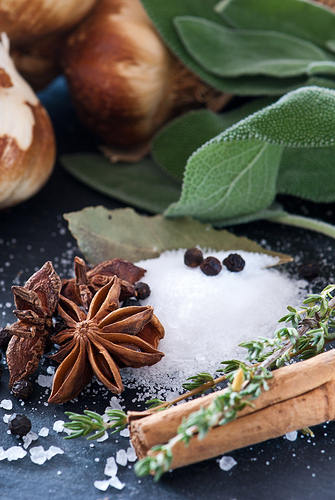
 Hello and welcome to the first post of Culinary Chemistry with Jenn! I am Jenn, your resident scientist with a gluten-free husband who is curious about all things related to the how and why of cooking. Today, we’re going to talk about brining, but each post will explore a different technique or phenomenon related to cooking/baking in the kitchen. Do you have questions or are curious about a particular aspect in the kitchen? Feel free to send me an email at jennoliver@theramblingepicure.com or on our online chat to the right of the screen, or join our Community and follow the Culinary Chemistry group and forum.
This past holiday season, families and friends gathered to share in their holiday traditions of a meal together — many of which surely included an oven-baked roast. Mine certainly did, as my husband and I celebrated our first Christmas abroad, a cozy romantic weekend together, marking our one-year anniversary since arriving to Switzerland, our current home. But just because the holidays are over doesn’t mean you have to swear off making roasts until next winter’s festivities roll around.
|
|
by Diana Zahuranec 
Why did I eat half a pound of carrots before tearing myself away from the refrigerator? It is not a Vitamin A deficiency. Nor was I hungry. It was this magic “pickled” carrot recipe with drugs in the ingredients – just kidding, of course, about that last part. I am not kidding about the magic part.
These carrots aren’t exactly pickled. I suppose they could be if the water-to-vinegar ratio was double-checked for optimum bacteria inhibition, and of course if all canning and preserving steps were followed. But there’s no point in actually canning these if they’re eaten in under a week (ahem, sometimes under 4 days). Anyway, they should keep for 4 weeks refrigerated – provided they last that long.
I first tasted these crunchy, addicting snackies during a University of Gastronomic Sciences potluck dinner. A jar of carrot sticks amidst homemade quince tart, cinnamon sticky bread, cheesy focaccia, and endive leaves filled with oniony salsa – who had time for carrot sticks? But all it took was two or three unsuspecting students to reach into the jar, get hooked, and munch through 2/3 of the supplies before they kindly, reluctantly, let me in on the secret. I tried two, glanced the other way, and the carrots were gone. My friend told me they were simple to make: “Just blanch the carrots and soak them in boiled water with vinegar for a while. And I add some sugar and spices.” How long do you soak them? What spices? How much sugar? I wanted to know. My friend shrugged.
Four months later, I googled “pickled carrots” and then created my own recipe based on a mix of the ones I saw. My friend’s casually imprecise directions are pretty much the whole idea behind making these, because if you’re not pickling them, just loosely follow these instructions with your ingredients at hand or of choice. There’s little reason to actually be precise. Here it is.
|
|
by Diana Zahuranec
It was soft and yellow-white with a thin, dark crust. The crust was not hard or chewy, but broke away perfectly from the rest of this pillow-y treat. It wasn’t a piece of bread, though it looked like one. Was it cake? It was on the end of a long table under a blue tent shading us from the summer sun. A gold cardboard plate presented perfect slices of this marvelous discovery.
I held the slice in my little sweaty hands, taking small bites that burst with butter, vanilla, and sugar. Its texture was half of the pleasure: smooth, moist, fine-grained, and soluble, I already wanted more. But the table was on the other side of the lawn now, and there were so many long tables laden with food with big people figures milling about, from one end to another. I never found it again.
|
|

by Amanda McInerney
The celebrity cooks and chefs of the United States, the UK and Europe are frequently familiar to Australians too, but I sometimes wonder if the reverse is true. We’ve bred some truly remarkable kitchen talents down here in the antipodes — both in Australia and New Zealand — and we well and truly have our share of local celebrity chefs on TV shows and cookbook shelves. While the international Masterchef franchise has blazed across our screens and spawned an entire new crop of culinary household names, there are plenty that have been steadily and consistently doing their kitchen/foodie thing without all of that fanfare and I’m taking this opportunity to introduce you to one of them.

|
|

by Jonell Galloway
I just stumbled on this list of Cooking Light’s top 6 French cookbooks from the last 25 years. What cookbooks would you add? Which ones would you remove? Do you own any one them?

|
|

by Jonell Galloway
To add to our ongoing series on fermentation, we invite you to take a look at this stuffed cucumber kimchi, a recipe developed by Korean-American Hyosun Ro on her wonderfully rich Korean food blog Eating and Living, now called Korean Bapsang.

|
|
 by Simón de Swaan
Some people like to paint pictures, or do gardening, or build a boat in the basement. Other people get a tremendous pleasure out of the kitchen, because cooking is just as creative and imaginative an activity as drawing, or wood carving, or music.–Julia Child

Julia Child was an American chef, author, and television personality. She is best known for bringing French cuisine to the American public with her début cookbook, Mastering the Art of French Cooking, and her subsequent television programs, the most notable of which was The French Chef, which premiered in 1963.
|
|
 Meet Jonell Galloway, a freelance writer and editor specialized in French cuisine.


