Part 6 on Fermentation: Sauerkraut Success

Published by Friday, August 31, 2012 Permalink 0

Part 6 on Fermentation: Sauerkraut Success

by Diana Zahuranec

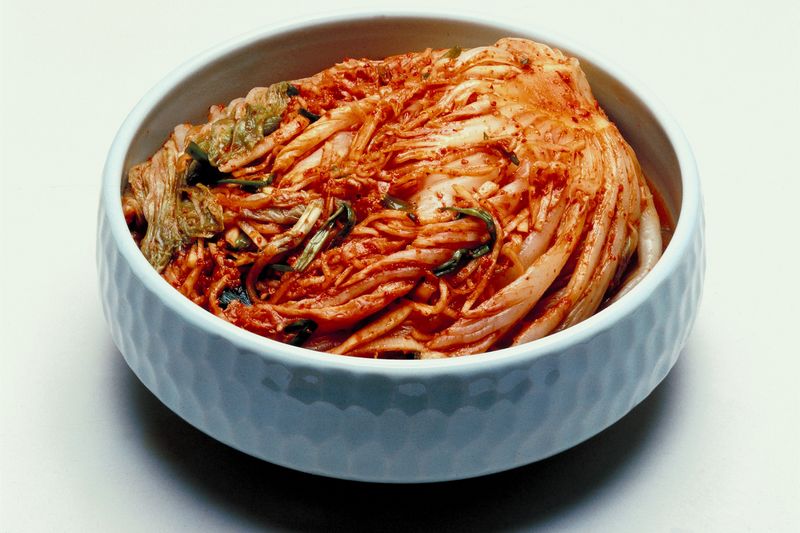
I filled two scalloped blue bowls with homemade sauerkraut and kimchi, sat down, and taste-tested.

I was hesitant, but I was encouraged by the lack of mold.

Kimchi wanna-be and sauerkraut

After two weeks of pushing down the bottles that weighed on my sauerkraut and “kimchi” (which was not actually kimchi, but will be referred to as such because that’s what I wanted it to be), I balanced the heavy, full bowls of vegetables on a flimsy, plastic tray and carried them to the kitchen counter.

I removed the bottles filled with water, the plates, and then the bags (why all this? Here’s why in Step-by-step Fermentation). I began to pour the mix into large containers of what once held 1 kg of yogurt, but I stopped when I lost too much liquid.

I assumed that the liquid of fermented vegetables contains all the healthy nutrients  that can be found in the vegetables themselves. I didn’t want to lose that, although I remain baffled as to what I could do with it, and haven’t found great sources backing up my Water-From-Fermented-Vegetables-Is-Healthy Theory (yet).

So I stuck my hand in and scooped it all out, pouring the liquid over top at the end. The liquids also help to preserve the vegetables when you store them in the refrigerator, and many say that the flavor improves as the fermentation slowly continues. And another reason to save the water: use a bit mixed in with the brine the next time you ferment vegetables, helping to jump-start the fermentation process.

According to Nourishing Days, ferments with 1-2% salt content will store for 4 to 9 months.

I filled two of those yogurt containers and some glass jars, or about roughly 13 cups of sauerkraut and kimchi from almost the same amount of vegetables. I had read that the vegetables will shrink as they lose their water, but the before:after ratio was nearly the same.

Success! They were both delicious. There was not a hint of rot. In fact, although many sources claim that it’s highly probable that you’ll lose some of your batch – especially a small one, like mine – due to air or uneven fermentation, I lost no more than a few shreds of cabbage.

Both were crunchy and flavorful. The pure cabbage had a more delicate flavor, and a bit of lactic acid tang. When I made the brine, I also added a teaspoon or two of yogurt whey to help . Sauerkraut naturally has a  lactic acid flavor, so I’m curious to see if fermented vegetables without added whey would give off that taste as strongly. Fermentation Project Number 2?

The kimchi was spicy from the chili pepper flakes and chopped hot peppers I added, and the mix of vegetable textures was delightful. The tastes all ran together – a carrot didn’t taste much different from a chard stem. And the chard stems were tougher than I wanted; but on second thought, it’s great that everything retained its crunchy structure. Mushy vegetables can be the result of not adding enough salt; I also read on Nourishing Days that tannins keep the structure of the vegetables intact, so you may be able to add grape leaves, for example, to retain crunch.

And now I’ll admit that I tentatively drank the fermented water, out of curiosity and refusal to waste something healthy. Its flavor wasn’t offensive, just mostly salty. I decided it might be healthier to forgo the salt than to absorb the other nutrients in there. And drinking fermented water just doesn’t sound very appetizing.

Never miss a post
Name: 
Your email address:*
Please enter all required fields
Correct invalid entries

Part 5: Kimchi vs. Sauerkraut – Fermenting Vegetables

Published by Wednesday, August 8, 2012 Permalink 3
cafemama / Foter / CC BY-NC-SA

Part 5 on Fermentation: Kimchi vs. Sauerkraut – Fermenting Vegetables

by Diana Zahuranec

Once again, Harold McGee’s The Science and Lore of the Kitchen comes to the rescue.

In fermented vegetables, remember that the two components that determine aroma and flavor are the salt concentration and temperature of fermentation. Those are the two main differences between kimchi and sauerkraut.

Bowl of kraut, by Diana Zahuranec for The Rambling Epicure, editor Jonell Galloway.

Bowl of kraut.


Sauerkraut, besides being cut more finely, has no other ingredients besides cabbage and brine. It ferments at 64-76 °F/18-24°C for 1 to 6 weeks. Its final salt content is 1-2%, and its final acidity level is 1-1.5%. That higher temperature for sauerkraut results in more lactic acid bacteria, giving it a tangier flavor.

Kimchi is cut into larger chunks and includes plant leaves and stems, too; and hot Korean chili pepper, garlic, and fish sauce are added for flavor. It’s fermented at a lower temperature than sauerkraut at 41-57°F/5-14°C for 1-3 weeks, with a higher salt content in the end (3%) and lower acidity (0.4-0.8%).

Bowl of kimchi, Part 5 on Fermentation: Kimchi vs. Sauerkraut - Fermenting Vegetables, by Diana Zahuranec for The Rambling Epicure, editor, Jonell Galloway.

Bowl of kimchi.


Never miss a post
Name:

Your email address:*

Please enter all required fields
Correct invalid entries

Never miss a post
Name: 
Your email address:*
Please enter all required fields
Correct invalid entries

Part 4: Step-by-step Fermentation – How to Ferment Vegetables

Published by Wednesday, August 1, 2012 Permalink 0

Part 4: Step-by-step Fermentation

by Diana Zahuranec

How to Ferment Your Own Vegetables

I said in my first fermentation post that I found a couple of particularly helpful websites:

Sandor Ellix Katz, “Making Sauerkraut”
Mary N. Mennes, “Make Your Own Sauerkraut”
Recipes from a German Grandma, “Make Your Own Sauerkraut”

Katz’s was detailed and informative, and I completely trusted his judgment because he is the undisputed wild fermentation expert. Also, he helped my friends and I make cheese, which turned out edible, if squeaky. The unnamed German Grandma had pictures, which I took too and I’ll provide them here for you fermentin’ folks.

Equipment used:

2 big glass bowls
2 freezer bags
Saran wrap
Big plastic tray

Ingredients used:

Click here for French/British/American converter

1 head of cabbage
1 onion
2-3 hot peppers
2 carrots
Stems from a bunch of catalogna (chicory (or a type of), a leafy green with tough stems that I didn’t want to throw out)
1/3 C mildly spicy coarse hot pepper
Salt, water: 3 T salt per 5 pounds of vegetables
Whey from yogurt

Procedure:

Note: This outlines what I did, and might not be the ultimate, end-all-be-all way to ferment; I’m just sharing the experience and knowledge I gained along the way!

(chicory (or a type of), a leafy green with tough stems that I didn’t want to throw out)
1/3 C mildly spicy coarse hot pepper
Salt, water: 3 T salt per 5 pounds of vegetables
Whey from yogurt

Procedure:

Note: This outlines what I did, and might not be the ultimate, end-all-be-all way to ferment; I’m just sharing the experience and knowledge I gained along the way!

[caption id="attachment_27484" align="alignleft" width="319"] Chopped vegetables


Continue Reading…

Never miss a post
Name: 
Your email address:*
Please enter all required fields
Correct invalid entries

Part 3: What is Fermentation?

Published by Monday, July 30, 2012 Permalink 0

“Fermentation is one of the oldest and simplest means of preserving foods. It requires no particular kind of climate, no cooking, and so no expenditure of fuel: just a container, which can be a mere hole in the ground, and perhaps some salt or seawater,” quoted from the ever-insightful Harold McGee, author of On Food and Cooking: The Science and Lore of the Kitchen.

On Food and Cooking

Harold McGee’s “On Food and Cooking: The Science and Lore of the Kitchen”

vegetable


The third article in this mini-series is going to be scientific and a little bit nerdy. Get ready to learn the nitty-gritty behind fermentation.

Fermentation begins in the vegetable or fruit. The naturally-occurring microbes in the food proliferate under the right conditions – namely, under the lack of air. At the same time, these beneficial microbes suppress the growth of harmful microbes that rot the fruit or vegetable. The good microbes metabolize the plant’s sugars and carbohydrates before the bad microbes get a chance. In a way, fermentation is a “controlled-rotting” process: the difference between sauerkraut and rotting cabbage is which microbes are allowed to grow.

When protected from air, these microbes get to work producing lactic acid, alcohol, carbon dioxide, and other compounds and nutrients.

Ferments can be made by crushing the vegetables or fruit until enough liquid is let out, ensuring that the vegetables are covered and protected from the air. Usually, though, the vegetables need a little bit of help: salt draws out the liquids, sugars, and other nutrients, and so ferments are often dry-salted or submerged in a salt-and-water brine before being stored in a covered container.

Crushing: wine is also a form of fermentation

As the plants ferment, much of the material remains intact, hence crunchy kimchi and sauerkraut as opposed to being mushy or slimy (two problems which usually signify contact with air; check out a great troubleshooting link). As the vegetables ferment, not only do they retain their vitamins, but additional nutrients are formed in the process: namely Vitamin B, folate, and the production of enzymes. New flavors and aromas begin to develop, and continue to age and change for as long as you ferment your food.

The salt concentration of the brine and the temperature during fermentation are the two main components that determine which beneficial plant microbes flourish and, consequently, the flavors and aromas that result. Vegetables with a low-salt brine and fermentation under low temperatures will produce mild but complex flavors with Leuconostoc mesenteroides. Fermentation done in high temperatures will produce almost exclusively lactic acid bacteria, from the Lactobacillus plantarum microbe. Also, fermentations undergo a dual process: they produce the first microbe, Leuconostoc mesenteroides, which is then taken over by Lactobacillus plantarum during the second stage of fermentation.

Never miss a post
Name: 
Your email address:*
Please enter all required fields
Correct invalid entries

Part 1: Food Fermentation for Beginners

Published by Tuesday, July 24, 2012 Permalink 0

Part 1: Food Fermentation for Beginners

by Diana Zahuranec

Cultures all over the world and for thousands of years have developed fermented foods and drinks. Japanese miso, Korean kimchi, kefir from Eastern Europe and the Middle East, sauerkraut from Germany; yogurt, sourdough bread, and even chocolate are some examples. While scarfing down some quickly “pickled” carrots I had made, I thought, why not make real fermented vegetables? I have a penchant for salty, sour foods, so why not ferment a big batch of it? The nutritional value actually builds and multiplies in fermented foods. I would satisfy my cravings, indulge in a natural, traditional super-food, learn about an ancient practice, and have a project to boot.

To learn the scientific details behind fermenting, I picked up Harold McGee’s On Food and Cooking: The Science and Lore of the Kitchen. For fermentation how-to, I quickly found an article on Sandor Ellix Katz’s blog (who, before, helped my friends and I make cheese). For a fermentation step-by-step picture guide, I found Recipes from a German Grandma.


I wanted to settle the nagging doubt about using equipment no more advanced than big glass bowls picked up in a used goods store. Pickl-It jars, Harsch crocks , and other crocks aren’t found easily in Italy, my home-away-from-home, or if they were I wouldn’t carry them around on my back while biking from store to store in the sweltering heat. Ideally, I would use Pickl-It jars or a Harsch crock over my open crock method, because I’ve never fermented vegetables and believe I’ve already made a few mistakes (ahem…this I will find out in roughly two weeks). Small batches of fermenting veggies are prone to come into contact with air when using the open crock method, causing you to lose some of the precious little you’ve made.

I don’t know which I would choose over the other, but apparently there are Team Pickl-It and Team Harsch Crock sides to this debate.

Too late now. I’ll find out if my haphazard but enthusiastic open crock method works in about two weeks. That will be the turning point in my brief fermentation career in making a major decision: to buy or not to buy a Pickl-It jar.

Pickl-It jars


Along with growing doubts as I read about fermentation, the more fascinating information I find. This post will be just the beginning of a short fermentation series that sort of follows along with my own method: dive right in knowing the basics, then nervously twist a strand of hair as I read more about it, then fixate on all things fermentation.

Harsch crock. I didn’t have strong doubts about the open crock method. No one 500 or 2,000 years ago had Pickl-It jars or a standard Harsch crock. Unfortunately, and after I already had my kraut for a day and a half, the more I read about it, the more uncertain I’ve become. Sandor Ellix Katz’s directions seemed straightforward, but some other articles worried me.


Let the fermentation begin!

Here are some other links I found useful:

Make your own sauerkraut, by Mary E. Mennes
Comparison of Vegetable Fermentation Methods, by Kimi Harris
Homemade sauerkraut, by Jenny
Vegetable Fermentation Further Simplified, by WildAdmin
Fermented Foods Webinair, by Jenny

Never miss a post
Name: 
Your email address:*
Please enter all required fields
Correct invalid entries

A Sausage Walks in to a Bar…..

Published by Monday, July 16, 2012 Permalink 0

by Alice DeLuca

A story for carnivores

Assador - Alice DeLuca 2012 (C) digimarc

Assador


This whole adventure started with a search for the perfect sausage to use in a recipe for pork with clams, which led to a little ceramic pig, and ended up with a truly excellent party. This cute little piece of specialty cookware, which looks like footwear for some impossible outer-space monster, is in fact designed for brazing sausages over flaming, hi-octane Portuguese liquor. As we learned the purpose and the method for using this device, we became completely distracted from our original mission and found ourselves planning a sausage-roast.

Linguica roasting - Alice DeLuca 2012 digimarc

Sausages roasting over flaming Aguardente

First, we had to obtain the little pig dishes from Portugal – that was easy and took only a few weeks. As soon as the dishes arrived we set about making home-smoked sausages and invited some guests to come over and roast them with us – RSVPs were instantaneous and none declined the invitation.

Continue Reading…

Never miss a post
Name: 
Your email address:*
Please enter all required fields
Correct invalid entries

Encylopedia of Pasta

Published by Friday, July 6, 2012 Permalink 0

by Diana Zahuranec

This is too exciting not to share.

I have discovered an entire, legally downloadable Encyclopedia of Pasta by Oretta Zanini de Vita, translated by Maureen B. Fant, with hand-drawn sketches of over 300 traditional types of pasta. A description and production method, origins and with what recipe each kind is used are included for every pasta shape. Plus, there’s a lovely introduction about pasta.

Next to see if it is downloadable on a Kindle.

Never miss a post
Name: 
Your email address:*
Please enter all required fields
Correct invalid entries

Yummy Umami: The 6th Basic Taste?

Published by Thursday, April 26, 2012 Permalink 0

Yummy Umami: The 6th Basic Taste?

by Diana Zahuranec

Quick, name the 5 basic tastes: sweet, sour, bitter, salty…and the fifth one is umami. Umami is the word that describes the savory taste of food, or perhaps “meatiness” of a food. It is the taste of the amino acid L-glutamate. The Japanese singled out this flavor in the early 1900s thanks to a chemistry professor from the Imperial University of Tokyo, Kikunae Ikeda, who isolated the glutamic acid compound C5H9NO4. Glutamic acid is found in both free and bound forms. The free form, which is formed when the protein molecule breaks down and releases glutamic acid, is the one we taste. “Umami” means in Japanese, literally, deliciousness.

Kikunae Ikeda, the Chemist who singled out MSG

A few years ago, I remember there was some hype that spread virally through America’s highly-informed (and often misinformed) consumer culture about MSG.

What is this lethal-sounding additive in the foods we eat, so cleverly covered up by only using three letters to trick us when we know better? It was soon known that MSG, or monosodium glutamate, is an ingredient added to most processed foods in order to enhance their flavors. In the media, MSG was linked to many ills, including migraines, nausea, and cancer, among others.

Wariness and fear of MSG actually began in the 1970s, after Dr. Ho Man Kwok wrote in the New England Journal of Medicine that he was experiencing all sorts of uncomfortable after-effects from a Chinese dinner, including numbness, weakness, and palpitations. He did not specifically link his symptoms to MSG, but a year later a study was done on baby mice by injecting high dosages of MSG (up to 4 grams per kilogram of body weight) and observing the brain lesions the mice suffered afterwards. Thus was born Chinese Restaurant Syndrome (CRS). Studies, anecdotes, and reports were quick to follow suit afterwards, claiming that MSG was linked to all sorts of ills. Some prominent nutritionists today are convinced that added MSG is harmful, especially for children.

Continue Reading…

Never miss a post
Name: 
Your email address:*
Please enter all required fields
Correct invalid entries

Quelling Quitchen Qualamities: Help! It’s not my fault! How to Tame a Raging Stovetop

Published by Wednesday, April 4, 2012 Permalink 0
by The Quonstant Quonnoisseur

Conquering the Basic Cooking Techniques of Poaching, Simmering and Boiling

One of the advantages of cooking for others is that no matter how those you are cooking for might attempt to intervene in the process, offer advice, snoop on your activities & etc., in most cases they lack the expertise, aptitude, patience and experience to take your place in front of the stove. However much those individuals might seek to run mind games on you because you are, in a sense, doing some work that they might have helped finance, in the very short term their relation to you is one of dependence.

The people you’re feeding, typically family members, will almost always be hungrier than you. And they will lack your access to sharp knives and convenient missiles (fruits and vegetables, for example) needed to drive them off.

This power relationship can be reversed in the case of your relationship to kitchen appliances. Remember: those things were designed by engineers and programmers who themselves were oppressed by doltish marketing managers and senior executives. The engineers’ goals and values might have led them to seek the most efficient and graceful designs.


To you, a lovely kitchen stove; to the engineers who designed it,
a purgatory they’re enduring
until they can design rocket ships and race cars.

Continue Reading…

Never miss a post
Name: 
Your email address:*
Please enter all required fields
Correct invalid entries

Simon Says: Daily Food Quote, April 2, 2012

Published by Monday, April 2, 2012 Permalink 0

by Simón de Swaan


As he chops, cuts, slices, trims, shapes, or threads through the string, a butcher is as good a sight to watch as a dancer or a mime.–Colette


81 Years Of Style: French Writer Colette’s Never Ending Influence On Fashion was the surname of the French novelist and performer Sidonie-Gabrielle Colette. She is best known for her novel Gigi, upon which Lerner and Loewe based the stage and film musical comedies of the same title.

Continue Reading…

Never miss a post
Name: 
Your email address:*
Please enter all required fields
Correct invalid entries

UA-21892701-1