Food Play: cómo hacer mantequilla en casa

Published by Monday, August 15, 2011 Permalink 0

por SandeeA
Click here to read English version

Hoy en día hemos olvidado el proceso de elaboración de los alimentos. Aunque no lo creáis, las aceitunas nacen con hueso y sin lata, y la leche no sale del tetrabrik. ¿Qué tal si nos divertimos haciendo magia en la cocina, y les enseñamos a nuestros hijos el proceso de convertir nata en mantequilla? Vamos a conseguir una mantequilla casera deliciosa, con un sabor increíble, y con un contenido de materia grasa en torno al 65%, a diferencia de las mantequillas comerciales que tienen al menos un 80%… y ningún sabor. Así que poned vuestra música favorita y a tocar las maracas! No sé quién dijo que con la comida no se juega…

Mantequilla casera 4

Receta de mantequilla casera

Tiempo de preparación: 4-5 min
Tiempo de cocción: 0 min
Total: 4-5 min
Cantidad: 40 gr de mantequilla (2 raciones, aproximadamente)

Dificultad: mi hijo de 3 años sabe hacerla

Ingredientes

100 ml de nata para montar, muy fría (mínimo 35 % MG, mejor si tiene 35,1% MG como Pascual por ejemplo)
un bote pequeño y que cierre herméticamente, por ejemplo un frasco de mermelada de 250 ml de capacidad


Preparación:

1. Introducimos 100 ml de nata en el bote y cerramos bien
Mantequilla casera 1

2. Ponemos la música.

Mantequilla casera 2

3. Agitamos de arriba a abajo. Puedes descansar un poco (pero acuérdate de apuntarte a un gimnasio) Notaremos como cada vez la mezcla se hace más ligera, llegará un momento en que parecerá que no se mueve nada dentro del bote. Hemos montado la nata (lleva unos 2 minutos)

4. Seguimos agitando el bote enérgicamente. De repente la nata se dividirá en una parte líquida y otra sólida. (tardará otros dos minutos). Ya tenemos la mantequilla por un lado, y el suero de leche (suero de mantequilla o buttermilk) por otro. Pasamos la mantequilla por agua fría, apretándola bien y amasándola para eliminar el exceso de suero, y ya está lista para consumir. El suero lo podemos usar en numerosas recetas de panes y repostería.

Mantequilla casera 3

Nota 1: Se puede hacer el mismo proceso mucho más rápido con una batidora de varillas para fabricar una cantidad mayor de mantequilla. Eso sí, será mucho menos divertido! Aquí tenéis un vídeo donde se muestra cómo hacerlo Cómo hacer mantequilla casera

Nota 2: La botella que se ve en las imágenes no es el recipiente más adecuado para fabricar la mantequilla, dado que cuando se solidifica resulta bastante complicado sacar la mantequilla. Mejor un envase de boca ancha como un bote de mermelada pequeño, tal y como comentaba anteriormente.

Nota 3: Los tiempos indicados en la receta son para un adulto. Si la elaboran niños, que tienen menos fuerza y son menos constantes en sus movimientos, les llevará más tiempo.

Visto en Ohdeedoh


Never miss a post
Name: 
Your email address:*
Please enter all required fields
Correct invalid entries

Food Art: Puff Pastry Salad, food photography by SandeeA

Published by Monday, August 15, 2011 Permalink 0

These photos are by SandeeA, author of the column Food Play, and who runs a site called . SandeeA is never lacking ideas when it comes to playful, fun recipes. Click here to find the recipe for this salad in a puff pastry. It would be a great recipe to get your kids in the kitchen!


Never miss a post
Name: 
Your email address:*
Please enter all required fields
Correct invalid entries

Rencontre avec des boulangers remarquables : Le boulanger de Kaboul

Published by Wednesday, August 10, 2011 Permalink 0

de Jean-Philippe de Tonnac

Click here to read this article in English

Dan de Mirmont, le boulanger de Kaboul

Comment découvre-t-on la cuisine et la panification à la française en Birmanie et décide-t-on de les faire connaître aujourd’hui aux gens de Kaboul ? C’est l’étonnant parcours de Dan de Mirmont qui réouvre son Bistro Bakery en octobre.

Ali, à droite, responsable de la
boulangerie-pâtisserie, et Zobaid,
à gauche, son assistant.
Dan de Mirmont, au centre.


Comment choisit-on de venir faire du pain à Kaboul ?

On n’y arrive pas en ligne droite. Il y a des détours. Si vous voulez un commencement, je vous propose la Birmanie.

Ça ne nous éloigne pas un peu ?

Vous verrez que non. Quatorze années d’un long flirt avec l’Union du Myanmar. Un grand bémol, les plaisirs de la table y sont comptés. Chose qui nous désole J., mon amie chinoise singapourienne, et moi. Bien qu’entourée de pays tels que l’Inde, la Chine, la Thaïlande, connus pour leurs cuisines, la table birmane offre peu d’émotions positives. Des vacances dans une petite maison au-dessus de Saint-Tropez et les merveilleux restaurants de l’arrière-pays nous apportent la conviction qu’il faut agir. Nous rentrons en Birmanie avec une soixantaine de kilos de livres de cuisine. Ni elle ni moi n’avons jamais mis les pieds dans une cuisine. Une sainte horreur des odeurs de graillons et des mains sales. Nous faisions jusqu’alors commerce de nos créations dans une très jolie galerie dans le centre de Yangon. Sans faire attention à ce que nous mangions.

Le début des apprentis cuisiniers est laborieux et difficilement supportable pour les amis, invités à goûter. Les cobayes s’y font lentement, vantent nos progrès et nous demandent progressivement de nourrir leurs soirées.

Continue Reading…

Never miss a post
Name: 
Your email address:*
Please enter all required fields
Correct invalid entries

How to build a recipe: a video by Grant Achatz, chef of Alinea

Published by Wednesday, August 10, 2011 Permalink 0

by Jonell Galloway

I always say to build a recipe you have to know how to think with your tastebuds. Here’s a video with a thorough explanation of the process by one of the best in the world: Grant Achatz, chef at Alinea in Chicago, Illinois, in the U.S. He approaches it in an intuitive, yet logical manner. I strongly advise up-and-coming chefs to watch this. It holds lessons for life.

Click here to watch video.

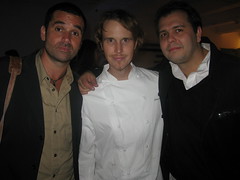
Dan Dunne, Grant Achatz, Simon Ford

Image courtesy of Caroline. Grant Achatz in center.

Related articles

  • Famous Spanish Restaurant El Bulli Shuts, for Now
  • Spanish chef Ferran Adria shuts El Bulli restaurant
  • Famed el Bulli eatery closes doors in Spain
Never miss a post
Name: 
Your email address:*
Please enter all required fields
Correct invalid entries

Food Art: Chocolate Popcorn, food photography by SandeeA

Published by Tuesday, August 9, 2011 Permalink 0

These photos are by SandeeA, author of the column Food Play, and who runs a site called La Receta de la Felicidad. SandeeA is never lacking ideas when it comes to playful, fun recipes. Click Scrumptious Jelly-Filled Fruits – Sandee A.’s Strawberry Bananas are a Fruity Way to Feed Friends
to find the recipe for this chocolate popcorn. It would be a great recipe to get your kids in the kitchen!

Never miss a post
Name: 
Your email address:*
Please enter all required fields
Correct invalid entries

Food Art: Soba Noodles, A Zen Perspective

Published by Monday, August 8, 2011 Permalink 0

 “Preparing food is not about yourself and others. It is about everything!”
– Shunryu Suzuki


Click here for more pictures and a recipe for “Cold Soba Noodle Salad“.

Never miss a post
Name: 
Your email address:*
Please enter all required fields
Correct invalid entries

Switzerland: Pan-fried Sérac Cheese & Potato Salad Recipe

Published by Friday, August 5, 2011 Permalink 0

Spontaneous Cuisine, by Jonell Galloway

Swiss Sérac cheese, a fresh cow’s milk cheese made with whey

Whey cheese is produced when the curds are separated from the whey to make cheese. Ricotta is also a whey cheese, but unlike Sérac, it is often made with sheep’s milk. As a result, you can use your local cheesemonger’s Sérac in most recipes that call for ricotta.

Photo courtesy of FribourgRegion tourist office.

Photo courtesy of Fribourg Region tourist office.


Sérac is made in most regions of Switzerland, and each region has its own version. Some regions smoke it; others flavor it with herbs, spices or pepper.

Sérac cheese is soft and creamy in texture, so it is easy to spread it on bread to make a healthy sandwich or snack, but Sérac is not only a snack cheese. It can also be used to make healthy, quick meals, such as the recipe below. In the summertime, I often use it like mozzarella, with tomatoes and basil or other Italian-inspired recipes.

It is a great way of teaching your children to eat healthy snacks. Top it with fresh fruit to make a healthy, low-fat dessert, or use it for between-meal snacks on chunky whole-grain bread.

Since it is a fresh milk cheese, it does not keep, and should be eaten shortly after purchasing. Because it is made from fresh milk whey, it is also naturally low in fat. In Switzerland, it would have about a 3.8% fat content, the same as milk.

Continue Reading…

Never miss a post
Name: 
Your email address:*
Please enter all required fields
Correct invalid entries

Switzerland: Spontaneous Cuisine: Fresh fruit croûte

Published by Friday, August 5, 2011 Permalink 0

by Jonell Galloway

Cheese Croûtes, a Perfect Winter Snack

Anyone who’s every traveled or skied in Switzerland knows we love croûte. Every ski station restaurant offers a wide range of croûtes. But what exactly is a croûte, you might ask.

A classic cheese croûte from the Refuge de Chesery

Literally, the word means “crust,” but in practice the dish is usually made with day-old bread, onto which a wide array of foodstuff can be placed. The classic croûtes are layers of toasted bread in a shallow baking dish, covered with any combination of ham, bacon, egg, cheese, tomatoes, etc., but never leaving out the cheese.

For these savory dishes, the bread is cut into slices about 1 cm thick and placed in a buttered shallow baking dish. The bread is browned on both sides in the oven, and then slightly dampened with a little white wine or water. Thin slices of a fatty, hard cheese, such as Gruyère or Emmental, are then distributed evenly over the toast, pepper is added (and other ingredients if desired), and the composition is popped back into the oven until the cheese melts and turns brown.

Because of the oven and the hot cheese, winter croûtes are certainly not appropriate for getting your kids in the kitchen, so I’ve come up with this summer version.

Continue Reading…

Never miss a post
Name: 
Your email address:*
Please enter all required fields
Correct invalid entries

Cailler Chocolate Museum in Canton of Fribourg, Switzerland

Published by Thursday, August 4, 2011 Permalink 0

Cailler Chocolate Museum in Canton of Fribourg, Switzerland

by Jonell Galloway

The Maison Cailler (Nestlé), in Broc, in the canton of Fribourg in Switzerland recently opened its doors to the public. The factory, built in 1898, and still in operation, has been converted into a chocolate museum and visitor center. It offers an interactive audiovisual and guided walk through the factory-museum which explains everything aspect of chocolate making.

The fact that it’s located in a working chocolate factory enhances the experience, and the guided tour explains the history of the factory from its beginning in 1898 to present.

The 7 million CHF renovation project created nine themed areas, including Aztec temples and Swiss hillsides, says Aus Food News. Since the factory is still up and working, you can actually witness chocolate bars being made.

Continue Reading…

Never miss a post
Name: 
Your email address:*
Please enter all required fields
Correct invalid entries

A chocolate school, and guess where? Switzerland

Published by Wednesday, August 3, 2011 Permalink 0

You can go to chocolate-making school at the Chocolaterie Rapp in Prangins, between Geneva and Lausanne, even if you don’t want to be a professional chocolatier.

The introductory course lasts one hour and a half and consists of:

  • visit of chocolate school
  • presentation and history of chocolate
  • introduction to chocolate making
  • chocolate tasting and drink at the chocolate school
  • issue of a tasting diploma from the Compagnie des fins becs, a Swiss gourmet tasting society

Classes are given on Monday, Tuesday and Thursday, and on reservation only.

Price: 15 CHF per person, with a minimum of 10 people per class.

The school can be visited on Saturday for 25 CHF per head.

The full course lasts 5 hours, and consists of:

  • visit of chocolate school
  • presentation and history of chocolate
  • handling of chocolate
  • chocolate moulding and tempering, depending on the season
  • chocolate desserts
  • praline and truffles
  • chocolate tasting and drink at the chocolate school
  • issue of a Chocolate Know-How diploma and notebook of recipes

Price: 160 CHF per person.

Unfortunately, all classes are fully booked until the end of August 2011. September dates will be announced soon.

If you want classes in English, please request well ahead of time.

For more information, call (41) (0)22 361 92 12 or contact the school by e-mail at  rapp-confiserie@bluewin.ch.


Never miss a post
Name: 
Your email address:*
Please enter all required fields
Correct invalid entries

UA-21892701-1