The TRE Quiz: Were You Destined to Become a Food Writer?

Published by Friday, August 15, 2014 Permalink 3

by Elatia Harris

Below you will find a spectrum of behaviors that are food writer markers in early life, as well as some behaviors that do not strongly associate to food writing. Say yes to all that apply. Attach a zero to behaviors that do not resonate with you. Each entry below, a. through e., is is worth points in ascending order — a. is 1, b. is 2, c. is 3, d. is 4, and e. is 5. So, the most you could accumulate for each division — (1,), (2.) and (3.) — is 15 points, for a total score of 45. My research and experience tell me that scoring higher than 40 makes you, hopelessly, a food writer. See that you think!

(1.) In childhood under 10, you

(a.) Ate what you were given, mainly, but thought over the texture pretty hard.

(b.) Wondered about the food in foreign countries. Was it better? Could you cook it just fine without going there?

(c.) Read carefully, rather than skipped over, the bits about food in your usual reading matter.

(d.) Sniffed from spice jars.

(e.) Were asked not to complain about the food, ever, even though you weren’t complaining, exactly. You were trying to help.

(2.) In early adolescence, you

(a.) Read and wrote well ahead of your grade level, regardless of other academic aptitudes.

(b.) Cooked with adults, for lack of interested peers. Cooked to get adults out of the kitchen.

(c.) Started feeling passionate about certain writers: they were writing for YOU.

(d.) Put out at least two issues of a newsletter about the food at school and at hangouts.

(e.) Sniffed wine, tried to taste it, daydreamed a lot, wanted to be older — at least 16.

(3.) Mid-adolescence through age 21, you

(a.) Worked to expand your food vocabulary because there were food sensations you experienced but had no words for.

(b.) Considered “year abroad” programs based on the food that might be involved.

(c.) Used more of your available funds to eat well than other students did, cut back elsewhere to afford it.

(d.) Sniffed fragrances, liked satin, drank wine.

(e.) Made lists of destination restaurants, and other things to experience for the sake of writing about them.


Elatia Harris is a writer and consulting editor in Cambridge, Mass. She is most often at work on books and articles about food, wine and travel. Contact her at elatiaharrisATgmailDOTcom or via text at 617-599-7159.

Never miss a post
Name: 
Your email address:*
Please enter all required fields
Correct invalid entries

Food Writing Prompts: The Morality of Plenty

Published by Friday, July 25, 2014 Permalink 1

The Morality of Plenty

Splendid Food — Does it Have a Moral Dimension?

by Elatia Harris

In The Embarrassment of Riches: An Interpretation of Dutch Culture in the Golden Age, Simon Schama tells of the sickening tensions produced in 17th-century Amsterdam when far too much in the way of material goods sat badly with an ethic that twinned virtue and thrift. The Dutch were suddenly able to have anything they could name, from anywhere in the known world. Immediately, they began ascribing sinfulness to certain new foodstuffs, candied fruit being high on their long list of gruesome luxuries.

Dutch painting of the 17th century illuminates a question familiar to us now: Has splendor beyond dreaming no moral dimension? Paintings such as this — Still Life, by Adriaen van Utrecht, painted in 1644 and now in the Rijksmuseum — both celebrate and condemn the expanding sensual world, full of the transient beauty that distracts without sustaining, but that so delights us. We too know that struggle, that makes it hard to think of the rarest and most wondrous foods without ambivalence.

For a writer, is it a matter of tone? Or one of content?

Elatia Harris is a writer and consulting editor in Cambridge, Mass. She is most often at work on books and articles about food, wine and travel. Contact her at elatiaharrisATgmailDOTcom or via text at 617-599-7159.

Never miss a post
Name: 
Your email address:*
Please enter all required fields
Correct invalid entries

Adriaen Coorte, Baroque Dutch Master of Asparagus

Published by Saturday, July 5, 2014 Permalink 1

Of the Dutch painter Adriaen Coorte, very little is known, not even the year of his birth or death. He was active for about three decades, in the late 17th and early 18th centuries. Only one contemporary matter of record truly stands out: in the provincial city of Middelburg, where he lived and worked, he was taxed for selling a painting without being a member of the local painters’ guild, after which he joined up. His simple compositions, their dark backdrops, their few and plain props, put him out of fashion, for he painted during the Dutch Golden Age, when nimiety ruled the still-life genre. He was forgotten until the 1950s. Since then, however, his 55 known works, a significant number of them depictions of asparagus, have gained a luster not bestowed on them during the artist’s life. In 2011, a newly discovered painting by Coorte went at auction for more than $4,000,000.

When an artist sticks with a subject over time, it’s natural to wonder why. In the 1600s, asparagus was a luxury food, as it is now. One might make the case that, in any era, an expensive food is a love food on those grounds alone, but asparagus was in the 17th century considered a love food for its special properties. The English physician and botanist Nicholas Culpeper, in his Complete Herbal (1652), wrote of asparagus that “being taken fasting several mornings together, [it] stirreth up bodily lust in man or woman (whate’er some have written to the contrary.)”

Did the reach of the Complete Herbal, a runaway bestseller for its time, extend to Middelburg, then a slave-trading hub whose first university came as late as 2004? How I wish I knew. But Coorte’s images — fruit, butterflies, shells, asparagus — are rich in the symbolic language used by painters of his time, and lit with a radiant specificity that suggests the deeper meaning will be revealed with contemplation.

Still Life with Asparagus, Adriaen Coorte, 1697. Oil paint on paper mounted on a panel, h. 25cm × w. 20.5cm. The Rijksmuseum, Amsterdam, The Netherlands
 
Elatia Harris is a writer and consulting editor in Cambridge, Mass. She is most often at work on books and articles about food, wine and travel. Contact her at elatiaharrisATgmailDOTcom or via text at 617-599-7159.
 
Never miss a post
Name: 
Your email address:*
Please enter all required fields
Correct invalid entries

The Story of Edouard Manet and the Bunch of Asparagus

Published by Sunday, June 1, 2014 Permalink 3

The art patron Charles Ephrussi (1849 –1905), one of the Parisians on whom Proust based the character Swann, was deeply appreciative of contemporary painting, and agreed to buy from Edouard Manet the delightful still-life, topmost above, for 800 francs. So great was his pleasure in ownership, however, that he paid the artist 1000 francs for it.

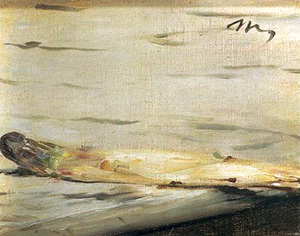
Not one to miss the chance for a witty flourish, Manet swiftly sent Ephrussi a smaller painting, of a single asparagus, with a note to say that one had slipped from the bunch.


Both paintings may be viewed by the public, but not together. The mother painting is in the Walraff Museum in Cologne, the solitary asparagus in the Musee D’Orsay in Paris.

Top: Édouard Manet (French, 1832-1883). Bunch of Asparagus, 1880. Oil on canvas. Wallraf-Richartz-Museum & Fondation Corboud, Cologne, Germany
Bottom: Edouard Manet (French, 1832-1905) One Asparagus, 1880. Oil on canvas, the Musee D’Orsay, Paris, France
 
Elatia Harris is a writer and consulting editor in Cambridge, Mass. She is most often at work on books and articles about food, wine and travel. Contact her at elatiaharrisATgmailDOTcom or via text at 617-599-7159.
Never miss a post
Name: 
Your email address:*
Please enter all required fields
Correct invalid entries

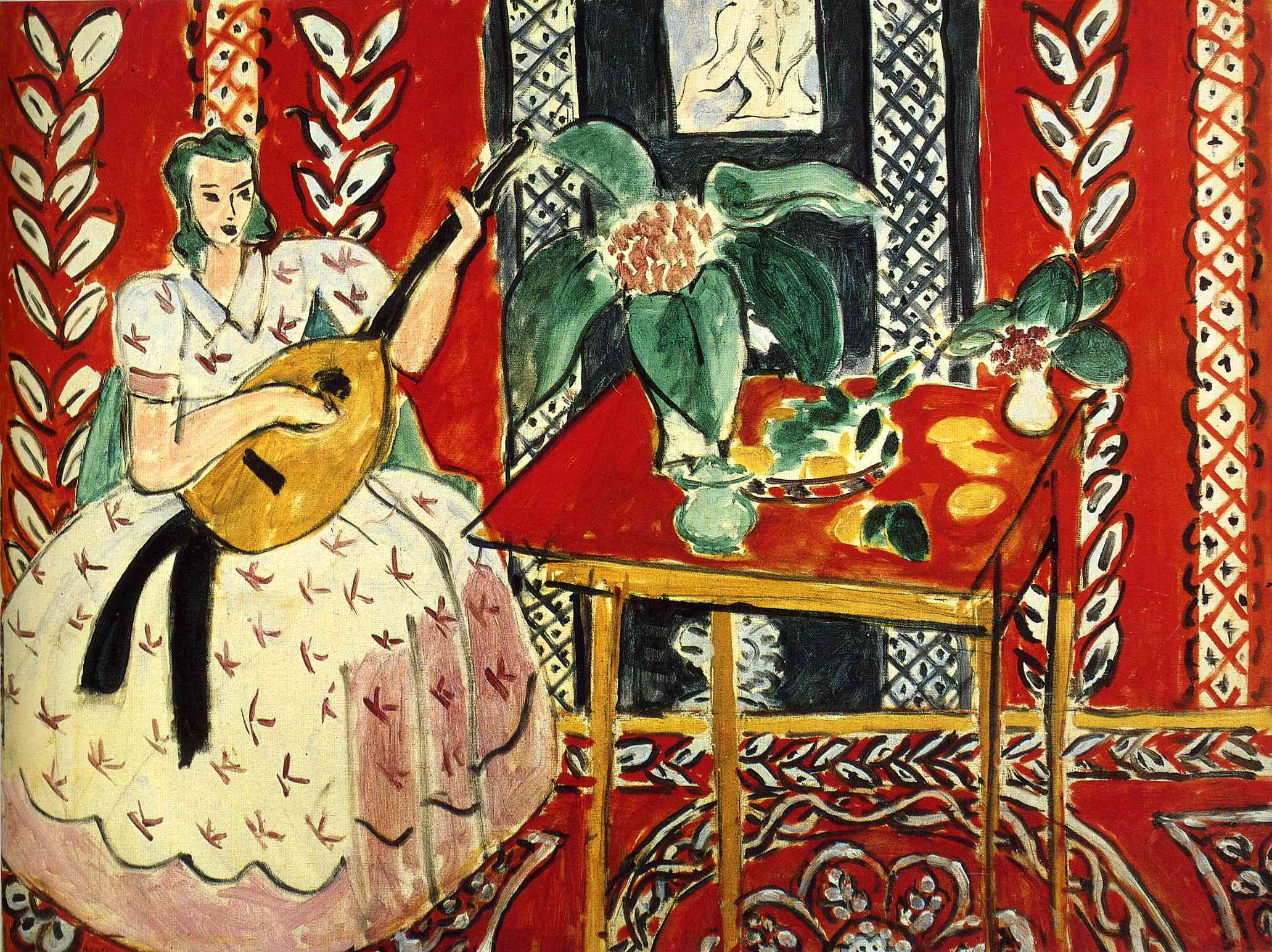
Food Art: Lute and Fruit, by Henri Matisse

Published by Friday, February 14, 2014 Permalink 0

Food Art: Lute and Fruit, by Henri Matisse

Lute and Fruit, painting by Henri Matisse


Never miss a post
Name: 
Your email address:*
Please enter all required fields
Correct invalid entries
Published by Monday, February 3, 2014 Permalink 0

Food Art: Still Life with Mouse, by Giovanna Garzoni (Italian Baroque Era Painter, 1600-1670), Rome

Garzone was one the first women painters to paint still lifes. Collectors loved her work, and she was able to immediately sell all she produced at just about any price she named. Garzone painted on vellum. She worked mainly for aristocratic patrons, such as the Medici family, and often took decorating commissions in their villas and palaces. She was most likely influenced by Jacopo Ligozzi, who was a botanical and zoological painter for the Medici court. Garzoni bequeathed all her work to the painters’ guild in Rome, the Accademia di San Luca, in exchange for the right to be buried there. Source: Getty Museum

Never miss a post
Name: 
Your email address:*
Please enter all required fields
Correct invalid entries

Food Art: Medieval Feast, by Ensiferrum

Published by Wednesday, January 29, 2014 Permalink 0

MedievalFeast


The Duke’s Feast, by .

Never miss a post
Name: 
Your email address:*
Please enter all required fields
Correct invalid entries

Food Art: Still Life with Pears, Apricots and Grapes III

Published by Monday, August 26, 2013 Permalink 0


Food Art: Still Life with Pears, Apricots and Grapes III, a Painting by Mia Brownell

Still Life with Pears, Apricots and Grapes III, by Mia Brownell, http://www.miabrownell.com/

Still Life with Pears, Apricots
and Grapes III, by Mia Brownell.


Mia Brownell, Still Life with Pears, Apricots and Grapes III, 2006, Giclée print, courtesy of the artist, New Rochelle, New York. See more at Art State.


Never miss a post
Name: 
Your email address:*
Please enter all required fields
Correct invalid entries

Food Art: Still Life with Geraniums, painting by Henri Matisse

Published by Friday, June 21, 2013 Permalink 0

Food Art: Still Life with Geraniums, painting by Henri Matisse

Henri Matisse painted “Still Life With Geranium” in 1906, when he was considered the “King of Fauvism.”It was the first Matisse painting to be purchased for a public exhibition.

An everyday subject matter is depicted in primary colors, thus infusing it with energy and emotion. At the same time, it resembles traditional decorative art.

Matisse was the leader of the Fauvist movement, and used vivid, primary colors long before his contemporaries. The colors always lent a sense of turbulent emotion to his work.

The term “Fauve” means literally “wild beast”. Another prominent member of this movement was André Derain.


Never miss a post
Name: 
Your email address:*
Please enter all required fields
Correct invalid entries

Food Art: Still Life with Flowers and Fruit, food painting by Alexej Georgewitsch Von Jawlensky

Published by Thursday, June 20, 2013 Permalink 0

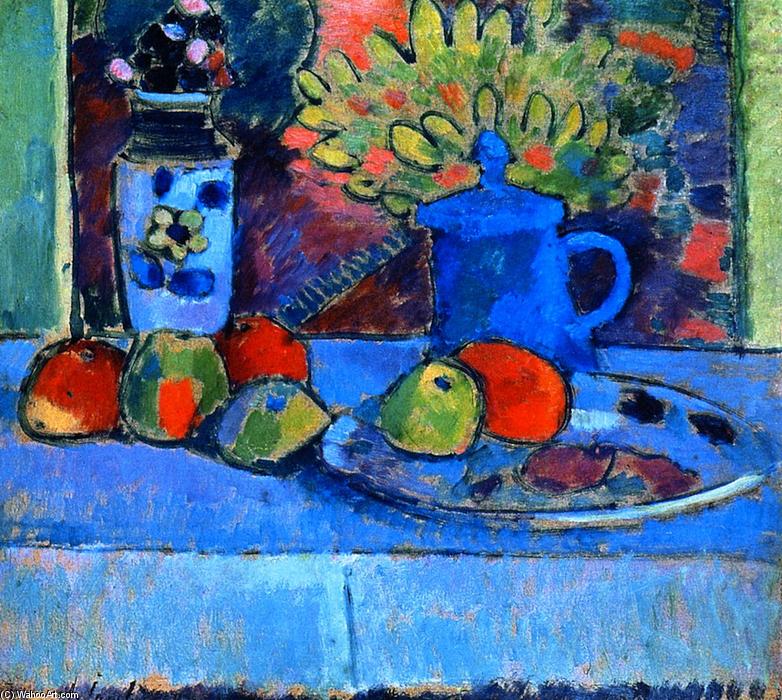
Food Art: Still Life with Flowers and Fruit, food painting by Alexej Georgewitsch Von Jawlensky

Still Life with Flowers and Fruit, by by Alexej Georgewitsch Von Jawlensky (1864-1941, Russia), http://en.wahooart.com/@@/8YE2G9-Alexej-Georgewitsch-Von-Jawlensky-Still-LIfe-with-Flowers-and-Fruit


Alexej Georgewitsch von Jawlensky was a Russian expressionist who lived from 1864 to 1941. “He was a key member of the New Munich Artist’s Association (Neue Künstlervereinigung München), Der Blaue Reiter (The Blue Rider) group and later the Die Blaue Vier (The Blue Four),” says Wikipedia. There is very little biographical information about him in Western literature.

Every artist works within a tradition. I am a native of Russia. My Russian soul has always been close to the art of old Russia, the Russian icons, Byzantine art, the mosaics in Ravenna, Venice, Rome, and to Romanesque art. All these artworks produced a religious vibration in my soul, as I sensed in them a deep spiritual language. This art was my tradition.Alexej Georgewitsch Von Jawlensky


Never miss a post
Name: 
Your email address:*
Please enter all required fields
Correct invalid entries

UA-21892701-1