At meat cleanse not thy teeth nor pick
With knife or straw or wand or stick.
The Book of Courtesy, c 1450
Published in 1868 under the title The Babee’s Book along with the second volume Queen Elizabeth’s Academy, published a year later, give the best example of medieval life and manners in England.
There are people who eat the earth and eat all the people on it like in the Bible with the locusts. And other people who stand around and watch them eat it.–Lillian Hellman, 1939
Lillian Florence “Lily” Hellman (June 20, 1905 – June 30, 1984) was an American playwright, linked throughout her life with many left-wing causes. She was romantically involved for 30 years with mystery and crime writer Dashiell Hammett (and was the inspiration for his character Nora Charles), and was also a long-time friend and literary executor of author Dorothy Parker.
American table manners are, if anything, a more advanced form of civilized behavior than the Europeans, because they are more complicated and further removed from the practical result, always a sign of refinement.–Miss Manners, 1982
Judith Martin, better known by the pen name Miss Manners, is an American journalist, author, and etiquette authority. Martin’s uncle was the economist and labor historian Selig Perlman. Click here to read her Washington Post column.
The unthankful heart discovers no mercies; but let the thankful heart sweep through the day and, as the magnet finds the iron, so it will find, in every hour, some heavenly blessings!— Henry Ward Beecher, American Congregationalist clergyman
Bonbons, which we call in English sweets or candy, are a recent enough arrival on the European food scene. The Crusaders brought back sugar cane from the Orient, arriving first in Sicily, where Jewish scientists in Sicily carried out experiments on it in around 1230. Until then, Europeans made their sweets using fruit juice and honey, often flavored with cinnamon.
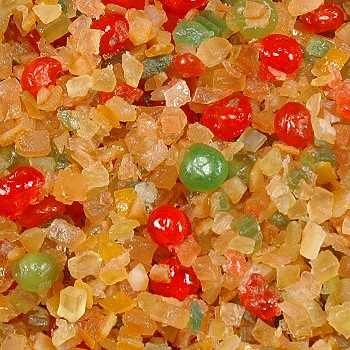
Candied fruit, fruit confit, one of the first forms of bonbons or candy
Candy instantly became the rage and techniques were refined. During the Renaissance, men of means carried bonbonnières, or candy holders, in their pockets, often decorated with precious stones, and offered ladies candy from them.
Bonbonnière, traditional French
porcelain candy dish
Wikipedia notes that the “Middle English word “candy” began to be used in the late 13th century, coming into English from the Old Frenchçucre candi, derived in turn from PersianQand (=قند) and Qandi (=قندی), ‘cane sugar’.”
For most of us, the word “fondue” conjures up images of poking those long skinny forks into a piece of bread and dipping it into a Swiss-style melted cheese fondue on the table in front of us, while sitting in a rustic chalet in the mountains with a beautiful view out over the mountains. Fondue certainly can mean that, but it doesn’t always.
The word literally means “melted” in French and should, if all be told, be used as an adjective. Although the name has been twisted a bit from the original meaning over the years, it still strongly retains traces of the original meaning, since it always includes the sense of something solid like cheese or chocolate melting into a sauce or pulp. The one exception to this is Burgundy fondue, which is basically like a smaller version of the medieval boiling pot of oil that was poured over the heads of invaders, and if spilled on you, it may not kill you, but it is highly possible it will leave you with lifetime scars.
The original fondue originated in Switzerland, and consists of a cheese sauce made with cheese, corn flour, kirsch, garlic and sometimes flavorings, such as wild mushrooms, tomatoes, shallots, depending on the canton.
Eighteenth-century French gastronome Brillat-Savarin also used the term in his Physiologie du goût, or Physiology of Taste, considered one of the great classics of all time on French cuisine. His fondue consisted of scrambled eggs and cheese, and the cheese was melted.
Many vegetable preparations also go by the name fondue. When vegetables are cooked slowly in fat for a very long time, they eventually start to “melt” and form a pulp. They can then be used to make sauces or as constituent elements in other dishes, for example fondue of carrots or fondue of onions.
XVIII . He who plays host without giving his personal care to the repast is unworthy of having friends to invite to it.—Jean Anthelme Brillat-Savarin
Jean Anthelme Brillat-Savarin was a French lawyer and politician, and gained fame as an epicure and gastronome. His famous work, Physiologie du goût (Physiology of Taste), was published in December 1825. The full title is Physiologie du Goût, ou Méditations de Gastronomie Transcendante; ouvrage théorique, historique et à l’ordre du jour, dédié aux Gastronomes parisiens, par un Professeur, membre de plusieurs sociétés littéraires et savantes. The book has never been out of print since it first appeared, two months before Brillat-Savarin’s death. Its most notable English translation was done by food writer and critic M.F.K. Fisher, who remarked, “I hold myself blessed among translators.” Her translation was first published in 1949.
Let the revolting distinction of rich and poor disappear once and for all, the distinction of great and small, masters and valets, of governors and governed. Since all have the same needs and the same faculties, let there be one education for all, one food for all.–François-Noël Babeuf, 1796
François-Noël Babeuf, known as Gracchus Babeuf (in tribute to the Roman tribunes of the people and reformers, the Gracchi brothers, and used alongside his self-designation “Tribune”), was a French political agitator and journalist of the revolutionary period.
Thought depends absolutely on the stomach, but in spite of that, those who have the best stomachs are not the best thinkers.–Voltaire, 1770
François-Marie Arouet, better known by the pen name Voltaire, was a writer, historian and philosopher of the French Enlightenment, famous for his wit and for advocacy of civil liberties, including freedom of religion, free trade and separation of church and state.
I will not eat oysters. They’re alive when you eat them. I want my food dead – not sick, not wounded – dead.–Woody Allen, 1967
Woody Allen an American screenwriter, director, actor, comedian, jazz musician, author, and playwright. Allen’s films draw heavily on literature, sexuality, philosophy, psychology, Jewish identity, and the history of cinema.

 by Simon de Swaan