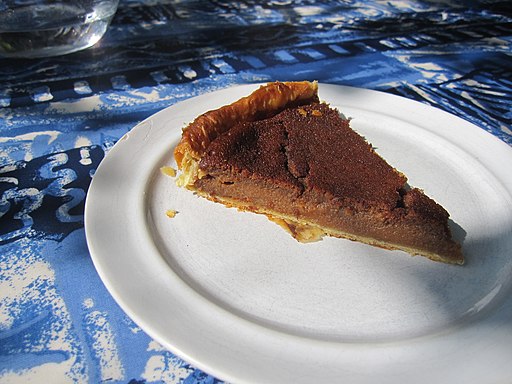
Swiss Food: Tarte à la Raisinée – Apple and Pear Molasses Pie
What is Swiss Raisinée?
The French-Vaudois word raisinée refers to a syrup or molasses made of the must of apples and pears. It was originally cooked in grape juice, thus the name — raisin means grape in French. Often called vin cuit, or “cooked wine,” it is in the form of a dark brown, viscous liquid. In still other parts of Switzerland, another concoction similar in consistency to jam and using the same ingredients is called cougnarde and probably dates back to at least the Middle Ages. Raisinée was used as a sweetener in many regions in Europe, and the tradition has lingered in Switzerland, especially in the cantons of Vaud, Fribourg and Neuchâtel. Today, it is mainly used for cakes and pies, and is not fermented, so it not technically a wine.
The tart itself has numerous names — raisinée, vin cuit (literally cooked wine), cougnarde and Biresaassa, depending on the location.
This recipe is inspired by Concert des Casseroles and translated with their authorization
Use a pie ring or pie tin 24 cm in diameter
Sweet Pie Crust
200 g of flour
100 g butter
3 g of fine salt
15 g walnut or hazelnut nillon* (here a mixture in equal parts)
1 small egg (less than 60 g)
60 g white sugar
Filling
3 eggs
2 egg yolks
200 g double cream
150 g pear raisinée (click on link to see our recipe for making raisinée)
Dough: Combine the butter and sugar. Add the beaten egg and walnut/hazelnut nillon, then flour, mix and form into a ball, then roll out or pat down to flatten. Wrap in plastic and chill for 30 minutes.
Spread the dough on a sheet of baking paper and place it along with the sheet in a pie ring or pie pan. Shape the edges by pinching the dough between your thumb and forefinger. Prick the bottom and edges with a fork. Cool for 30 minutes to firm up and avoid sagging when cooking.
Preheat oven to 180° C. Place baking paper and beans or ceramic beads on the dough to prevent it from swelling. Bake for 20 minutes: the dough should barely brown.
Meanwhile, prepare the filling by mixing the eggs and yolks, the double cream and the raisinée.
Remove dough from oven. Remove weights and parchment paper. Lower thermostat to 150°C.
Pour the filling into the dough and cook for about 30 to 40 minutes. The filling must be taken when it is not too firm and must have a slightly caramelized smell. It will probably still appear liquid when it comes out of the oven, but do not prolong the cooking, as it gets much firmer while it is cooling.
*Nillon: Nillon (or nion), is a local product used in French-speaking Switzerland. It is the residue from pressing of nuts. It is found in sheets, grated or powdered form. There are walnut and hazelnut nillons packaged in small 160-gram bags. In the canton of Vaud (Switzerland), nillon is used to make a walnut cake and apple pie. In France, it is known as walnut flour or walnut meal.
I’m Jonell Galloway, a freelance food and travel writer, editor and consultant.
I created The Rambling Epicure in 2011. It is a daily international food ezine, joining the voices of professional food and travel writers from around the world who talk about the art of mindful and sustainable eating, drinking, traveling and living, with an emphasis on good writing and spectacular photos by some of the best in the business.
Based in Switzerland, The Rambling Epicure food writers and artists promote a mindful, responsible approach to real food shopping, cooking, and eating, as well as food politics, safety, history, art, literature and philosophy.
We sponsor this non-profit project through freelance writing, editing and publishing; custom-tailored culinary tours, cooking classes, and tasting events; recipe development and testing; book reviews and sales of recommended books and products, and seminars and workshops on the various subjects we cover. Thank you for supporting us by clicking the Sponsor Us button in the right-hand sidebar.
My Personal Profile
You can learn more about my personal career path in my LinkedIn profile. I’ve been rambling around the world eating food and writing about it for over 30 years now, so there’s a lot to tell.
I ramble mainly in Switzerland and Europe, looking for good food and restaurants. My articles are available on TheRamblingEpicure.com, 10Best.com/USAToday, GenevaLunch.com, Paris Voice and TheRamblingEpicure.tumblr.com.
I studied cooking at the Cordon Bleu and La Varenne in Paris, and wine tasting here, there and everywhere in France and at CAVE S.A. in Geneva and Gland. In France, I worked for some years as a contributing editor for the English edition of the GaultMillau guide and as a food translator, while I ran a small cooking school in a château near Paris. I now live in Switzerland, where I have learned to love the earthy Swiss food and wine. One of my many interests is promoting Les Artisanes de la Vigne et du Vin as an ambassadress for this Swiss women wine producers association and Slow Food, of which I am an active member.
Apart from various restaurant guides for France and Switzerland recently published books include: Ma Cuisine Méditerranéenne in collaboration with Christophe Certain (in France) and Le tour du monde en 80 pains / Around the World with 80 Breads published by Orphie, in collaboration with Jean-Philippe de Tonnac (part of the French and all of the English) (covers history of bread around the world), André Raboud (Swiss sculptor), Edipresse.
My cooking method is “spontaneous cuisine.” Lessons consist of writing out a tentative menu based on seasonal, local products; going shopping for the products, and adapting the menu according to what is available and fresh; going to the wine seller to select a wine to go with the menu, then going home and cooking all afternoon with my students. The day ends with a candlelight dinner at the château (in the past), and now, at my chapel converted into a house in Chartres or in your home.
I give Mindful Eating seminars and therapy for those who have problem relationships with food and eating in general, helping them reconstruct their lifestyle and relationship to food and eating.
Specialties: French, Swiss and Italian cuisine with a bit of American influence. I believe in healthy, natural, sustainable cooking in the spirit of Slow Food, so all my articles, recipes and classes have this emphasis.
Now that Christmas and the New Year have passed, my neighbors here in Costa Rica are putting away lights, ornaments, Styrofoam snowmen, straw reindeer and faux pine trees. For the family Sunday mid-day meal many are dining on tamales.
Tamales are stuffed cakes of corn dough, masa harina, wrapped and steamed. In Costa Rica, they are an art form as well as a common food. Tamale making is a seasonal family affair. Multiple generations of family cooks assemble pork or chicken, vegetables – mostly carrots and peas, and herb fillings artistically in rectangular packets of freshly made cornmeal, wrap them in folded plantain leaves and tie them decoratively with reeds or twine. They are traditionally given to neighbors at Christmas. It is an economical and egalitarian way for friends to exchange similar thoughtful gifts without the adversarial “can you top this” attitude that pervades gift giving in some other cultures.
In Colombia and Venezuela, they are called hallacas and may contain raisins or olive pieces. In Mexico, they are wrapped in dry corn- husks. Cuban tamales are fluffier and spicy. When the same ingredients are layered and baked without a wrapper, the result is tamale pie. Tex-Mex tamale pie usually is laced with red and green chili peppers.
Hallaca leaves drying to make Venezuelan version of tamales
Tico (Costa Rican) tamales freeze well. They are most often tied together in groups of four. Tamales are steamed or simmered before eating, but they can go from freezer to table via the microwave in about two minutes and rekindle holiday warm fuzzy feelings and a delicious sense of community. Buen provecho and a happy and healthy 2014.
Swiss tasting week, referred to as “La Semaine du Goût” in the French-speaking part of the country, starts on Thursday, September 12, and runs until the 22nd. Each producer, restaurant and farm participating offers events. I will list a program of events, by day, in the Geneva area.This event is sponsored in part by Slow Food Switzerland. Here is the schedule for Thursday, September 12.
When my husband and I first started cooking gluten-free in our kitchen, we mainly focused on one type of meal — those that were naturally gluten-free.
The naturally gluten-free foods were the easiest to cook from scratch because they required no substitutions at all — risottos, fresh fruit, vegetables, custards & puddings, stir fry, roasted potatoes, homemade “chips”, salads, fresh steamed fish, bean stews, meringues, and even a macaron attempt or two. As a beginner to the gluten-free world nearly five years ago, I was thrilled with how many foods we could make without ever having to worry about an ingredient on a package label that could be harmful to my husband’s health. As long as we cooked from entirely fresh ingredients and avoided anything that came in a package or required flour, we were fine — and what a great variety we had to choose from!
But it didn’t take long before my husband would say, “You know, I really miss pizza,” or “Wouldn’t it be nice to have a thick creamy gravy to go on mashed potatoes sometime?” It was inevitable, really, that shunning all things flour-related was bound to cause waxing nostalgia for the meals we no longer ate. While it was great to get our feet wet by starting with the easy gluten-free meals that didn’t require any substitutions or extra thought, it seemed wrong to deprive ourselves completely of other foods that we enjoyed.
I set out on a mission of sorts to figure out how to convert our favorite foods to gluten free, where I found a veritable “Wild West” frontier land when it came to recipes — myriad flour blends and formulas either in packages on grocery store shelves or listed in books, none of which explained how they came to be or why they worked, often calling for expensive and elusive ingredients. It all seemed like some esoteric recipe voodoo.
I decided instead to create my own blends, first categorizing the various alternative flours and ingredients by texture and coarseness, and then quickly realizing that while those aspects do play a role in the end product, the key factor was in fact not the texture, but the starch, protein, and fat content, as these are the things that determine most how a flour will behave in a recipe. I can’t say I get a perfect product every single time on the first try, but the turning point in my success was when I started looking into exactly what I was replacing with my gluten-free flour blends.
Sometimes it really is the gluten that needs to be emulated, such as in a bread recipe, where the developed network of gluten in conventional breads actively works to trap the air pockets made by the yeast, allowing the bread to rise. Techniques for mimicking this include adding other leavening agents to help account for the fact that some of the air will indeed escape before the bread is done, or adding binding agents to help trap the air that is formed — and maybe even a combination of both of these techniques.
Often this is why one sees gluten-free recipes that include extra eggs, or gelling agents like ground flax or chia seeds, manufactured gums, or incorporation of starches into the GF blend, such as tapioca or arrowroot. Once we understand why these ingredients exist in a gluten-free recipe, we can better judge how to make substitutions to fit our needs – for example, don’t have ground chia seeds? Maybe adding an egg in its place will do the trick. The bread fell flat a bit and was too dense? We now have options. We consider the properties of the ingredients we are using, and this information can be used as tools for determining how to logically go about changing our recipes to improve them.
Other recipes that conventionally use flour don’t actually care about the gluten at all. Take, for example, a roux, essentially made up of a flour and a fat that are cooked together and then used as a thickening agent in soups and stews, such as gumbo. In the case of roux, there’s no elasticity needed, and no air to be trapped – all we are looking for is thickening, which occurs thanks to the starch components within wheat flour. This is great news for gluten-free cooks; there are lots of starchy gluten-free ingredients at our disposal that we can use to replace conventional wheat flour!
All-purpose wheat flour contains, along with gluten, a fair amount of starch. So to create a 1:1 substitution (by weight of course), one would just need to come up with a gluten-free flour blend that is also mostly (but not all) starch. This can be done either by using flours with similar starch content to wheat flour, or by supplementing the GF blend with a pure starch (cornstarch, tapioca, arrowroot, potato, glutinous rice flour, etc.). Each type of starch differs slightly in its chemistry, but for the most part they all have gelling and viscosity properties – i.e. they help food thicken and stick together. In something like our roux example, it’s not going to matter a whole lot what kind of starches we use, because the only aspect of the starch we are calling upon in this case is its thickening power.
Obviously, for baking, things get a little more complicated, but I’m convinced the overall strategy remains the same. The first thing I ask myself when converting a recipe is, “what in conventional wheat flour is doing the work? What traits do I need to make sure I replace with my gluten-free mix?” And then we can use our knowledge about the various gluten-free ingredients available to reproduce those properties. Actually, I think once one gets a bit more comfortable with gluten-free substitutions, there is even more freedom and more possibilities for “customizing” than when working with conventional all-purpose wheat flour. This is because one has the ability to pick and choose from amongst so many great ingredients — not just for certain properties, but also for flavors. For example, I often incorporate chestnut flour, because I just love the earthy rustic qualities it lends to baked goods.
Gluten-free substitutions don’t have to involve some mysterious wizardry in order to have success. Sometimes it’s just a bit of recipe tweaking, and other times, a little knowledge about the science behind why a recipe works goes a long way.
For the second post in this mini series on fermentation, let’s get into the “why” of fermentation.
Cultures from all over the world have fermented a food or drink. The principle reason has been to preserve their harvest. Over the winter months, fermented vegetables last and provide a source of calories, nutrients, and an accompaniment to the endless plates of what I imagine were sausage, jerky, smoked meat, and potatoes.
A 3 -litre jar of salsa, ready to start fermenting.
I like to imagine what the first aspiring fermenters thought when they heaped their extra produce into a large mound in a dark, warm, covered area, poured brine over top (or not), and – fully aware that vegetables rot – left it to stew before digging in with their hands. “Let’s see what this tastes like! Sort of sour but…”
France: How Reducing Food Waste is Part of Fighting Hunger
An initiative on the part of the French Ministry of Agriculture creates a link between professionals from the agrifood sector and public charities with the aim of reducing food waste and fighting hunger. It is referred to as the French National Pact against Food Waste.
A practical example: the “donation market”
The “donation market” is an initiative from the French Ministry of Agriculture to create a link between professionals from the agrifood sector and public charities. This idea arose out of the fact that professionals and charitable associations both have difficulty finding contacts, and don’t have time to give away food for free or find donors, says the French government. This public Internet platform responds to these difficulties and is easy to implement. Donors propose the kind of donation they want to make as well as its conditions of use and its transportation on the platform itself. As soon as it is posted on the Internet, all potential “receivers” are alerted by e-mail and can accept it. Donors can propose either food, equipment, transportation or knowledge on the platform.
As well as helping connect people and fighting hunger, this platform is also a way of reducing food waste, as it encourages people to give food rather than to throw it away and to offer extra room in transportation, for example.
Origin of Food Waste and Means of Action
In their Agrimonde and Dualine projects, French researchers from CIRAD, the French Agricultural Research for Development, and INRA, the French National Institute for Agricultural Research, examined possible systems of production and supply to feed the world in 2050. According to them, feeding 9 billion people by 2050 is possible so long as we:
increase yield in a sustainable way
reduce waste from field to fork
manage to change our food habits
They insist on the fact that wasting food also means wasting the energy, soil and water used to produce it, and will in turn be used to destroy the waste. Researchers also make a distinction between food loss, which occurs during the early stage of production (just after the harvest, during the first storage, transport, and first transformation) and which mostly concerns poor countries, and food waste, which is due to consumption habits (at home, in restaurants) or mismanagement of storage in the retail sector. Food waste mostly concerns rich countries. Food waste and food loss of course require different solutions.
To reduce food waste by 50% before 2025, the European Commission has proposed guidelines to Member States:
to educate people
to encourage better labeling and packaging
to ask Member States to favor partnership with responsible catering companies
Examples are also provided, such as:
to produce a new “sell-by date” label
to encourage new sizes of packaging for better preservation of products
to teach children good practices for proper use of food
Key Data
In the European Union, food waste comes from:
42% from domestic use
39% from the food-industry
5% from retailers
14% from the catering sector
every individual wastes 394 lbs. per year
89 million metric tons of food are wasted each year in the 27 countries of the EU
To learn more about this subject, here is the French National Pact against Food Waste.
Based on press release from the French Ministry of Agriculture
I’ve just discovered , dedicated to making traditional Swiss and other recipes dairy-free.
Heddi started her site in 2012 to face up to the daily task of cooking for her son, who has multiple allergies, including milk allergies.
A dairy-free version of many traditional Swiss recipes for lactose-intolerant people. Switzerland is a land of milk and cheese, so this is a difficult task. Bravo for her efforts.
Introducing our new “TRE Quality Label”: Healthy, Homemade Meals Delivered to Your Door, Geneva
The TRE Quality Label
Introducing our new “TRE Quality Label”
In this complex world of industrial food, where even organic food is sold by agro food conglomerates, it is important to know the quality and origin of what we eat. Thus the importance of a quality label that has been tested by people like us who are experienced in the real-food business. When we give the TRE Quality Label, we know where the ingredients came from, we know how the food was processed and treated — and most of it is entirely local, allowing you too to eat locally. We also know how it tastes, because we’ve tasted it all.
All the important criteria make up part of the TRE Quality Label: quality, origin, and taste. You can be sure of what you’re buying if it has a TRE Quality Label.
Today, we’d like to introduce the first product to which we’re giving our label: panbeh, a Geneva grassroots operation that makes every attempt to meet all these criteria, and to put something healthy, natural and tasty on your plate.
panbeh‘s meals are delivered straight to your door in Geneva. Most of the ingredients are from Geneva or nearby in the countryside.
It is the perfect solution for those who are home bound and for the elderly, as well as for those who simply don’t have the time to do the shopping required to cook a healthy, well-balanced meal. It’s great for those weeks when your work schedule is heavy, and ensures that you’ll get a home-cooked, healthy meal every day, delivered straight to your door.
Geneva: Healthy, Homemade Meals Delivered to Your Door by panbeh
panbeh describes itself:
panbeh means “pure cotton” in Farsi: the purity of a healthy, home-cooked meal
Panbeh’s very own cotton plant in Geneva, Switzerland
As we all know, what we eat is important for our daily activity and well-being, so we are introducing our new concept: the pleasure of eating healthy, natural, homemade food while fully enjoying the taste of what you eat, delivered right to your door.
No additives and no pesticides, no hormones and no chemicals — only the real, natural flavor of top quality, artisanal ingredients, the origin of which we systematically list. And you benefit from the real taste of the whole, untreated, unprocessed food, prepared fresh every day in a high-fiber, low-fat manner.
Whenever possible, we use only organic ingredients.
We propose a daily lunch menu and will deliver it to you at your home or your office, free of charge. Please find below are our daily menus for the month of July.
Delivery to your home or office
Order the night before (before 6 pm) for next day’s lunch, or order for the whole week
Orders are delivered between 12 and 1 pm
Order by email:
panbeh@servge.ch or by phone:
076 630 79 56
Free delivery for Petit-Saconnex, Grand-Saconnex, Grand-Pré and Nations.
It is our right to know where our food comes from:
Bread: Eric Emery bakery, Geneva.
Vegetables, fruits and mountain herbs (organic): Marché à la Ferme de Budé, Geneva.
Cheese (organic) : Casa Mozzarella, Geneva.
Salmon: Wild from Alaska or Scotland, sold by Francesco Drago, Halle de Rive covered market, Geneva.
Tomato sauce (organic): Marché a la Ferme de Budé, Geneva.
Spaghetti (organic): Marché à la Ferme de Budé, Geneva.
Rice & Quinoa (organic): Marché de Vie, Geneva
Olive oil: Greece, sold by Marché à la Ferme de Budé, Geneva
Eggs (organic): Marché à la Ferme de Budé, Geneva.
Chicken (organic) : Swiss origin
Wheat (organic) : Swiss origin
Tuesday
Shirazi salad (tomato, cucumbers, onion, fresh mint)
Indian Tilda rice with safran, berberis (barberries) and chicken, or wild rice with chicken and vegetables
Fresh fruit salad




 by
by