We sponsored a Twitter chat “Is French Cuisine Dead?” a couple of months ago. You can view the discussions here or by searching the hashtag #FutureFrenchCuisine.
Haute cuisine may well be unaffordable for ordinary people — it always has been — but regional cuisine is what the people eat and remains affordable. It is eaten in local bistros, which are reasonably priced and nowhere near disappearing; it is eaten in homes. French regional cuisine is a reflection of the soil, people and language, a reflection of the seasons and family; it is what memories are made of. It is the product of a place and of a people and the French people are very much alive.
What to Eat in France: Soupe de Légumes, or French Vegetable Soup
French children hate soup because most of the soup they get looks like the one below. You’ll not find any tiny pasta alphabets swimming around in French soup. It looks like mush or worse, children say. And it does. It’s anything but the bright, primary colors that would attract a child.
Adults see it differently. In fall and winter, soup often replaces salad as a starter. It has a high vegetable content, therefore providing all the vegetables one needs for a day, and it always uses seasonal, mainly root, vegetables. Every region has their own version, as does every cook, and any day’s version depends on what is available at the market and in the larder.
Most French soup uses a classic potato and leek purée as a base, the same one used to make vichyssoise, no matter what the region.
In the country, there is a longstanding tradition of pouring a little red wine into the last few spoonfuls of soup, and drinking it straight from the bowl. This is referred to as “faire chabrot” (or “faire chabrol” or “fà chabroù” in other regions). All these variations come from the Latin capreolus. It means literally “to drink like a goat.” The tradition exists mainly south of the Loire. Today, it is mainly older people in the country who still practice it.
This recipe is from the Lyon region, where they add a bit of cabbage to the otherwise classic base.
Recipe
Ingredients
1 leek 1 carrot 1 turnip 1 stick of celery 2 onions 2 potatoes Chunk of cabbage 4 1/2 cups veal or chicken broth, hot 1 T. butter
Salt and pepper to taste Slices of country bread Parsley, chopped Glass of red wine for each diner
Directions
Chop vegetables into small cubes and place in saucepan or soup pot. (I leave on the skin for added fibre.)
Cover with hot broth.
Bring to a boil over medium-high heat, then cook over medium-low heat for about 1 1/2 hours.
Toast bread.
Purée in a food processor or with a potato masher.
Add butter and mix well. Add salt and pepper to taste.
Lay slices of toast in soup bowls.
Pour soup over toast.
Sprinkle with parsley.
Serve immediately.
When there are just a few spoonfuls of soup left in the bowl, add a little red wine and drink the rest of your soup straight from the bowl (if you dare).
Taste Unlocked Autumn Equinox 2015 in Chartres, France
Taste Unlocked 2015 was a great success. Our guests have returned to England, but the house reverberates with the still-fresh memories of their presence and the joys of good food, fine wine and the excellent company we shared. Happy souvenirs of their visit, a few unfinished bottles we tasted will be emptied in coming days, but we shall toast our special guests each time we partake.
I prepared traditional dishes from the Beauce region, using the recipes I’ve researched over the years and the best products from local farmers and producers. These were accompanied by what we consider our local wine, that of the Loire Valley, which starts less than 50 miles down the road from here.
We kicked off the weekend on Thursday over a dinner of locally farmed duck cooked in Eure-et-Loire apple cider and served with Beauce turnips and carrots and apples. This was followed by a curried green gauge plum sautée with Financier almond cake.
No one loves cream or creaminess more than the French. They love it so much that they call all sorts of things other than cream “crème“: cream soups, pudding, sauces, custard filling, pastry cream, coffee with hot milk, puréed chestnuts, almond cream, cream horns, and even certain liqueurs. Just about anything creamy is likely to be called cream in French.
Cream has existed ever since milk existed. Despite our association with French cuisine, in general, cream is more a specialty of the north of France where it’s cooler, of the land of butter, than of the south, the land of olive oil and duck fat.
Normandy might well be called the cream capital of the world, or at least of France. The Vikings brought what we now call Normande cows to Normandy a thousand years ago. They, along with Jersey cows, are known for the quality of their fatty, high-protein milk, which makes excellent cream, butter and cheese. Half of all French milk and cream now comes from Normandy.
From Southern biscuits to French baguette. You might wonder how a country girl from Kentucky who grew up on fried chicken, creamed corn, biscuits, cornbread, and church supper fruit pies could be qualified to tell others about boeuf bourguignon, cassoulet, choucroute or coq au vin. Yes, I’m writing a book we’ll call The French and What They Eat, since the title hasn’t yet been finalized. I’ll tell you the story in the book — from a general store/cream station/feedstore in a spot in the road in Kentucky, where the loafers discussed whether it was better to put a bag of peanuts into a Coke or an RC, to the City of Light and the Cordon Bleu Cooking School, eventually cooking, eating and drinking my way around France.
“What to Eat in France,” a series of regional French recipes with a story and a bit of history, is laying the groundwork for this book. If you’d like to follow the series on a regular basis, sign up for the newsletter in the right-hand column.
Apples and cream are a quintessentially Norman flavor combination. This is a festive dish made on Sundays and holidays.
In Normandy, they would traditionally drink it with dry cider or Pommeau, but a fruity white wine such as a Riesling goes well, or even dry white Burgundies. If you prefer red, try a light one, such as Saint-Nicolas-de-Bourgueil or another Loire red.
Quand se garnis uno ensalado, Fau qu’aquéu que met la sau fugue un sage; Aquéu que met lou vinaigre, un avare; Aquéu que met l’òli, un proudigue.–Popular minstrel rhyme
“When dressing a salad, the person who adds the salt has to be careful; the person who adds the vinegar wise, and the person who adds the oil generous,” said the wandering minstrels in Langue d’Oc.
Anchoyade is the langue d’oc spelling. In French (and in the Provençal dialect), it is written anchoïade. In English, anchoiade.
The former province of Languedoc bordered Provence, where anchoïde is king, but in Languedoc, anchovies are mashed into a paste. Anchoïade is to Provence what fondue is to the Savoy. When the anchovy mixture is pounded in a mortar, as it is in Provence, it is actually anchovy paste. Anchoyade Languedocienne differs in that the anchovies are fried and served whole.
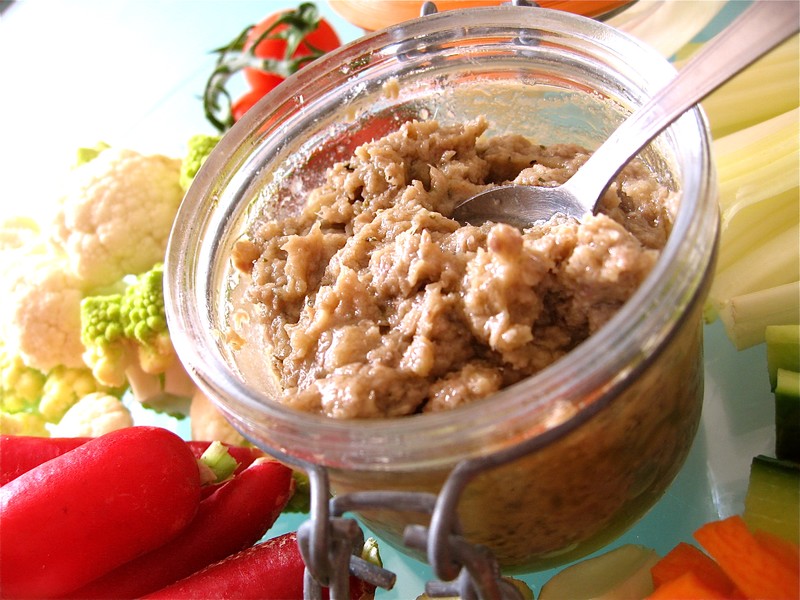
Technically, anchoïade is considered a sauce in France, although it is eaten as we would eat dip, called bagna cauda, or banha cauda in Provençal, with fresh raw vegetables into which it is dipped, or as a spread on toast. It is also used to make Fougasse aux Anchois and on salads.
In the region, anchoïade is most often accompanied by a dry white Cassis wine.
This is a traditional recipe and is perfect for topping a salad. Today, it is almost always ground into a paste like in Provence before serving as a dip. If you wish to do this, see the instructions following the traditional recipe.
Bourride is the specialty of Sète, a town on the coast of the Languedoc in Provence. Sète is one of the largest fishing ports in the region. Native poet Paul Valéry called it l’île singulaire, the singular island, because it is nestled in between two salt water lakes and the sea.
Bourride is said to date back to the Phocaeans, the ancient inhabitants of Marseilles, then called Massilia.
In Provençal, it is called boulido, meaning “boiled.” It is not unlike bouillabaisse, a specialty of nearby Marseilles, the difference being that bourride is made with only white fish — monkfish tails in particular, and that it is accompanied by aioli instead of the traditional rouille served with bouillabaisse. Shellfish are never added.
My recipe is very traditional. There are many variants, but the aim of this series of articles “What to Eat in France” is to seek original or traditional recipes for traditional, regional dishes.
This dish is a sure pleaser for parties and is easy enough to cook ahead, doing everything but poaching the fish, which should be done before serving.
In the region, many locals drink rosé wine such as Coteaux-d’Aix-en-Provence with bourride, but one might just as easily pair it with a perfumed Languedoc white. There are a world of them to be discovered, but since they are not, for the most part. A.O.C., it’s difficult to recommend one in particular. It’s a matter of producer as much as place.
Before having the best Cotignac sent from Orléans, because you were yearning for the tastes of your childhood…Avant de faire venir d’Orléans le meilleur cotignac, puisque vous vouliez redevenir enfant et goûter au cotignac…—Balzac, Lettres à l’Étrangère
Quince is my husband’s favorite word. Annoying situations or people are quinces in his lexicon. But quinces can be most agreeable, as in the case of quince paste, a cherished confection in France. Although the fruit must be cooked to be digestible, rather like annoying situations have to be cogitated over to be digested, it is worth the effort. They are, after all, a member of the Rosaceae family, like apples and pears.
Quince paste, often called quince cheese or in Spanish membrillo, is not specific to France. In fact, it dates as far back as the Ancient Greeks, who made a similar preparation using honey instead of sugar.
Cotignac d’Orléans, quince cheese from the region of Orléans, has a special place in the history of France. In the Middle Ages, a pastry chef from the village of Cotignac in the region of Var in the southeast set up shop in Orléans. He made quince cheese, which came to be known as Cotignac, and which became a favorite of King François I. French kings continued the tradition, and Louis XIV and XV offered Cotignac to ambassadors and other important guests.
There are also historical references to a Cotignac from Mâcon.
How is Cotignac different from other quince cheese? It’s not, really. The name just stuck because of its place in history.
Saffron mussel soup is from the Loire region. The particularity of the Loire version of this soup is that it has leeks, which are not commonly used with mussels. The Loire Valley produces more than 24% of all leeks in France, more than any other region.
The proportions of the ingredients can vary, although the fumet needs a bit more precision than the mussels and soup. The general rule is to make as much fumet as you need for the amount of mussels you’ve cooked.