WHAT TO EAT IN FRANCE: BLANQUETTE DE VEAU

Published by Tuesday, June 2, 2015 Permalink 0

Chartres-style Blanquette de Veau Recipe / Apple, onion, carrot and veal stew in apple juice and white sauce recipe

This dish hails from Normandy, where cream, butter, apples and calves are abundant. Chartres is not officially in Normandy, but its cuisine is similar.

by Jonell Galloway

1 kilogram or 2 pounds veal shoulder, cut into 2″ x 2″ pieces
12 pearl onions, or the white of 12 small spring onions, peeled and whole
1 apple, chopped
4 carrots, cut into large chunks crosswise
Apple juice
Veal or chicken broth
6 small new potatoes in jacket
4-5 tablespoons flour
2-3tablespoons butter
1/2 liter or 1 quart milk
Italian or flat parsley, chopped
Salt
Pepper
Dutch oven or similar large pan

  1. Put the veal pieces in Dutch oven.
  2. Add the onions, apple and carrots.
  3. Cover with half apple juice and half veal broth. Salt and pepper.
  4. Simmer gently for 1 hour, then add the whole potatoes.
  5. Simmer for 30 to 45 minutes, or until the potatoes are cooked.
  6. Drain broth from meat and reserve it to make white sauce.
  7. Melt butter in a large, deep frying pan or saucepan. When melted, gradually whisk in 3-4 tablespoons of flour, stirring constantly until the roux starts to gently brown.
  8. Gradually whip in the milk until sauce starts to thicken. Continue whipping until all the milk is absorbed. It should be extra thick. If not, put one more tablespoon of flour into a ladle and add white sauce to ladle. Mix well to form a smooth paste, then whip this into white sauce.
  9. Gradually whip the broth from the stew into the white sauce. When smooth and thick, pour this back into the stew.
  10. Gently mix, turning the meat and vegetables over in white sauce.
  11. Simmer very gently for 5 minutes, stirring carefully so that meat and vegetables don’t fall apart.
  12. Serve, sprinkling with chopped parsley.

Note: This is often served with rice. If you prefer rice, leave out the potatoes. Small turnips can also be added at the beginning, as well as other vegetables, according to taste.


Never miss a post
Name: 
Your email address:*
Please enter all required fields
Correct invalid entries

FRENCH RECIPES: POT-AU-FEU OR PETITE MARMITE

Published by Saturday, May 23, 2015 Permalink 1

Emmanuel Ménétrier / Foter / CC BY-NC-SA

ESCOFFIER’S RECIPE FOR POT-AU-FEU OR PETITE MARMITE

Pot-au-feu and petite marmite in today’s vocabulary are the same thing. Until the nineteenth century, the term pot-au-feu simply referred to a family soup to which was added different ingredients every day, usually with beef and chicken added on Sunday. The regional variations were endless, depending on availability and season and depending on the cook.

In 1829, the French etymology dictionary defined  pot-pourri  as “the name our fathers gave to the pot-au-feu.” In the nineteenth century, the recipe started to take on its modern ingredients of beef, root vegetables and a veal bone, but it still included chicken, which many people, including my French butcher’s wife, leave out these days.

Escoffier, who codified French cuisine in the late nineteenth century and early twentieth century, set down the recipe in Le Guide Culinaire in 1902, still calling it petite marmite. The regional variations started to disappear, and the recipe has now been simplified by most home cooks to contain only beef, no chicken. Escoffier insisted on the importance of the chicken, but today, one rarely finds a pot-au-feu with mutton, veal, pork, chicken, duck or turkey. The other name, petite marmite, has pretty much gone out of usage.

Continue Reading…

Never miss a post
Name: 
Your email address:*
Please enter all required fields
Correct invalid entries

WHAT TO EAT IN FRANCE: FOIE GRAS

Published by Tuesday, May 19, 2015 Permalink 0

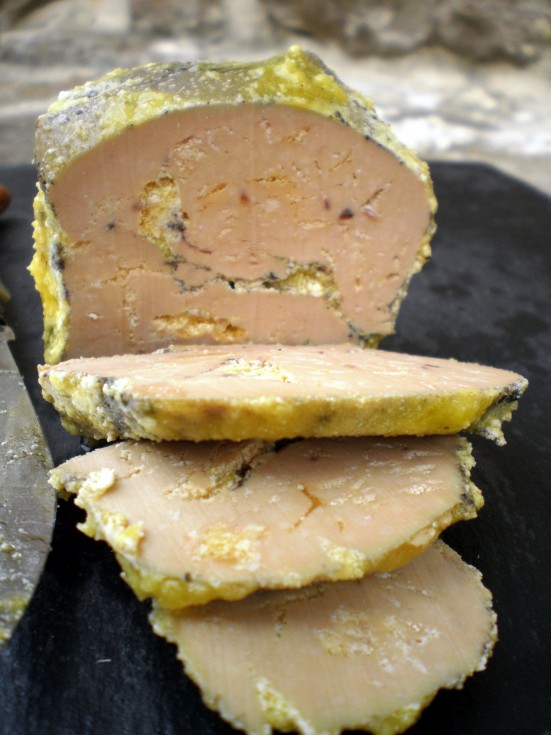
WHAT IS FOIE GRAS? READ THE FINE PRINT!

by Jonell Galloway

The French eat 90% of the foie gras they make themselves. That’s how much they like it, but they didn’t invent it. Although the Egyptians might have force-fed their birds, we’re not sure that they ate foie gras. The Greeks probably did, since the 4th-century Greek poet Archestratus wrote about it in his Gastronomy. The liver is the soul of the goose, he said.

Foie gras is made using a process called gavage, which consists of force-feeding ducks or geese through a feeding tube to fatten them. The Romans stuffed dried figs down their throats. In Latin, the word for liver even comes from fig, ficus. Scipio Metellus, a Roman chef, had the idea of soaking still warm livers in honey and milk to swell them even more before cooking.

Apart from the region of Béarn in the southwest, this practice disappeared in medieval France, coming back to life in the southwest and Alsace during the Renaissance.

French foie gras is made by force-feeding corn to geese and ducks, and still, occasionally, figs, which swells the livers.


Goose foie gras has traditionally been the most cherished because it is fattier, but it cannot be produced year round. Duck liver is less fatty, and can be produced year round and industrially, meeting the ever-increasing demand.

The fattened liver can be made into terrine, pâté, mousse, parfait, and a host of other things, and, in more recent times, there is a trend of cutting fresh foie gras into thin slices and pan-searing it. It can be eaten fresh or preserved in glass jars, and can be seasoned with truffles, port, Armagnac or Sauternes. Southwesterners prefer a simple, less perfumed foie gras, while Alsacians like to add flavor.

When purchasing, there are legal distinctions in names that indicate the purity and therefore determine the price:

  1. Foie gras entier means that it contains the actual lobes of the liver. The only legally allowed addition is truffles. As it’s solid, you cut it with a knife, just like you do extra-tender beef filet.
  2. Foie gras consists of pieces of liver that are put back together and pressed.
  3. Bloc de foie gras is reconstituted liver combined with other ingredients, but containing at least 50% foie gras for goose, and 30% for duck .
  4. Parfaits are preparations containing 75% foie gras and made by mechanical means, to which regular, unfattened liver is added.
  5. Médaillon or pâte de foie de canard or d’oie contains 50% duck or goose foie gras or bloc de foie gras in the middle, surrounded by forcemeat.
  6. Galantine is a butcher’s mixture of meats and other forcemeats, with no defined percentage of foie gras.
  7. Mousse contains 50% foie gras mixed with forcemeat, giving it the texture of foie gras.

Terrine is pure foie gras pressed into pâté shape.

Forcemeat can consist of one or several ingredients, including pork, veal or chicken fat; pork or chicken liver; scraps from deveining; poaching fat; eggs; milk; lactoproteins; flour, and starch.

Foie gras comes in a jar, plastic package or can or fresh from the butcher. When purchasing, be aware of the different cooking preparations, since the temperature at which it is cooked and the method of cooking change the flavor and shelf-life. Generally speaking, fresh is better.

It is important to make sure you are being sold what you ask for in both restaurants and shops. As a consumer, you have a legal right.

The French don’t eat foie gras every day. Traditionally, it is for special occasions and holiday meals, especially Christmas and New Year’s celebrations.

Coming soon: What to Eat with Foie Gras

Continue Reading…

Never miss a post
Name: 
Your email address:*
Please enter all required fields
Correct invalid entries

Switzerland: Brasserie Lipp Geneva: The Brasserie of all Brasseries

Published by Thursday, July 25, 2013 Permalink 0


//

Switzerland: Brasserie Lipp Geneva: The Brasserie of all Brasseries

by Jonell Galloway

From the archives

The Brasserie Lipp in Geneva even tops the one in Paris. Some may say that’s not difficult to do in a sleepy, provincial town like Geneva, but it is not so simple as that.


It’s l’ensemble, the “package” with all its details, that makes it work to perfection: the top-notch French-style service, the professionalism, the decor, the reliability of the food, the atmosphere, its late opening hours, even on Sunday.

You can watch them in action on their site!

I love their site, which gives you a glimpse of all the qualities above through a short video.

Menu

The menu includes classic brasserie fare, such as choucroute, souris d’agneau confite or lamb’s shank – one of the tenderest parts of the lamb, steak with Béarnaise sauce, leeks ravigote and shellfish platters. They offer Gillardeau oysters as well as the usual selection of shellfish found in a brasserie. It is always impeccably fresh.


But unlike many brasseries, they also have a menu that changes with the seasons. It invariably offers an assortment of tartares, cold or hot soups, salads, and dishes that often have North African and Asian accents. One of my favorites that they have been doing for 3 or 4 winters, is the vegetarian couscous. It’s like no other couscous I’ve ever had, a modern, up-to-date “revision” that I never tire of.

Service

If you listen to their video, you’ll understand what I mean about the professionalism of the service. They will never get annoyed with you if you ask questions about the dishes or if you change your mind 3 times. They are old-fashioned, but in the good sense of the term. The servers are always polite and patient.

  • .
    Never miss a post
    Name: 
    Your email address:*
    Please enter all required fields
    Correct invalid entries

Mediterranean Food Connection: Zucchini and preserved lemon salad, a recipe by Christophe Certain

Published by Tuesday, July 9, 2013 Permalink 0


Mediterranean Food Connection: Zucchini and preserved lemon salad, a recipe by Christophe Certain

Recipe translated from the French and adapted by Jonell Galloway

This recipe is perfect for Ramadan.

Recipe

Ingredients

2 onions, chopped
4 zucchini / courgettes
1 tablespoon of capers in vinegar
1 preserved lemon (see note I posted here a month or so ago about how to make them), chopped into 3 mm / 1/8” cubes
Salt
Pepper
Olive oil or butter

Equipment

Large, deep frying pan

Instructions

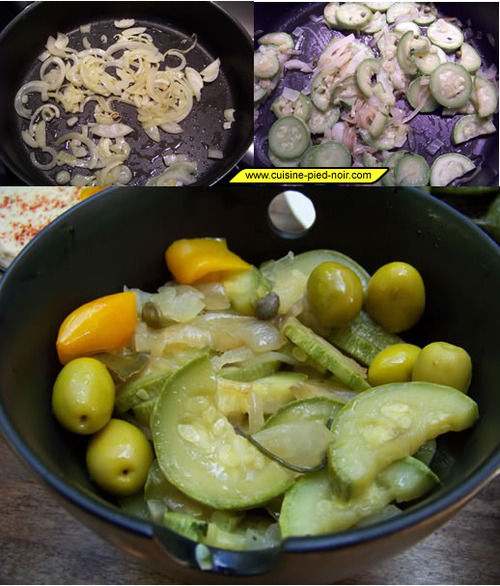
  1. Heat olive oil or butter. Sautée onions.
  2. While onions are cooking, wash zucchini / courgettes. Start by cutting off ends, then cut then slice them into medium-thick slices, leaving the skin on.
  3. When onion is translucent, add zucchini / courgettes. Mix well, but gently.
  4. Let this mixture cook over low heat for about 15 minutes, until the water from zucchini / courgette has evaporated. They should remain crunchy, but if you prefer them soft, just cook them a little longer.
  5. Add capers and chopped lemon.
  6. Leave on burner for a few minutes, gently stirring, so that the zucchini / courgette will absorb the lemon flavor.
  7. This dish can be eaten warm with chicken or fish, for example, or cold, as a salad.

You can view the original recipe in French on Christophe’s website Cuisine Pied Noir.


Never miss a post
Name: 
Your email address:*
Please enter all required fields
Correct invalid entries

Simon Says: Daily Food Quote, March 2, 2012

Published by Friday, March 2, 2012 Permalink 0

by Simón de Swaan

Life is too short for cuisine minceur and for diets. Dietetic meals are like an opera without the orchestra.Paul Bocuse

Paul Bocuse is a French chef based in Lyon, renowned for the high quality of his restaurants and his innovative approaches to cuisine. He is one of the most prominent chefs associated with the Nouvelle Cuisine, which is less opulent and calorific than the traditional cuisine classique associated with the Escoffier school of cooking, and stresses the importance of fresh ingredients of the highest quality. Paul Bocuse claims that Henri Gault first used the term Nouvelle Cuisine to describe food prepared by Bocuse and other top chefs for the maiden flight of the Concorde airliner in 1969.


Click here to see Bocuse’s restaurant website.


Deutsch: Restaurant Paul Bocuse in Collonges a...


Related articles


Never miss a post
Name: 
Your email address:*
Please enter all required fields
Correct invalid entries

French Food Quote: Daily Food Quotes, August 23, 2011

Published by Tuesday, August 23, 2011 Permalink 0

by Jonell Galloway

The funeral home employee asked the widow if her husband were incinerated, would she rather it be in a French oven or an Italian oven. She replied: “Oh, a French oven! My husband couldn’t stand Italian food!–Alphonse Allais

L’employée des pompes funèbres demandait à la veuve si on brûlerait son mari qu’on devait incinérer, dans un four français ou un four italien : “Oh ! monsieur, le four français ! Mon mari ne pouvait pas sentir la cuisine italienne ! — Alphonse Allais

Alphonse Allais (1854-1905)
Related articles
Never miss a post
Name: 
Your email address:*
Please enter all required fields
Correct invalid entries

UA-21892701-1