Quand les poules auront des dents. / Literally, “when chickens have teeth,” meaning that will never happen.
Bresse chicken or poulet de Bresse has had an A.O.C. since 1957, which defines the way in which they are raised as well as the geographic zone in which they can be raised.
It is a French breed known as Bresse-Gauloise. The feathers are generally white, and they have a red, crenelated comb. They have blue feet and a white beard. About a million chickens are sent to market every year.
Poulet de Bresse and other poultry from Bresse — including guinea fowl, capon, hen and even turkey — is raised under strictly defined conditions, but it is not organic. They are free range and have a grass-based diet, but also eat worms and mollusks. Final fattening is with cereals and milk products in wooden cages. Bresse poultry cannot be slaughtered under 5 months of age if they are to bear the A.O.C.
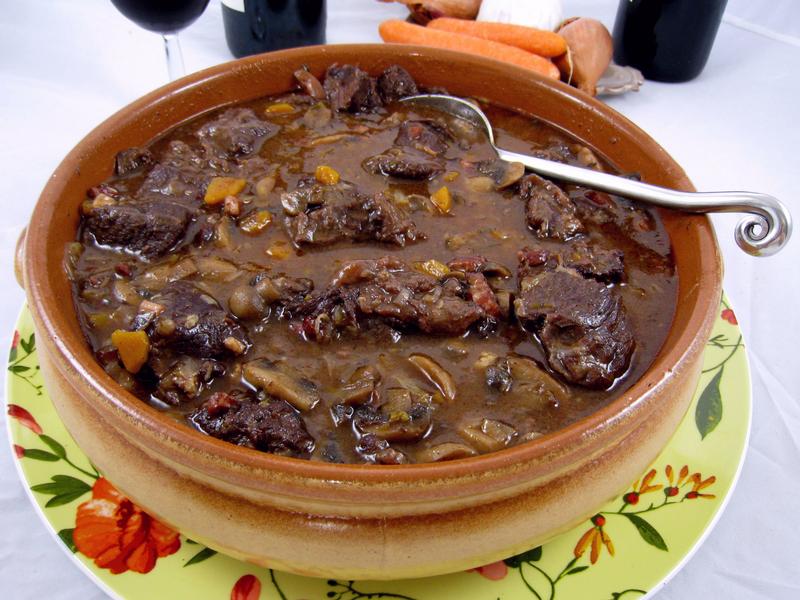
Boeuf à la bourguignonne, also referred to as beef or boeuf bourguignon, is a French classic from the Burgundy wine region of France. It is made with red Burgundy wine, and simmered for hours. It makes up part of what the French refer to as “plats cuisinés“, or slow-cooked dishes.
This recipe is quite easy to make, and should serve about 8 people. Plan to make it well in advance, since it is best when it is left to marinate for 24 hours and cook slowly several hours on the day of serving. It is the perfect dish for dinner parties or potlucks, and is one of the best leftovers around.
Boeuf Bourguignon Recipe
Click here for metric-Imperial-U.S. recipe converter
Sauces were once the domain of French haute cuisine, aristocratic food. This started changing after the Revolution, first in the bourgeoisie, who copied the ways of the former royalty, and eventually in restaurants.
In France, there have always been sauces. Even the Franks and the Gauls moistened their food with a “flavored liquid.”
French cuisine, influenced by Roman cuisine, saw the first sauce recipes using meat jus in the fifth and sixth centuries, and were then called saulce. To the jus was added vinegar, wine, acidic fruits and spices. The Romans had already used ginger and cloves, but in the eleventh century, the Crusaders brought back others from the Levant, including cinnamon, the most commonly used, galangal (or ginger), coriander seeds, cumin, nutmeg, cardamom, saffron, grains of paradise and pepper. The acidic quality was often given to sauces through the addition of verjus, made from green grapes, which are not yet sweet in flavor and remain acidic, or with other acidic fruit such as apple, lemon or plums. Verjus is still used in French sauces.
Guillaume Tirel, known as Taillevent (after whom a Paris palace of gastronomy is named), wrote the first known cookbook, Le Viandier, around 1375. Stews and other slow-cooked dishes didn’t yet exist; most meat was boiled or cooked over a spit, i.e. quite plain, so sauces were a way to liven them up. About thirty sauces have been recorded during the medieval period. They of course featured in the cuisine of the well-to-do; most common people were still eating gruel, as they always had.
During the Renaissance, spices dropped out of French cuisine. It was the halcyon days for sauces, which proliferated. Slow-cooked sauces were invented using fonds, mirepoix, butter and flour for thickening. Simple jus and coulis became common. Recipes for green sauces from Italy using new ingredients and herbs were also popular and easy to make since herbs were plentiful and grew wild in even the coldest parts of France.
It was La Varenne in the seveneenth century who started precisely defining sauces and how they’re made and documented roux, which then consisted of a paste of flour and lard for thickening:
Thickening of flowre
Melt some lard, take out the mammocks; put your flowre into your melted lard, seeth it well, but have a care it stick not to the pan, mix some onion with it proportionably. When it is enough, put all with good broth, mushrums and a drop of vinegar. Then after it hath boiled with its seasoning, pass all through the strainer and put it in a pot. When you will use it, you shall set it upon warm embers for to thicken or allay your sauces.—The French Cook, Francois Pierre La Varenne
To the “low-fat” sauces of the Middle Ages were added bread, eggs and cream, making them much heavier, and herbs replaced spices from the Orient. Roux was the thickener of choice. Beurre blanc and hollandaise sauce accompanied pike, a popular dish.
In the eighteenth century, Carême perfected the art of sauce making and was the first to classify the mother sauces: béchamel, espagnole, velouté, and allemande. Auguste Escoffier later refined this list to the contemporary five mother sauces by dropping allemande as a daughter sauce of velouté, adding hollandaise and sauce tomate, in his classic Le Guide Culinaire, published in 1903.
Today, French people of all social and economic classes eat sauce. It is not restricted to the wealthy or the aristocrats. Just about anyone can whip up mayonnaise without a recipe.
—————————-
Jonell Galloway grew up on Wendell Berry and food straight from a backyard Kentucky garden. She is a freelance writer. She attended Le Cordon Bleu and La Varenne cooking schools in Paris and the Académie du Vin, worked for the GaultMillau restaurant guide and CityGuides in France and Paris and for Gannett Company in the U.S., and collaborated on Le tour du monde en 80 pains / Around the World with 80 Breads with Jean-Philippe de Tonnac in France; André Raboud, Sculptures 2002-2009 in Switzerland; Ma Cuisine Méditerranéenne with Christophe Certain in France, At the Table: Food and Family around the World with Ken Albala, and a biography of French chef Pierre Gagnaire. She ran a cooking school in France, and owned a farm-to-table restaurant, The Three Sisters’ Café, with her two sisters in the U.S. She organizes the Taste Unlocked bespoke food and wine tasting awareness workshops with James Flewellen, is an active member of Slow Food, and runs the food writing website The Rambling Epicure. Her work has been published in numerous international publications and she has been interviewed on international public radio in France, Switzerland, and the U.S. She has just signed on at In Search of Taste, a British print publication, and is now working on two books, The French and What They Eat and What to Eat in Venice.
We sponsored a Twitter chat “Is French Cuisine Dead?” a couple of months ago. You can view the discussions here or by searching the hashtag #FutureFrenchCuisine.
Haute cuisine may well be unaffordable for ordinary people — it always has been — but regional cuisine is what the people eat and remains affordable. It is eaten in local bistros, which are reasonably priced and nowhere near disappearing; it is eaten in homes. French regional cuisine is a reflection of the soil, people and language, a reflection of the seasons and family; it is what memories are made of. It is the product of a place and of a people and the French people are very much alive.
Apples and cream are a quintessentially Norman flavor combination. This is a festive dish made on Sundays and holidays.
In Normandy, they would traditionally drink it with dry cider or Pommeau, but a fruity white wine such as a Riesling goes well, or even dry white Burgundies. If you prefer red, try a light one, such as Saint-Nicolas-de-Bourgueil or another Loire red.
Saffron mussel soup is from the Loire region. The particularity of the Loire version of this soup is that it has leeks, which are not commonly used with mussels. The Loire Valley produces more than 24% of all leeks in France, more than any other region.
The proportions of the ingredients can vary, although the fumet needs a bit more precision than the mussels and soup. The general rule is to make as much fumet as you need for the amount of mussels you’ve cooked.
A charlotte is traditionally fruit sautéed in butter which is then placed in a mold lined with bread. In our day, the bread is usually ladyfingers, but I’ve used financier, a dense almond flour cake made with beurre noisette, giving it a distinctive flavor.
Insteading of sautéing the strawberries, I’ve marinated them in rum and used the marinade to “wet” the cake, similar to the way the British make trifle.
600 g strawberries 2 T. brown sugar
1 tsp. cinnamon 4 T. rum 3/4 c. water 4 financier cakes, individual size (or other type of soft, but dense, almond cakes) 200 g thick cream 1/2 vanilla bean 2 T. brown sugar
4 parfait dishes
Top strawberries and cut in half. Place in mixing bowl.
Mix in 2 T. brown sugar and cinnamon.
Add rum and water. Mix gently.
Leave for 30 minutes, mixing gently from time to time. A natural sauce should form. If it doesn’t, add a little more water and rum.
Meanwhile, mix cream with vanilla from vanilla bean and brown sugar.
Break up 1/3 of each financier into each parfait cup. Spoon in 1/9th of strawberries into each cup, pouring some juice onto the cake to moisten it.
Cover with 1/9 of cream.
Add two more layers of financier, strawberries and cream, in the same proportions, ending with cream.
Decorate top with bits of strawberry, mint, or dark chocolate.