Salone del Gusto versus Good, Clean, and Fair: Part 1

Published by Wednesday, December 12, 2012 Permalink 0


Salone del Gusto versus Good, Clean, and Fair: Part 1

by Diana Zahuranec

Salone del Gusto, an event held biannually in Turin, Italy by the organization Slow Food, gathers artisanal producers from around the world in five days of selling organic or biodynamic, high quality, artisanal, innovative and traditional products; tasting workshops; and conferences about the state of the world’s food system and what can be done to promote sustainable growth. It’s an amalgamation of the green movement and everything it could possibly stand for before such a thing as “green washing” existed.

So what were the Italian supermarket COOP, the internationally famous Italian espresso company Lavazza, and the ubiquitous road-side Italian convenience store Autogrill doing at the Salone?

A supermarket is the antithesis of Slow Food’s “good, clean, and fair” motto. Products are available at any quality, starting at “low” and often not reaching above “decent;” produce and packaged goods come from all over the world, with little thought as to what other countries deem as “safe” pesticides, and with less thought about the energy used to transport everything; and finally, it’s anyone’s guess as to how many products lining the shelves were made under unpleasant or dangerous working conditions with low wages as poor compensation.

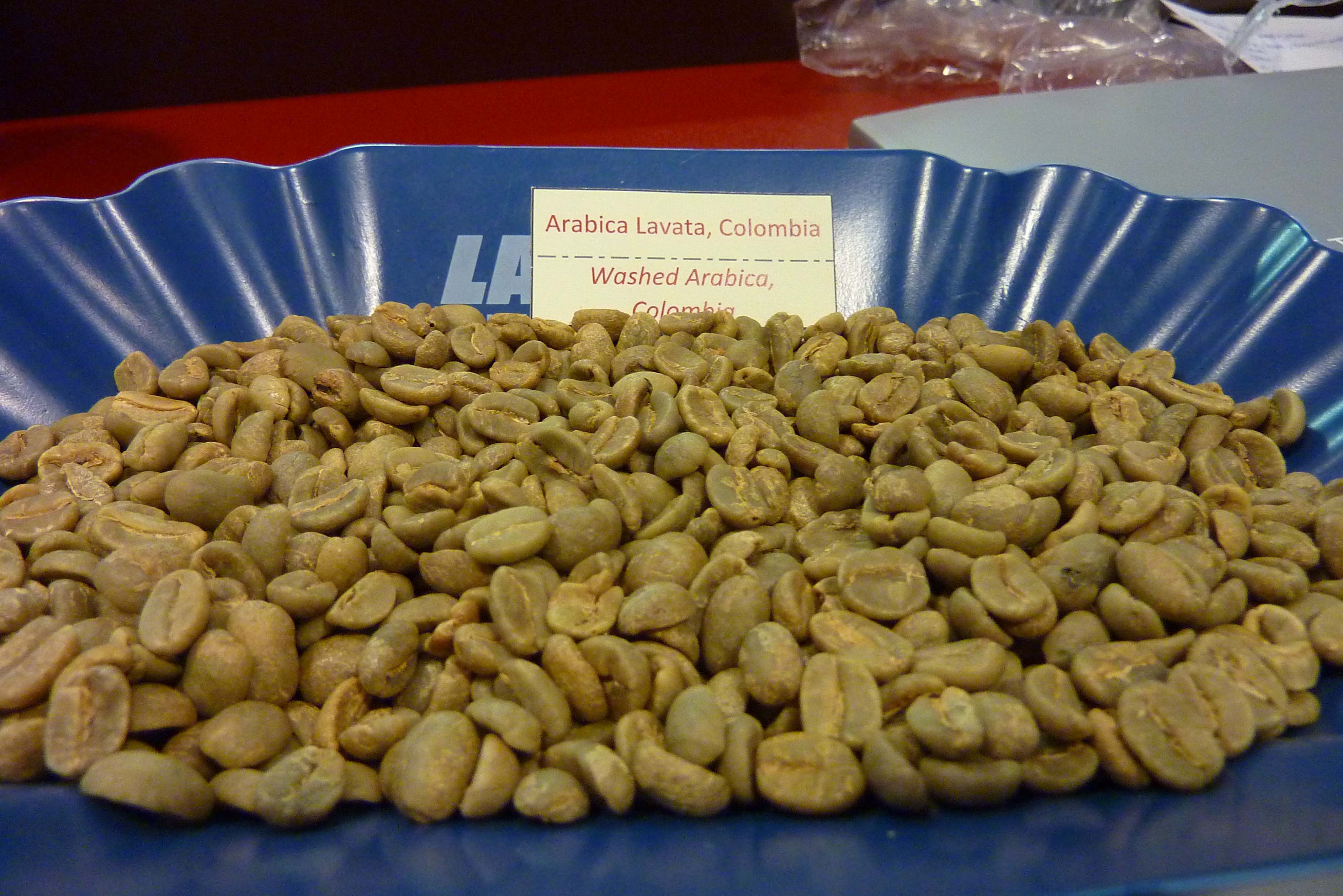
Coffee beans are notorious for their high demand pitted against their low cost, possible only through unfair working conditions and wages. Coffee plants are harvested using mono-cropping methods, which is environmentally friendly only in the interests of that particular crop.


Continue Reading…

Never miss a post
Name: 
Your email address:*
Please enter all required fields
Correct invalid entries

Wild Woman on Feral Acres: Eating in Season? Pick a Pack of Parsnips!

Published by Thursday, December 6, 2012 Permalink 0

by Esmaa Self

From the archives

Consider the parsnip. Sweet. Nutty. recipe. From fritters (recipe) to soup (recipe), homemade gnocchi (recipe) to curry (recipe), the mighty parsnip delivers folate, vitamin C, fiber and flavor. Even if you’ve never before tasted parsnips, my bet is that if you try one of these recipes, you’ll not only want more parsnips, you’ll want to grow your own (tips on that below).

Photo courtesy of Sharon Mollerus

Speaking of yum, here’s a recipe from Simple Organic Kitchen & Garden that I’ve adapted to fit the items in my pantry, notably dried tomatoes and porcini mushrooms. The original recipe is known as Parsnips and Chickpeas in Garlic, Onion, Chili and Ginger Paste. I added ingredients, skipped a couple others and decided to shorten the title to the equally descriptive Parsnips Piquant.

Incredible flavor, marvelous nutrition

RECIPE

PARSNIPS PIQUANT

Ingredients


Click here for Imperial-metric recipe conversion

2 pounds parsnips, cut into ½ inch chunks
½ pound dried chickpeas, soaked overnight and drained (or 2 cans)
1 ½ cups dehydrated tomatoes, reconstituted and chopped
1 ½ cups dehydrated porcini mushrooms, reconstituted and chopped
2 ¼ cups vegetable broth (made from reconstituting mushrooms and tomatoes, see below)
½ cup chopped mixed salted nuts (set aside)
8 garlic cloves, minced
1 small onion, chopped
2 inch piece of fresh ginger, peeled and chopped
4 medium Serrano chilies, chopped
4 Tbsp porcini and sun-dried tomato infused olive oil (or plain olive, sesame, or peanut oil)
1 Tbsp sesame seeds
2 tsp coriander seeds
1 tsp turmeric
1 tsp chili powder
1 tsp ground cumin
Fresh ground pepper
Plain yogurt


Instructions


  1. Presoak chickpeas.
  2. Cover chickpeas with fresh water and boil for 10 minutes. Reduce heat, letting it boil gently. Let cook for 60 to 90 minutes, or until done. Drain and set aside. (If using canned chickpeas, simply drain and set aside.)
  3. Set tomatoes and mushrooms in a bowl; cover with boiling water. Let cool. Reserve broth.
  4. Set about a quarter of the minced garlic aside. Put remaining garlic in a blender with the ginger, onion and half of the chilies. Add enough vegetable broth to make a paste (about ¼ cup).
  5. Heat the oil in a frying pan; add coriander seeds, turmeric and chili powder. Add garlic-ginger-onion-chili paste. Stirring constantly, cook until broth begins to evaporate. Add tomatoes; stir. Cook another minute or two.

    Simmer until liquid is reduced

  6. Add the parsnips, chickpeas and remaining water; boil, stir then simmer, uncovered 15 minutes or until the parsnips are tender but not mushy and sauce has been reduced.
  7. Stir in Serranos, sesame seeds and reserved garlic.
  8. Plate Parsnips Piquant, add fresh ground pepper. Sprinkle with chopped nuts and a dollop of yogurt. Garnish with parsley. Serves 4.
  9. Chapatis, naan and kulcha make a lovely accompaniment, as does homemade sourdough or wheat berry bread.

Growing Parsnips


Photo courtesy of Matthew Folley


The parsnip’s full flavor emerges after the plant has been exposed to near freezing temperatures, thus this root crop is considered a winter vegetable. Here in Colorado where we redefine cool, if not winter, a person may scoff at the very idea of growing a slow maturing vegetable. But parsnips are the only root crop that can survive in the ground all winter. Indeed, it is one of the few crops with which high elevation gardeners might achieve success. (source)

According to Shane Smith, in his book, Greenhouse Gardener’s Companion, parsnips require bright light, cool temperatures and may go to seed if overwintered. So you might wonder if I’ve slipped a cog when I mention that I grew two small patches of parsnips last winter in our attached passive solar greenhouse and that both test plots were partly shaded and further  that one of the beds regularly reached air temperatures above 87 F.

However, if I mentioned that I fully intend to seed parsnips again for Colorado’s less industrious, though longer, growing season (AKA winter), you might want details regarding these attempts. You are in luck.

Two tries, two successes

I planted one batch in early August for inclusion in December’s root crop rich menus. This first sowing was in the raised bed nearest the southern greenhouse vent, which is the bed furthest from the main house’s southern wall and which is largely shaded in winter, thus the coldest spot in the greenhouse. The soil does not freeze, though air temps do occasionally reach the mid 30s. The parsnips we harvested from this test plot were every bit as large and straight and lovely (not to mention sweet) as those we’ve purchased in the store.

In addition, I grew a dozen parsnips in the west wing. This second test plot is within three feet of the main house’s west wall. The bed receives afternoon sun, which in the winter months, means that air temperatures reach the nineties, but soil temperature remains between 50-65 F. In addition, overnight air temps are generally a few degrees warmer than those in the first plot. We planted the second crop of parsnips in mid-October and harvested them in late January. They were two-thirds the size of the others, but possessed incredible flavor. Parsnips from this plot are featured in the images of Parsnips Piquant, above.

Companion plants include peas, potatoes, peppers, beans, radishes and garlic. Get more parsnip growing tips here.

Read more about Esmaa’s organic farming techniques on her site Middleground Farm.

Never miss a post
Name: 
Your email address:*
Please enter all required fields
Correct invalid entries

What we’re reading: Persian chicken stew, Yam’Tcha Chinese fusion in Paris, anti-inflammatory recipes, Slow Down Diet

Published by Tuesday, November 27, 2012 Permalink 0

by Jonell Galloway

Click here to keep up with the latest in world food and wine news.


Never miss a post
Name: 
Your email address:*
Please enter all required fields
Correct invalid entries

Our Word of Thanksgiving: Thanks to our readers for their loyalty

Published by Thursday, November 22, 2012 Permalink 0

We would above all like to thank our readers for supporting us in our efforts to build a site that joins the voices of people from around the planet who care about cooking, farming, health and everything related in a responsible, ethical manner. We think of our readers as part of our community, a sort of family that cares about the way food is grown, cooked, eaten; the mark it leaves on the planet; the health of our children.

So to all our readers (and contributors) around the globe:

Jonell Galloway, Editor


Never miss a post
Name: 
Your email address:*
Please enter all required fields
Correct invalid entries

What we’re reading: how food replaced art, history of coffee, heirloom apples and pie, 5 misconceptions about Port wine

Published by Friday, November 16, 2012 Permalink 0

by Jonell Galloway

Click here to keep up with the latest in world food and wine news.

Photo by Jonell Galloway ALL RIGHTS RESERVED (C)


Never miss a post
Name: 
Your email address:*
Please enter all required fields
Correct invalid entries

A Look at Slow Food’s Salone del Gusto, October 2012, in Turin, Italy

Published by Saturday, November 3, 2012 Permalink 0

by Diana Zahuranec

Salone del Gusto ended on Monday 29, but I can’t stop thinking about it.

Salone del Gusto, held in Turin, Italy, is a Slow Food biannual food fair and conference. To sum it up in these few words undermines everything else it is, too, and its importance as an event that brings together producers from all over the world. These are producers that grow ancient varieties of grain to save genetic biodiversity, that make Slow Food Presidia cheeses or salumi, that pipe their cannoli full of the freshest organic ricotta you’ve ever tasted, and whose principles and values align with your own and, it goes without saying, Slow Food’s – good, clean, and fair food for all.

The Slow Food mascot

For all things Slow Food, here are some links courtesy of Scoop.it and Slow Food. To understand a few of those words in the paragraph above, just look at the end of the article.

This year, Salone del Gusto was a marriage of the original Salone del Gusto, first held in 2006, and Terra Madre, first held in 2004. While both events had food artisans and producers from all over the world, different activities were held at each and were not all accessible to the public. Salone del Gusto focused more on the exposition and sale of high quality foods and products, while Terra Madre was a gathering of a network of food producers from around the world. Having never been to either of these before, I can’t offer judgment on the differences of before and after. What I would love to do is share my first-time impressions of this year’s.

To say Salone is a food fair means that, like your down-home county fair, the place is jumping with activity – with a few notable differences. The funnel cakes are replaced with French butter cookies in 20 different flavors, the groundhog whacking game is replaced with the foodie’s (divisive word, I know) form of fun, that is vertical Barolo wine tastings, and that feeling of riding the Zipper right after you eat your funnel cake is replaced by the feeling of pressing up against crowds right after you drink your Barolo wines.

Continue Reading…

Never miss a post
Name: 
Your email address:*
Please enter all required fields
Correct invalid entries

Beef Production in Feedlots – How we do it in Australia

Published by Friday, November 2, 2012 Permalink 0

by Amanda McInerney

I have no illusions. The majority of people do not think too hard about where their food comes from. There are lots of reasons for that – life can be a pretty distracting business for many and they just don’t need another thing on their plate (pardon my pun) to cause anxiety and emotional or financial stress. What concerns me, though, is that those who find their way to my site and others like it and actively choose to consider their food options do so from a well-informed foundation. To that end I always endeavor to make sure I am as well informed as possible about a subject before I start “blowing off “about it.


I’m a carnivore and a (very) small-scale Angus beef producer, so have a direct interest in how beef is produced in this country. My cattle live a very pleasant life indeed and their end is relatively quick and clean, but for some time now I’ve been curious about what happens to other cattle. While it would be nice if all livestock could avoid the industrial food system, this is unlikely to happen any time soon and I wanted to try to understand how the general beef production model works. These days we hear much that is negative in relation to U.S. feedlots, so I’ve been interested in learning about the conditions on Australian feedlots and comparing our system with the the US model. Recently, I have had several requests for information regarding the perceived difficulties of sourcing grass-fed beef and a query regarding the Australian commitment to corn crops and government subsidies of them, so clearly I’m not the only one who needs to become a little more well-informed on this subject.

There are quite a lot of clean, comfortable and slightly detached ways to go about researching a topic these days, but never let it be said that your trusty correspondent was reluctant to face up to the cold hard facts of life – which is how I found myself at one of Australia’s largest feedlots and processing plants just outside of Toowoomba in Queensland last week. I was pleased to be able to accept an offer from Meat & Livestock Australia to see, absolutely first-hand, exactly how feedlotting is operated here and, while it is a little tricky to use the word “enjoy” in this context, I certainly found the experience enlightening and even bracing.

Housing cattle in feedlots is an intensive animal feeding technique designed to fatten livestock and encourage the deposit of more fat in the beast’s muscles – known as marbling. There are approximately 600 accredited beef cattle feedlots in Australia, with over 95% family-owned and -operated. In the U.S. the feedlots are much, much bigger than any here in Australia, often holding 150,000 to 200,000 head of cattle. Beef City, the lot I visited, has a 25,000-head capacity and we have only one other which is larger than that in this country.

The fact is most Australian beef is grass-fed and even feedlot cattle spend 80-90% of their lives on grass, only being sent to feedlots for “finishing”.  Cattle are generally sent to feedlots when poor pasture quality during poor seasons or during the dryer winter months, and in southern Australia during the dryer summer months, can result in low weight gain and the need for feedlot finishing.  In comparison, U.S. beef cattle are introduced to a grain diet very early – indeed, some are weaned on to it – and generally spend a much larger percentage of their life confined in small feedlot yards.

As I’m sure many are aware, U.S. grain-feeding is heavily dependent upon a ration of GM corn by-products (obtained from ethanol production), with the addition of antibiotics to prevent the infections that will arise as a result of the stress placed on the beasts. Once again, this is not at all the case here.  Australian feedlots use a much more varied combination of wheat, barley and sorghum – all grains which cattle prefer to grass – and follow strict transitional protocols over a period of weeks to ensure that the beasts have no rumen problems from a sudden change in diet. Antibiotics are NOT used as preventatives here in Australia and are only ever introduced on direct evidence of infection.

Australian feedlots are regulated through the industry’s quality assurance program, the National Feedlot Accreditation Scheme which, in 1995, was the first agricultural quality assurance scheme introduced in Australia and means that every lot in the country is individually audited every year. Environmental aspects are of significant importance here in Australia, too, and all feedlots have to provide monitoring data on soil quality and water tables annually.

My own impressions of Beef City in no way contradicted any of these facts. I was one of a group who were visiting the lot as part of their training and we were taken through every single part of the operation. Nothing was hidden from us, no question went unanswered, and the only thing we were requested not to photograph was the actual kill in the abattoir – not an unreasonable request, I thought.

The cattle in the yards (which were ALL shaded) were content, relaxed, but alert and very curious about the visitors – just as my own cattle in the paddocks are. They are very inquisitive beasts and like to know what is going on. Another thing which is worth knowing about cattle is that they are highly “vocal” and leave you in no doubt if they are unhappy or distressed about something. There was not a murmur out of this lot – apart from the odd contented conversational lowing – and certainly not the calling I hear from mine if one or two of them become separated, or the anxious bellowing of the cows when the calves are separated from the herd.  If they were uncomfortable or distressed, they sure weren’t talking about it.

I’m not aiming to convert anyone with the above thoughts, nor am I posing as any sort of a mouthpiece for industrial agriculture – this is simply an issue which is of personal interest to me. As it turns out,  the facts are a good deal less confronting than I expected and I’m nowhere near as horrified as I thought I’d be.   Large-scale meat production not going to go away and, if we are going to eat it, there is no point in being squeamish about how it gets on our plates. As meat-eaters we have a responsibility to the beast that dies for our dinner and that responsibility includes treating it respectfully while it is alive. Of course, that will not happen in every case, but the standards which are in place are helping us get there. I believe that, as far as Australian beef production is concerned, we are on the right track.

 

Never miss a post
Name: 
Your email address:*
Please enter all required fields
Correct invalid entries

Switzerland: Raphael of Fribourg making Fribourg-style Swiss fondue using cheese he makes

Published by Friday, November 2, 2012 Permalink 0

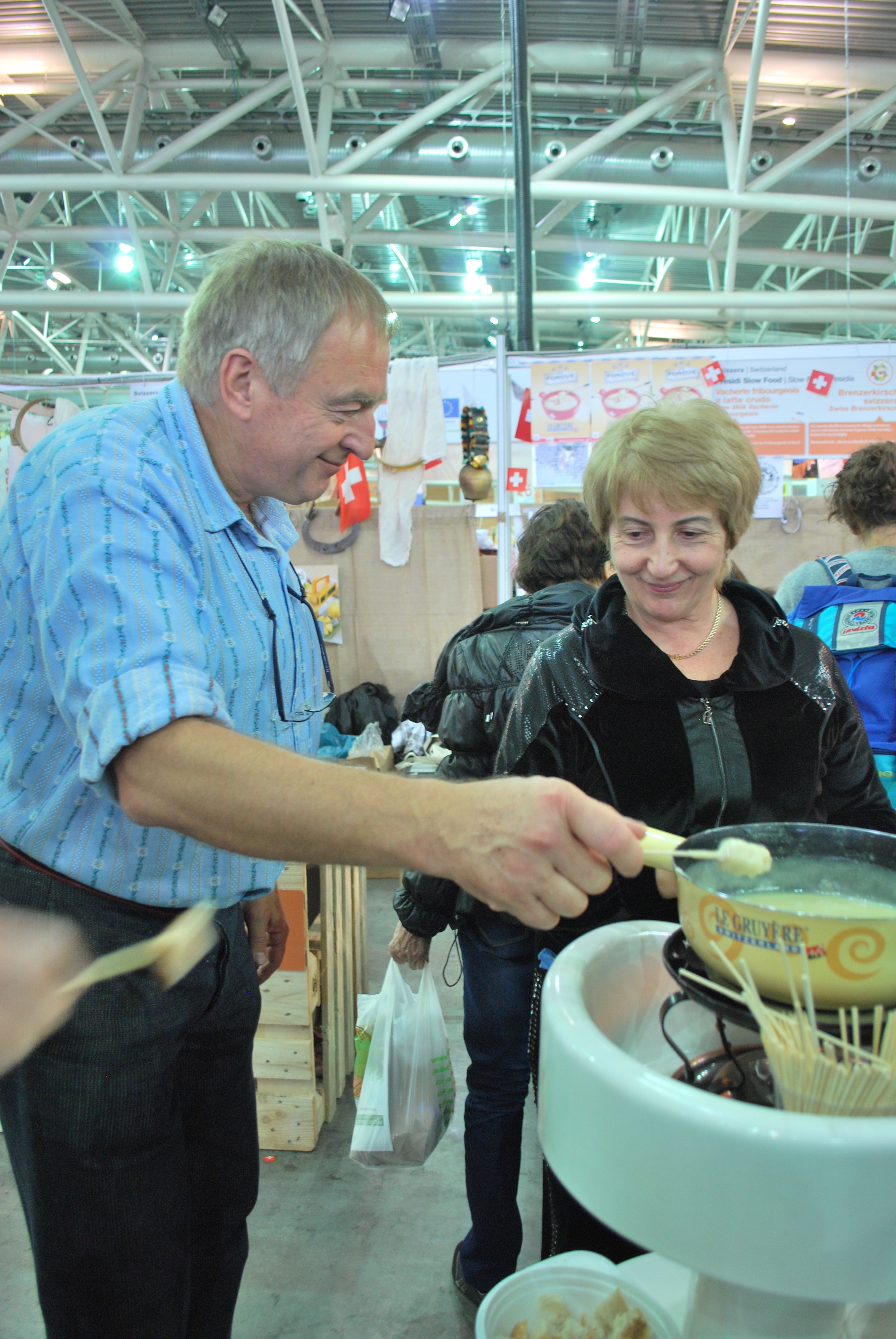
Fribourg-style Swiss fondue is referred to as moitié-moitié. Unlike fondues from other regions, it is made with a hard, cooked cheese native to Fribourg, known as Vacherin Fribourgeois (not to be confused with Vacherin or Mont d’Or). The recipe calls for half Vacherin Fribourgeois and half Swiss Gruyère.

In this photo, Raphael is making fondue using the handmade cheeses he makes himself, at the Slow Food Switzerland stand at the Salone del Gusto in Turin, Italy last week. The visitors ran to his stand every time he put a new pot of fondue out. Obviously, it was very good!


Never miss a post
Name: 
Your email address:*
Please enter all required fields
Correct invalid entries

What we’re reading: food sculptures, hugging carrots, revolting cakes, Salone del Gusto 2012, 100 best American cakes

Published by Thursday, November 1, 2012 Permalink 0

by Jonell Galloway

Click here to keep up with the latest in world food and wine news.


Never miss a post
Name: 
Your email address:*
Please enter all required fields
Correct invalid entries

Slow Food’s Salone Internazionale de Gusto Food Fair

Published by Thursday, October 25, 2012 Permalink 0

The 2012 Salone Internazionale de Gusto food fair started in Torino, Italy, today October 25, 2012, and will continue until Monday, October 29, 2012. Hope to see you there!


Never miss a post
Name: 
Your email address:*
Please enter all required fields
Correct invalid entries

UA-21892701-1