Is haute cuisine still relevant? Yes. What’s happening with it and does it still matter?
In 2009, Michael Steinberger, in his book Au Revoir to All That, declared that the ostensible decline of Michelin-starred restaurants mirrors the decline of France. While it is true that French cuisine, in particular the haute cuisine of the gastronomic palaces, may be threatened by high overheads and a weak economy, it would be wrong and premature to announce its demise. Profit margins are slim in high-end, labor-intensive restaurants, and labor laws are strict. The over-indulgence of the grandes tables of the past with their thousands of bottles of ancient claret in the cellar has been compromised by taxes on stock and thirty-nine hour work weeks that simply don’t work in the restaurant business, even if it’s four hours more than in other sectors.
Despite all that, French cuisine is still alive and kicking, and the number of Michelin star restaurants increases every year: today France has 26 three-star restaurants, four more than in 2000, and 80 two-star restaurants, ten more than in 2000, according to the Financial Times. In 2015, there are 25 per cent more one-star restaurants. These palaces remain quintessentially French in their food, service and organization. Simplified versions of these chefs’ dishes are published in cooking magazines and imitated in millions of homes around France, making it relevant even in middle class households. French families may not eat in such establishments often, but they will save and go to them once a year for a special occasion. This French devotion to their food traditions will ensure its survival.
What many of us think of as “French cuisine” is actually haute cuisine, the cuisine that evolved from the aristocratic cuisine of the royalty. This cuisine was centered mainly in Paris and Versailles. Regional cuisine as we know it today did not even exist at the time, since regions didn’t exist until after the Revolution. Until the Revolution, there were provinces and feudal “kingdoms,” abolished afterward. Cuisine bourgeoise, the cooking of the upper middle classes and later middle classes, developed after the Revolution, and gradually filtered down to the broader population.
Regions didn’t formally exist by name until 1890, so there was little meaning attached to the word “region”. One cooked and ate what was available, what one grew and raised and that varied widely. Even the gruel was made with different grains in different regions. Regions only formed an identity after this. Knowledge of regional cuisines increased as travel became easier and accessible to all, especially after the generalization of cars.
French cuisine has always consisted of two tiers: haute cuisine and regional cuisine. Elements of haute cuisine — the cuisine that we inherited from the courts and later the affluent bourgeoisie, the cuisine that elevated sauce-making to an art form — have over the centuries infiltrated the cuisine of the regions, and regional cuisine is the lifeline and wherein lies the future.
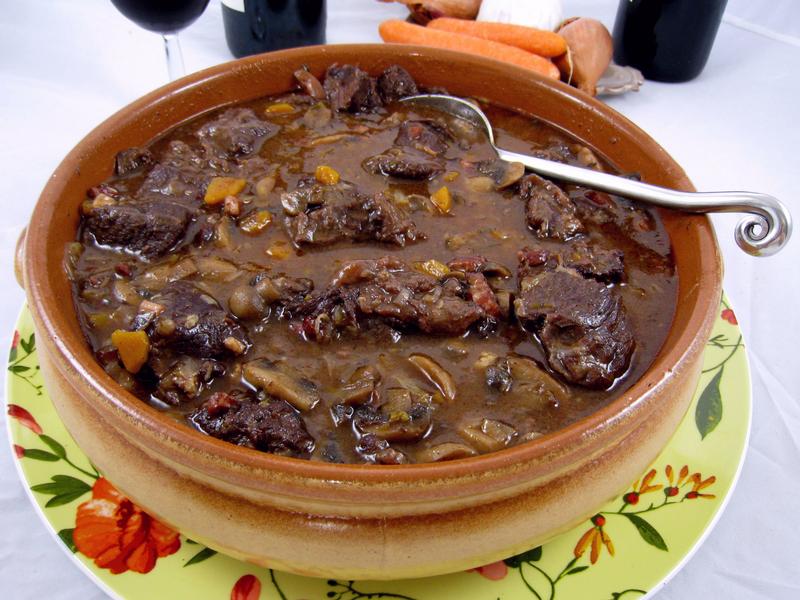
Boeuf à la bourguignonne, also referred to as beef or boeuf bourguignon, is a French classic from the Burgundy wine region of France. It is made with red Burgundy wine, and simmered for hours. It makes up part of what the French refer to as “plats cuisinés“, or slow-cooked dishes.
This recipe is quite easy to make, and should serve about 8 people. Plan to make it well in advance, since it is best when it is left to marinate for 24 hours and cook slowly several hours on the day of serving. It is the perfect dish for dinner parties or potlucks, and is one of the best leftovers around.
Boeuf Bourguignon Recipe
Click here for metric-Imperial-U.S. recipe converter
Sauces were once the domain of French haute cuisine, aristocratic food. This started changing after the Revolution, first in the bourgeoisie, who copied the ways of the former royalty, and eventually in restaurants.
In France, there have always been sauces. Even the Franks and the Gauls moistened their food with a “flavored liquid.”
French cuisine, influenced by Roman cuisine, saw the first sauce recipes using meat jus in the fifth and sixth centuries, and were then called saulce. To the jus was added vinegar, wine, acidic fruits and spices. The Romans had already used ginger and cloves, but in the eleventh century, the Crusaders brought back others from the Levant, including cinnamon, the most commonly used, galangal (or ginger), coriander seeds, cumin, nutmeg, cardamom, saffron, grains of paradise and pepper. The acidic quality was often given to sauces through the addition of verjus, made from green grapes, which are not yet sweet in flavor and remain acidic, or with other acidic fruit such as apple, lemon or plums. Verjus is still used in French sauces.
Guillaume Tirel, known as Taillevent (after whom a Paris palace of gastronomy is named), wrote the first known cookbook, Le Viandier, around 1375. Stews and other slow-cooked dishes didn’t yet exist; most meat was boiled or cooked over a spit, i.e. quite plain, so sauces were a way to liven them up. About thirty sauces have been recorded during the medieval period. They of course featured in the cuisine of the well-to-do; most common people were still eating gruel, as they always had.
During the Renaissance, spices dropped out of French cuisine. It was the halcyon days for sauces, which proliferated. Slow-cooked sauces were invented using fonds, mirepoix, butter and flour for thickening. Simple jus and coulis became common. Recipes for green sauces from Italy using new ingredients and herbs were also popular and easy to make since herbs were plentiful and grew wild in even the coldest parts of France.
It was La Varenne in the seveneenth century who started precisely defining sauces and how they’re made and documented roux, which then consisted of a paste of flour and lard for thickening:
Thickening of flowre
Melt some lard, take out the mammocks; put your flowre into your melted lard, seeth it well, but have a care it stick not to the pan, mix some onion with it proportionably. When it is enough, put all with good broth, mushrums and a drop of vinegar. Then after it hath boiled with its seasoning, pass all through the strainer and put it in a pot. When you will use it, you shall set it upon warm embers for to thicken or allay your sauces.—The French Cook, Francois Pierre La Varenne
To the “low-fat” sauces of the Middle Ages were added bread, eggs and cream, making them much heavier, and herbs replaced spices from the Orient. Roux was the thickener of choice. Beurre blanc and hollandaise sauce accompanied pike, a popular dish.
In the eighteenth century, Carême perfected the art of sauce making and was the first to classify the mother sauces: béchamel, espagnole, velouté, and allemande. Auguste Escoffier later refined this list to the contemporary five mother sauces by dropping allemande as a daughter sauce of velouté, adding hollandaise and sauce tomate, in his classic Le Guide Culinaire, published in 1903.
Today, French people of all social and economic classes eat sauce. It is not restricted to the wealthy or the aristocrats. Just about anyone can whip up mayonnaise without a recipe.
—————————-
Jonell Galloway grew up on Wendell Berry and food straight from a backyard Kentucky garden. She is a freelance writer. She attended Le Cordon Bleu and La Varenne cooking schools in Paris and the Académie du Vin, worked for the GaultMillau restaurant guide and CityGuides in France and Paris and for Gannett Company in the U.S., and collaborated on Le tour du monde en 80 pains / Around the World with 80 Breads with Jean-Philippe de Tonnac in France; André Raboud, Sculptures 2002-2009 in Switzerland; Ma Cuisine Méditerranéenne with Christophe Certain in France, At the Table: Food and Family around the World with Ken Albala, and a biography of French chef Pierre Gagnaire. She ran a cooking school in France, and owned a farm-to-table restaurant, The Three Sisters’ Café, with her two sisters in the U.S. She organizes the Taste Unlocked bespoke food and wine tasting awareness workshops with James Flewellen, is an active member of Slow Food, and runs the food writing website The Rambling Epicure. Her work has been published in numerous international publications and she has been interviewed on international public radio in France, Switzerland, and the U.S. She has just signed on at In Search of Taste, a British print publication, and is now working on two books, The French and What They Eat and What to Eat in Venice.
We sponsored a Twitter chat “Is French Cuisine Dead?” a couple of months ago. You can view the discussions here or by searching the hashtag #FutureFrenchCuisine.
Haute cuisine may well be unaffordable for ordinary people — it always has been — but regional cuisine is what the people eat and remains affordable. It is eaten in local bistros, which are reasonably priced and nowhere near disappearing; it is eaten in homes. French regional cuisine is a reflection of the soil, people and language, a reflection of the seasons and family; it is what memories are made of. It is the product of a place and of a people and the French people are very much alive.
Please choose a color:
NEWSLETTER
Meet Jonell Galloway, a freelance writer and editor specialized in French cuisine.