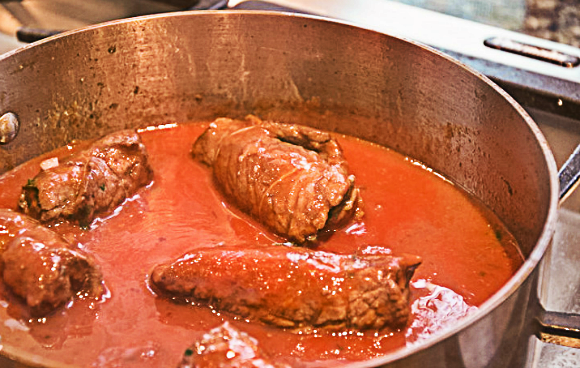
Whether it’s Ragù Napolitano “Classico” or “Leggere,” this richly flavored sauce is a perfect example of traditional, long, slow-cooked (slow, very slow) food, the sort of memory-filled dish that makes all Neapolitans, rich or poor, remember their childhood and nonnas or grandmothers with even just one bite; or even with just one sniff of the bubbling sauce.
Because it needs to be looked after, slowly cooked and attention paid that it doesn’t burn or scorch, it was given the name sugo della guardaporta, the doorkeeper’s sauce, as it needed someone to watch over it as it slowly, slowly, slowly bubbled its way to perfection.
Though now it has come to symbolize family food, it was no doubt created in the 19th-century kitchens by the chefs of aristocratic Naples — its abundance of meat and attention-demanding cooking method would have been beyond the means of the city’s poorer inhabitants, which meant most of the population. Its name came from the French ragout, or saucey stew. The Neapolitan ragù is exactly that: a large piece of meat simmered in either tomatoey or oniony (La Genovese) sauce unlike the ragù of other
regions, which include small pieces of chopped meats and vegetables.
This guide is the testament of a woman who based her cooking life on the truth of every dish she cooked and taught, the vigorous truth of clear, uncluttered taste, taste that arises neither from obeisance to dogma, nor from a craving for attention, but evolves inspired by, and respectful of, the ingredients that nourish it.–Victor Hazan in the introduction to Ingredienti
Marcella Hazan, the “godmother of Italian cooking” and the woman many credit with bringing Italian cuisine to the U.S., died in 2013, leaving behind two years’ worth of handwritten notes in Italian in preparation for Ingredienti. Her lifetime collaborator, Victor Hazan, translated and edited these notes, resulting in what is undoubtedly a classic before its time.
With Marcella Hazan’s cookbooks in my suitcase, I was already “tasting Italy” on my way back from London to my home in France. I had a plan: to use her books to learn how to cook Italian food.
That was nearly twenty years ago. It didn’t take me long to realize that the precious ingredients required were simply not available in provincial France. French supermarkets sold pasta made in France with French flour, not Italian pasta made from grano duro. Frenchtomatoes were watery-tasting, even the canned ones. Mozzarella and Parmigiano-Reggiano were rarities found only in a few exclusive shops in Paris. The French were just starting to get interested in olive oil, although in the Southeast it had long been the fat of choice thanks to its Greek and Roman history.
Disappointment quickly set in. Marcella’s Italian recipes weren’t going to taste of Italy using French ingredients. It is no wonder that she wanted to write Ingredienti. She knew this was a problem when living outside Italy and felt the need to enlighten her readers about how to choose and treat ingredients.
It was only later when I moved to Switzerland, where good-quality Italian ingredients of all kinds — tomatoes, pasta, cheese, fruit — were readily available that I returned to Marcella. From Geneva, it was also easy to travel to Turin to the Slow Food gatherings. During the Terra Madre conference, I’d arrive every morning with a roller suitcase and, over the course of the day, fill it with food to take back to Switzerland.
Later, in my Italian food journey — even when living in Italy — Marcella, and later Victor, became for me household words, their books like a treatise, a bible, that I refer to in times of doubt, for example, when I make “red” spaghettini alle vongole, which I must have made a hundred times using Marcella’s recipe.
As important as this book is, Marcella Hazan’s recipes are not only about ingredients. The true secret to her success is the lucid precision of the explanations. A scientist by training with two doctorates, her instructions are methodical, almost mathematical. She counts in minutes and half minutes, and you can count on what she says. Though her cookbooks were not written as culinary classes per se, once you’ve followed her risotto instructions a couple of times, you are struck by the rigorousness of the recipe, of how each step is in its proper place, and each time given is exact, and it becomes like a work of art or a perfect mathematical equation, with no excess and no frill.
Ingredienti is indeed a testament to Marcella Hazan’s undying commitment not only to Italian cooking, but also to the importance of choosing products and the actual process of shopping, on which we put too little emphasis. Marcella had an intimate relationship with products, knowing them inside and out as if they were the baby she’d raised. “Choose a pepper by its size, shape, and heft. It should be large, heavy, shiny, firm, and cubical in form. The long tapered ones are not as solidly meaty.” Now you have a clear image in your mind of what to look for next time you buy a pepper. The entire book is like this, leaving you with the impression that you’d been going to a market class with Marcella for a week and held the artichokes or peppers or onions in your hands.
Speaking of extra-virgin olive oil, she says, “if olive oil were a drug, it would have a place of honour among miracle drugs,” saying that “it well might be the most significant contribution to my survival.” Although she embraces the use of lard and butter, used in her native Emilia-Romagna, olive oil was the superstar in her kitchen.
On the important subject of pasta: one can’t say fresh pasta is always better than dried pasta. Fresh pasta, made with eggs and flour, longs for butter and cream, which seep into the crevices of its rough surface; dried pasta, made with water and flour, is a perfect marriage for olive-oil and tomato-based sauces, which slide gracefully around it. You’ll never look at pasta the same way once you’ve “consumed” this chapter; in fact, you’ll want to read it over and over, making sure not to miss a single point.
She tells you everything you need to know about Parmigiano-Reggiano, not to be confused with generic parmesan cheese. Its goodness depends on the origin of the milk, the breed of cow, the age, the season, and, of course, the method used to make it. Though this is not a recipe book, Marcella throws in the prize of Victor’s grandmother’s recipe for Parmigiano crostini, not to be missed.
The book is broken down by category of ingredient, including “Produce,” “The Essential Pantry,” and “Salumi,” with individual chapters devoted to classic Italian ingredients such as artichoke, eggplant, and tomatoes; pasta, risotto rice, olive oil, Parmigiano-Reggiano, and red wine vinegar; prosciutto, pancetta, and lardo, and a whole host of other products.
For those who live in locations in the U.S. where Italian ingredients are not available in the same way, just as I did in France, the book includes a fairly exhaustive list of online suppliers of good-quality ingredients with precise indications of what to order from whom.
Count on reading the book from front to cover in one or two sittings, and then keeping it on your kitchen shelf for easy, repeated reference, as you might do with a prayer book. As with all of Marcella and Victor Hazan’s collaborations, there is never an extraneous word, sentence, or idea, so you’ll want to read the important passages numerous times.
Like a yogi, Marcella repeated the same “postures” over and over, meditating upon the ingredients, seeking the truth in them with a focused faith and methodical effort. As a result, Ingredienti reads much like a text written by a spiritual master in old age. It is concrete proof of her dedication; it is the wisdom of years lived in perfect harmony with food, based on her immeasurable knowledge and intimate relationship with ingredients, but also on an almost spiritual reverence for their integrity. It is, indeed, a testament of Marcella and the truth she sought by going to the essence of every foodstuff she touched, and of the truth she attained in her reasoned, scientific manner.
I’ve spent the last week with a wonderful group of journalists and chefs in Bellaria Igea Marina on the Adriatic Coast of Italy on a press trip called #LovingRomagna, learning the cuisine of Romagna with Nonna Violante at the Hotel Eliseo. I’ll be posting soon about the incredible hospitality, wonderful food, and history of this region.
In the meantime, James Flewellen and I are busy preparing our Taste Unlocked food and wine tasting workshop, which starts on Thursday. Bon appétit et bonne semaine!
“Biscotti” (pronounced “bee-scoat-tee”) are relatively new to me. Actually, a few years ago (about 6 years ago) I had no clue what they were. That is quite understandable if you consider the fact that I’ve lived all my life in Switzerland and never travelled to Italy (I passed through that country when going to Greece, but I doubt that this can qualify for holidays) nor to America where this speciality is widespread…
I was introduced to these Italian cookies when I received James McNair and Andrew Moore’s “Afternoon Delights” for my birthday in 2003. It was love at first sight. The very second I lay my eyes on the picture that illustrated their “Almond Biscotti” recipe I knew that I had to bake them immediately in order to satisfy my curiosity. Since then I have not seized being a big fan of this crispy treat.
Before I moved away from home and started cooking for myself, I had never really tasted any Italian pastry apart from “Amaretti Macaroons” and knew absolutely nothing about “Biscotti”. Here in Switzerland, the only biscuits that can be compared to them are oven-dried brioche slices called “Zwiebacks”. Although they taste more like sweet bread than cookies and are far from being as sweet or having an identical shape, I always enjoyed eating those delicious rusks.
We’d like to welcome Italian food photographer Guila Scarpaleggia, who runs the website Juls’ Kitchen, to The Rambling Epicure.
Guila Scarpaleggia’s Bio
My name is Giulia Scarpaleggia, I am an optimist, a dreamer, a 28 29 30 31 year old full-time herbs blogger. I am the one who appears in the reflections of the spoons in this blog’s photos and – I have to admit it – I am also responsible for the missing slices in each cake.
I live in Tuscany, in the countryside between Siena and Florence, I dream of a blooming vegetable garden, though I am content with a brick wall crammed with pots of fresh herbs and a February 2009 plant that suffers from the heat.
Trieste holds a unique place in European history and culture. Next to the Balkans (5 km from Slovenia and 10 km from Croatia), a port built by the Austro-Hungarian Empire on an ancient Roman site, for a short time an independent principality, now part of Italy: the influences are many. It has a mini-culture all its own, with influences from all these countries and periods. You’ll see it in the architecture, churches, food, and, we heard it in the language and names of dishes and foods. The author James Joyce lived in Trieste for 15 years, partially to get away from the “crowd” and get some writing done, and partially to be near his writer friend, the Italian author, Triestine Italo Svevo, whose statue you will see in this photo documentary, and who some say served as a model for Joyce’s character Leopold Bloom in Ulysses.
You can either watch this as a slideshow, or if you want to see the full shot, just click on the photo.
I don’t know if you have the same uncomfortable feeling as I, but I have the impression this year is flying by, and that we are more than ever racing against time, without being able to get a grip on the present moment or connect with the now. It is insane and quite confusing…
As incredible and shocking as it might seem, September has already arrived and so has autumn (and by the way, just in case you have already got the creeps, we are dangerously approaching Christmas – only 3 1/2 months to go before the ludicrous craze!). Even if you try “lying” to yourself, you cannot do anything other than confirm that the hot season is over and the slow decline of nature is taking its toll. As sad as it might sound, we have no other choice than to bid goodbye to the joys of summer and to the delightful sensation of lightness as well as worry-free days, it is a harbinger for the cold, dark, gloomy days that gently weasel their way into our lives. All those changes are real, visible and can be perceived very clearly.