Daily Food Quotes: Farm Philosophy from Wendell Berry

Published by Sunday, March 24, 2013 Permalink 0

by Jonell Galloway

For 50 or 60 years, we have let ourselves believe that as long as we have money we will have food. This is a mistake. If we continue our offenses against the land and the labor by which we are fed, the food supply will decline, and we will have a problem far more complex than the failure of our paper economy. The government will bring forth no food by providing hundreds of billions of dollars to the agribusiness corporations.

Wendell Berry, “in the op-ed piece he published with his old friend and collaborator Wes Jackson, shortly after the economy crashed in the fall of 2008.” (Michael Pollan, in introduction to Wendell Berry’s Bringing it to the Table: On Farming and Food).


Wendell Berry speaking in Frankfort, Indiana

Wendell Berry speaking in Frankfort, Indiana

Never miss a post
Name:

Your email address:*

Please enter all required fields
Correct invalid entries

Related articles

Never miss a post
Name: 
Your email address:*
Please enter all required fields
Correct invalid entries

The Big Apple on a Budget: Mas (la grillade), a Restaurant Review

Published by Monday, March 18, 2013 Permalink 0

by Leonor White

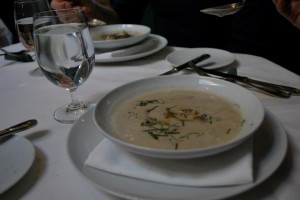
I recently discovered a farm-to-table restaurant in the West Village. I was looking for an upscale lunch at an affordable price to dine with my family. Mas (la grillade) is the sister restaurant to Mas (farmhouse), but, as the name indicates, focuses on grilled meats.

During lunch hours, a seasonal menu of locally grown foods cooked solely over wood fires of oak, apple and other hardwoods is served. This menu is comprised of three courses: appetizer, main course and desert, and it all comes at a very reasonable price, $27.  Lunch à la carte is also available, but I would recommend opting for the menu, as you get a chance to experience Chef Galen Zamarra’s seasonal favorites. The restaurant is also open for dinner, and just as for lunch, there is a prix fixe menu (but for a higher price, $68), as well as an à la carte dining.

We went for lunch on a Saturday, and it did not disappoint. The restaurant is simply but tastefully decorated, making a bold statement with regards to its farm-to-table concept. As the menus arrived, we all had our eyes fixed on the first item in the menu: “Grilled Pear and Sunchoke Soup with Mint, Black Truffle and Hen of the Woods Mushrooms.” Despite the fact that there were other appetizers to choose from, such as the “Grilled Trumpet Royale Mushrooms with a Salad of Mizuna, Grilled Onion Vinaigrette, and Croutons,” we all thought that the soup sounded divine, and it was indeed. The grilled pear and sunchoke flavors made for a distinctive taste; the soup was sprinkled with mint and black truffles and topped with mushroom croutons.

Continue Reading…

Never miss a post
Name: 
Your email address:*
Please enter all required fields
Correct invalid entries

Wendell Berry Interview, by Mark Bittman

Published by Friday, March 15, 2013 Permalink 0

by Jonell Galloway

There’s probably no better short overview of Wendell Berry‘s views on agriculture and sustainability than Mark Bittman‘s interview of Berry in The New York Times in 2012.

Wendell Berry speaking in Frankfort, Indiana

Wendell Berry speaking in Frankfort, Indiana


Here are a few excerpts about agriculture and sustainability:

“That’s one of Wendell’s recurring themes: Listen to the land.”

“If you imitate nature, you’ll use the land wisely.”

“The two great aims of industrialism — replacement of people by technology and concentration of wealth into the hands of a small plutocracy — seem close to fulfillment.”

Mark Bittman

Mark Bittman (Photo credit: rebuildingdemocracy)


“You can describe the predicament that we’re in as an emergency, and your trial is to learn to be patient in an emergency.”

“[N]o great feat is going to happen to change all this; you’re going to have to humble yourself to be willing to do it one little bit at a time. You can’t make people do this. What you have to do is notice that they’re already doing it.”

“I’ve been thinking about that question about what city people can do. The main thing is to realize that country people can’t invent a better agriculture by ourselves. Industrial agriculture wasn’t invented by us, and we can’t uninvent it. We’ll need some help with that.”

Read The New York Times entire article here.


Never miss a post
Name: 
Your email address:*
Please enter all required fields
Correct invalid entries

Simple Sustenance: Flavors of the Mediterranean — Parsley, Dill, and Bean Dip with Feta

Published by Wednesday, March 13, 2013 Permalink 0


//


by Renu Chhabra

“Salt is born of the purest of parents: the sun and the sea.”Pythagoras

IMG_6898

Pass the salt please.

We hear this often while eating meals. I sometimes think what life in the kitchen would be without salt. Nature’s pure offering and staple of any pantry!  It’s one ingredient that can put life in any recipe. Just a pinch of it does wonders. But it’s the right amount of it, according to one’s taste buds that makes a recipe sing….. not too much or too little. Hence the term, “salt to taste.”

Some overly salty feta cheese was the center to make this dip. It was too salty for our taste buds. Really salty. And wasting it seemed unnecessary. To give it a new life, I combined it with a few ingredients on hand. A can of unsalted garbanzo beans worked well to mellow the saltiness of the feta. Parsley added color and freshness, and dill enhanced it with its delicate flavor. Lemon juice and garlic brought all the flavors together.  I finished it with olive oil and a sprinkle of sumac.

Continue Reading…

Never miss a post
Name: 
Your email address:*
Please enter all required fields
Correct invalid entries

Local vs. Non-local Food: The Arguments

Published by Saturday, January 12, 2013 Permalink 0

by Jonell Galloway

I think we got spoiled by eating cheap food from all over the world. That put us out of sync with nature and skewed the price of local produce and products vs. produce and products from distant places, leading us to waste what we once had held precious because it was seasonal and local and therefore rare. Slow Food USA and Josh Viertel were right in fighting for fair wages for our own farmers and trying to lead us back to a way of eating that is in line with nature, which of course means paying a little more, but improving our health and local economy.


There are many more arguments to be put forth. Let’s talk about it: the pros and cons, your experiences, your convictions, etc. We’d love to get a big discussion going here.

Click here to watch Building a Slow Food Nation, outlining the history of Slow Food in the U.S., and including Josh Viertel’s view.


Never miss a post
Name: 
Your email address:*
Please enter all required fields
Correct invalid entries

What we’re reading: Persian chicken stew, Yam’Tcha Chinese fusion in Paris, anti-inflammatory recipes, Slow Down Diet

Published by Tuesday, November 27, 2012 Permalink 0

by Jonell Galloway

Click here to keep up with the latest in world food and wine news.


Never miss a post
Name: 
Your email address:*
Please enter all required fields
Correct invalid entries

Salone del Gusto versus Good, Clean, and Fair: Part 2

Published by Monday, November 26, 2012 Permalink 0

by Diana Zahuranec

In Salone del Gusto versus Good, Clean, and Fair: Part 1, I’ve already mentioned some healthy skepticism about the presence of two big Italian names at Salone del Gusto: Lavazza Italian coffee, and the supermarket Coop.

Lavazza takes on the responsibility of Fair Trade coffee, but wearing a label doesn’t necessarily prove honest actions behind it. There are loopholes to be jumped in any policy. Without venturing beyond the comfort of online research to the plantations in South America, however, I couldn’t say with utter certainty how good, clean, and fair they are. My main conclusions? Don’t check off the Good Deed Done for the Day box just by buying Fair Trade, without knowing all the facts behind it.

It just doesn’t look Slow Food-y

As for Coop, I was very surprised to see this popular Italian supermarket in a haven of small-time producers at the Salone. Coop is no WalMart nor, on this side of the Atlantic, EuroSpin; shopping in my local Coop store, I’ve noticed very high quality, Alpine mountain cheeses, for example, alongside the added-preservatives-colors-skim-milk-binder, generic salumi; and I suppose I notice more organic produce overall. As far as the realm of supermarkets is concerned, my limited observations earn Coop a dull gold star. But a place at Salone del Gusto? Hardly, I thought.

Asking fellow Slow Food members what they thought, a Swiss friend informed me that it was in large part thanks to Coop, a charter member of Slow Food, that Slow Food Switzerland was initiated and is running strong today. Polish that gold star!

In fact, Slow Food and Coop have a partnership, with Coop supporting and promoting Slow Food values through selling local products as well as over 100 Presidia products (a Presidia labeled food being the equivalent of a protected or endangered animal in the food world).

Coop’s powerful, positive presence in the world of local producers and Presidia was brought home when I sat in for a tasting of some products during Salone del Gusto. Not that I wanted to taste anything. By the end of one of Salone’s last days, I had done as much tasting as my belly and buds could bear. But my legs were tired, and Coop had set up a booth lined with dangling Prosciutto legs, plastic chairs in rows, and a tasting of jam and juice. I didn’t resist.

The tasting was introduced by a Coop Quality Control employee and a representative of a Bosnian company based in Bratunac called Frutti di Pace, or “Peace Fruits.” Together, they told a story of how the Coop employee traveled to Bosnia for this product, met with the Bosnian woman, and formed an instant friendship that was strengthened, as in all cultures, over an abundant welcoming meal.

The employee found that the hardworking spirit and community of the women of Frutti di Pace were as charming as the incredible, all-natural flavors of their products were delicious.

Frutti di Pace was established after the Bosnia and Herzegovina War in 1992-1995. The members of this cooperative, mostly widowed women or women with husbands injured from the war, wanted to spur growth: of the local economy, of a long-held tradition ground to a halt from the war (raspberry production), and of a sense of community and confidence.

The first product we tasted was a thick raspberry juice. No colors, sugars, or conservatives were added – just water and red raspberry. It was exactly like plucking a handful of raspberries from a bush, squishing them all into your mouth, and squeezing out the juices with your tongue. The jams were next, and equally impressive in their bright, strong raspberry flavors. It lacked seeds, but that’s a personal preference of mine for raspberry jams.

Frutti di Pace spent ten years trying to get into the European market. The speaker was overwhelmed almost to tears when she recalled how happy they had been when Coop began selling their products. “’To hope’ is still difficult after everything we’ve been through,” she said.

My knee-jerk reaction to “supermarket” is “too much fluorescent light!” and then, “against all things Slow Food.” But this is not true (well, the second one). Today’s food market is pulled in two directions: one towards a global system made of imports, exports, and oil, the other towards local, small production, trends, and being organic. It’s important to consider the possibility that, between these two polar opposites, not everything is black and white. The grey areas will be necessary to marry two things that won’t go away for better or for worse: supermarkets in many parts of the world, and the importance of strong, local economies and good, clean, and fair food in all parts of the world.

Selling local food (or organic, or from a small producer, etc.) through a medium that everyone uses and will continue to use as long as it exists is ethically responsible and also quite genius.

The question remains: Does Coop Italia earn the good, clean, and fair award? It is still a supermarket that sells items ranging from low to high quality, from all parts of the world, and at prices too low to actually be profitable for the producer. But the answer is nevertheless yes – just, in a rather grey way.

Never miss a post
Name: 
Your email address:*
Please enter all required fields
Correct invalid entries

Our Word of Thanksgiving: Thanks to our readers for their loyalty

Published by Thursday, November 22, 2012 Permalink 0

We would above all like to thank our readers for supporting us in our efforts to build a site that joins the voices of people from around the planet who care about cooking, farming, health and everything related in a responsible, ethical manner. We think of our readers as part of our community, a sort of family that cares about the way food is grown, cooked, eaten; the mark it leaves on the planet; the health of our children.

So to all our readers (and contributors) around the globe:

Jonell Galloway, Editor


Never miss a post
Name: 
Your email address:*
Please enter all required fields
Correct invalid entries

Thanksgiving Turkey News: Tips on Choosing, Buying and Cooking

Published by Tuesday, November 20, 2012 Permalink 0

by Jonell Galloway

How to Choose, Buy and Bake a Turkey in the U.S. and Europe

The USDA gives useful facts about about turkey hygiene and cooking, all based on the assumption that you’re cooking frozen turkey. If you live in the U.S., you’ll most likely be cooking a frozen turkey, so this information is spot-on.

Julia Child’s The Way to Cook still rates top on my list for detailed, illustrated explanations of how to prepare and cook a turkey and lots of other tips.

If you live in Western Europe, there are plenty of free-range, grain-fed turkeys. I order mine months ahead from a farmer near me, since in Europe they only eat turkey at Christmas and they won’t be fattened otherwise.

In Paris, in the 7th and 16th arrondissements in particular, many butchers have fattened turkeys for Thanksgiving, and they are often free range and natural. One of the most prized origins in France is dinde de Bresse, which of course comes from Bresse and is free range. In Geneva, you can buy these, stuffed or unstuffed, at La Boucherie Molard across from the Globus during the Thanksgiving period.

If you live in other cities in Western Europe, you may not have a lot of choice. I’ve had a number of bad experiences ordering turkeys through the butchers in the provinces. They are never sure whether they’ll actually receive a fattened turkey or a scrawny thing which was intended to be fat for Christmas. If you live in the country, however, try and find a turkey farmer near you. They will invariably be cheaper and often better.

Free-range, organic turkeys will never weigh as much as the supermarket variety, but the ratio of meat to bone is greater. It’s amazing how much meat there is on a 9 or 10 lb. turkey.

I have never tasted Mary’s Turkey in California, but they sound appetizing. Mary certainly takes her poultry seriously. They are free-range, vegetarian-fed, gluten-free, and free of all antibiotics, preservatives and hormones. They are also USDA-certified organic. You can order them online, or find a store near you that sells them.

Click here to watch an entertaining but helpful video about the dangers of frying turkeys.

Chowhound has a great discussion board about whether free-range, heritage turkeys are worth the price. I would always vote for free-range and natural. They have more meat and less bone, probably due to the fact that they’ve not been gorged with antibiotics, steroids and we probably don’t want to know what else. In addition, they don’t taste like meal.

The wild turkey population is growing in much of the U.S., so I’m sure many are tempted to shoot a big one for Thanksgiving. That’s all fine, but keep in mind: cooking a wild turkey is an entirely different bag of worms. If they are large, they risk tasting gamy. Here is some good common-sense advice for preparing and cooking them.

Truth About Turkey” gives an excellent layman’s explanation about how the various kinds of turkey in the U.S. are raised.

Have a Slow Food Thanksgiving” gives a list and directories of where to buy heritage, organic and free-range turkeys in the U.S.

Whenever possible, buy directly from a local farmer. When buying fresh turkey, always ask about the “use by” date. It will depend on packaging as well as when the turkey has been slaughtered. If bought fresh and unpackaged, The New York Times and Seattle Times suggest you can keep it one or two days maximum in the refrigerator, so plan your pick-up time carefully.


Related articles
Never miss a post
Name: 
Your email address:*
Please enter all required fields
Correct invalid entries

What we’re reading: how food replaced art, history of coffee, heirloom apples and pie, 5 misconceptions about Port wine

Published by Friday, November 16, 2012 Permalink 0

by Jonell Galloway

Click here to keep up with the latest in world food and wine news.

Photo by Jonell Galloway ALL RIGHTS RESERVED (C)


Never miss a post
Name: 
Your email address:*
Please enter all required fields
Correct invalid entries

UA-21892701-1