Thanksgiving and Christmas Recipes: Cranberry-orange Relish

Published by Sunday, November 18, 2012 Permalink 0

Spontaneous Cuisine, by

From the archives

A healthier, tastier recipe than the traditional cranberry sauce

Cranberry sauce is of course a mainstay of any Thanksgiving dinner. In Switzerland, we eat a lot of game, so it is good to always have some on hand to eat with deer, wild fowl, boar, or whatever the hunters bring in.

This is a variation of the very plain, classic recipe. I’ve been using it for years. It’s easy, quick and a no-brainer. You can make it ahead of time (in fact, it’s better to make it a day or two before Thanksgiving). In addition, it keeps for ages, just like jelly or jam.

Recipe

Cranberry-Orange Relish

Click here for Imperial-metric converter

12 oz/375 g fresh cranberries
1/2 cup light brown sugar (if you like it really sweet, you can double the quantity)
1 tablespoon water
1 large navel orange
1 small sliver of ginger, finely grated (optional), or 1 stick of cinnamon (optional)
1/2 cup shelled walnuts (optional)
  1. Place cranberries in a large saucepan with sugar and water.
  2. Juice the orange and remove any white pith that lingers. Cut peel into small juliennes or zests, carefully removing any pith that is sticking to them. Add zests and juice to cranberry mixture.
  3. Add ginger (optional) or cinnamon stick (optional).
  4. Bring to a boil, then turn down heat, cover and cook until all the berries have popped open. This can take 20 to 30 minutes. Just be patient and keep an eye on them. If liquid evaporates before all the berries burst, add a just enough water to prevent them from sticking. Remove from heat.
  5. Taste and adjust sweetness if necessary.
  6. Pour into bowl you plan to serve it in and let it set. This can take a couple of hours, so it is advisable to make it well ahead of time, even 2 or 3 days. It keeps well in the refrigerator.
  7. When ready to serve, shell and chop walnuts. Add at last minute, right before serving (otherwise, they tend to get soggy).

This recipe was originally published on GenevaLunch.

Never miss a post
Name: 
Your email address:*
Please enter all required fields
Correct invalid entries

What we’re reading: how food replaced art, history of coffee, heirloom apples and pie, 5 misconceptions about Port wine

Published by Friday, November 16, 2012 Permalink 0

by Jonell Galloway

Click here to keep up with the latest in world food and wine news.

Photo by Jonell Galloway ALL RIGHTS RESERVED (C)


Never miss a post
Name: 
Your email address:*
Please enter all required fields
Correct invalid entries

Simon Says: Daily Food Quote, November 16, 2012

Published by Friday, November 16, 2012 Permalink 0

by Simón de Swaan

The king and high priest of all the festivals was the autumn Thanksgiving. When the apples were all gathered and the cider was all made, and the yellow pumpkins were rolled in from many a hill in billows of gold, and the corn was husked, and the labors of the season were done, and the warm, late days of Indian Summer came in, dreamy, and calm, and still, with just enough frost to crisp the ground of a morning, but with warm traces of benignant, sunny hours at noon, there came over the community a sort of genial repose of spirit — a sense of something accomplished.–Harriet Beecher Stowe

Harriet Beecher Stowe was an American abolitionist and author. Her novel Uncle Tom’s Cabin was a depiction of life for African-Americans under slavery. It reached millions as a novel and play, and became influential in the United States and United Kingdom. It energized anti-slavery forces in the American North, while provoking widespread anger in the South.


Never miss a post
Name: 
Your email address:*
Please enter all required fields
Correct invalid entries

Sicilian Orange and Fennel Salad

Published by Thursday, November 15, 2012 Permalink 0


//

Sicilian Orange and Fennel Salad Recipe

by Diana Zahuranec

As fall slips into winter, the open air markets in Turin, Italy push nature’s seasonal fruits and vegetables to make early appearances in the crates and boxes stacked inside each bancarella, or stand. Oranges, grapefruits, and clementines from Calabria and Sicily showed their waxy globes in the middle of October; bitter turnip tops called cime di rapa were available by the end of September; spiky artichokes, still not technically in season, have been around for weeks.

The sweet, crispy finocchio, or fennel, one of my newly-discovered favorites, entered the scene two weeks ago at the beginning of November. Last year’s discovery that I’ve waited impatiently for since the end of September is the sweet, soft kaki vaniglia, the persimmon, which has a designated corner in my refrigerator. These bombs of juicy, fruity sugar are an after dinner treat that could almost replace autumn pies. Almost.

According to the illustrated and finely detailed wheel of seasonal fruits and vegetables that I bought at Eataly, citrus fruits have just begun their yearly cycle in November. I pat myself on the back, since I resisted buying these until a few days ago. There was one mysterious exception in the form of yellow-green skinned citrus fruits, easy to peel and sour-sweet inside. They came from Calabria, and the hulking, big man that sold them ensured me they were sweet and ripe, never mind their greenness. The man who sold them seemed to have been plucked from another time and place, where people can and still do pick oranges in the fields all day for decent wages, the weakening winter sun warm on their backs. His nails were dirty and his accent thick (presumably Calabrian).

Once at a food photographer’s studio in Emilia-Romagna, the chefs and food stylists there prepared a tangy, salty, sweet salad from the South. It had been inspired by the chef’s Sicilian roots. It’s now one of my favorite meals, and I have to wait for these seasonal fruits and vegetables before I can enjoy it. It evokes flavors from a land where the sun shines across fields with rows and rows of citrus trees, bright orbs decorating the branches in a warm Christmastime.

The traditional olives to pair with this are black ones, but I had green, which I might actually prefer. Being the salt queen that I am, a shot of capers hits the spot, but I don’t know how “traditional” that is. Also, blood oranges knock the pretty factor up a notch for this already aesthetically-pleasing plate.

Recipe

Sicilian Orange and Fennel Salad

For 2-4 people (depending on if using as a light lunch or as a side dish)


Ingredients

1 large fennel
1 medium orange
¼ red onion, sliced finely (or less)
¼ cup black or green olives, pitted and sliced thinly
Salt and pepper to taste
Extra virgin olive oil
Optional: 1-2 Tbsp capers, hot pepper
  1. Slice the fennel in half, and then core each half by cutting out the tough triangular sections at the bottom.
  2. Trim the ends, reserving green fennel leaves for garnish. Trim any bruised parts. Slice finely and set aside. Note: I also slice the very end green stems, because they’re strong in flavor and very crunchy. They may be too astringent for some tastes.
  3. Peel the orange. Setting it on its side, slice it very thinly so that each piece is divided into segments. Keep them as full round slices, or break them into halves or double segments.
  4. Layer the fennel, orange, and onion, then scatter the sliced olives over the top. Sprinkle with salt and pepper, drizzle with olive oil, and garnish with the fennel leaves. Add a dash of hot pepper and a sprinkling of capers if you so choose.
Never miss a post
Name: 
Your email address:*
Please enter all required fields
Correct invalid entries

From Tokyo: Quirk of Fate after the Quake

Published by Wednesday, November 14, 2012 Permalink 0

by Nancy Singleton Hachisu

From the archives, in celebration of Nancy Singleton Hachisu’s new book Japanese Farm Food, already on its way to becoming a classic

My Surreal Dinner at Les Créations de Narisawa Restaurant after the Quake in Tokyo

Just moments before the Great East Japan Earthquake began to shake I was thinking about food.

While making my way towards Tokyo Station to catch the bullet train back to my local area 100 kilometers northwest of Tokyo, I was toying with dropping by my regular sushi shop near Tokyo Station for a palate cleanser (to chase away a disappointing sushi lunch earlier). Though really, I was wishing I could stay in town for dinner. Alas, I knew this would not sit well with my husband as I had just gotten back a couple days earlier from a quick trip to the U.S. And I had been gone way too much this last year.

Nonetheless, the idea took hold.

That morning I had sat in on a brain storming session exploring logistics of bringing the next edition of Cook It Raw to Japan. As the talk flowed around me, my nascent desire to “experience” Yoshihiro Narisawa’s provocative Japanese-influenced French “food” swelled into an obsessive urge to eat at his Minami Aoyama restaurant, Les Créations de Narisawa that night. Impractical, crazy, costly…impossible. Or so I thought.

When the ground of the massive station building where I stood stopped rippling and the initial terror had passed, the other passengers and I all waited quietly with backs leaning against the station walls. All eyes were fixed on our cell phones in hand, trying unsuccessfully to get a signal. No one said a word.

I emailed my 14-year-old son, home sick from school that day, and got a return email immediately. The house and family were fine.

At that point I still thought the trains would be running again, because the JR announcements were telling us there had been a “big earthquake,” and to wait as they checked the train lines. I dutifully waited for 45 minutes before realizing it was pointless. And so I made my way through underground walkways to Tokyo Station and began to realize the enormity of what had just happened.

Student groups trapped on their way through Tokyo for the annual School Trip were seated on the floor as teachers gave instructions. The bullet train would not be running that day (or the next).

My first thought was getting a hotel (and that I could stay for dinner). I had already squandered a crucial hour waiting for the trains to run, so the streets had swollen with commuters by the time I surfaced outside of Tokyo Station. I only knew of a few hotels and was not sure which side of the station they were located. Tokyo Station is a massive behemoth spanning multiple city blocks. When I finally got my bearings, it was getting on towards 5pm, already 2 hours after the earthquake. The hotels were full, so I lined up for the payphone to call Les Créations de Narisawa. My iPhone battery was dying, I was getting cold, and I knew I needed to get to a safe haven to recoup my energy before the night ahead of me. I needed food and I needed good food.

It was now about 6pm. I glanced over at the hoards waiting for taxis and optimistically told the restaurant I would try to get there by 7:30, but gave them my email for contact.

I now had a destination and nothing would deter me from getting there. Nothing.

The line for taxis looked insanely long and seemed to feed in from different directions. I dithered. I stood in line for a while, still unable to commit: wait it out or find another way. I tried to gauge how long it would take by talking to others around me in line—I’m not sure what we were thinking. We somehow believed that if we stood there long enough, the taxi would take us where we wanted to go. But what exactly was, “long enough?” One hour…five?

The alternative was unthinkable. Walk.

But I didn’t have all night to passively wait. I had less than 2 hours to get to my asylum away from the massive surge of humanity that had filled the sidewalks and streets. I knew I could handle a night on the floor of Tokyo Station, but desperately needed something to ground me in the chaos. And the only thing that does that for me is a quiet room and thoughtful food.

So I set off walking. Power walking, that is.

Thanks to a fellow “traveler” met early on in my trek, I got to Minami Aoyama in about an hour and a half. We stopped one time on a pedestrian bridge over Aoyama Dori (a main thoroughfare). The vast sea of lights before us was from the cars that barely inched forward. No taxis were getting through that night. Walking had been a good decision.

A flute of champagne in hand, my iPhone charging, I heaved a huge sigh of relief. I was “home.”

For the next two hours, a surreal dinner like I had never had before unfolded. It almost seems obscene in retrospect: tree bark, tree sap…bread baked before my eyes in a small stone capsule. Unusual and whimsical morsels from land and sea played together on the equally fanciful “plates.” I was the only customer that night. Perhaps I was the only one crazy enough to take refuge in such a place. Shut off from the outside world, none of us in that hushed room of Les Créations de Narisawa really knew or understood the gravity of the earthquake and all the horror and devastation it had brought. Nor had any of us imagined the unthinkable happening as it has happened at Fukushima Daiichi.

That night at Les Créations de Narisawa, I was caught in a soft little bubble, coddled by the staff. All of us unaware of what awaited us when the bubble burst.

At 10 o’clock, I stepped back out into the brisk night and started my return voyage. Long (useless) waits for trains, a night spent shivering on the marble floor of Tokyo Station, and more endless lines later, I finally got home late the following day. And for now we are safe, though 215 kilometers does not seem far enough from Fukushima Daiichi. But hundreds of thousands of Japanese are still in shelters and many will not be able to go home for many years to come.

And in the aftermath, we try to pick up our lives. I am planting seeds for the summer and looking towards the future. I am trying to organize food for a shelter in our prefecture and to offer a family the vacant teacher apartment at our school, but the wheels grind slowly here and accepting help from outside sources means someone has to manage that. There seems to be an absence of organization to deal with donations and the shelter contacts prefer money or instant ramen over real food like a big pot of stew from farm chickens and local (non-irradiated) vegetables. But that’s Japan, it’s all about the face-to-face meeting, not phone arrangements. I suppose a road trip is in order.

 

Never miss a post
Name: 
Your email address:*
Please enter all required fields
Correct invalid entries

Culinary Chemistry: On the Technique of Brining

Published by Tuesday, November 13, 2012 Permalink 0

Culinary Chemistry: On the Technique of Brining

by Jenn Oliver

Hello and welcome to the first post of Culinary Chemistry with Jenn! I am Jenn, your resident scientist with a gluten-free husband who is curious about all things related to the how and why of cooking.  Today, we’re going to talk about brining, but each post will explore a different technique or phenomenon related to cooking/baking in the kitchen. Do you have questions or are curious about a particular aspect in the kitchen? Feel free to send me an email at jennoliver@theramblingepicure.com or on our online chat to the right of the screen, or join our Community and follow the Culinary Chemistry group and forum.

This past holiday season, families and friends gathered to share in their holiday traditions of a meal together — many of which surely included an oven-baked roast. Mine certainly did, as my husband and I celebrated our first Christmas abroad, a cozy romantic weekend together, marking our one-year anniversary since arriving to Switzerland, our current home. But just because the holidays are over doesn’t mean you have to swear off making roasts until next winter’s festivities roll around.

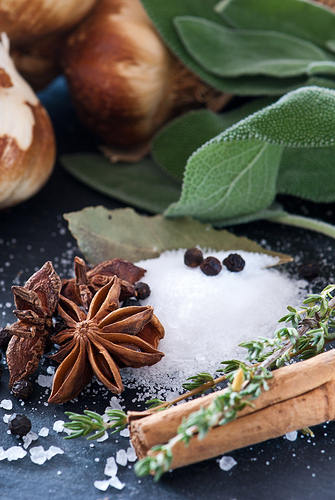
Spices for pork roast brine.


Continue Reading…

Never miss a post
Name: 
Your email address:*
Please enter all required fields
Correct invalid entries

Pumpkin “Museum”, Salone del Gusto 2012, Slow Food Italia

Published by Tuesday, November 13, 2012 Permalink 0

All the Pumpkins Varieties in the World: A Photo Essay

by Jonell Galloway

Pumpkin varieties of the world, Salone del Gusto 2012

Image 1 of 6


Never miss a post
Name: 
Your email address:*
Please enter all required fields
Correct invalid entries

Food Art: Vineyards in B&W 3, food photography by Rosa Mayland

Published by Tuesday, November 6, 2012 Permalink 0


//

This is the third in a series of B&W vineyard photographs by Rosa Mayland, author of our column Rosa’s Musings. She also runs a popular food blog, RosasYummyYums.


Never miss a post
Name: 
Your email address:*
Please enter all required fields
Correct invalid entries

Beef Brisket Recipe: Bookmark This

Published by Tuesday, November 6, 2012 Permalink 0

Beef Brisket Lover Recipe: Bookmark This

Chicago Tribune‘s Bill Daley interviews Daniel Rose in Paris about how the French make beef brisket. Rose, who runs , formerly in Chicago and now in Paris, shares his beef brisket recipe.


Never miss a post
Name: 
Your email address:*
Please enter all required fields
Correct invalid entries

Food Art: Vineyards in B&W 1, food photography by Rosa Mayland

Published by Tuesday, November 6, 2012 Permalink 0

This is the first in a series of B&W vineyard photographs by Rosa Mayland, author of our column Rosa’s Musings.


Never miss a post
Name: 
Your email address:*
Please enter all required fields
Correct invalid entries

UA-21892701-1