France: How Reducing Food Waste is Part of Fighting Hunger
An initiative on the part of the French Ministry of Agriculture creates a link between professionals from the agrifood sector and public charities with the aim of reducing food waste and fighting hunger. It is referred to as the French National Pact against Food Waste.
A practical example: the “donation market”
The “donation market” is an initiative from the French Ministry of Agriculture to create a link between professionals from the agrifood sector and public charities. This idea arose out of the fact that professionals and charitable associations both have difficulty finding contacts, and don’t have time to give away food for free or find donors, says the French government. This public Internet platform responds to these difficulties and is easy to implement. Donors propose the kind of donation they want to make as well as its conditions of use and its transportation on the platform itself. As soon as it is posted on the Internet, all potential “receivers” are alerted by e-mail and can accept it. Donors can propose either food, equipment, transportation or knowledge on the platform.
As well as helping connect people and fighting hunger, this platform is also a way of reducing food waste, as it encourages people to give food rather than to throw it away and to offer extra room in transportation, for example.
Origin of Food Waste and Means of Action
In their Agrimonde and Dualine projects, French researchers from CIRAD, the French Agricultural Research for Development, and INRA, the French National Institute for Agricultural Research, examined possible systems of production and supply to feed the world in 2050. According to them, feeding 9 billion people by 2050 is possible so long as we:
increase yield in a sustainable way
reduce waste from field to fork
manage to change our food habits
They insist on the fact that wasting food also means wasting the energy, soil and water used to produce it, and will in turn be used to destroy the waste. Researchers also make a distinction between food loss, which occurs during the early stage of production (just after the harvest, during the first storage, transport, and first transformation) and which mostly concerns poor countries, and food waste, which is due to consumption habits (at home, in restaurants) or mismanagement of storage in the retail sector. Food waste mostly concerns rich countries. Food waste and food loss of course require different solutions.
To reduce food waste by 50% before 2025, the European Commission has proposed guidelines to Member States:
to educate people
to encourage better labeling and packaging
to ask Member States to favor partnership with responsible catering companies
Examples are also provided, such as:
to produce a new “sell-by date” label
to encourage new sizes of packaging for better preservation of products
to teach children good practices for proper use of food
Key Data
In the European Union, food waste comes from:
42% from domestic use
39% from the food-industry
5% from retailers
14% from the catering sector
every individual wastes 394 lbs. per year
89 million metric tons of food are wasted each year in the 27 countries of the EU
To learn more about this subject, here is the French National Pact against Food Waste.
Based on press release from the French Ministry of Agriculture
O subjetivo na escrita culinária: revisitando M.F.K. Fisher
Betina Mariante Cardoso
Soon to be translated from the Portuguese to the English
Para mim, a leitura da obra de M.F.K. Fisher (Mary Frances Kennedy Fisher) ultrapassa o prazer literário provocado por sua escrita: trata-se de um profundo enriquecimento pessoal. Meu livro favorito desta autora? É difícil escolher, mas atravessar as linhas de The Gastronomical Me foi um fenômeno transformador.
Em uma tradução ligeira, o título é: “O Eu Gastronômico”. Sim, ligeira, pois há grande força e simbolismo nas fibras deste título. Apesar de Mary Frances explorar suas histórias e perspectivas subjetivas nos textos, ao ler com atenção, percebo que cada um de nós, para quem o ato culinário é precioso, poderia ocupar a identidade deste ‘Eu Gastronômico’, deste “Me”, no idioma inglês. Aliás, qualquer um de nós poderia ocupar esta identidade, pois temas como o ‘comer’ e a ‘fome’, também tratados por ela, respondem ao nosso Humano mais profundo.
Na minha leitura, são textos em que a narradora nos empresta seu lugar, seu ponto de vista, para que possamos experimentar suas vivências, como se estivéssemos em seu papel, em sua ‘primeira pessoa’, nos sabores que descobre. Esta característica dá grande força aos seus textos, através do uso desta narrativa em primeira pessoa do singular. Ler-nos em suas sensações, percepções, vicissitudes é aceitar que a autora nos conduza em uma viagem para dentro de nossas próprias narrativas. Um passeio autobiográfico, então. E pergunto: cozinhar não é também uma autobiografia, um ‘contar de si’?
‘Dip’ agridoce de tomates, para aperitivo- receita minha
Bom, há vários focos de encanto, no conjunto desta obra, que, sem aviso, despertam o leitor para a reflexão. Sou pega de surpresa já pelo trecho de abertura:
[Para ser feliz, você deve ter conhecido a dimensão de suas forças, experimentado as frutas de sua paixão e aprendido qual é seu lugar no mundo]- Santayana
(Tradução livre- Betina MC)
Ao folhear este livro, encontro diversos capítulos de mesmo nome, escritos em datas diversas e entremeados com textos de títulos diferentes.”The Measure of my powers” (‘A dimensão de minhas forças‘), repete-se uma série de vezes, trazendo à tona a menção ao trecho de abertura, de Santayana; a repetição deste título específico, contudo, dá o tom autobiográfico e intimista de “The Gastronomical Me”. Sinto, ao percorrer as páginas, a profundidade com que a autora conta de suas histórias culinárias, suas descobertas e reflexões. É como se, a cada um dos capítulos que intitula ‘A dimensão de minhas forças’, ela respondesse ao trecho inicial, contando de sua busca pela dita felicidade. “Para ser feliz, você deve ter conhecido a dimensão de suas forças”, diz o trecho, e Mary Frances trata de retomar esta ‘ordem’, nos capítulos do livro, mantendo a busca como linha condutora de sua escrita subjetiva.
Mercado Público: convite aos sentidos…
Se a tônica me parece estar no ‘ser feliz’, há, nas entrelinhas, uma procura ainda mais profunda: a procura pela sua identidade, por suas ‘forças’ e potenciais, por sua essência, facetas de si que ela traduz por sua relação com o universo do ‘comer’e do ‘fazer culinário’. Para mim, é neste aspecto que seu ‘eu‘, primeira pessoa do singular, pluraliza-se e torna-se ‘nós‘; é neste aspecto que o título do livro, “The Gastronomical Me” (“O ‘Eu’ Gastronômico”) destina-se a um plural de sujeitos que se identificam com as sensações, vivências e sentimentos escritos pela autora. Sujeitos em qualquer parte do mundo. É neste aspecto que ela empresta seu pronome ‘Me’ ao leitor, emprestando, também, seus sentidos para que possamos experimentar, em palavras, os sabores, aromas, texturas, sons, gostos e cores de suas cenas. É possível, ainda, ir além desta compreensão: ao abordar a dimensão de suas forças, ou ao exprimir emoções e memórias no conjunto de textos deste livro, a autora não apenas nos empresta sua fome, mas a partilha conosco, seus leitores. Fome que nós, humanos, sentimos.
Fome?
Esta é a palavra-chave da famosa introdução desta obra, em que ela responde por que escreve sobre comida, e não sobre a luta pelo poder, pela segurança, ou sobre o amor ou sobre a guerra. “A resposta mais fácil é dizer que, como a maioria dos Humanos, eu sinto fome“. E acrescenta, com maestria, que, quando escreve sobre fome, na verdade está escrevendo sobre o amor e a fome por este, sobre o afeto e o amor por este e a fome por este…”Conto sobre mim mesma (…), e acontece, sem que eu queira, que estou contando também sobre aqueles que estão comigo, e sobre sua necessidade mais profunda pelo amor e pela felicidade.”
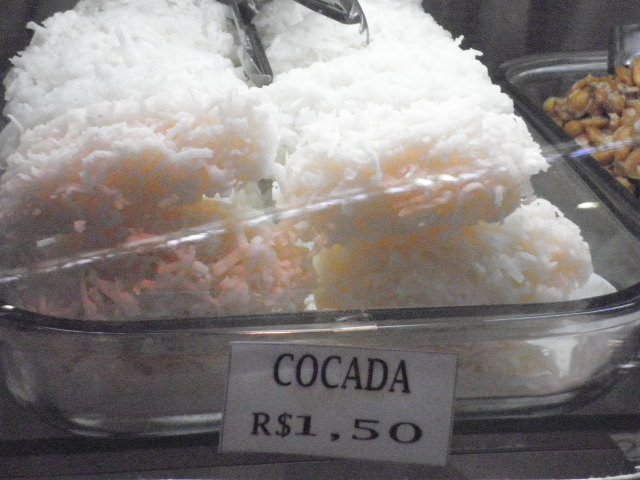
Cocada: doce brasileiro de coco, tradicional e saboroso
Sendo o alimento parte essencial da vida de todos nós, bem como as emoções e percepções através dos sentidos, cada indivíduo está presente no texto desta autora; suas experiências coincidem com as nossas próprias lembranças. Temos em comum a humanidade e, como ela refere, a ‘fome’. Por instantes, nos sentimos personagens de sua autoria; noutras vezes, nos sentimos o ‘Eu Gastronômico’ que escreve as histórias. As fomes são as mesmas.
E, então, a beleza do último parágrafo deste prefácio está na partilha de sua emoção, com o leitor: “Há uma comunhão para além dos nossos corpos, quando o pão é partido e o vinho é bebido. E esta é minha resposta, quando as pessoas me perguntam: ‘por que você escreve sobre fome, e não sobre guerras ou amor?‘”
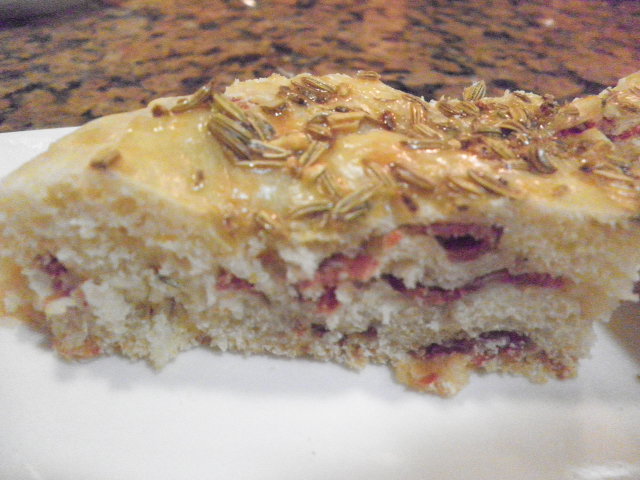
Partilha do meu pão de salame e funcho, no primeiro dia de 2013…
Seja ao ver sua avó fazendo geléias, seja ao partilhar uma refeição com sua irmã e seu pai, seja ao olhar com atenção um cardápio e escolher seu desejo, pela primeira vez: em cada história contada, há algo de nós. Porque, se as emoções são tão diversas em nossa subjetividade, há um ponto em comum em nós, humanos, e que nos torna co-autores destes textos: comemos, sentimos o sabor (ou a falta dele), temos fome, preparamos o alimento, sentimos prazer(aceso ou apagado)…Em qualquer tempo e geografia, comida e emoção nos despertam ou adormecem, nos satisfazem ou nos incompletam, nos nutrem ou nos destroem; seja como for, comida e emoção respondem à nossa necessidade primordial, a fome. Esta, de que Mary Frances Kennedy Fisher fala com tanta profundidade.
É de cada um de nós que a autora conta, quando escreve um texto que intitula: ‘A dimensão de minhas forças’. Você pode não desejar cozinhar, nem desejar escrever sobre a comida ou sobre o ato culinário; entretanto, a leitura desta obra é um passo firme, e prazeroso, na trajetória do comer consciente. E, com certeza, também na trajetória da conscientização de nossa fome pelo amor, pelo afeto, pela segurança, pela felicidade.
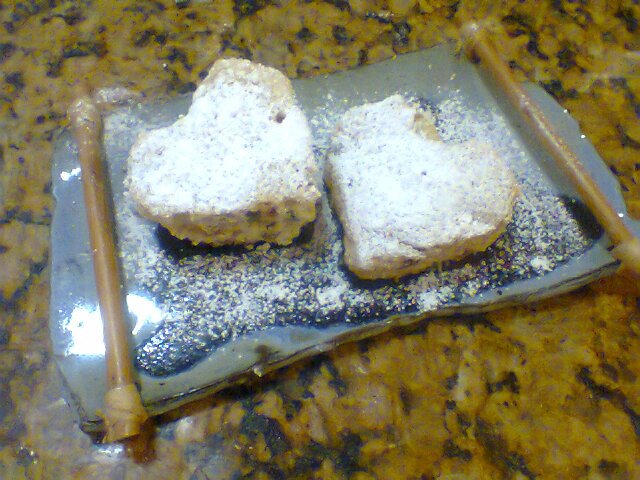
Bolo para celebrar o amor!
Minha leitura? A busca é, no fim das contas, pela ‘dimensão de nossas forças‘ e pelo saciar de nossas fomes, quanto mais buscamos conhecer a nós mesmos. Lendo ou cozinhando, descobrimos trechos de nosso subjetivo, experimentamos nossos sentidos e sentimentos. Somos nós, ali, refletidos em temperos ou em palavras. Basta nossa fome pela descoberta.
Sou Betina Mariante Cardoso, brasileira, trinta e poucos anos. Nasci e moro em Porto Alegre, no Sul do Brasil, cidade que amo de coração e onde vivencio o apego, o calor da família e a constância, virtudes necessárias na minha vida. Paradoxo, tenho encantos por viajar, romper a linearidade rotineira, esquecer o mapa no hotel e perder-me pelas ruas dos lugares que visito. Por quê? Para ter a chance de conhecer aquela confeitaria antiga na rua lateral, coisa que só o acaso permite. Tenho uma ligação forte com o conforto do cotidiano mas, quando me torno viajante, parto em busca das descobertas, do desconhecido. É quando me entrego à Serendipity que as viagens propiciam. E é com este mesmo estado anímico que venho para a cozinha: trazendo comigo a aventura, a curiosidade, o ímpeto pelo novo. Gosto de criar minhas receitas, mas sou também fã dos cadernos culinários, escritos à mão e com manchas de vida em suas páginas. Outro paradoxo.
Agradam-me os livros, as revistas, os blogs de forno-e-fogão. E tenho verdadeiro encanto pelas ‘Histórias do como-se-faz’, as narrativas orais que transmitem o conhecimento empírico, prático e caseiro, de geração a geração. Escutar uma história de cozinha é, para mim, uma riqueza única, porque faz parte de uma conversa, de uma partilha entre as pessoas. Sou médica psiquiatra e psicoterapeuta, profissão que exerço com amor e dedicação, e que dispara meu olhar para o subjetivo de nossas entrelinhas. Minha segunda atividade profissional é como proprietária de uma pequena editora, a Casa Editorial Luminara, ligação entre trabalho e espaço de liberdade.
No tempo livre, meu hobby principal é a culinária, desde a infância. Hoje, com a descoberta da ‘food writing‘, realizar a escrita culinária é, para mim, uma prática tão lúdica quanto cozinhar. Realizo algo que chamo de ‘cozinha perceptiva’. Nesta, escrita e a fotografia são ferramentas, pois ampliam a percepção e a descrição dos detalhes do ato culinário, ampliando também a exploração sensorial e a atenção ao presente, com benefícios para o autoconhecimento. Escrever, curiosar, ler, fazer colagens, blogar, viajar e fotografar são também experiências prazerosas para mim, com altas doses de felicidade.
I’ve just discovered , dedicated to making traditional Swiss and other recipes dairy-free.
Heddi started her site in 2012 to face up to the daily task of cooking for her son, who has multiple allergies, including milk allergies.
A dairy-free version of many traditional Swiss recipes for lactose-intolerant people. Switzerland is a land of milk and cheese, so this is a difficult task. Bravo for her efforts.
1 large fennel
3 medium-size raclette or new potatoes
Juice of one blood orange or regular orange, if not available
Olive oil
Salt and pepper to taste
1 1/2 to 2 teaspoons Country Potato spice* OR aniseed/fennel seeds
Preheat grill or broiler.
Cut stalk end of fennel out, then slice thinly in the lengthwise direction.
Scrub potatoes, but do not skin. Slice thinly.
Spread fennel and potatoes onto a heavy roasting tin, in a single layer. Brush both sides with olive oil.
Grill under broiler until nice and brown. Remove tin from oven, and use a metal spatula to turn them, taking care to still have a single layer.
Put back under broiler. When cooked but not yet brown, add spices. Stir well and put back under broiler. When golden brown, remove from oven.
Put mixture into a mixing bowl. Pour juice of one blood orange over mixture. Mix gently but thoroughly, so that the vegetables absorb the juice.
Set aside for 5 minutes so that all the flavors blend together.
Serve warm, either as a salad or side dish. It is a perfect accompaniment to grilled cod or salmon, and why not chicken?
*Country Potato spice is readily available in Switzerland, but if you don’t have access to it, you can make your own. It’s great on oven fries, chicken breast, and all sorts of other bland dishes you just want to liven up. It is a mixture of curcuma, cumin, coriander, ground manioc, fenugreek, garlic, salt, fennel seeds, chili powder, pepper, paprika, marjoram, ginger, garlic and a touch of sugar.
Introducing our new “TRE Quality Label”: Healthy, Homemade Meals Delivered to Your Door, Geneva
The TRE Quality Label
Introducing our new “TRE Quality Label”
In this complex world of industrial food, where even organic food is sold by agro food conglomerates, it is important to know the quality and origin of what we eat. Thus the importance of a quality label that has been tested by people like us who are experienced in the real-food business. When we give the TRE Quality Label, we know where the ingredients came from, we know how the food was processed and treated — and most of it is entirely local, allowing you too to eat locally. We also know how it tastes, because we’ve tasted it all.
All the important criteria make up part of the TRE Quality Label: quality, origin, and taste. You can be sure of what you’re buying if it has a TRE Quality Label.
Today, we’d like to introduce the first product to which we’re giving our label: panbeh, a Geneva grassroots operation that makes every attempt to meet all these criteria, and to put something healthy, natural and tasty on your plate.
panbeh‘s meals are delivered straight to your door in Geneva. Most of the ingredients are from Geneva or nearby in the countryside.
It is the perfect solution for those who are home bound and for the elderly, as well as for those who simply don’t have the time to do the shopping required to cook a healthy, well-balanced meal. It’s great for those weeks when your work schedule is heavy, and ensures that you’ll get a home-cooked, healthy meal every day, delivered straight to your door.
Geneva: Healthy, Homemade Meals Delivered to Your Door by panbeh
panbeh describes itself:
panbeh means “pure cotton” in Farsi: the purity of a healthy, home-cooked meal
Panbeh’s very own cotton plant in Geneva, Switzerland
As we all know, what we eat is important for our daily activity and well-being, so we are introducing our new concept: the pleasure of eating healthy, natural, homemade food while fully enjoying the taste of what you eat, delivered right to your door.
No additives and no pesticides, no hormones and no chemicals — only the real, natural flavor of top quality, artisanal ingredients, the origin of which we systematically list. And you benefit from the real taste of the whole, untreated, unprocessed food, prepared fresh every day in a high-fiber, low-fat manner.
Whenever possible, we use only organic ingredients.
We propose a daily lunch menu and will deliver it to you at your home or your office, free of charge. Please find below are our daily menus for the month of July.
Delivery to your home or office
Order the night before (before 6 pm) for next day’s lunch, or order for the whole week
Orders are delivered between 12 and 1 pm
Order by email:
panbeh@servge.ch or by phone:
076 630 79 56
Free delivery for Petit-Saconnex, Grand-Saconnex, Grand-Pré and Nations.
It is our right to know where our food comes from:
Bread: Eric Emery bakery, Geneva.
Vegetables, fruits and mountain herbs (organic): Marché à la Ferme de Budé, Geneva.
Cheese (organic) : Casa Mozzarella, Geneva.
Salmon: Wild from Alaska or Scotland, sold by Francesco Drago, Halle de Rive covered market, Geneva.
Tomato sauce (organic): Marché a la Ferme de Budé, Geneva.
Spaghetti (organic): Marché à la Ferme de Budé, Geneva.
Rice & Quinoa (organic): Marché de Vie, Geneva
Olive oil: Greece, sold by Marché à la Ferme de Budé, Geneva
Eggs (organic): Marché à la Ferme de Budé, Geneva.
Chicken (organic) : Swiss origin
Wheat (organic) : Swiss origin
Tuesday
Shirazi salad (tomato, cucumbers, onion, fresh mint)
Indian Tilda rice with safran, berberis (barberries) and chicken, or wild rice with chicken and vegetables
Fresh fruit salad
Meeta Khurana Wolff is a freelance food photographer, stylist and writer, currently living in the culturally rich city of Weimar in Germany with her German husband and their 8-year-old son, where she enjoys preparing multicultural, home-cooked meals using fresh organic ingredients. When she is not styling, photographing or writing about food, Meeta loves to travel the world, exploring new cultures and capturing it all on camera. The unique mood that Meeta creates in her food photography is also found in her travel, still life and landscape photography.
When our souls are happy, they talk about food.–Charles Simic
Dušan “Charles” Simić is a Serbian-American poet and was co-poetry editor of The Paris Review. He is widely recognized as one of the most visceral and unique poets writing today, and his work has won numerous awards, including the Pulitzer Prize in 1990 for his prose poem “The World Doesn’t End:”
I am the last Napoleonic soldier. It’s almost two hundred years later and I am still retreating from Moscow. The road is lined with white birch trees and the mud comes up to my knees. The one-eyed woman wants to sell me a chicken, and I don’t even have any clothes on.
The Germans are going one way; I am going the other. The Russians are going still another way and waving good-by. I have a ceremonial saber. I use it to cut my hair, which is four feet long.
He also received the MacArthur Foundation “genius grant,” the Griffin International Poetry Prize, and, simultaneously, the Wallace Stevens Award and appointment as U.S. Poet Laureate.
___________________
Simon de Swaan is Food and Beverage Director at the Four Seasons hotel in New York City. He studied at the Culinary Institute of America and has an incredible collection of antique cookbooks and books about food and eating, from which he often posts interesting and unusual quotes. In his column Simon Says, he gives us daily food quotes from his tomes.
A tradition so richly experienced on the festival eve of San Giovanni, better known as “St. John’s,” in Spilamberto (near Modena – Emilia-Romagna) had me transported me back to innocent childhood days in Wales. Straying across the fields from the parental home I’d live more in my grandmother’s old cottage – hers was once an inn on a long forgotten village green and was built using the village stocks as a door lintel into her dining room. So the story goes, mature hardwood had been short for building and everything was saved – including timbers from broken ships, recognised even then by their Lloyd’s number carved or burnt into the side. Grandma had one of those too – and stirring tales of bravery at sea to go with it.
Around this time (end-June/early-July), yet knowing nothing then of the Saint’s Day, we would pick ‘green’ walnuts – green skinned and soft before their hard shells formed below the fleshy outer casing.
These we would wash, dry and prick with a pin several times per nut. They would then be cooked in salted water, dried and let to cool before being set to cure in a vinegar sweetened with brown sugar – or perhaps it was molasses given the rich, dark colour. There are recipes going back through the ages – even Hannah Glasse in her The Art of Cookery wrote three. One each for ‘green’, ‘white’ and ‘black’ walnuts.
There would surely have been mace and nutmeg in Grandma’s recipe as there were her two favourite spices – she wore a whole nutmeg about her person, swearing it would ward off arthritis. At over 86 years when she died, arthritis was never one of her ailments.
Height of season for Valais apricots, considered best in Switzerland
It is the height of the Valais apricot season, I thought it timely to offer you a few ideas for using them while they’re ripe and ready.
Choosing your apricots
Photo courtesy of Ellen Wallace.
The first and most important thing is to buy tree-ripened apricots. By definition, this means local ones, since ripe apricots are soft to the touch and do not travel well.
If you plan to eat them fresh, they should be soft, but not blemished or bruised. The riper they are, the more flavorful they are.
If you are using them for cooking, the riper the better, and you can even get by with blemishes as long as they are not rotten-looking. As a general rule, the softer the sweeter.
You will often see crates of extra-ripe apricots discounted in farmers markets. Look them over, and if there are not too many black or rotting ones, they are actually the best for cooking purposes, especially for jams, cakes and sauces.
Recipe ideas for apricots
Note: With all apricot recipes, the amount of sugar used depends on the acidity of the apricots. The acidity depends on the ripeness, origin and variety. With so many factors coming into play, taste tests are indispensable and the quantity of sugar should be determined by taste, using the quantities given here as a guideline.
Food doesn’t exist, but can only be invented. And reinvented. –– Joyce Carol Oates
Joyce Carol Oates is an American author, born on June 16, 1938, in Lockport, New York. She developed a love for writing as a child, going on to become an acclaimed, bestselling scribe known for her novels, stories, poetry and essays, and winning the National Book Award for 1969’s them. Oates has had a prolific, award-winning career, with books such as A Garden of Earthly Delights, We Were the Mulvaneys, Blonde, The Gravedigger’s Daughter and The Accursed.
————————–
Simon de Swaan is Food and Beverage Director at the Four Seasons hotel in New York City. He studied at the Culinary Institute of America and has an incredible collection of antique cookbooks and books about food and eating, from which he often posts interesting and unusual quotes. In his column Simon Says, he gives us daily food quotes from his tomes.