WHAT TO EAT IN FRANCE: HOW TO EAT FOIE GRAS

Published by Thursday, May 21, 2015 Permalink 0

WHAT TO EAT WITH FOIE GRAS

by Jonell Galloway

I tell you it will be more tolerable for the Fejee that salted down a lean missionary in his cellar against a coming famine; it will be more tolerable for that provident Fejee, I say, in the day of judgment, than for thee, civilized and enlightened gourmand, who nailest geese to the ground and feastest on their bloated livers in thy pate-de-foie-gras.”–Herman Melville, Moby Dick (1851)

In What to Eat in France: Foie Gras, we talked about how foie gras is made and the different legal classifications, which determine both the quality and price. Let’s move on to the fun part now. We’ve bought our high-quality foie gras and we want to eat it in the best way possible. Here are some ideas, both traditional and inventive.

Cooked Foie Gras

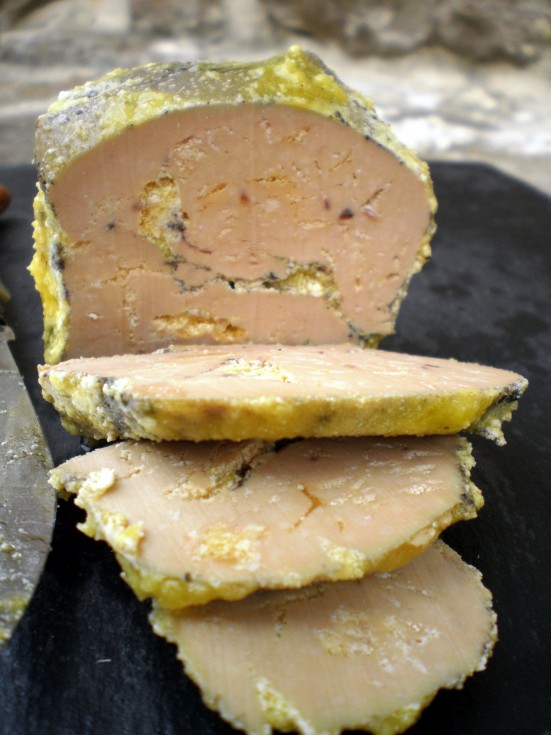
So you’ve bought a foie gras entier, a foie gras, or a bloc de foie gras. You’ll be eating pure or fairly pure foie gras, but how do you eat it and with what?

There is no one way to eat it. The Romans soaked it in honey and milk to fatten it still more before cooking. The first recipe on record comes from Apicius in his fourth century De re culinaria: Thinly slice the foie gras with a reed. Soak in garum. Crush some pepper, lovage and two bay leaves. Wrap in a caul. Grill and serve.

Today we eat it differently. Cold foie gras is most often eaten with something acidic to help digest the fat. This traditionally includes cold, sweet garnishes such as apple, rhubarb, fresh or dried figs, grapes, or pears, and toast, but contemporary chefs venture outside these limits, serving it with dried fruit and nuts and toasted brioche or raisin-fruit bread. More contemporary garnitures are onion jam or caramelized onions, Balsamic vinegar, port or Sauternes jelly, chutney, cassis berries, raspberries, blueberries or coarse sea salt.

Some people simply eat it with green salad, although I find that salad dressing deadens the natural depth of flavor. It’s also possible to eat it with cornichons and pickled onions. like one does with regular pâté, but once again, the vinegar is likely to overpower the delicate flavor.

Cooked foie gras should never be reheated. It should be eaten just colder than room temperature, so take it out of the refrigerator about 45 minutes before serving. Slice it with a knife while it is still cold. It is usually served with cold garnishes, most often as a starter.

Continue Reading…

Never miss a post
Name: 
Your email address:*
Please enter all required fields
Correct invalid entries

WHAT TO EAT IN FRANCE: FOIE GRAS

Published by Tuesday, May 19, 2015 Permalink 0

WHAT IS FOIE GRAS? READ THE FINE PRINT!

by Jonell Galloway

The French eat 90% of the foie gras they make themselves. That’s how much they like it, but they didn’t invent it. Although the Egyptians might have force-fed their birds, we’re not sure that they ate foie gras. The Greeks probably did, since the 4th-century Greek poet Archestratus wrote about it in his Gastronomy. The liver is the soul of the goose, he said.

Foie gras is made using a process called gavage, which consists of force-feeding ducks or geese through a feeding tube to fatten them. The Romans stuffed dried figs down their throats. In Latin, the word for liver even comes from fig, ficus. Scipio Metellus, a Roman chef, had the idea of soaking still warm livers in honey and milk to swell them even more before cooking.

Apart from the region of Béarn in the southwest, this practice disappeared in medieval France, coming back to life in the southwest and Alsace during the Renaissance.

French foie gras is made by force-feeding corn to geese and ducks, and still, occasionally, figs, which swells the livers.


Goose foie gras has traditionally been the most cherished because it is fattier, but it cannot be produced year round. Duck liver is less fatty, and can be produced year round and industrially, meeting the ever-increasing demand.

The fattened liver can be made into terrine, pâté, mousse, parfait, and a host of other things, and, in more recent times, there is a trend of cutting fresh foie gras into thin slices and pan-searing it. It can be eaten fresh or preserved in glass jars, and can be seasoned with truffles, port, Armagnac or Sauternes. Southwesterners prefer a simple, less perfumed foie gras, while Alsacians like to add flavor.

When purchasing, there are legal distinctions in names that indicate the purity and therefore determine the price:

  1. Foie gras entier means that it contains the actual lobes of the liver. The only legally allowed addition is truffles. As it’s solid, you cut it with a knife, just like you do extra-tender beef filet.
  2. Foie gras consists of pieces of liver that are put back together and pressed.
  3. Bloc de foie gras is reconstituted liver combined with other ingredients, but containing at least 50% foie gras for goose, and 30% for duck .
  4. Parfaits are preparations containing 75% foie gras and made by mechanical means, to which regular, unfattened liver is added.
  5. Médaillon or pâte de foie de canard or d’oie contains 50% duck or goose foie gras or bloc de foie gras in the middle, surrounded by forcemeat.
  6. Galantine is a butcher’s mixture of meats and other forcemeats, with no defined percentage of foie gras.
  7. Mousse contains 50% foie gras mixed with forcemeat, giving it the texture of foie gras.

Terrine is pure foie gras pressed into pâté shape.

Forcemeat can consist of one or several ingredients, including pork, veal or chicken fat; pork or chicken liver; scraps from deveining; poaching fat; eggs; milk; lactoproteins; flour, and starch.

Foie gras comes in a jar, plastic package or can or fresh from the butcher. When purchasing, be aware of the different cooking preparations, since the temperature at which it is cooked and the method of cooking change the flavor and shelf-life. Generally speaking, fresh is better.

It is important to make sure you are being sold what you ask for in both restaurants and shops. As a consumer, you have a legal right.

The French don’t eat foie gras every day. Traditionally, it is for special occasions and holiday meals, especially Christmas and New Year’s celebrations.

Coming soon: What to Eat with Foie Gras

Continue Reading…

Never miss a post
Name: 
Your email address:*
Please enter all required fields
Correct invalid entries

‘Nduja: The Spicy and Spreadable Calabrian Treat

Published by Tuesday, March 13, 2012 Permalink 0

by Diana Zahuranec

‘Nduja (n-due-yah) is a spreadable, spicy, red pork meat that can be found everywhere in Calabria. Calabria is the southern Italian region that is the “toe” of the boot, so to speak. Nduja Nduja is used for sauces, bruschetta, or on anything that spreadable meat – spalmabile – would be tasty, including a spoon.

‘Nduja is produced from the throat of a pig, called the guanciale meat, and also the guanciale – stomach meat – and the back lardo, or fat. The lardo, when mixed with salt and added to the meat, takes on another name that has no exact English translation, called sugna. This meat and fat mix is ground with salt, local peperoncino (the Italian chili pepper), and absolutely nothing else. Not even nitrates, a common preservative added to most sausages and cured meats (linked to a higher risk in cancer), adulterate this all-natural ‘nduja. Salt, the extended maturation, and the fact that 30% of ‘nduja is peperoncino, which acts as a natural preservative, defy the need for synthetic additives.


Luigi Caccamo, left

Continue Reading…

Never miss a post
Name: 
Your email address:*
Please enter all required fields
Correct invalid entries

Cross-Continental Cuisine / Cocina Transcontinental: Paté al cava y sangría de jengibre

Published by Tuesday, July 26, 2011 Permalink 0

por SandeeA y Tricia Martin

Click here to read English version

Pate al cava / Giger sangria
Me pasé toda la infancia soñando con probar la comida de la que hablaban en los libros… me parecía tan exótica y apetecible! Los emparedados, los pasteles de carne y manzana, la cerveza de jengibre de los libros de Enyd Blyton, … y quién no ha soñado con comerse uno (o dos) jabalíes con Astérix y Obélix… y ya puestos darles unos mamporros a esos “malditos romanos” y decirle al pescadero del pueblo galo que su pescado no está fresco para que se organice una buena :P?

Este mes el ingrediente elegido para nuestro Cross-Continental Cooking project fue el cava… y gracias a este proyecto conjunto que tengo con Tricia de Eating is Art voy a poder preparar mi propia cerveza de jengibre, simplemente mezclando sirope de jengibre con agua con gas… De los sueños gastronómicos infantiles ya solo me queda pendiente la pelea a besugazos (o pangazos, según como esté la economía :P) No dejéis de visitar la receta de Tricia: sangría de cava que, como todas las anteriores, está traducida al español. Además Tricia se ha embarcado en un nuevo proyecto: su propio estudio fotográfico Studio Tricia Martin. No dejéis de visitarlo, os dejará sin palabras… En cuanto a mi receta, tenéis que probarla, de verdad, y no volveréis a comprar uno de esos “blocs de foie” con ingredientes dudosos por los que te piden un riñón

Pate al cava / Ginger sangria

Continue Reading…

Never miss a post
Name: 
Your email address:*
Please enter all required fields
Correct invalid entries

UA-21892701-1