The Top 10 Restaurants in French-Speaking Switzerland

Published by Wednesday, June 5, 2013 Permalink 0

I compiled this list of the top 10 restaurants in French-speaking Switzerland from the March 28, 2013, issue of the French-language magazine L’Hebdo.

  1. Hôtel de Ville – Benoît, Crissier
  2. Domaine de Châteauvieux, Satigny
  3. Hôtel Terminus – Didier de Courten, Sierre
  4. L’Ermitage de Bernard Ravet, Vufflens-Le-Château
  5. Le Pont de Brent, Brent
  6. Le Cerf, Cossonax
  7. Hôtel Beau-Rivage, Le Chat Botté, Geneva
  8. Hôtel Beau-Rivage, Anne-Sophie Pic, Lausanne
  9. Georges Wenger, Le Noirmont
  10. Denis Martin, Vevey

English: Logo of the Swiss magazine L'Hebdo Fr...

Never miss a post
Name: 
Your email address:*
Please enter all required fields
Correct invalid entries

Switzerland: Geneva Restaurant Suggestions

Published by Sunday, June 2, 2013 Permalink 0


//


by

Jardins de Brunswick (in front of Le Richemond), rue Adémar-Fabri 7, 1201 Geneva. +41 022 731 60 16. Open 07H15 to 22H00 Mon. thru Wed, 07H15 to 24H00 Thurs. and Fri., and 10H00 to 24h00 on Saturday. Closed Sundays. info@cottagecafe.ch, www.cottagecafe.ch

When you have to meet someone near the quai du Mont-Blanc or in the Pâquis neighborhood, this is a great stopoff if you don’t have the pocketbook for the more upscale Richemond and Beau-Rivage venues right behind it. Plus, it is in a beautiful setting, right smack in the middle of the Brunswick gardens.

It’s nice in both summer and winter. The terrace is spectacular, of course, and you even get glimpses of jet d’eau from time time. Inside, it’s cozy and funky.

Breakfast includes birchermuësli, homemade jams and freshly squeezed juices. They have a daily lunch menu, serve pastries in the afternoon, and tapas starting at 18h00.

There is a selection of good quality local wines by the glass or bottle, along with some wines from other places.

Quirinale

Rue de la Rôtisserie 6, 1204 Geneva. +41 022 748 48 48

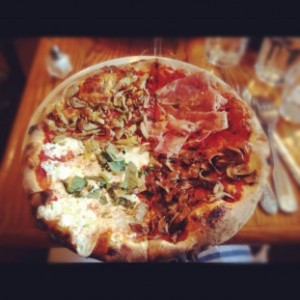
I’ve only had the truffle pizza, which is the house specialty, but I have been dreaming of it ever since.

Emmanuel de Savoie is part owner I hear.

Great central location, chic and full of jetsetters, and a little pricey if you eat a 3-course meal with wine. They do have lunch specials however, and that truffle pizza . . .

La Terrazza

Route de Florissant 51, 1206 Geneva. +41 022 345 56 00. Open for lunch and dinner. Closed Saturday and Sunday.

I discovered this almost hidden Swiss-style café-restaurant many years ago on my treks back and forth to the Beaulieu clinique.

Mr. Borella started as waiter at the Lion d’Or during its golden age. He later set out on his own and has been in this same location for about 25 years. Mrs. Borella cooks and Mr. Borella serves. They are from the Dolomites, so they cook hardy, traditional dishes, as well as some well turned-out Swiss classics.

The price is about as right as you can get, and they buy all their ingredients from local producers. The tomatoes taste like tomatoes and the salads, well they come straight from Chapuis.

Nologo Restaurant

Rue de Fribourg 11, 1201 Geneva. +41 022 901 03 33. Open Mon. thru Fri. lunch and dinner, Sat. dinner only. Closed Sundays. resto@nologo.ch, www.nologo.ch

This is Japanese food like you eat in Japan, not adapted for Western tastes. Wonderful mixtures of unusual flavors and ingredients like you’d never find in your regular, standardized-menu sushi bars.

Don’t count on them being friendly, just think about what’s on your plate. Tiny space so reserve well ahead.

Never miss a post
Name: 
Your email address:*
Please enter all required fields
Correct invalid entries

Paris to the Pyrenees: David Downie Eats His Way Down the Way of St. James, Interview by Elatia Harris

Published by Monday, April 22, 2013 Permalink 0


Left: Cross with Rocks, copyright Alison Harris.
Right: Forest Cathedral, copyright Alison Harris


Interview by Elatia Harris

Their 50th birthdays in sight, the acclaimed travel and food writer David Downie, and his wife, the photographer Alison Harris, decided that trekking from Paris to Spain, would be just the thing. They are based in Paris, so the Way of St. James, for a millennium one of the world’s most celebrated pilgrimage routes, was right at their back door. Neither Alison nor David is religious — the classical pilgrimage experience was not what they were seeking. What were they seeking? Renewal, changed perspectives. Perhaps to test themselves, over 72 days and 1100 km of — at times — very rough terrain. And thereby hangs a tale.

Paris to the Pyrenees: A Skeptic Pilgrim Walks the Way of St. Jameslaunches this week. Scroll to the end to see book tour information. Permission to post on TRE the superb photos from the book was granted by Alison Harris.


ELATIA HARRIS: There has been a lot in the news lately on pilgrimage, however one understands the phenomenon. People who do it talk about needing to lose their routine and find themselves. Most set out alone, meeting others en route. You and Alison started together.

DAVID DOWNIE: Our choice to walk together happened organically. I had planned to do this on my own. Alison came along to keep me out of trouble. If you ask her, she’s likely to say it was her idea about 25 years ago, when she suggested we do something similar.

EH: Readers cannot but wonder how they would hold up, in these circumstances. I pictured a long leisurely walk through a French countryside movie. Cows, chateaux…oh, perhaps a few mildly strenuous stints.  I was so wrong. This was a test of all your combined resources. It would be for any couple. 72 days of togetherness and real physical hardship. And you had already spent years collaborating on your books.

DD: Like some old couples, we have merged in mind and spirit — if such a thing exists — while remaining very different people, and very pig-headedly independent. So, while we were together on the pilgrimage, we were often apart both in our mental spheres and physically. Alison stopped constantly, ran ahead, took detours, disappeared, got lost—often, though not always, in pursuit of a photograph. She probably walked twice as many miles as I did. By the end of the pilgrimage, my regard for her had only deepened. I can’t speak for her, of course.

Continue Reading…

Never miss a post
Name: 
Your email address:*
Please enter all required fields
Correct invalid entries

The Big Apple on a Budget: Tocqueville, a New York Restaurant Review

Published by Thursday, April 18, 2013 Permalink 0

The Big Apple on a Budget: Tocqueville, a New York Restaurant Review

by Leonor White

I discovered Tocqueville last New Year’s Eve, and it’s been my go-to place ever since when special people come to town. My latest visit to this understated yet elegant Union Square New American-French restaurant with a French flare and amiable, well-trained servers brought rave “reviews” from the entire table.

Seven days a week, the restaurant offers an excellent value prix fixe menu ($29). The menu consists of three courses — appetizer, main course and dessert — as well as an amuse-bouche and interesting housemade bread à go-go. In the evening, Tocqueville offers a pre-theatre menu at $44, as well as a full à la carte menu. We went for Saturday lunch, when the restaurant was unusually uncrowded, so we sat on the ground floor from where we could enjoy a view of the restaurant’s refined décor. The dining room was pleasantly quiet with tables set widely apart and well-designed acoustics, allowing us to concentrate on the marvelous food and have good conversation too.

As mentioned, the prix fixe offers three courses, with two choices per course. From the appetizers, everyone tried both offerings, the “creamless sunchoke soup” and the “salad with mushroom terrine”; both dishes were flawless, the flavors bold but balanced. Prior to our appetizer arriving, we were served an excellent “roasted asparagus and beetsamuse-bouche, a great start to our culinary adventure. Throughout the lunch we were also able to enjoy an assortment of homemade bread, namely, brioche, focaccia filled with olive chunks, and crusty, white sourdough with homemade butter (you heard me right, homemade).

Continue Reading…

Never miss a post
Name: 
Your email address:*
Please enter all required fields
Correct invalid entries

Swiss Travel: Hotel Basel, an Excellent “Base” in Basel

Published by Tuesday, March 26, 2013 Permalink 0

Swiss Travel: Hotel Basel, an Excellent “Base” in Basel

by Peter Heller White

Belying its unassuming 1970s exterior, the quality of the Hotel Basel‘s reception, the room (spacious and totally soundproof in our case, at least), and the food make this an excellent choice for enjoying and exploring the vibrant, fun city of Basel. A minute’s walk to the Marktplatz (Market Square) where you will find food stalls, the historic and lovely Rathaus (City Hall) and tram links to take you wherever you wish to go in and around the city (for free, since you only need to show your hotel reservation confirmation or free pass available at reception). We had a perfectly prepared four-course dinner in the Brasserie (there is also a restaurant that we didn’t try) and the breakfast, which is served in the barrel-vaulted basement, was copious and leisurely. All-in-all a most pleasant choice for a weekend break in Basel.

English: Basel City Hall Deutsch: Rathaus Basel

Basel City Hall or ” Rathaus Basel”


Never miss a post
Name: 
Your email address:*
Please enter all required fields
Correct invalid entries

Best Fondue Restaurants in French Savoie as per Michelin Restaurant Guide

Published by Tuesday, March 19, 2013 Permalink 0


 Best Fondue Restaurants in French Savoie as per Michelin Restaurant Guide

by Jonell Galloway

For reference: here is a list of the Michelin guide’s favorite fondue restaurants in the Geneva/French Savoie area.

A magnificent collection

A magnificent collection of the Michelin “red guides”


Never miss a post
Name: 
Your email address:*
Please enter all required fields
Correct invalid entries

The Big Apple on a Budget: Mas (la grillade), a Restaurant Review

Published by Monday, March 18, 2013 Permalink 0

by Leonor White

I recently discovered a farm-to-table restaurant in the West Village. I was looking for an upscale lunch at an affordable price to dine with my family. Mas (la grillade) is the sister restaurant to Mas (farmhouse), but, as the name indicates, focuses on grilled meats.

During lunch hours, a seasonal menu of locally grown foods cooked solely over wood fires of oak, apple and other hardwoods is served. This menu is comprised of three courses: appetizer, main course and desert, and it all comes at a very reasonable price, $27.  Lunch à la carte is also available, but I would recommend opting for the menu, as you get a chance to experience Chef Galen Zamarra’s seasonal favorites. The restaurant is also open for dinner, and just as for lunch, there is a prix fixe menu (but for a higher price, $68), as well as an à la carte dining.

We went for lunch on a Saturday, and it did not disappoint. The restaurant is simply but tastefully decorated, making a bold statement with regards to its farm-to-table concept. As the menus arrived, we all had our eyes fixed on the first item in the menu: “Grilled Pear and Sunchoke Soup with Mint, Black Truffle and Hen of the Woods Mushrooms.” Despite the fact that there were other appetizers to choose from, such as the “Grilled Trumpet Royale Mushrooms with a Salad of Mizuna, Grilled Onion Vinaigrette, and Croutons,” we all thought that the soup sounded divine, and it was indeed. The grilled pear and sunchoke flavors made for a distinctive taste; the soup was sprinkled with mint and black truffles and topped with mushroom croutons.

Continue Reading…

Never miss a post
Name: 
Your email address:*
Please enter all required fields
Correct invalid entries

Bio

I have been passionate about food for a long, long time now. The creative door was pushed wide open for me in the 1970’s – working as a young commis chef at the Carlton Tower Hotel in London. An inspirational chef, Bernard Gaume, at the forefront of UK Cuisine Nouvelle – in its correct context as taught by Fernand Point and further developed by Michel Gérard, Roger Vergé and the Troisgros brothers; not the misunderstood object of derision it later became. But oh, the ingredients! Live langoustine and crayfish every week, baskets of wild mushrooms in season, direct from France and the fish! So fresh and always whole and untouched until we got our hands on them. And the herbs, boxes of intensely fragrant basil and tarragon and my own favourite chervil whose subtlety belies a very happy marriage with eggs and cream. Ingredients that are sirens to the soul, how could one not fall in love with cooking? I should mention foie gras too – for which (and I make no apology) I have developed a life-long passion. I never thanked M. Gaume – and I should like to, I owe him a lot; he got me started.

A new chef joined us – Ian McAndrew – a brilliant chef of his generation, who was kind enough to introduce me to Anton Mosimann at the Dorchester Hotel and the journey began again, lifting me to new heights and experiences. This quietly charismatic chef had incredible vision and a passion for the best ingredients that was so infectious. Special moments were travelling with Hr Mosimann to the Dracula Club in St Moritz to cook a special dinner for 50 people, and competing in the Culinary Olympics in Frankfurt (and winning gold) as part of the Dorchester Hotel team. There is a picture of me (with others) in The Essential Mosimann; I didn’t know this when the book was first published and only saw it years later. It brought back many happy memories!

On my return from a season at the Hotel Kulm in St Moritz, I applied for, and got, a position at the Connaught Hotel in London. Michel Bourdin was only the 4th Head Chef there in 80 years and the kitchen was steeped in history, tradition, experience and…truffles! These have since been added to my list that includes foie gras – nothing, and I mean absolutely nothing, compares to the aroma of a wicker basket full of fresh truffles. Almost impossible to describe flavour or aroma – and I have been asked many times. Holder of two Michelin stars, the passion M. Bourdin held was so tangible and visible – Hr Mosimann and M. Gaume had this too, but it was quieter, controlled. With M. Bourdin it was always bubbling on the surface in a way that was exciting and very Gallic!

I worked at the Carlton Tower and Connaught twice, the Dorchester only once, but for a longer period. Although there were other good kitchens, it is these three brilliant and great chefs that nurtured my love of food.

And so on to photography. A passion developed later in life, and one I wished I’d started much earlier. So much thought goes into the way a chef wants to present a dish and yet it is eaten so quickly! A photograph preserves that moment in time, yet if the food is to be eaten as well, the opportunity to get the shot is as fleeting as a landscape photographer catching the dying rays of the setting sun. Food ingredients themselves also offer endless scope for photography, whether a macro shot of mushroom gills or a beautifully back-lit rhubarb leaf or colourful stems of rainbow chard. The photograph gives us the opportunity to show our appreciation and respect for fine ingredients in a way that presents them at their best and stimulates our senses.

Whether a finished dish, a beautiful ingredient or the people that inspire, food photography should seek to convey that passion and make us hungry for more!


You can see more of Rob’s work at Real Food Photography.


Never miss a post
Name: 
Your email address:*
Please enter all required fields
Correct invalid entries

The Big Apple on a Budget: Celeste, a New York Restaurant Review

Published by Wednesday, December 19, 2012 Permalink 0

The Big Apple on a Budget: Celeste, a New York Restaurant Review

by Leonor White

Celeste, located on Amsterdam Avenue between 84th and 85th, in New York, is one of my favorite places when I’m facing a cash squeeze. Thanks to the excellent value it offers, as well as the authentic Italian food it serves, it has deservedly become a popular fixture in the neighborhood.

After being greeted by the owner, you are taken to your table and presented with fantastic Italian bread and extra-virgin olive oil. The antipasti range from Fegatini Di Pollo (chicken livers) to Saute Di Cozze (sautéed clams) to Crostini Con Alici (breadsticks wrapped in anchovies), and my personal favorite, the Involtini De Melanzane, consisting of eggplant rolls stuffed with prosciutto and pecorino cheese baked with tomato sauce.


Continue Reading…

Never miss a post
Name: 
Your email address:*
Please enter all required fields
Correct invalid entries

From Tokyo: Quirk of Fate after the Quake

Published by Wednesday, November 14, 2012 Permalink 0

by Nancy Singleton Hachisu

From the archives, in celebration of Nancy Singleton Hachisu’s new book Japanese Farm Food, already on its way to becoming a classic

My Surreal Dinner at Les Créations de Narisawa Restaurant after the Quake in Tokyo

Just moments before the Great East Japan Earthquake began to shake I was thinking about food.

While making my way towards Tokyo Station to catch the bullet train back to my local area 100 kilometers northwest of Tokyo, I was toying with dropping by my regular sushi shop near Tokyo Station for a palate cleanser (to chase away a disappointing sushi lunch earlier). Though really, I was wishing I could stay in town for dinner. Alas, I knew this would not sit well with my husband as I had just gotten back a couple days earlier from a quick trip to the U.S. And I had been gone way too much this last year.

Nonetheless, the idea took hold.

That morning I had sat in on a brain storming session exploring logistics of bringing the next edition of Cook It Raw to Japan. As the talk flowed around me, my nascent desire to “experience” Yoshihiro Narisawa’s provocative Japanese-influenced French “food” swelled into an obsessive urge to eat at his Minami Aoyama restaurant, Les Créations de Narisawa that night. Impractical, crazy, costly…impossible. Or so I thought.

When the ground of the massive station building where I stood stopped rippling and the initial terror had passed, the other passengers and I all waited quietly with backs leaning against the station walls. All eyes were fixed on our cell phones in hand, trying unsuccessfully to get a signal. No one said a word.

I emailed my 14-year-old son, home sick from school that day, and got a return email immediately. The house and family were fine.

At that point I still thought the trains would be running again, because the JR announcements were telling us there had been a “big earthquake,” and to wait as they checked the train lines. I dutifully waited for 45 minutes before realizing it was pointless. And so I made my way through underground walkways to Tokyo Station and began to realize the enormity of what had just happened.

Student groups trapped on their way through Tokyo for the annual School Trip were seated on the floor as teachers gave instructions. The bullet train would not be running that day (or the next).

My first thought was getting a hotel (and that I could stay for dinner). I had already squandered a crucial hour waiting for the trains to run, so the streets had swollen with commuters by the time I surfaced outside of Tokyo Station. I only knew of a few hotels and was not sure which side of the station they were located. Tokyo Station is a massive behemoth spanning multiple city blocks. When I finally got my bearings, it was getting on towards 5pm, already 2 hours after the earthquake. The hotels were full, so I lined up for the payphone to call Les Créations de Narisawa. My iPhone battery was dying, I was getting cold, and I knew I needed to get to a safe haven to recoup my energy before the night ahead of me. I needed food and I needed good food.

It was now about 6pm. I glanced over at the hoards waiting for taxis and optimistically told the restaurant I would try to get there by 7:30, but gave them my email for contact.

I now had a destination and nothing would deter me from getting there. Nothing.

The line for taxis looked insanely long and seemed to feed in from different directions. I dithered. I stood in line for a while, still unable to commit: wait it out or find another way. I tried to gauge how long it would take by talking to others around me in line—I’m not sure what we were thinking. We somehow believed that if we stood there long enough, the taxi would take us where we wanted to go. But what exactly was, “long enough?” One hour…five?

The alternative was unthinkable. Walk.

But I didn’t have all night to passively wait. I had less than 2 hours to get to my asylum away from the massive surge of humanity that had filled the sidewalks and streets. I knew I could handle a night on the floor of Tokyo Station, but desperately needed something to ground me in the chaos. And the only thing that does that for me is a quiet room and thoughtful food.

So I set off walking. Power walking, that is.

Thanks to a fellow “traveler” met early on in my trek, I got to Minami Aoyama in about an hour and a half. We stopped one time on a pedestrian bridge over Aoyama Dori (a main thoroughfare). The vast sea of lights before us was from the cars that barely inched forward. No taxis were getting through that night. Walking had been a good decision.

A flute of champagne in hand, my iPhone charging, I heaved a huge sigh of relief. I was “home.”

For the next two hours, a surreal dinner like I had never had before unfolded. It almost seems obscene in retrospect: tree bark, tree sap…bread baked before my eyes in a small stone capsule. Unusual and whimsical morsels from land and sea played together on the equally fanciful “plates.” I was the only customer that night. Perhaps I was the only one crazy enough to take refuge in such a place. Shut off from the outside world, none of us in that hushed room of Les Créations de Narisawa really knew or understood the gravity of the earthquake and all the horror and devastation it had brought. Nor had any of us imagined the unthinkable happening as it has happened at Fukushima Daiichi.

That night at Les Créations de Narisawa, I was caught in a soft little bubble, coddled by the staff. All of us unaware of what awaited us when the bubble burst.

At 10 o’clock, I stepped back out into the brisk night and started my return voyage. Long (useless) waits for trains, a night spent shivering on the marble floor of Tokyo Station, and more endless lines later, I finally got home late the following day. And for now we are safe, though 215 kilometers does not seem far enough from Fukushima Daiichi. But hundreds of thousands of Japanese are still in shelters and many will not be able to go home for many years to come.

And in the aftermath, we try to pick up our lives. I am planting seeds for the summer and looking towards the future. I am trying to organize food for a shelter in our prefecture and to offer a family the vacant teacher apartment at our school, but the wheels grind slowly here and accepting help from outside sources means someone has to manage that. There seems to be an absence of organization to deal with donations and the shelter contacts prefer money or instant ramen over real food like a big pot of stew from farm chickens and local (non-irradiated) vegetables. But that’s Japan, it’s all about the face-to-face meeting, not phone arrangements. I suppose a road trip is in order.

 

Never miss a post
Name: 
Your email address:*
Please enter all required fields
Correct invalid entries

UA-21892701-1