Switzerland: Swiss Food: Rhubarb Cream Recipe

Published by Monday, May 27, 2013 Permalink 0

by Jonell Galloway

Cherry-Rhubarb Fool

When you talk about rhubarb cream in Switzerland, you mean rhubarb cream, not pudding or custard. This naughty dessert is one of the easiest rhubarb desserts around, and is so thoroughly Swiss.

Recipe for Rhubarb Cream

Ingredients

Photo courtesy of Robin Stewart


1 lb. / 500 g rhubarb
3/4 cup / 200 g cane sugar
 2 egg yolks
 Cinnamon or lemon juice, according to which taste you prefer
3/4 cup / 0.2 l whipping cream

Directions

  1. Scrape or cut off any hard outer surface of rhubarb.
  2. Dice rhubarb and put into saucepan. Add sugar. Cover with water. Cook until tender but firm, 5 to 10 minutes.
  3. While rhubarb is cooking, beat the yolks until smooth.
  4. Run cooked rhubarb through food processor or chinois to purée.
  5. Add hot rhubarb purée to beaten egg yolks. Beat until thoroughly blended and eggs start to cool.
  6. Mix in cinnamon or lemon juice. Set aside to cool.
  7. Beat whipping cream. When it starts to form hard peaks, fold in cooled rhubarb and egg mixture.
  8. Cool in refrigerator, either in individual serving dishes or in a large bowl.
  9. Serve cool.


Never miss a post
Name: 
Your email address:*
Please enter all required fields
Correct invalid entries

Switzerland: Easy Egg-Free Quark Chocolate Mousse Recipe

Published by Friday, May 24, 2013 Permalink 0

by Jonell Galloway

This egg-free quark chocolate mousse recipe was developed by Maison Cupcake, but the use of quark cheese is so incredibly Swiss, I thought I should list it as a “Swiss recipe”. Next week Maison Cupcake will be developing a rhubarb mousse using quark, so keep your eye on this site.


Click here for recipe.


Never miss a post
Name: 
Your email address:*
Please enter all required fields
Correct invalid entries

What to Eat in Switzerland: A Geneva Christmas: Longeole Sausage

Published by Friday, December 21, 2012 Permalink 0

by Jonell Galloway

From the archives

Christmas traditions in Switzerland

One should never think that everybody in Switzerland eats the same thing for Christmas dinner. With four languages and a multitude of “mini-cultures” tucked away its various mountain niches, and with a huge international population, Switzerland may well have more Christmas menus than any other country in the world.

In the French-speaking part of Switzerland, Geneva’s traditions are quite apart from the Vaud, for example, due to the late date Geneva finally decided to become part of Switzerland. Geneva traditions are often more influenced by their Savoyard and French neighbors, since they share about 100 km of border with them and only 5 km with canton Vaud.

What’s so special about a Longeole?

Many Genevois eat a sausage specific to Geneva called longeole. Every region and many villages have their own sausage recipes, but the longeole is quite apart from the others for several reasons.


Longeole sausage and potatoes cooked in
white wine, a Geneva Christmas specialty.


For one thing, it contains not only ground pork but also ground pork rind. This keeps it from drying out and gives it fuller flavor. The other, and quite major, difference is that that it is speckled with fennel seeds, probably a Savoyard influence.

Any good local butcher makes his own longeole. If not, it is advisable to find one who does. It’s Christmas, so you want to be certain it’s of good quality.

Cooking Longeole

Longeole is easy to cook, but you must allow yourself enough time. It takes longer to cook than other cooking sausages because of the addition of the pork rind, which is harder than simple ground pork.

Use a soup pot tall enough to hold your sausage. Fill with water and bring water to boil. Add a touch of salt. Drop in sausage, lower heat, and let it simmer for 2 hours 45 minutes or 3 hours. The water should be just on the verge of boiling during the whole cooking time. It is then ready to slice and eat.

Some cooks prick the Longeole with a fork before cooking, but purist that I am, I think you risk losing some of the juices, which would take away from the flavor and make the sausage less succulent in the mouth. It is also important not to let it boil, because this too will dry it out.

What do Genevois eat with Longeole?

Like everywhere, different families have different traditions, different favorites, but the most common accompaniments are potatoes cooked in white wine, lentil stew and cardoon gratin, all Geneva specialties as well.

Continue Reading…

Never miss a post
Name: 
Your email address:*
Please enter all required fields
Correct invalid entries

What to Eat in Switzerland: A Geneva Christmas: White Wine Potatoes

Published by Friday, December 21, 2012 Permalink 0

A Geneva Christmas: White Wine Potatoes Recipe

by Jonell Galloway

From the archives

English: Jet d'Eau, Geneva

In A Geneva Christmas: Longeole sausage, I think I got your mouth watering talking about longeole, or fennel seed sausage. But did you see the potatoes in the photo? That’s THE essential side dish: potatoes cooked in broth and white wine.

I translated and adapted this recipe from A la mode de chez nous, Plaisirs de la table romande, a book on cooking in French-speaking Switzerland, by M. Vidoudez and J. Grangier.

Recipe

A Geneva Christmas-white wine potatoes-Longeole-recipe-Switzerland-the rambling epicure-jonell galloway-genevalunch-traditional dish

Longeole sausage served with
potatoes cooked in white wine and broth

Ingredients

1 kg / 2.2 lbs type 2 all-purpose potatoes
Olive oil, just enough to lightly coat potatoes
1 tablespoon spelt flour (farine d’épeautre), or otherwise whole wheat
240 ml / 1 cup chicken broth
1 onion, diced
1 laurel leaf
3 whole cloves
300 ml / 1 1/4 cup dry white wine
1 bouquet garni
Fresh parsley, chopped
Salt and pepper to taste

Instructions

Fennel-flavored Longeole sausages for Christmas, made by Jacky Bula butcher in Geneva


  1. Scrub potatoes. If you really don’t like potato peels, or your potatoes have lots of black spots on them, peel them. Just remember: all the fiber and vitamins are in the peel.
  2. Chop potatoes into large cubes. Put potatoes in a large saucepan. Coat lightly with olive oil and mix well.
  3. Sautée for 2 or 3 minutes, stirring constantly.
  4. Heat broth. Pour hot broth over potatoes. Add chopped onion, laurel, cloves, salt, pepper and bouquet garni. Bring to a boil. Cover, then lower heat and let it boil gently.
  5. Cook until potatoes are soft, about 15 or 20 minutes, depending on the kind of potato and the kind of pan.
  6. While the potatoes are cooking, mix flour and olive oil in a small utility bowl, until it becomes a smooth paste. Add a couple tablespoons of the hot broth from the potatoes to paste, and beat with wire whip until smooth.
  7. Add paste to potatoes, and beat gently with a wire whip. When smooth, add white wine.
  8. Continue cooking, stirring often so that it doesn’t stick, and gently boiling until the sauce starts to thicken.
  9. Taste. Add salt and pepper if required.
  10. Sprinkle with chopped parsley when serving. Traditionally, in Geneva this is served with longeole sausage at Christmas, but it goes well with many dishes, for example a smoked cooking sausage from the canton of Vaud.

Cooking notes:  I use a Kuhn Rikon Durotherm to maintain the vitamins and decrease cooking time. This also allows you to use less liquid, which gives a more intense flavor. In this case, you would use just enough broth to cover the potatoes.

Continue Reading…

Never miss a post
Name: 
Your email address:*
Please enter all required fields
Correct invalid entries

What to Eat in Switzerland: A Geneva Christmas: Cardoon Gratin Recipe

Published by Wednesday, December 19, 2012 Permalink 0

by Jonell Galloway

From the archives


Cardoon gratin is a classic Geneva Christmas dish, but only brave souls should try to prepare them because they are prickly, and the preparation can be long and tedious. Many farmers markets in Switzerland now sell them prepared sous vide, in plastic vacuum-packed packages, which is probably the best option for those who don’t get a thrill out of getting a few pricks. In any case, it is important to schedule it carefully into your meal preparations, because it is time-consuming any way you go about it.

Cardoon Gratin Recipe

Preparation of Cardoons for Gratin

  1. Throw out any hard stems and any that are wilted.
  2. Peel the cardoons by removing leaves, spines and stringy parts. The exterior will then be covered with a fuzzy layer. Use a cloth to rub stalks gently to remove fuzz.
  3. Cut stems into 8 cm (3 cm) slices. Rub with lemon, or if you intend to use them later, put slices into lemon water so they won’t turn dark.
  4. You now have two choices: you can either cook them in a white vegetable broth you’ve made ahead of time, or you can cook them in the lemon water you soaked them in.
  5. Bring to a boil and boil until tender. It should take about 30 minutes for them to become tender, but if they are larger in diameter it can take up to 2 hours, so allow plenty of time.

Recipe


All these steps can be carried out while the cardoons are cooking. There are actually several ways of doing this. You can either make a Béchamel (white) sauce and sprinkle cheese on the cardoons before you put them in the oven, or you can make a Mornay (cheese) sauce and pour it on the cooked cardoons before putting in the oven to brown. I think it’s tastier to make a Mornay sauce, and then sprinkle a bit of cheese on the top before putting it in the oven. Here’s my recipe.

Ingredients

Click here for British/American/metric recipe converter

Approximately 1 kg of cardoons
30 g of butter
1 tablespoon of flour
2.5 dl of whole milk
1 dl of cream
50 g of cheese, type Gruyère or Swiss (see photo below), grated
Lemon juice, freshly squeezed
Salt and pepper to taste
 

Emmentaler (also known as Swiss Cheese), while...


DIRECTIONS

  1. Make a Béchamel sauce, using the proportions of ingredients above.
  2. When finished and seasoned, add cream and cheese, setting aside a tablespoon of cheese. Set aside.
  3. Preheat oven to 250° C.
  4. Once cardoons are tender, drain, making sure all water is drained off.
  5. In a large bowl, mix cooked cardoons and Mornay sauce.
  6. Pour into a baking dish of the appropriate size, so that there is a layer of about 3 cm high.
  7. Sprinkle evenly with remaining grated cheese and a few knobs of butter.
  8. Put in hot oven for 15 to 20 minutes, or until golden brown.

Notes: It is important to use a hard, Swiss-type cheese. Cheddar cheese would have too strong of a taste. If you can’t find cardoons, the same recipe can be made with Swiss chard, thus eliminating the long, meticulous preparation. Simply cut them as for the cardoons and cook in chicken broth until tender, then follow the other steps in the recipe for making the gratin. Its texture is quite similar to that of cardoons.

Related articles


Never miss a post
Name: 
Your email address:*
Please enter all required fields
Correct invalid entries

Rosa’s Musings: Beet Salad with Cottage Cheese & Soft-boiled Egg

Published by Monday, November 5, 2012 Permalink 0

Rosa’s Musings: Beet Salad with Cottage Cheese & Soft-boiled Egg

by Rosa Mayland


Some people are not afraid of the cold and others regard it with utter contempt. Even though I can’t say I savor every season or mid-season of the year, I nonetheless definitely prefer the fresher season as I hate sweating excessively or getting sunburned like a shrimp on a barbie.

Sometimes I wonder if those predispositions are linked to my DNA or whether is it just a personal preference. What if our genes influenced our manner of conducting ourselves and our traits of character? Hmmm, that is quite a difficult question to answer, but I believe that if our health can be defined by our bloodline, then there are chances that our emotions, temperament and identity are also outlined by it.

You see, my father’s ancestors were Swiss mountaineers who might have had Danish or English origins (my family name is NOT Swiss at all). Then, on my my mother’s side they came from the rugged areas of Northern England where Viking settlers made themselves at home and also from European Russia, a place which is known for its dreadful cold.

Continue Reading…

Never miss a post
Name: 
Your email address:*
Please enter all required fields
Correct invalid entries

Switzerland: Tasting Week (La Semaine du Goût) Program

Published by Thursday, September 20, 2012 Permalink 0

by Jonell Galloway

Click to see the Tasting Week program for the entire country. Tasting week runs from 13 to 23 September 2012.

This year many of the events are sponsored by Savoring a week of ‘slow food’ across the country.


Never miss a post
Name: 
Your email address:*
Please enter all required fields
Correct invalid entries

Switzerland: Historical Cheese Events around the Country

Published by Thursday, September 20, 2012 Permalink 0

by Jonell Galloway


Cheese

Keep up with all the real (vs. industrial) cheese events all over Switzerland. Click here for listings and updates.


Never miss a post
Name: 
Your email address:*
Please enter all required fields
Correct invalid entries

Part 5: Kimchi vs. Sauerkraut – Fermenting Vegetables

Published by Wednesday, August 8, 2012 Permalink 3
cafemama / Foter / CC BY-NC-SA

Part 5 on Fermentation: Kimchi vs. Sauerkraut – Fermenting Vegetables

by Diana Zahuranec

Once again, Harold McGee’s The Science and Lore of the Kitchen comes to the rescue.

In fermented vegetables, remember that the two components that determine aroma and flavor are the salt concentration and temperature of fermentation. Those are the two main differences between kimchi and sauerkraut.

Bowl of kraut, by Diana Zahuranec for The Rambling Epicure, editor Jonell Galloway.

Bowl of kraut.


Sauerkraut, besides being cut more finely, has no other ingredients besides cabbage and brine. It ferments at 64-76 °F/18-24°C for 1 to 6 weeks. Its final salt content is 1-2%, and its final acidity level is 1-1.5%. That higher temperature for sauerkraut results in more lactic acid bacteria, giving it a tangier flavor.

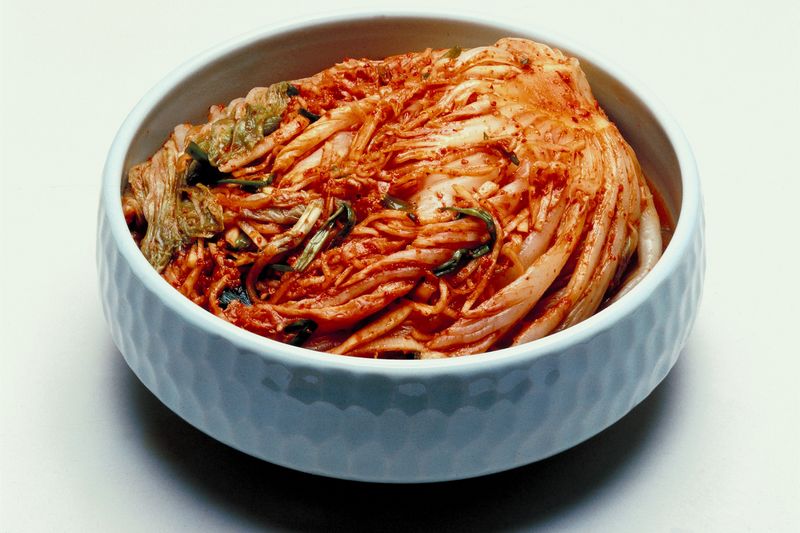
Kimchi is cut into larger chunks and includes plant leaves and stems, too; and hot Korean chili pepper, garlic, and fish sauce are added for flavor. It’s fermented at a lower temperature than sauerkraut at 41-57°F/5-14°C for 1-3 weeks, with a higher salt content in the end (3%) and lower acidity (0.4-0.8%).

Bowl of kimchi, Part 5 on Fermentation: Kimchi vs. Sauerkraut - Fermenting Vegetables, by Diana Zahuranec for The Rambling Epicure, editor, Jonell Galloway.

Bowl of kimchi.


Never miss a post
Name:

Your email address:*

Please enter all required fields
Correct invalid entries

Never miss a post
Name: 
Your email address:*
Please enter all required fields
Correct invalid entries

Switzerland: Fresh Fruit Séré/Quark Cheese Mousse

Published by Wednesday, August 1, 2012 Permalink 0

by Jonell Galloway

In Switzerland, séré, as it is called in the French-speaking part of the country, or quark, as it is called in the German-speaking part, is a fresh cheese similar to curd cheese or cottage cheese and to ricotta, but the process of making it differs somewhat. Milk is first soured, then warmed until the desired degree of denaturation of milk proteins is met. It is then strained, so that it is smooth in consistency.

It is good eaten simply, with fresh fruit and a touch of sugar, but it can also be used for cooking.

When summer fruit is so abundant, this fresh fruit mousse makes for a different way of eating it.

You can buy either the full-fat version or a low-fat one. The full-fat version will be marked séré de crème in supermarkets; the full-fat version will be marked séré maigre or quark “maigre,” meaning low-fat. For this recipe, it’s best to buy it homemade from the cheesemonger or the full-fat version.

If séré is not available in your area, follow this easy recipe to make it yourself.

Continue Reading…

Never miss a post
Name: 
Your email address:*
Please enter all required fields
Correct invalid entries

UA-21892701-1