Simple Sustenance: Roasted Red Onion, Fennel and White Bean Soup

Published by Thursday, October 4, 2012 Permalink 0

by Renu Chhabra

The essence of pleasure is spontaneity.–Germaine Greer


Spontaneity in the kitchen can be fun sometimes and a challenge at other times. But it does get our creative juices rolling, and pushes us to bring out our best. Often times, with no set plans, and working with what we’ve got produces great results. New recipes are born, and new talents are discovered. That’s the beauty of spontaneity. Who wouldn’t like that?

Continue Reading…

Never miss a post
Name: 
Your email address:*
Please enter all required fields
Correct invalid entries

Switzerland: Tasting Week (La Semaine du Goût) Program

Published by Thursday, September 20, 2012 Permalink 0

by Jonell Galloway

Click to see the Tasting Week program for the entire country. Tasting week runs from 13 to 23 September 2012.

This year many of the events are sponsored by Savoring a week of ‘slow food’ across the country.


Never miss a post
Name: 
Your email address:*
Please enter all required fields
Correct invalid entries

Simple Sustenance: Spud Love — Spiced Potatoes and Dill

Published by Wednesday, September 19, 2012 Permalink 0

by Renu Chhabra

If people take the trouble to cook, you should take the trouble to eat.–Robert Morley

It is hard to find someone who does not like potato.

From french fries, latkes, croquettes, gratins, fritters, hash browns, salads, to soups and stews — the list is endless. Most of us have our favorite potato dish or two.

This starchy tuber may seem like a very humble commodity, but is definitely celebrated in kitchens around the globe. Americans, Italians, Indians, French, or Irish — they all have their potato specialties making it difficult to ignore its place in the gastronomic arena.

My recent visit to India confirmed its importance even more.

Continue Reading…

Never miss a post
Name: 
Your email address:*
Please enter all required fields
Correct invalid entries

Simple Sustenance: MarketDay in a mid-September California farmers market with Renu Chhabra

Published by Wednesday, September 12, 2012 Permalink 0

by Renu Chhabra


Let us not forget that the cultivation of the earth is the most important labor of man. When tillage begins, other arts will follow. The farmers, therefore, are the founders of civilization.–Daniel Webster

These are the colors of California farms — rich and vibrant!

Summer vegetables are brimming with freshness, and the abundance!  Everywhere I set my eyes, there is something that draws me to it. I can’t control myself; I want to shoot every colorful heap I see. I guess it’s the temptation to enjoy them, visually, later? After all, it is a feast for the eyes.

Continue Reading…

Never miss a post
Name: 
Your email address:*
Please enter all required fields
Correct invalid entries

Part 6 on Fermentation: Sauerkraut Success

Published by Friday, August 31, 2012 Permalink 0

Part 6 on Fermentation: Sauerkraut Success

by Diana Zahuranec

I filled two scalloped blue bowls with homemade sauerkraut and kimchi, sat down, and taste-tested.

I was hesitant, but I was encouraged by the lack of mold.

Kimchi wanna-be and sauerkraut

After two weeks of pushing down the bottles that weighed on my sauerkraut and “kimchi” (which was not actually kimchi, but will be referred to as such because that’s what I wanted it to be), I balanced the heavy, full bowls of vegetables on a flimsy, plastic tray and carried them to the kitchen counter.

I removed the bottles filled with water, the plates, and then the bags (why all this? Here’s why in Step-by-step Fermentation). I began to pour the mix into large containers of what once held 1 kg of yogurt, but I stopped when I lost too much liquid.

I assumed that the liquid of fermented vegetables contains all the healthy nutrients  that can be found in the vegetables themselves. I didn’t want to lose that, although I remain baffled as to what I could do with it, and haven’t found great sources backing up my Water-From-Fermented-Vegetables-Is-Healthy Theory (yet).

So I stuck my hand in and scooped it all out, pouring the liquid over top at the end. The liquids also help to preserve the vegetables when you store them in the refrigerator, and many say that the flavor improves as the fermentation slowly continues. And another reason to save the water: use a bit mixed in with the brine the next time you ferment vegetables, helping to jump-start the fermentation process.

According to Nourishing Days, ferments with 1-2% salt content will store for 4 to 9 months.

I filled two of those yogurt containers and some glass jars, or about roughly 13 cups of sauerkraut and kimchi from almost the same amount of vegetables. I had read that the vegetables will shrink as they lose their water, but the before:after ratio was nearly the same.

Success! They were both delicious. There was not a hint of rot. In fact, although many sources claim that it’s highly probable that you’ll lose some of your batch – especially a small one, like mine – due to air or uneven fermentation, I lost no more than a few shreds of cabbage.

Both were crunchy and flavorful. The pure cabbage had a more delicate flavor, and a bit of lactic acid tang. When I made the brine, I also added a teaspoon or two of yogurt whey to help . Sauerkraut naturally has a  lactic acid flavor, so I’m curious to see if fermented vegetables without added whey would give off that taste as strongly. Fermentation Project Number 2?

The kimchi was spicy from the chili pepper flakes and chopped hot peppers I added, and the mix of vegetable textures was delightful. The tastes all ran together – a carrot didn’t taste much different from a chard stem. And the chard stems were tougher than I wanted; but on second thought, it’s great that everything retained its crunchy structure. Mushy vegetables can be the result of not adding enough salt; I also read on Nourishing Days that tannins keep the structure of the vegetables intact, so you may be able to add grape leaves, for example, to retain crunch.

And now I’ll admit that I tentatively drank the fermented water, out of curiosity and refusal to waste something healthy. Its flavor wasn’t offensive, just mostly salty. I decided it might be healthier to forgo the salt than to absorb the other nutrients in there. And drinking fermented water just doesn’t sound very appetizing.


Never miss a post
Name: 
Your email address:*
Please enter all required fields
Correct invalid entries

Food Art: Vegetables and Other Comestibles, food photography by Meeta Khurana Wolff

Published by Monday, August 20, 2012 Permalink 0

See more beautiful photo compositions at Meeta K. Wolff.


Never miss a post
Name: 
Your email address:*
Please enter all required fields
Correct invalid entries

Switzerland: Best Source of Tomatoes in Lake Geneva/France Region

Published by Monday, August 13, 2012 Permalink 0

by Jonell Galloway

Sandrine and Olivier Chapuis
1037 route des Mermes
74140 Veigy-Foncenex
Tel. +33 (0)4 50 94 84 09

Sandrine and Olivier Chapuis in Veigy-Foncenex in France are the great specialists of juicy, full-flavored tomatoes in the Geneva area. They grow between 20 and 30 different varieties every year. There are yellow, orange, green, tiger stripe, red: a cornucopia of color and as sweet as fruit (of course they are fruit, technically speaking).


The market is flowing with oodles of summer vegetables.


The Chapuis also have the widest range of wild greens and mescluns I’ve seen in Geneva.


You can also buy directly from them in Veigy-Foncenex, but Sandrine prefers that you call beforehand because she is not always there. After all farmers have to work in the fields sometimes!

They produce all the produce they sell in the farmers market, so you can be sure that is both fresh and local. Sandrine, or “Sabi,” as she is nicknamed, has lots of great recipes in her head for every product she sells.

Since their fields are scattered out in various places, she prefers customers to tell her what they want, and she will have it ready for them when they come to pick it up. The best time is Tuesday or Friday between 4 and 8, or any other evening on appointment. The Chapuis are trying to set up a system for opening every evening, but are awaiting authorization from city authorities regarding parking, since they are right off the route nationale.


Never miss a post
Name: 
Your email address:*
Please enter all required fields
Correct invalid entries

Food Art: Tomatoes Fresh off the Vine, a food photography exhibit by Renu Chhabra

Published by Thursday, August 9, 2012 Permalink 0

“It’s difficult to think anything but pleasant thoughts while eating a homegrown tomato.”–Lewis Grizzard


How would you like to eat them? Any ideas for dinner tonight?

Never miss a post
Name: 
Your email address:*
Please enter all required fields
Correct invalid entries

Part 5: Kimchi vs. Sauerkraut – Fermenting Vegetables

Published by Wednesday, August 8, 2012 Permalink 3
cafemama / Foter / CC BY-NC-SA

Part 5 on Fermentation: Kimchi vs. Sauerkraut – Fermenting Vegetables

by Diana Zahuranec

Once again, Harold McGee’s The Science and Lore of the Kitchen comes to the rescue.

In fermented vegetables, remember that the two components that determine aroma and flavor are the salt concentration and temperature of fermentation. Those are the two main differences between kimchi and sauerkraut.

Bowl of kraut, by Diana Zahuranec for The Rambling Epicure, editor Jonell Galloway.

Bowl of kraut.


Sauerkraut, besides being cut more finely, has no other ingredients besides cabbage and brine. It ferments at 64-76 °F/18-24°C for 1 to 6 weeks. Its final salt content is 1-2%, and its final acidity level is 1-1.5%. That higher temperature for sauerkraut results in more lactic acid bacteria, giving it a tangier flavor.

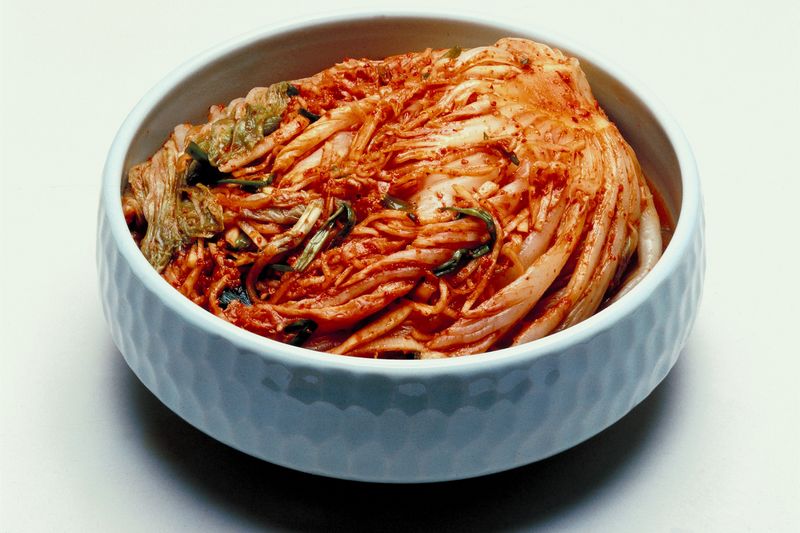
Kimchi is cut into larger chunks and includes plant leaves and stems, too; and hot Korean chili pepper, garlic, and fish sauce are added for flavor. It’s fermented at a lower temperature than sauerkraut at 41-57°F/5-14°C for 1-3 weeks, with a higher salt content in the end (3%) and lower acidity (0.4-0.8%).

Bowl of kimchi, Part 5 on Fermentation: Kimchi vs. Sauerkraut - Fermenting Vegetables, by Diana Zahuranec for The Rambling Epicure, editor, Jonell Galloway.

Bowl of kimchi.


Never miss a post
Name:

Your email address:*

Please enter all required fields
Correct invalid entries

Never miss a post
Name: 
Your email address:*
Please enter all required fields
Correct invalid entries

Simple Sustenance: Kale Power — Kale and Sunflower Seed Pesto

Published by Tuesday, August 7, 2012 Permalink 0

by Renu Chhabra


“Eat food. Not too much. Mostly plants.” Michael Pollan

This one is for kale lovers. I know. I am one of them. Until not too long ago, I did not have the slightest idea of its existence; or let’s just say, it did not visit my produce bag. But once I tasted it, I was hooked on the amazing wonders of kale like most health enthusiasts.

Kale is known by several flattering names — Queen of Greens, Powerhouse of Nutrients, King of Greens. These days kale is one of the most talked about super foods. From soups and stews to salads and stir fries, it has found its way in every possible form of cooking. Kale juice anyone? How about kale chips for a healthy snack? And if that’s not enough, just puree these hearty leaves to transform them into pesto. Now that opens up several more ways to enjoy its versatility.  Stir it in pasta, spread it on breads and crackers, or thin it a little to make dressings. If none of those options are appealing to you, a few spoonfuls as is works for me.

Speaking of pesto, I made this recipe with sunflower seeds instead of nuts. Sunflower seeds provide fair share of good fats, and they also give it a rustic texture. I left cheese out making thus making it an option for vegans. But if you prefer a cheesy flavor, add some pecorino or parmigiano. Good olive oil, lemon, and garlic with a few grinds of sea salt make it absolutely delicious. Store in refrigerator and enjoy.

Recipe

1 medium bunch kale, stems removed
1 large clove of garlic
½ cup unsalted roasted sunflower seeds
Juice of one large lemon
Sea salt to taste
Freshly ground pepper (optional)
½ cup olive oil

Instructions

Put kale leaves in boiling water for 30 seconds. Drain in a colander, and run cold water over to stop the cooking process. Squeeze kale to remove water completely.

In a food processor, pulse garlic a couple times. Add sunflower seeds and pulse again 2-3 times. Add kale, lemon juice, salt, pepper and puree.  Drizzle oil while the machine is running. Puree it to desired consistency.

Adjust lemon and salt to taste. If the pesto is too thick for your taste, add a little water.


  • In a food processor, pulse garlic a couple times. Add sunflower seeds and pulse again 2-3 times. Add kale, lemon juice, salt, pepper and puree.  Drizzle oil while the machine is running. Puree it to desired consistency.

    Adjust lemon and salt to taste. If the pesto is too thick for your taste, add a little water.


    Never miss a post
    Name: 
    Your email address:*
    Please enter all required fields
    Correct invalid entries

UA-21892701-1