Les sept vies du pain / The 7 Lives of Bread: All the Bread in the World (English version)

Published by Wednesday, February 16, 2011 Permalink 0

by Jean-Philippe de Tonnac

translated and adapted by Jonell Galloway

Click here for French version

All the Bread in the World

Good news: You don’t have to be French to love bread. Indians, Iraqis, Israelis, Egyptians, Peruvians, Greeks, and Germans are also fond of it. The truth is all peoples dwelling on this earth are “bread eaters”, if you accept the formula Homer used in the Odyssey. For Homer, the art of bread-making was the criterion for distinguishing those who were civilized from the others, the savage barbarians. But the Greek bard probably didn’t even know that the American Indians existed. The Indians did not sit around waiting for the arrival of the “civilized” to understand the value of arepa, cassava, tortilla and hallaca.

Continue Reading…

Never miss a post
Name: 
Your email address:*
Please enter all required fields
Correct invalid entries

Coming up later today, stand by!

Published by Wednesday, February 16, 2011 Permalink 0

A new food photo exhibition

English version of Jean-Philippe de Tonnac’s “Tous les Pains du Monde,” published in French this morning

New article by David Downie

Never miss a post
Name: 
Your email address:*
Please enter all required fields
Correct invalid entries

Les sept vies du pain / The 7 lives of bread : Tous les pains du monde (original French version)

Published by Wednesday, February 16, 2011 Permalink 0

Dictionnaire Universel du PainLes sept vies du pain / The 7 lives of bread : Tous les pains du monde (original French version)

de Jean-Philippe de Tonnac

Click here for English version

Tous les pains du monde

Vous n’avez pas besoin d’être Français pour apprécier le pain. Les Indiens, les Irakiens, les Juifs, les Egyptiens, les Italiens, les Péruviens, les Grecs, les Allemands en sont friands, autrement dit tous les peuples de « mangeurs de pains », selon la formule qu’utilise Homère dans l’Odyssée pour distinguer ceux qui ont acquis l’art de la panification des autres, sombres barbares. Probablement l’aède grec ignorait-il l’existence des Amérindiens. Ceux-là ne l’ont pourtant pas attendu pour apprécier l’arepa, la cassave, la tortilla, le hallaca.

Mais même les nouveaux venus, peuples récemment convertis à la panification, ne tarissent pas d’éloges à propos des mérites du pain à mie ou à croûte. Car il faut choisir son camp. Sachez, en effet, que la véritable « ligne Maginot » dans le monde de la boulangerie universelle est celle qui sépare les amateurs de « pain à croûte », les Latins, des amateurs de « pain de mie », les Anglo-saxons et que la compétition est très largement en faveur des seconds. Raison pour laquelle, même en France, Mecque du pain à croûte (obtenue grâce à la réaction de Maillard), les consommateurs ont tendance à réclamer un « pain pas trop cuit ». Ce qui irrite par dessus tout notre spécialiste du french bread, l’historien Steven L. Kaplan, bien connu pour ses coups de gueule.

Continue Reading…

Never miss a post
Name: 
Your email address:*
Please enter all required fields
Correct invalid entries

Hunter Gatherer: Waste not want not: Carli Ratcliff visits Sydney’s newest (and greenest) restaurant

Published by Tuesday, February 15, 2011 Permalink 0

by Carli Ratcliff

A Pop-up restaurant: Greenhouse by Joost in Sydney, Australia

Our Australian correspondent Carli Ratcliff visits Sydney’s newest (and greenest) restaurant

Joost Bakker is a designer with abhorrence for waste. The son of Dutch flower growers he grew up surrounded by plants and nature and has long held the view that we must touch lightly on the earth. His own home is a straw bale construction, a technique he has also adopted in the construction of his pop-up restaurants.

The Dutch-born designer (his family migrated to Melbourne when he was nine years old) unveiled his first pop-up restaurant in Melbourne’s Federation Square in 2008 and he has another permanent greenhouse in Perth, Western Australia, which was named Perth’s ‘Restaurant of the Year’ in 2010.

His harbourside pop-up, which sits prominently on the point between The Sydney Opera House and The Sydney Harbour Bridge, opened to the public on Monday.

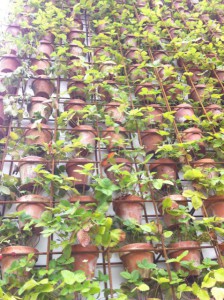
Constructed of shipping containers and the aforementioned straw bales, the interior walls are clad in magnesium oxide boards, impregnated with Bio-Char (a type of charcoal that captures and stores carbon). The exterior of the restaurant is covered in thousands of terracotta pots holding wild strawberry plants.

Serving breakfast, lunch and dinner the menu is based on local, seasonal ingredients, with an emphasis on wholefoods. Local oysters and sustainable fish, including grilled mackerel, are on offer, so too a grass-fed Waygu beef and papaya salad and handmade pappardelle with beef ragù and gremolata (the parsley comes from the roof). All arrive on slabs of plantation timber, which serve as plates, with compostable timber cutlery.

The wheat for pizzas is ground on site; the Perth restaurant currently grinds nearly a tonne of local wheat each week. Butter and yoghurt are made here, as is tonic water, the pasta, bread and pastries. Fresh juices are hand-squeezed to order and natural wines are poured straight from the barrel, both are served in jam jars.

Herbs and leaves are grown on the roof, fed regularly with compost made from the restaurant’s waste, while the oil from the deep fryer is converted into diesel which fuels the restaurant’s electricity.
In six short weeks the restaurant will be packed up. Next stop Milan.

For more information, contact Carli at carliratcliff@theramblingepicure.com

Never miss a post
Name: 
Your email address:*
Please enter all required fields
Correct invalid entries

Simon Says: Daily Food Quote, February 14, 2011

Published by Monday, February 14, 2011 Permalink 0

by Chez Pim

Happy and successful cooking doesn’t rely only on know-how; it comes from the heart, makes great demands on the palate and needs enthusiasm and a deep love of food to bring it to life.–Georges Blanc, Ma Cuisine des Saisons

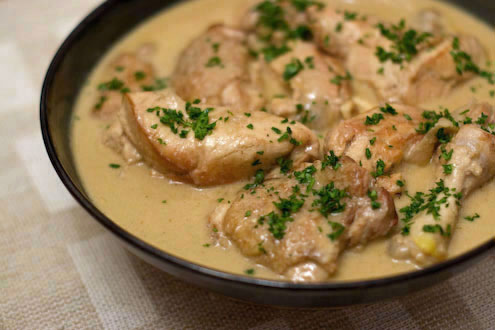
Georges Blanc is considered one of France’s greatest chefs. His restaurant, which he took over from his grandmother, known as “La Mère Blanc,”  and mother, is located in the small village of Vonnas near Bourg-en-Bresse. Bresse is considered by most to produce the best chickens in France, and Blanc’s chicken in cream sauce is hailed as being the best in all of Burgundy. It is his grandmother’s recipe.

George Blanc's poulet à la crème.

Photo courtesy of Chez Pim.

Never miss a post
Name: 
Your email address:*
Please enter all required fields
Correct invalid entries

Destination Dessert: Chocolate Cherry Pound Cake with Mascarpone Whipped Cream

Published by Monday, February 14, 2011 Permalink 0

by Jamie Schler

Jamie’s blog Blogger’s Choice Awards 2011 has been nominated for Best Food Blog 2011 on
. If you like her recipes, please vote for her!

I’ve got a crush on you, sweetie pie
All the day and night time, hear me sigh
I never had the least notion
That I could fall with such emotion

Could you coo, could you care
For the cottage, we two could share
The world will pardon my mush
Because I’ve got a crush on you
– George Gershwin, 1930

Continue Reading…

Never miss a post
Name: 
Your email address:*
Please enter all required fields
Correct invalid entries

Simon Says: Daily Food Quotes, February 11, 2011

Published by Friday, February 11, 2011 Permalink 0

by Jonell Galloway

Eating with the fullest pleasure – pleasure, that is, that does not depend on ignorance – is perhaps the profoundest enactment of our connection with the world. In this pleasure we experience our dependence and our gratitude, for we are living in a mystery, from creatures we did not make and powers we cannot comprehend.–Wendell Berry

Never miss a post
Name: 
Your email address:*
Please enter all required fields
Correct invalid entries

Les sept vies du pain : Recette du pain à la sueur (French version)

Published by Friday, February 11, 2011 Permalink 0

de Jean-Philippe de Tonnac

Click here for English version.

Panophiles délicats, esprits sensibles s’abstenir.

L’action de pétrir une pâte à pain de plusieurs kilos, abondamment hydratée, a constitué dans nos fournils, avant l’introduction des pétrins mécaniques, ni plus ni moins que ce que les Sioux Lakotas désignent sous le nom de I-ni-pi ceremony : séquestré volontaire dans une hutte de sudation, l’initié accomplit sa metanoia (μετάνοια) en  pleurant toutes les larmes de son corps. On ne saurait se présenter devant le Créateur qu’une fois l’âme dégraissée, affûtée.

Continue Reading…

Never miss a post
Name: 
Your email address:*
Please enter all required fields
Correct invalid entries

Mediterranean Food Connection: Grilled Peppers, a Classic Mediterranean Dish

Published by Friday, February 11, 2011 Permalink 0

by Christophe Certain

Click here for French version.

Grilled Peppers, à la Grand-mère

This recipe is simple but absolutely delicious. It was passed down to me by my grandmother. When people who’ve never eaten it taste it for the first time, they always ask me what I put in it to give it that incredibly special taste. The answer is: nothing.

Grilled bell peppers have a totally different taste from raw bell peppers; they are sweet and fruity. A chemist might say this is due to the transformation of the starch into sugar during cooking, with undoubtedly a few Maillard reactions thrown in (a chemical reaction between an amino acid and a reducing sugar).

Continue Reading…

Never miss a post
Name: 
Your email address:*
Please enter all required fields
Correct invalid entries

Simon Says: Daily Food Quotes, February 10, 2011

Published by Thursday, February 10, 2011 Permalink 0

by Simon de Swaan and Jonell Galloway

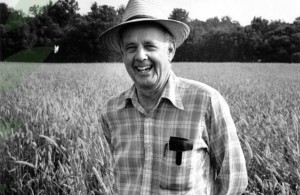
If we apply our minds directly and competently to the needs of the earth, then we will have begun to make fundamental and necessary changes in our minds. We will begin to understand and to mistrust and to change our wasteful economy, which markets not just the produce of the earth, but also the earth’s ability to produce. We will see that beauty and utility are alike dependent upon the health of the world. But we will also see through the fads and the fashions of protest. We will see that war and oppression and pollution are not separate issues, but are aspects of the same issue. Amid the outcries for the liberation of this group or that, we will know that no person is free except in the freedom of other persons, and that man’s only real freedom is to know and faithfully occupy his place – a much humbler place than we have been taught to think – in the order of creation.–Wendell Berry (page 89, “Think Little”)” (The Art of the Commonplace: The Agrarian Essays of Wendell Berry)

Photo courtesy of Festival of Faiths.

Never miss a post
Name: 
Your email address:*
Please enter all required fields
Correct invalid entries