Jonell Galloway grew up on Wendell Berry and food straight from a backyard Kentucky garden. She is a freelance writer. She attended Le Cordon Bleu and La Varenne cooking schools in Paris, worked for the GaultMillau restaurant guide, CityGuides and other restaurant guides in France and Paris, and for Gannett Company in the U.S., and collaborated on Le tour du monde en 80 pains / Around the World with 80 Breads with Jean-Philippe de Tonnac in France; André Raboud, Sculptures 2002-2009 in Switzerland; Ma Cuisine Méditerranéenne with Christophe Certain in France, and a biography of French chef Pierre Gagnaire. Before moving to Switzerland, she ran a cooking school called Spontaneous Cuisine in France, and in the U.S., a farm-to-table restaurant called The Three Sisters, which she owned with her two sisters. She organizes the Taste Unlocked bespoke food and wine tasting awareness workshops with James Flewellen, a wine tasting specialist. She is an active member of Slow Food and runs the food-writing website and Facebooks pages under the moniker The Rambling Epicure. Her work has been published in numerous international publications and broadcast on public radio.
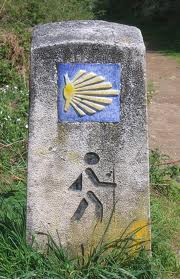
In Paris to the Pyrenees, David Downie takes us right along with him on the Way of St. James, without our ever leaving our armchairs. As stated in the subtitle, “A Skeptic Pilgrim Walks the Ways of St James,” we’re not talking about a conventional pilgrim, so we don’t expect his transformations to be like those of traditional Christians. But then, the Way of St. James, like so many pilgrim routes in the world, becomes a spiritual journey spreading well beyond the confines of Christianity.
Downie makes it a personal journey, full of the classical culture and history he knows so well, and we have the pleasure of experiencing it along with him. His journey through classicism and French history becomes ours, as we learn about the Druids, the Galls, the Romans, former French President François Mitterand, and much more; as he carries around a stone he was convinced had magical power because it looked like a scallop shell, until it becomes too heavy to carry; as we wolf down hearty French meals and sup coarse local wine after a long day of walking, before we fall like a stone into bed.
And though we might not receive penance, we end the journey all the richer in knowledge, having read a good tale, too. The book is a latter-day Canterbury Tales, with a varied lot of pilgrims, locals, and farmers all along the way. Alison Harris’ photos are in perfect harmony with Downie’s narrative. You’ll want to wear a scallop shell around your neck after reading this book.
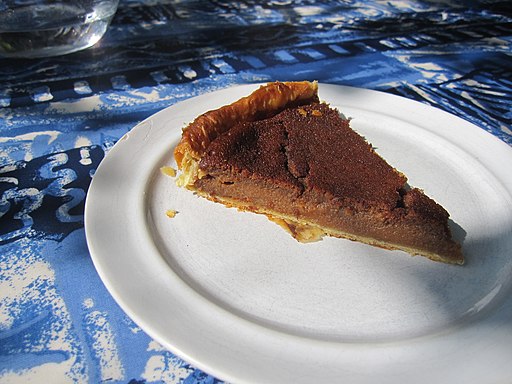
Swiss Food: Tarte à la Raisinée – Apple and Pear Molasses Pie
What is Swiss Raisinée?
The French-Vaudois word raisinée refers to a syrup or molasses made of the must of apples and pears. It was originally cooked in grape juice, thus the name — raisin means grape in French. Often called vin cuit, or “cooked wine,” it is in the form of a dark brown, viscous liquid. In still other parts of Switzerland, another concoction similar in consistency to jam and using the same ingredients is called cougnarde and probably dates back to at least the Middle Ages. Raisinée was used as a sweetener in many regions in Europe, and the tradition has lingered in Switzerland, especially in the cantons of Vaud, Fribourg and Neuchâtel. Today, it is mainly used for cakes and pies, and is not fermented, so it not technically a wine.
The tart itself has numerous names — raisinée, vin cuit (literally cooked wine), cougnarde and Biresaassa, depending on the location.
This recipe is inspired by Concert des Casseroles and translated with their authorization
Use a pie ring or pie tin 24 cm in diameter
Sweet Pie Crust
200 g of flour
100 g butter
3 g of fine salt
15 g walnut or hazelnut nillon* (here a mixture in equal parts)
1 small egg (less than 60 g)
60 g white sugar
Filling
3 eggs
2 egg yolks
200 g double cream
150 g pear raisinée (click on link to see our recipe for making raisinée)
Dough: Combine the butter and sugar. Add the beaten egg and walnut/hazelnut nillon, then flour, mix and form into a ball, then roll out or pat down to flatten. Wrap in plastic and chill for 30 minutes.
Spread the dough on a sheet of baking paper and place it along with the sheet in a pie ring or pie pan. Shape the edges by pinching the dough between your thumb and forefinger. Prick the bottom and edges with a fork. Cool for 30 minutes to firm up and avoid sagging when cooking.
Preheat oven to 180° C. Place baking paper and beans or ceramic beads on the dough to prevent it from swelling. Bake for 20 minutes: the dough should barely brown.
Meanwhile, prepare the filling by mixing the eggs and yolks, the double cream and the raisinée.
Remove dough from oven. Remove weights and parchment paper. Lower thermostat to 150°C.
Pour the filling into the dough and cook for about 30 to 40 minutes. The filling must be taken when it is not too firm and must have a slightly caramelized smell. It will probably still appear liquid when it comes out of the oven, but do not prolong the cooking, as it gets much firmer while it is cooling.
*Nillon: Nillon (or nion), is a local product used in French-speaking Switzerland. It is the residue from pressing of nuts. It is found in sheets, grated or powdered form. There are walnut and hazelnut nillons packaged in small 160-gram bags. In the canton of Vaud (Switzerland), nillon is used to make a walnut cake and apple pie. In France, it is known as walnut flour or walnut meal.
I’m Jonell Galloway, a freelance food and travel writer, editor and consultant.
I created The Rambling Epicure in 2011. It is a daily international food ezine, joining the voices of professional food and travel writers from around the world who talk about the art of mindful and sustainable eating, drinking, traveling and living, with an emphasis on good writing and spectacular photos by some of the best in the business.
Based in Switzerland, The Rambling Epicure food writers and artists promote a mindful, responsible approach to real food shopping, cooking, and eating, as well as food politics, safety, history, art, literature and philosophy.
We sponsor this non-profit project through freelance writing, editing and publishing; custom-tailored culinary tours, cooking classes, and tasting events; recipe development and testing; book reviews and sales of recommended books and products, and seminars and workshops on the various subjects we cover. Thank you for supporting us by clicking the Sponsor Us button in the right-hand sidebar.
My Personal Profile
You can learn more about my personal career path in my LinkedIn profile. I’ve been rambling around the world eating food and writing about it for over 30 years now, so there’s a lot to tell.
I ramble mainly in Switzerland and Europe, looking for good food and restaurants. My articles are available on TheRamblingEpicure.com, 10Best.com/USAToday, GenevaLunch.com, Paris Voice and TheRamblingEpicure.tumblr.com.
I studied cooking at the Cordon Bleu and La Varenne in Paris, and wine tasting here, there and everywhere in France and at CAVE S.A. in Geneva and Gland. In France, I worked for some years as a contributing editor for the English edition of the GaultMillau guide and as a food translator, while I ran a small cooking school in a château near Paris. I now live in Switzerland, where I have learned to love the earthy Swiss food and wine. One of my many interests is promoting Les Artisanes de la Vigne et du Vin as an ambassadress for this Swiss women wine producers association and Slow Food, of which I am an active member.
Apart from various restaurant guides for France and Switzerland recently published books include: Ma Cuisine Méditerranéenne in collaboration with Christophe Certain (in France) and Le tour du monde en 80 pains / Around the World with 80 Breads published by Orphie, in collaboration with Jean-Philippe de Tonnac (part of the French and all of the English) (covers history of bread around the world), André Raboud (Swiss sculptor), Edipresse.
My cooking method is “spontaneous cuisine.” Lessons consist of writing out a tentative menu based on seasonal, local products; going shopping for the products, and adapting the menu according to what is available and fresh; going to the wine seller to select a wine to go with the menu, then going home and cooking all afternoon with my students. The day ends with a candlelight dinner at the château (in the past), and now, at my chapel converted into a house in Chartres or in your home.
I give Mindful Eating seminars and therapy for those who have problem relationships with food and eating in general, helping them reconstruct their lifestyle and relationship to food and eating.
Specialties: French, Swiss and Italian cuisine with a bit of American influence. I believe in healthy, natural, sustainable cooking in the spirit of Slow Food, so all my articles, recipes and classes have this emphasis.
Alice Herz-Sommer died on Sunday, March 2, 2014, at her home in London, at the age of 110. She was the oldest known survivor of the Holocaust.
Mrs. Herz-Sommer was a concert pianist in her native Czechoslovakia before the war, and said that it was Frédéric Chopin who had “fed” both her and her audiences in over a hundred concerts she gave in her two years in the ghetto-concentration camp in Theresienstadt. She spent most of her time perfecting Chopin’s Études, a set of 27 solo pieces known for their technical innovation and sheer mechanical difficulty. Chopin became her food; it nourished her soul.
Images from the book The Garden of Eden in Hell. Photograph: Droemer (C)
In Theresienstadt, her son would often ask her, “Mother, why don’t we have anything to eat?” She believed human beings don’t need food when they have something spiritual. “The concerts, the music was our food.” But wasn’t it painful to not have food? “No, I was always laughing,” although she slept on a stone slab floor with no covers and no pillow.
If she could play the piano, she was happy. She was glad to be alive with her son; her concerts ensured that she and her son would survive. Her secret to happiness was to be thankful, thankful for everything. Thankful for seeing the sun, for seeing a smile, for a nice word from someone. Everything we experience is a gift; we have to be thankful for it all, was her philosophy.
She learned Bach by heart. When she got cancer at 83, her doctor told her that knowing Bach by heart was more healing than all the pills she could take.
Sometimes she was thankful to have been at Terezin. “We all learn from mistakes.” Bad has to exist, she said with a smile, always a smile. I lived my life backwards, looking back at all the beautiful and wonderful things I have had.
And she learned from the bad, saying hatred eats the soul of the hater. Reminiscent of the Dalai Lama, she said complaining is a waste of time. “I know about the bad, but I only look at the good things.” Everything you receive is a present and arises out of how you look at the world.
She never hated, not even the Nazis, saying that we all do wrong sometimes: forgiveness of the ultimate sort.
Until virtually the end of her life, she practiced for three hours every day, and it is what helped her survive the death of her son Raphael in 2001.
Music was the food of her soul, and her music fed the souls of so many. It kept them living when they had no food to eat. Her music continues to resonate, as does her example as a human being. She continues to nourish us, even though only in spirit.
Why don’t we have anything to eat, Mommy? Not to worry, we have music. Paraphrasing Shakespeare, “if music be the food of life, play on.”
Now that Christmas and the New Year have passed, my neighbors here in Costa Rica are putting away lights, ornaments, Styrofoam snowmen, straw reindeer and faux pine trees. For the family Sunday mid-day meal many are dining on tamales.
Tamales are stuffed cakes of corn dough, masa harina, wrapped and steamed. In Costa Rica, they are an art form as well as a common food. Tamale making is a seasonal family affair. Multiple generations of family cooks assemble pork or chicken, vegetables – mostly carrots and peas, and herb fillings artistically in rectangular packets of freshly made cornmeal, wrap them in folded plantain leaves and tie them decoratively with reeds or twine. They are traditionally given to neighbors at Christmas. It is an economical and egalitarian way for friends to exchange similar thoughtful gifts without the adversarial “can you top this” attitude that pervades gift giving in some other cultures.
In Colombia and Venezuela, they are called hallacas and may contain raisins or olive pieces. In Mexico, they are wrapped in dry corn- husks. Cuban tamales are fluffier and spicy. When the same ingredients are layered and baked without a wrapper, the result is tamale pie. Tex-Mex tamale pie usually is laced with red and green chili peppers.
Hallaca leaves drying to make Venezuelan version of tamales
Tico (Costa Rican) tamales freeze well. They are most often tied together in groups of four. Tamales are steamed or simmered before eating, but they can go from freezer to table via the microwave in about two minutes and rekindle holiday warm fuzzy feelings and a delicious sense of community. Buen provecho and a happy and healthy 2014.
A weekend in the Trastevere neighborhood of Rome lets you live and feast like a real Roman, if only for a short time. It is rich in history and culture, and plenty of fun and good food to boot. A little hotel we’ve found near Piazza Santa Maria will let you melt into this hidden corner of Rome.
A Little History about Trastevere
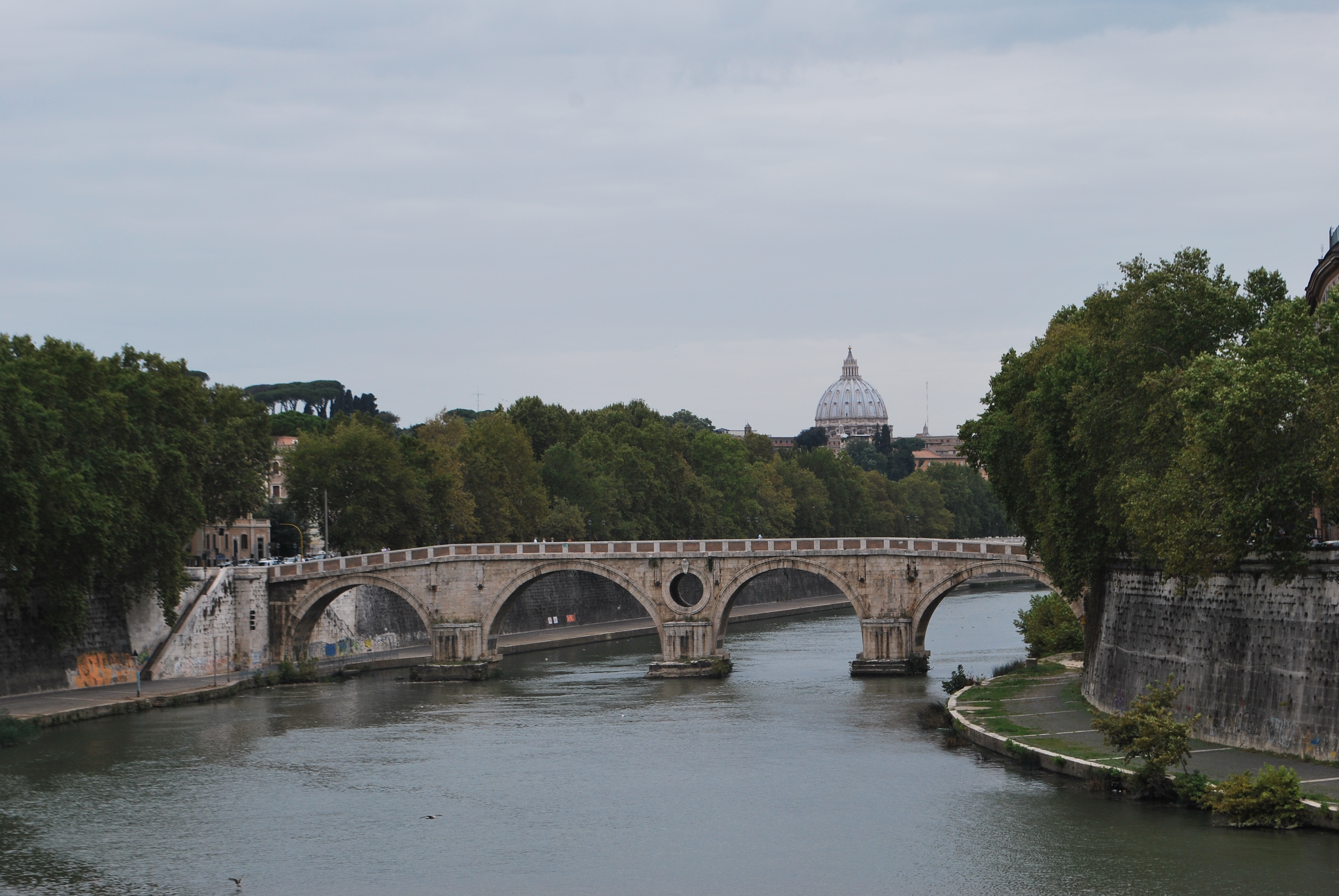
This side of the Tiber was Etruscan, until the Romans claimed it around the 6th century B.C. It was incorporated into the city of Rome’s 14 quarters by the Emperor Augustus with the “Trans Tiberim.” Thus the name, which means “across the Tevere,” the Roman name for the Tiber.
It was a plebian quarter, where the servants and laborers and the free citizens of Rome’s as well as sailors, fishermen, Phoenicians and Jews lived. It would be the principal Jewish quarter of Rome until the end of the Middle Ages, when the Ghetto, across the river from Trastevere, became the residential area to which Jews were henceforth restricted.
Renaissance Romans began building more noble villas around the edges of the ancient quarter, but the Trastevere of today retains its medieval, labyrinthine layout, full of narrow, winding alleys. It remains a working class neighborhood, with children playing soccer in the street, old people sitting on their stoops, and families gathering around a table in the street to visit. Trastevere lies between the western banks of the river Tiber and the Janiculum hill, one of Rome’s storied seven hills, that looms above it. It’s but a short 15-minute walk across the Tiber to the ruins of ancient Rome, the “salon” of Rome with its extravagant fountains, and only a little bit further by foot to St. Peter’s Square and the Vatican. One of the liveliest gathering places is the square in front of the church of Santa-Maria-in-Trastevere, construction of which began early in the 3rd century with the church completed in the mid-4th century, and ultimately completed in Romanesque style in the 12th century, then converted in several other centuries, giving it an unusual combination of Ancient Roman details and varied architectural features from later periods. The octagonal fountain in the piazza is an ancient Roman fountain restored and enlargened in the 17th century by Carlo Fontana.
Santa Maria with church, with ancient Roman foundation in center. The piazza is full of life at night.
What to See and Do in Trastevere
The Church of Santa Maria in Trastevere
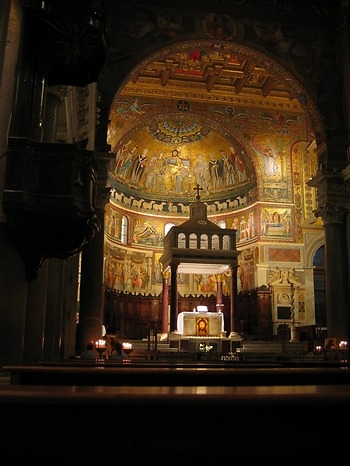
Santa Maria in Trastevere is undoubtedly the oldest church in Rome, and deserves several visits if you want to appreciate its full architectural and historical depth. Most of the mosaics date from the 12th century. They are illuminated at night, and the golden light of the façade fills the piazza with a warm glow.
12th-century gold mosaics in Santa Maria in Trastevere
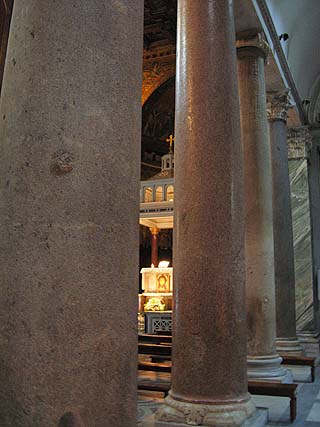
The 22 granite columns lining the nave are said to have come from the ruins of the Baths of Caracalla; the capitals are adorned with the heads of female pagan deities.
Numerous Roman funeral inscriptions can also be found in the church.
Eating and Nightlife
There is no shortage of reasonably priced osterie, trattorie and restaurants that serve authentic Roman food in a no-frills setting. The neighborhood is timeless, with its mix of historical architectural periods and lively local residents; it remains quintessentially Roman. If you want to pretend you’re Roman for a weekend, this is the place to do it.
Old cellars and stables have been converted into bars, discos and cafés, providing a lively nightlife scene, with customers spreading out into the streets when the weather is fine.
Signs like this demonstrate the colorful character of the locals, and offer contrast to our notion of contemporary, ultra-chic Italy.
Sidewalk cafés and restaurants preserve the romantic character of Old Italy, spilling out onto the streets. My favorite source of restaurants in Rome is David Downie’s Food Wine Rome. David is half Roman, and sees food through the eyes of a Roman. His recommendations are all about the authentic and the unpretentious, and you’ll seldom find tourists in the places he recommends.
Hotel
While the Hotel Santa Maria is located in the very heart of the vibrant Santa Maria neighborhood just steps from the piazza, within the walls of this converted 16th-century convent, it’s so quiet and peaceful that you may think you’re staying in a remote Tuscan country house. The renovation is simple, but tasteful, with classic Roman terracotta floors and well-fitted bathrooms. Bedroom furnishings are tasteful, solid-wood reproductions. Almost all rooms are on the ground floor and give onto the courtyard. The few that do have a room above them (near the rooftop terrace) are not so quiet due to the tile floors. Otherwise, the clientele is quiet and respectful.
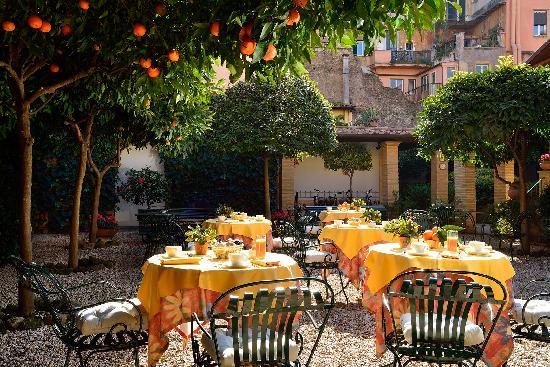
Courtyard with orange trees where you can eat breakfast or have a drink
One enters the hotel courtyard through a large, locked iron gate, so security is good. The L-shaped convent-cum-hotel with an inner courtyard enclosing a small orange grove boasts wrought-iron tables and chairs for leisurely sitting in the sun or eating breakfast when weather permits. The breakfast room is in a converted cellar, with breakfast consisting of an international and Italian buffet with something to suit everyone, offering freshly squeezed orange juice and coffee from a professional espresso machine.
The small rooftop terrace is furnished with chic wooden lounge chairs and armchairs. It’s a great place to have a drink before dinner, read in the early evening, or sunbathe during the day. The view of the surrounding rooftops and balconies of Trastevere is a photographer’s dream. All rooms have satellite television and air conditioning, as well as Wi-Fi, which can sometimes be unstable. Bikes are available for rental at the reception.
How to Get There
If you’re flying, take the train from the Fiumicino Leonoardo da Vinci airport station to the Trastevere station, about a 30-minute train ride, then take a cab, which should take about 10 minutes. This should cost around 15 Euros all-inclusive, versus approximately 50 Euros with tip for a cab direct from the airport. A cab ride from the Termini train station to the hotel should cost around 15 Euros. The hotel is lost in a winding street and difficult to access by car. Even taxi drivers get confused with all the one-way and dead-end streets. Study your map and know the names of the surrounding streets and squares, because the driver may be forced to let you off in another street around the corner from the hotel.
Practical Info
Reservations: http://www.htlsantamaria.com Address Vicolo del Piede 2 – 00153 Rome – Italy Tel. (39) 06 5894626 – Fax: (39) 06 5894815 Click here for map: Map to Hotel Santa Maria
Jonell Galloway grew up on Wendell Berry and food straight from a backyard Kentucky garden. She is a freelance writer. She attended Le Cordon Bleu and La Varenne cooking schools in Paris and the Académie du Vin, worked for the GaultMillau restaurant guide and CityGuides in France and Paris and for Gannett Company in the U.S., and collaborated on Le tour du monde en 80 pains / Around the World with 80 Breads with Jean-Philippe de Tonnac in France; André Raboud, Sculptures 2002-2009 in Switzerland; Ma Cuisine Méditerranéenne with Christophe Certain in France, At the Table: Food and Family around the World with Ken Albala, and a biography of French chef Pierre Gagnaire. She ran a cooking school in France, and owned a farm-to-table restaurant, The Three Sisters’ Café, with her two sisters in the U.S. She organizes the Taste Unlocked bespoke food and wine tasting awareness workshops with James Flewellen, is an active member of Slow Food, and runs the food writing website The Rambling Epicure. Her work has been published in numerous international publications and she has been interviewed on international public radio in France, Switzerland, and the U.S. She has just signed on at In Search of Taste, a British print publication, and is now working on two books, What to Eat in France and What to Eat in Venice.
Food Art: Still Life with Mouse, by Giovanna Garzoni (Italian Baroque Era Painter, 1600-1670), Rome
Garzone was one the first women painters to paint still lifes. Collectors loved her work, and she was able to immediately sell all she produced at just about any price she named. Garzone painted on vellum. She worked mainly for aristocratic patrons, such as the Medici family, and often took decorating commissions in their villas and palaces. She was most likely influenced by Jacopo Ligozzi, who was a botanical and zoological painter for the Medici court. Garzoni bequeathed all her work to the painters’ guild in Rome, the Accademia di San Luca, in exchange for the right to be buried there. Source: Getty Museum
Gareth has an incredible network of people who follow his every move. His whole family – and most of his friends — share his fervor for food. His dedication to an honest cuisine is matched by few. He is the epitome of what the French call “passionné”: unfaltering in his eternal search for the best quality ingredients at a fair price; willing to go to distant places and lose countless hours of sleep to find the perfect products. Whether it’s cooking and scrubbing pans with a Nonna in a hidden corner of Italy or crossing the Channel on a Sunday morning to buy fresh shellfish in Boulogne – to be served up fresh on his lunch table in London — his devotion to his “cause” is virtually boundless.
But Gareth’s blood can run hot when it comes to food and his vision of it. He is lucid about what he likes and what he doesn’t like and his sense of ethics and justice make him look on this world like the Egyptian goddess Ma’at with her scales of justice, weighing the “hearts” of products to decide whether they are balanced and good enough to go to his version of food heaven.
Gareth Jones’s tastes were not formed overnight. He grew up on a farm in Wales, in the middle of fragrant orchards and gardens. The surrounding woods and pastures were his playground. He is a man of the earth. The scents, tastes and sensory experiences of these days gone by make up an essential part of who he is and how he relates to the world, in particular to food: rustic yet refined, never losing sight of his roots.
When from the distant past nothing remains, after the beings have died, after the things are destroyed and scattered, still, alone, more fragile, yet more vital, more insubstantial, more persistent, more faithful, the smell and taste of things remain poised a long time, like souls, ready to remind us, waiting and hoping for their moment, amid the ruins of everything else; and bear unfaltering, in the tiny and almost impalpable drop of their essence, the immense architecture of memory.
Yet again I had recalled the taste of a bit of madeleine dunked in a linden-flower tea which my aunt used to give me (although I did not yet know and must long await the discovery of why this memory made me so happy), immediately the old gray house on the street where her room was found, arose like a theatrical tableau…
–Marcel Proust, Du côté de chez Swann (1913) in: À la recherche du temps perdu vol. 1, p. 47
Proust’s face engraved on a Madeleine
Gareth is a living temple of Proust’s perception of the sensory experience that is life, with food as its altar. His devotion is boundless, and he surrounds himself with writers who share his zeal and dedication. There’s no better recipe for editing a food magazine.
Yet, there’s a lot of country gentleman mixed into his formula, which takes him a long way from Proust’s decadence. Thus the term he coined, “Blue Collar Gastronomy,” inspired by a visit to the Leclerc supermarket in Boulogne-Outreau – “often frequented by working class people the majority of whom are below average education and a town where unemployment is in the high teens if not +20%,” says Jones. As he was filling his trolley, he noted how intelligently and carefully the locals were filling theirs. You might never have known it was a poor, run-down, even sad, place if you looked at the contents, fit for a minor Roman feast.
The smells and tastes of the world have indeed been poised for a long time in Jones’s mind, but time has not been lost. His life has been a fine weave of the senses and food, which makes for dishes that have real taste, that are authentic and lacking all pretentions. He is a master at finding the crème-de-la-crème for even the simplest food purchase, even a chicken carcass for making soup and broth. In the words of Pete Seeger, “Any darn fool can make something complex; it takes a genius to make something simple.” And this is what Gareth Jones has understood and mastered.
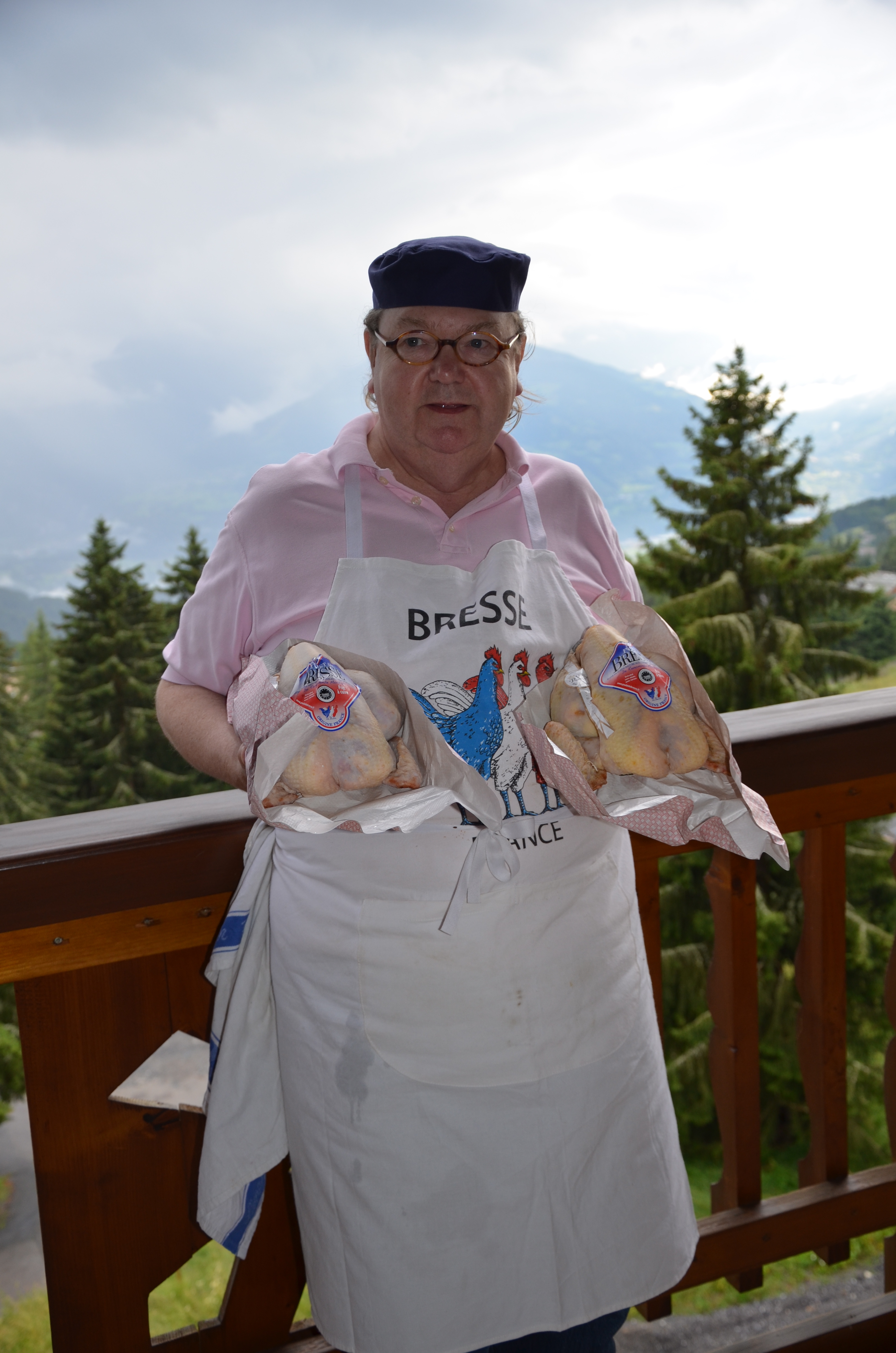
On a sunny day in August, Gareth made poulets de Bresse, the prince of all chickens. He and his family had made a special detour to Bresse on their drive from London to our mountain home in Villars-sur-Ollon just to buy the chickens. To start the work, he put on his chef’s hat and apron – the one you see in all the photos — only to spend hours in the kitchen, smiling and giggling at their beauty all the while, patting them on the breast as if they were a much-loved child. His treatment of the “little princes” was itself princely and full of the respect they deserve. You would have thought it was a beast epic and that they were whispering to the chef, giving him instructions on how to proceed, but no. Gareth is the chicken whisperer and knows what they want and need. He knows the beauty of keeping it simple and letting the natural tastes come to the foreground. Bresse chickens will never be the same.


 Paris to the Pyrenees: A Review of David Downie’s Book
 Paris to the Pyrenees: A Review of David Downie’s Book