Do you know this painting? Well, here’s the recipe

Published by Friday, July 1, 2011 Permalink 0

by Miriam Garcia

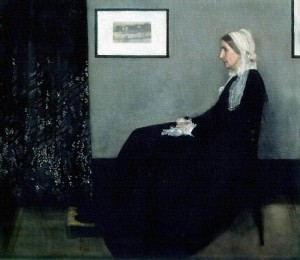
Do you know this painting?
Photography by courtesy of Wikimedia Commons

Its formal name is Arrangement in Grey and Black: The Artist’s Mother, but it is commonly known as Whistler’s Mother. Its creator, American artist James McNeill Whistler, happens to be one of my (many) favorite painters. In August 1995, while on vacation in London, I stumbled upon a little book with this painting grazing its front cover. It was Whistler’s mother’s cookbook, with the recipes collected by Anna McNeill Whistler (1804-1881) through the years. The recipes are recreated and annotated for the modern cook, but included the endearing original writing of Mrs. Whistler, with all its own spelling and punctuation errors. Go figure, a book that coupled two of my most serious addictions, cooking and painting. I had to buy it.

Whistler’s mother’s recipes were among a collection of books and letters that were bequeathed by Whistler’s sister-in-law to the University of Glasgow after his death. Whistler lived in Europe most of his working life. Mrs. Whistler led quite a remarkable life herself for a 19th-century housewife; she went from the United States, via Russia and sudden widowhood at a young age, to London with her son, where she recorded in her diaries visits to the Whistler household from such artists as Algernon Swinburne and Dante Gabriel Rossetti. The book’s fascinating account of the Whistler household in America, Russia and Britain offers a unique and delightful glimpse into 19th-century family life and cooking. The recipes are simple and transmit the flavors and aromas of good home cooking.

As a token of that age and to bring to the pressed 21st century some 19th century calm and simplicity, I have chosen to replicate a recipe of her apple pudding, called Marlborough pudding.

RECIPE

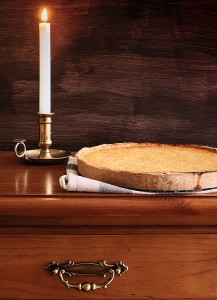
Apple Marlborough Pudding
Ingredients:

1 sheet of store-bought or homemade puff pastry or shortcrust
5 medium-sized cooking apples
1 lemon, juice and peel

200g (1 cup) sugar
5 medium eggs

200ml (4/5 cup) whipping cream
50ml (1/5 cup) whole milk

Click here for metric recipe converter

Method:

  1. Preheat the oven to 180°C if convection type, to 160°C if radiation.
  2. Prepare the pudding base: butter and flour a 30-cm (12inch) pie mold. Roll the crust, transfer to the mold and press to set. Trim the excess off the edges. Bake the crust blind for 10-15 minutes. Then take out of the oven and let cool a bit. Lower the oven temperature 20°C.
  3. Prepare the filling. Peel and core the apples, sprinkle them with lemon juice to prevent them from browning. Put them in a bowl, cover and microwave them 3-4 minutes, until tender.
  4. Transfer the apples to a food processor, add the rest of the ingredients: lemon juice and peel, sugar, cream, milk and eggs. Process to the desired “chunkiness”.
  5. Pour the mixture on the pie crust (this amount yields a large pie and a small cup of filling left) to the brim, then bake 1 hour. Watch it during the last stages to prevent it from excessive browning; lower the temperature if needed. After that baking time, take the pudding out and let cool completely.


I personally loved this Marlborough pudding. I love any dessert with apple though (well, except roast apples). It is lemony, creamy, light and only slightly crunchy. And as rustic and homely as I expected. Accompany it with a strong tea and open a snuff box for you to feel exactly like Whistler. And the next time you see this painting I’m sure you will remember that this lady baked delicious pies for her family.

Sources:
“Whistler’s mother and the West Coast”, BBC website
Whistler’s Mother Cook Book, Margaret McDonald

The Scottish Roots site says:

This unconventional portrait of a grey-garbed matron, commonly known as “Whistler’s Mother,” patiently sitting for her artistic son became an American icon and an emblem of motherhood. The subject of the painting, Anna Matilda McNeill Whistler, was born in North Carolina in 1804 to a middle class family of Scots descent.

Anna led a remarkable life for a 19th-century housewife; moving from the United States, via Tsarist Russia and sudden widowhood at a young age, to London with her son “Jemsie,” where she recorded in her diaries visits to the Whistler household from such literary and artistic luminaries as Algernon Swinburne and Dante Gabriel Rossetti. A traditional woman with a strong sense of morality, Anna Whistler upheld the conventional family values of the time, turning a blind eye to her artistic son’s bohemian amorous involvements in favour of encouraging his genius.

Widowed in 1849, she wore mourning for the rest of her life.

The book’s fascinating account of the Whistler household in America, Russia and Britain offers a rare and delightful glimpse into 19th-century family life and cooking. The recipes are simple and transmit the flavors and aromas of good home cooking.

Never miss a post
Name: 
Your email address:*
Please enter all required fields
Correct invalid entries

Food Art: Classic Spanish octopus, food photography by Steve Homer

Published by Thursday, June 30, 2011 Permalink 0

Our ongoing series of tapas photos from our latest food artist discovery: food photographer Steve Homer of Sabor de Almería in the southeast of Spain.

Never miss a post
Name: 
Your email address:*
Please enter all required fields
Correct invalid entries

Crónica de españa – Mujeres y consumo de vinopor

Published by Wednesday, June 29, 2011 Permalink 0

por Raquel Pardo

This article is currently being translated into English

Ellas piden, ellas deciden

“¿Qué buscan las mujeres en un vino? Lo mismo que los hombres: vinos con carácter, interés y a buen precio. Si usted cree que prefieren Chardonnays glicéricos antes que Zinfandels con mucho cuerpo, piénselo dos veces.”(Agi Toth, educadora vinícola).

Continue Reading…

Never miss a post
Name: 
Your email address:*
Please enter all required fields
Correct invalid entries

Rosa’s Musings: My Swiss Grandmother’s Cooking: the Deep Roots, Bonds and Nostalgia of Food

Published by Tuesday, June 28, 2011 Permalink 0

by Rosa Mayland

My Swiss Grandmother and Her Glorious Cuisine

“As a grandmother of six, I believe that it is crucial that we make time to pass on our recipes, cooking and growing skills and other crafts to our grandchildren.”— Darina Allen, president of Slow Food Ireland

Grandmothers link us to our culinary heritage

In our modern world, most women choose or have to work, and countless couples don’t have the time or energy to become kitchen bees. Many people prefer buying prepackaged food and don’t see any point in spending their free time preparing homemade snacks. The majority of 21st-century grandmothers hail from a generation of females who cut themselves off from old traditions, therefore nowadays, very few kids are lucky enough to have grandmothers* who cook or enjoy cooking, and who are able to share their family’s culinary legacy with their grandchildren.

Continue Reading…

Never miss a post
Name: 
Your email address:*
Please enter all required fields
Correct invalid entries

Food Art: Spanish beach bar food: prawn & monkfish kebabs, food photography by Steve Homer

Published by Tuesday, June 28, 2011 Permalink 0

Our ongoing series of tapas photos from our latest food artist discovery: food photographer Steve Homer of Sabor de Almería in the southeast of Spain.

Never miss a post
Name: 
Your email address:*
Please enter all required fields
Correct invalid entries

Food Play: Saint John’s Coca, a Catalan specialty

Published by Monday, June 27, 2011 Permalink 0

by SandeeA

Para leer la versión en español, pinche aquí

Food Play: Saint John's Coca, a Catalan specialty. Food Play, by SandeeA. The Rambling Epicure. Editor, Jonell Galloway.

Saint John’s coca is a typical Catalonian sweetened bread eaten during the celebration of Saint John’s Eve in June. It is usually oval, but I wanted to give it a a playful twist… would you like to try some?

Continue Reading…

Never miss a post
Name: 
Your email address:*
Please enter all required fields
Correct invalid entries

Simon Says: Daily Food Quote, June 24, 2011

Published by Friday, June 24, 2011 Permalink 0

by Simón de Swaan

Food is a subject of conversation more spiritually refreshing even than the weather, for the number of possible remarks about the weather is limited, whereas of food you can talk on and on and on. Moreover, no heat of controversy is induced by mention of the atmospheric conditions (seeing that we are all agreed as to what is a good day and what is a bad one) and where there can be no controversy there can be no intimacy in agreement. But tastes in food differ so sharply…that a pronounced agreement in them is of all bonds a union the most intimate. Thus, if a man hates tapioca pudding he is a good fellow and my friend.–A. A. Milne, “Lunch” (1934)

Alan Alexander Milne was an English author, best known for his book about a teddy bear named Winnie the Pooh.

Never miss a post
Name: 
Your email address:*
Please enter all required fields
Correct invalid entries

Food Art: Spanish sea bream composition, food photography by Steve Homer

Published by Friday, June 24, 2011 Permalink 0

Our ongoing series of tapas photos from our latest food artist discovery: food photographer Steve Homer of Sabor de Almería in the southeast of Spain.

Never miss a post
Name: 
Your email address:*
Please enter all required fields
Correct invalid entries

Simon Says: Daily Food Quote, June 23, 2011

Published by Thursday, June 23, 2011 Permalink 0

by Simón de Swaan

I must….descant a little upon the mint-julep, as it is, with the thermometer at 100 degrees F., one of the most delightful and insinuating potations that ever was invented, and may be drunk with equal satisfaction when the thermometer is as low as 70 degrees.–Captain Frederick Marryat’s diary (1838)

Captain Frederick Marryat (July 10, 1792 – August 9, 1848) was an English Royal Navy officer, novelist, and a contemporary and acquaintance of Charles Dickens, noted as an early pioneer of the sea story. He is now known for a widely used system of maritime flag signaling.

Click here for a mint julep recipe.


Never miss a post
Name: 
Your email address:*
Please enter all required fields
Correct invalid entries

Simon Says: Daily Food Quote, June 22, 2011

Published by Wednesday, June 22, 2011 Permalink 0

by Simón de Swaan

He who receives his friends and gives no personal attention to the meal which is being prepared for them, is not worthy of having friends.–Jean-Anthelme Brillat-Savarin (April 1, 1775 – February 2, 1826) The Physiology of Taste

Jean-Anthelme Brillat-Savarin, a French lawyer, magistrate, and politician, wrote one of the most celebrated works on food, Physiologie du goût (The Physiology of Taste), which was published only months before his death.


Never miss a post
Name: 
Your email address:*
Please enter all required fields
Correct invalid entries

UA-21892701-1