The Many Names for Tamales

Published by Friday, February 28, 2014 Permalink 0


The Many Names for Tamales

by Lenny Karpman

Now that Christmas and the New Year have passed, my neighbors here in Costa Rica are putting away lights, ornaments, Styrofoam snowmen, straw reindeer and faux pine trees. For the family Sunday mid-day meal many are dining on tamales.


MasaHarine


Tamales are stuffed cakes of corn dough, masa harina, wrapped and steamed. In Costa Rica, they are an art form as well as a common food. Tamale making is a seasonal family affair. Multiple generations of family cooks assemble pork or chicken, vegetables – mostly carrots and peas, and herb fillings artistically in rectangular packets of freshly made cornmeal, wrap them in folded plantain leaves and tie them decoratively with reeds or twine. They are traditionally given to neighbors at Christmas. It is an economical and egalitarian way for friends to exchange similar thoughtful gifts without the adversarial “can you top this” attitude that pervades gift giving in some other cultures.

Homemade tamales


In Colombia and Venezuela, they are called hallacas and may contain raisins or olive pieces. In Mexico, they are wrapped in dry corn- husks. Cuban tamales are fluffier and spicy. When the same ingredients are layered and baked without a wrapper, the result is tamale pie. Tex-Mex tamale pie usually is laced with red and green chili peppers.

Hallaca Leaves Drying (CC)

Hallaca leaves drying to make Venezuelan version of tamales


Tico (Costa Rican) tamales freeze well. They are most often tied together in groups of four. Tamales are steamed or simmered before eating, but they can go from freezer to table via the microwave in about two minutes and rekindle holiday warm fuzzy feelings and a delicious sense of community. Buen provecho and a happy and healthy 2014.


Never miss a post
Name: 
Your email address:*
Please enter all required fields
Correct invalid entries

The 7 Lives of Bread

Published by Wednesday, September 4, 2013 Permalink 0


The 7 Lives of Bread

by Jean-Philippe de Tonnac

Translated from the French and adapted by Jonell Galloway. Cliquez ici pour la version française.

If you ask an artisan bread baker who is passionate about his work from where he derived his passion, he or she will almost invariably reply, with no hesitation, that it arose out of the “mystery of the fermentation.” Did you know that bread is the result of an alcoholic fermentation, and the baker therefore actually manufactures alcohol? Now how does that come about, you might ask?* (If you’re interested, read the very technical footnote below.)


It’s not really surprising that a bread baker shares the wine maker’s penchant for the processes of “alteration,” “deterioration,” and “transformation,” which make them both somewhat sorcerers, metaphorically speaking. While a baker talks about bread fermentation, the wine maker continually refers to “maceration,” and the cheese maker to “maturation.” But whether it consists of alcoholic or lactic fermentation, we are still talking about transubstantiation, a sort of “sacrament,” which creates an aura without parallel around these “artists”. They are aware of this, and they know it is at the very heart of their art. Bread baker, cheese maker, wine maker: they all fight the same battle, that of transformation of food, of true metamorphosis.

When does dough become bread?

At the same time, at what point in this long sequence of processes does the product we actually consume merit the name “bread”? This is not an easy question.

In most of our minds, bread is a loaf or a baguette; it is ciabatta in Italy and pumpernickel in Germany. In Iran, they call it sangak, in Denmark, rugbrød, in Jamaica, bammy, eaten straight out of the oven.

Can we call the fat roll of dough after kneading and shaping or left to rise “bread”? Is the dough left to ferment in the dough trough not already bread?

The large sacks of flour that the miller delivers every morning, are they not, in some ways, already bread? Is a grain that we mill, or even a seed that we plant, not bread? Is leftover bread, bread we let dry, whether on purpose or not, and that we use to make croutons for a thick winter’s soup that we lap up like a Jacques Brel song, not also bread?

This 7 Lives of Bread column will explore every facet of bread, walking you through all the phases of transformation, from seed and grain to the end product you savor.

The 7 Lives of Bread will trace the life of a loaf of bread, from its “birth” to its “death”. Bread is therefore:

  1. The grain prepared for milling.
  2. The flour that results from milling.
  3. The dough that seals the coming together of flour and water, a meeting that starts the fermentation process.
  4. The dough roll that is detached from this initial bulk of dough, and then starts down its own individual path.
  5. The dough roll when it is baked in the oven.
  6. The bread we choose at the bread bakery, or the bread we make ourselves.
  7. Stale bread, that can be baked again (the term “biscuit” means literally, in French, “cooked twice”, in the spirit of Melba toast) so as to conserve it for future use.

The latter is typically the bread of sailors and nomads. The Greeks – great seafarers — are given credit for having invented the double cooking process.

The 7 paths: in the sweat of thy face shalt thou eat bread

In the 7 Lives of Bread, we will explore all seven paths of these seven “lives”. If fermentation is at the very heart of bread baking, it can also be considered that all steps – from the cultivation of wheat and milling to the actual bread making itself – are active participants in the transformation process.

This concept is aptly put in Genesis 3:19: In the sweat of thy face shalt thou eat bread, till thou return unto the ground; for out of it wast thou taken: for dust thou [art], and unto dust shalt thou return.

Bread is therefore to be taken in like mother’s milk, earned with the sweat of our brows. Symbolically, it is interesting to attempt to understand why bread has a price, the price of transformation or of conversion: the bread changes to the same degree as the man or woman who makes it.

If we look at it in this light, for ten thousand years now, it is as much bread that has shaped humankind as it is the hands of women and men who have shaped bread. The realization of this reciprocal shaping and, through it, conversion is the starting point of this column.

*The chains of starch (complex carbohydrates, which along with gluten constitute the essence of the endosperm or starchy kernel and quantitatively speaking, the essence of the wheat grain), under the action of enzymes or amylases, are broken down into simple glucose (C6 H12 O6), which is, in turn, converted by yeast or enzymes into either carbon dioxide (2CO2) and ethanol or ethyl alcohol (2C2 H5 OH) and energy.
 
Jean-Philippe de Tonnac is editor of the Dictionnaire Universel du Pain or Universal Dictionary of Bread, published in French by Éditions Laffont on October 16, 2010.
Never miss a post
Name: 
Your email address:*
Please enter all required fields
Correct invalid entries

Les sept vies du pain / The 7 Lives of Bread

Published by Wednesday, September 4, 2013 Permalink 0


de Jean-Philippe de Tonnac

Les sept vies du pain / The 7 Lives of Bread Click here for English version.

Si vous demandez à un artisan boulanger passionné par son métier de vous dire où s’origine sa passion, vous verrez que la plupart du temps, la réponse qui vous est faite a trait de près ou de loin au « mystère de la fermentation ». Saviez-vous que le pain est la résultante d’une fermentation alcoolique et que le boulanger est donc une sorte de fabricant d’alcool ? Comment cela ? Voyez la note *

Pas étonnant alors qu’il partage avec le vigneron ce goût des « corruptions », « dégradations », « transformations » qui fait d’eux des apprentis sorciers. Si le boulanger parle de « fermentation panaire », le vigneron évoque, lui, la « macération », quand, de son côté, le fromager mise sur l’ « affinage ». Mais qu’il s’agisse de fermentation alcoolique ou lactique, nous sommes bien rendu au lieu d’une transsubstantiation qui confère à ces artistes une aura sans pareille. Eux le savent et c’est là que se concentre l’essentiel de leur art. Boulanger, fromager, vigneron : même combat, celui des mutations et métamorphoses alimentaires.

Il est en même temps bien difficile de déterminer, dans la longue séquence de la panification, où se trouve le pain ? Le pain est, très probablement, cette grosse miche, ou cette baguette, ou cette ciabatta (Italie), ou ce pumpernickel (Allemagne), ou ce sangak (Iran), ou ce rugbrød (Danemark), ou ce Bammy (Jamaïque) qui sortent du four. Mais n’est-il pas aussi ce pâton posé sur le tour après façonnage ou laissé en repos dans le parisien ? N’est-il pas cette pâte laissée à fermenter dans le pétrin ou en bac (pointage en masse) ? N’est-il pas dans ces sacs de farine déposés le matin même par le meunier dans le fournil ? N’est-il pas, en amont, un grain qu’on écrase, voire même un grain qu’on sème ? Et en aval, un pain qu’on a laissé, intentionnellement ou non, sécher et qui termine ses jours dans une soupe épaisse dégustée, comme dans la chanson de Jacques Brel, avec des grands « slurp » ?

Continue Reading…

Never miss a post
Name: 
Your email address:*
Please enter all required fields
Correct invalid entries

Apollonia Poilâne and the Making of the Paris Poilâne Bread “Empire”

Published by Saturday, June 1, 2013 Permalink 0

by Jonell Galloway

Did the French Bread Revolution start with Poilâne Bread?

The familiar French word for friend, “copain,” means “to share bread with each other.”–Apollonia Poilâne, now head of the Poilâne bread “empire”

A humble baker called Pierre Poilâne started a bakery on the rue du Cherche-Midi in Paris in 1932. The 6th arrondissement was not a chic neighborhood at the time; penniless artists lived there, and often paid Poilâne in paintings. We might ask, did the French Bread Revolution start here at 8 rue du Cherche-Midi?

Poilâne used stoneground, unprocessed, whole-grain flour and sourdough starter, baking his bread in a wood oven — then unheard of in Paris, the capital of the baguette. It was unfashionable to eat anything other than white bread. This way of thinking was further reinforced by WWII, during which the French had no choice but to eat heavy, dark bread. He continued making it nonetheless, says France Today, and today, Apollonia Poilâne, Pierre’s granddaughter, runs the bakery.

Until 2007, she studied at Harvard and ran the bakery at the same time, having her personal supply of bread sent to her every week in Boston.

Note the elegant “P” carved into the top of each loaf.


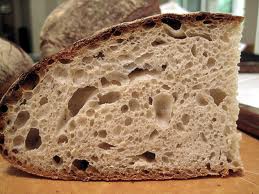
This now-classic Poilâne loaf has a hard, crusty outside and a firm, dense crumb on the inside. It can keep be eaten fresh for up to 5 days after baking, after which it can be toasted.

Inside Pain Poilane bread creative common license http://www.thefreshloaf.com/keyword/pointeacalliere


Pain Poilâne or miche, meaning “round loaf,” weighs in at around 2 kg / 4.4 lb. The recipe is secret, and it is not a whole-grain bread in the traditional sense of the word. Environmentally correct, pesticide-free varieties of wheat are grown and stored. They are then stone-ground, thus preserving the wheat germ. Stone grinding makes it possible to eliminate any coarse bran that might contain impurities.

Poilâne flour is what is called in French farine biseor wheatmeal — a brown flour intermediate between white flour and wholemeal flour — which maintains a higher nutritional value than white flour. Levain or sourdough starter and salt from the salterns of Guérande, a swamp of salt water in Brittany.

Pierre brought this type of bread with him from his native Normandy, where loaves were large and round, in the style of what the French now call “country bread.” Today, it is distributed all over the world.

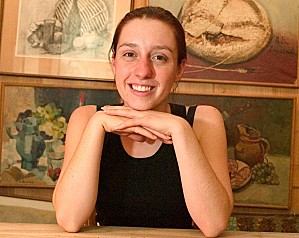
Apollonia Poilâne, current owner of Poilâne bread bakeries


Pierre’s sons Lionel and Max took over the bakery in 1970. Just like Apollonia, they had learned bread baking by working right alongside their father, and continued the tradition of the original round loaf marked with the signature “P.” They eventually took separate paths, with Lionel keeping the original bakery started by his father, and Max going off on his own to start a bakery under his own name, Max Poilâne. In Paris, people have long discussions over which of the brothers makes/made the better bread, since both have continued to bake their father’s signature recipe.

Lionel Poilâne is better known outside France, since he grew the original family business, making it into an international name. This growth was made possible by his excellent teaching skills and his embracing of modern developments in the industry, such as the use of machine kneading, while at the same time maintaining his father’s philosophy of each baker following and taking responsibility for his or her loaves from start to finish. He referred to his concept as “retro-innovation.”

Lionel and his wife died when their helicopter, piloted by Lionel, crashed in 2002, leaving behind daughters Athena and Apollonia, the latter who is now following in her father’s footsteps. She started running the bakery on graduation from high school.

In this video, Martha Stewart visits the Poilâne bakery in Paris and learns about the bread making process in an interview with 22-year-old Apollonia Poilâne when she was still at Harvard. Click here to watch the video interview of Apollonia by Martha Stewart herself.


Martha Stewart

The offiical Poilâne site lists a number of recipes, for making and using some of the Poilâne bread and pastries.


Poilâne Bakeries

8 rue du Cherche-Midi, Paris 6th arrondissement
Tel. +33 (0) 1 45 48 42 59
 
49 bld de Grenelle, Paris 15th arrondissement
Tel. +33 (0) 1 45 79 11 49
Open on Sundays
 
38 rue Debelleyme, Paris 3rd arrondissement
Tel. +33 (0) 1 44 61 83 39
Open on Sundays
 
46 Elizabeth Street, London SW1W
Tel. +44 (0) 207 808 4910


To read more about the French Bread Revolution, see also (bilingual in French and English):

The Revolution of French Bread Baking (part 1), by Jean-Philippe de Tonnac

The Revolution of French Bread Baking (part 2), by Jean-Philippe de Tonnac

Book Review: Jean-Philippe de Tonnac’s “Dictionnaire Universel du Pain” or Universal Dictionary of Bread, by Jean-Philippe de Tonnac

The 7 Lives of Bread: Pascal Auriac, master bread baker in Laguiole, a hidden corner of France, by Jean-Philippe de Tonnac

Never miss a post
Name: 
Your email address:*
Please enter all required fields
Correct invalid entries

Food Art: The Food of the Dead for the Living, painting by David Olere

Published by Saturday, March 30, 2013 Permalink 0


“What is of note, is the survival of the arts within the walled ghetto. John Hersey’s masterpiece novel, The Wall, based on actual diaries (Emanuel Ringelblum), show the arts being practiced; theatre and music and fine art within a ghetto atmosphere mortified by repetitive eve of destruction. The record left by ghetto dwellers, camp internees, and displaced persons create snapshots of life and death under Hitler. Inmate drawings and paintings were legitimate articulations of man’s inhumanity and cruelty,” says Dave in Art of Insurrection and Resurrection.


Never miss a post
Name: 
Your email address:*
Please enter all required fields
Correct invalid entries

What we’re reading: best cities for street food, India’s women farmers, baker from Kabul, Southern cuisine food trend, etc.

Published by Friday, October 19, 2012 Permalink 0

by Jonell Galloway

Click here to keep up with the latest in world food and wine news.


Never miss a post
Name: 
Your email address:*
Please enter all required fields
Correct invalid entries

The 7 Lives of Bread: Pascal Auriac, master bread baker in Laguiole, a hidden corner of France

Published by Friday, May 6, 2011 Permalink 0

Dictionnaire Universel du Painpar Jean-Philippe de Tonnac

Translated from the French and adapted by Jonell Galloway

In the food world, the name Laguiole — a tiny village tucked away in the highlands of the Aveyron Aubrac region of France — is generally associated with the brilliant, one-of-a-kind, self-taught chef Michel Bras, whose restaurant here earned its third Michelin star in 1999, and is held in the highest esteem by gourmets around the world. In the world of haute cuisine, he is considered to be an exceptionally gifted chef who works like a sorcerer in his kitchen laboratory hidden in the Puech du Suquet region, turning out dishes that resemble none other, but which are quickly dished out by a long line of copycats.

So you can just imagine how the young chefs who spend time in his kitchen walk away with a lasting impression of a single man, who didn’t quite live in sync with the times. Perhaps he was a Cistercian monk in another life, using a golden ratio to secretly slip secret formulas into his culinary compositions. If you ask Michel Bras what inspired him most in his creative progress, he says: “Photography and foot racing!” One might say asceticism and contemplation.

Pascal Auriat — master bread baker in Laguiole, who once worked in Bras’ kitchens — is still under the influence of this “ascetic aesthete”. When he speaks about the years he spent at Bras, his tone rather resembles that of a religious convert who has not slipped in his ways after all these years. What he has most retained is the veritable alchemy of fermentation.

The bonds that started to germinate between restaurants and bread baking — hardly perceptible even now — are still moving in a positive direction. It’s now difficult to imagine that there really was a time in France, not so long ago, when a 3-star menu served mediocre bread, not worthy of being placed on such high tables of gastronomy. To remedy this situation, chefs such as Michel Bras, Alain Passard (L’Arpège in Paris) and Olivier Roellinger (former Maison de Bricourt in Cancale in Brittany), as well as many others, started installing small bread ovens in their kitchens and making bread in a somewhat primitive fashion.

Restaurant pastry, which has followed its own path, quite separate from grande pâtisserie, has a similar story. Although they both followed their own separate paths, they never stopped mutually nurturing and influencing each other. Will there come a day when the ovens in the laboratory-kitchens of the great gastronomic establishments will  be directly connected to bread ovens, each housing one of France’s handcrafted bread bakeries?

Another way for a chef to improve the quality of his or her bread is of course to order it from a bread baker worthy of her name. Some artisanal bread bakers, such as Jean-Luc Poujauran, have already dug a deep niche for themselves.

It was like a calling when Pascal Auriat, with a vocational training certificate in cuisine already under his belt, came to Laguiole to try to work for Bras. In 1992, Bras gave him his chance. His first job was the vegetable station, which might well be the heart of Bras’ creative “offensive”, so it was a true sign of trust on the part of Bras. After two seasons, a place opened in the team he had his heart set on: pastry and micro-bread baking. At the time, the three daily batches were “germinated” using sourdough starter made from yogurt, a recipe that Bras had perfected and that Auriat was to scrupulously replicate, while, at the same time getting acquainted with the world of pastry making, working alongside Philipe Andrieu. Andrieu later went on to Fauchon and Ladurée, where he is now Executive Pastry Chef, so Auriat didn’t learn pastry making in just any old school.

Pascal Auriat entre Michel et Sébastien Bras au Mazuc (première implantation à Laguiole)

Restaurant pastry making inevitably calls on its counterpart. Pascal Auriat felt the need to perfect his training, so he left his mentor, a daring act indeed. So off he went to work with Pierre Hermé (now dubbed by Vogue as being “the Picasso of pastry making”) at Ladurée, which had just opened on the Champs-Elysées in Paris. Then a famous family of bread bakers, the Holders, bought out the noted Ladurée, started by Louis Ernest Ladurée, a former miller, in 1862.

Musical chairs: the miller Ladurée opened a pastry shop/tearoom, which was bought out over a hundred years later by a bread baker. A cook who learned to make pastry from another cook abandons the highland stoves of remote Aubrac to try his hand at small and big jobs on the Champs-Elysées. Gastronomic explorers have no bounds.

But Auriat did make his way back to Laguiole in 1999, when Bras asked him to become No. 2 pastry chef. The restaurant had just gotten its third Michelin star, and had to face up to the inundation of guests. There was no lack of work, and the horizons were unlimited. Michel and his son Sébastien were invited to open a branch in the Hokkaido Windsor hotel in Japan. Auriat packed his suitcases.

It just so happened that Eric Kayser, bread baker/fellow of the craft and today head of an empire including more than 60 bakeries spread out on all continents, also landed in the Windsor, where he opened a bread bakery. The three men met and talked about fermentation. Bras’ old yogurt only slightly interested Kayser, who advised him to use a liquid starter that he had patiently perfected. In the world of fermentation, Kayser had it all; Bras was convinced to change his ways.

When Auriat returned to his fold in the Aveyron, he started applying the “new school” methods of making sourdough bread using liquid starter. And just as every pastry chef puts his hands in the dough, his shoulder to the wheel, he left them there. He would have had to leave a starter in the refrigerator for six months, out of spite, to obtain what he was looking for, in vain, on his own: a good starter to incorporate into his tried and true kneading techniques.

Pascal set up shop on his own with Anne, whom he had met at Bras, and started perfecting his magic formulas using a starter made from wheat and rye from the Auvergne region, delivered straight from the moulins Antoine mill.

When he talks about himself, he says that the time he spent at Bras as cook, pastry chef and bread baker made him put taste above all else. One might call it bread baker’s aesthetics, expressed through taste. It could be his slogan.

It’s not often that a bread baker gets his training in the world of haute cuisine. And when it comes to Michel Bras’ kitchens, one might question whether a bread baker merits the attention of bread lovers.

Master bread baker in Laguiole, a hidden corner of France, cradle of creativity: it does sound good on a sign, doesn’t it?

Anne & Pascal Auriat
1 place Auguste Prat
12210 Laguiole
Tel : 00 33 (0) 5 65 44 31 09
Site : http://www.maison-auriat.fr/

Never miss a post
Name: 
Your email address:*
Please enter all required fields
Correct invalid entries

Les sept vies du pain : Pascal Auriat, boulanger à Laguiole

Published by Wednesday, May 4, 2011 Permalink 0

Dictionnaire Universel du Painpar Jean-Philippe de Tonnac

Click here for English version

On associe traditionnellement le nom de Laguiole, petit village des hauts plateaux de l’Aubrac aveyronnais, à celui d’un restaurateur émérite, autodidacte génial qui a décroché en 1999 sa troisième étoile ainsi que la considération des gourmets du monde entier : Michel Bras. Dans le monde de la haute cuisine, il est regardé comme un touche-à-tout surdoué qui, dans son laboratoire arrimé au Puech du Suquet, invente sans patron, sans modèle et fait de nombreux imitateurs. On peut imaginer combien ceux qui ont fait une halte dans ses cuisines ont été profondément marqués par la fréquentation d’un homme qui donne l’impression d’habiter un temps différent du vôtre. Peut-être a-t-il été moine cistercien dans une autre vie, cherchant à introduire dans ses compositions culinaires des formulations secrètes inspirées par le nombre d’or. Lorsqu’on demande à Michel Bras ce qui l’inspire le plus dans son cheminement créatif, il répond : « C’est la photographie et la course à pied ! ». Autrement dit, l’ascèse et la contemplation. Pascal Auriat, boulanger à Laguiole, en tous les cas, transpire encore de cette fréquentation avec le cuisinier ascète-esthète. Lorsqu’il parle de ses années passées chez Bras, il évoque une sorte de « conversion » à ce qui aujourd’hui le retient durablement : l’alchimie des fermentations.

Continue Reading…

Never miss a post
Name: 
Your email address:*
Please enter all required fields
Correct invalid entries

Un boulanger ne fait pas le printemps mais y contribue (2)

Published by Friday, April 15, 2011 Permalink 0

Dictionnaire Universel du Painpar Jean-Philippe de Tonnac

Click here for English version

La révolution du Berger

La boulangerie française est en secrète révolution. Elle s’adapte à un monde qui change. Elle redécouvre avec étonnement son passé immémorial. Elle se réinvente à la lumière des expertises scientifiques qui lui font mieux connaître les blés, les ferments, le sel, l’eau avec lesquels elle travaille. Elle cherche à dynamiser ses équipes dédiées à la production et à la vente. C’est dans ce dernier secteur que l’Etoile du Berger innove résolument.

Franck Debieu, son créateur, donne l’impression de s’être échappé d’un tableau de Fragonard. Extrême douceur mariée à une exigence extrême. Les mariages, c’est son obsession. Les atouts de ce boulanger entrepreneur sont multiples. Intelligence des matières et des hommes. Sens de la boulangerie qui retrouve sa place dans une société française en totale dé/recomposition. Intuitions, audaces, sens du commerce. Il a voyagé pendant sept ans comme compagnon sur le Tour de France, puis comme expert auprès des boulangers dans le monde entier. Il a étudié différentes formes de levain, dont un levain liquide qui a fini par avoir sa préférence. Il a ouvert trois magasins à l’enseigne de l’Etoile du Berger à Sceaux, Fontenay aux Roses et Meudon, aux portes sud de la capitale, où il propose un pain qui tient les promesses qu’on avait placé dans ce compagnon boulanger.

L’Etoile désormais allumée au firmament de la boulangerie, Franck s’est attelé à cette tâche innovante et prometteuse : évaluer le potentiel exact d’une équipe de boulange(è)r(e)s – pâtissie(è)r(e)s aguerris, d’une part, d’une équipe de vendeu(r)s(es) d’autre part et imaginer entre l’une et l’autre des passerelles, des transferts, des complicités cachées. La boulangerie a commencé à se réinventer en France par les fournils, une fois libéré la force créatrice des artisans (libération des prix en 1987 et décret de la baguette de tradition française en 1993), mais elle est encore loin d’avoir traduit ces changements au niveau de la vente. Demeure une ligne Maginot entre le fournil et le magasin, traditionnellement entre le boulanger et son épouse, même si les protagonistes ont changé, les fonctions évolué.

La petite révolution de l’Etoile est donc d’inviter ceux qui produisent à vendre et ceux qui vendent à produire. Inacceptable, l’attitude du boulanger enfermé dans son fournil qui ne se soucie pas de ceux qui vont manger son pain. Inacceptable, l’attitude de la vendeuse qui annone sa leçon à propos du pain « sur levain liquide » et qui n’a jamais plongé ses mains dans l’onctueuse pétrissée durant ses longues heures de pointage. Si la vendeuse franchie les portes du fournil, enfile le tablier, inventorie les entrants de la recette dont elle ne connaît que le stade final (la « tourte du grenier », le « pavé du Berger », l’ « épeautre et graines de lin bio », le « torchon abricot », le « cœur de rêve », etc.), fait tourner le pétrin, façonne, enfourne, écoute la petite musique du ressuage, alors il y a une sorte de « déclic », une petite illumination, après quoi la vente n’aura plus jamais la même saveur. Ni le monde. Ces jours dans le fournil lui donnent des ailes. Même chose pour le mutique artisan qui montre le bout de son nez enfariné dans le magasin et découvre tout à trac ce que sont les mangeurs de pain. Bigre !

Ajoutez à ces roques, le sentiment partagé par quelques-uns dans la profession qu’il est temps de féminiser les fournils, à partir du moment où la mécanisation du process permet de solliciter musculairement les acteurs d’une manière plus yin. « Féminiser les fournils | masculiniser la vente » pourrait être le devise d’un Berger qui cherche à favoriser toutes les mobilités et partant, of course, la c.r.é.a.t.i.v.i.t.é.

Sabrina Tesan, responsable d’une équipe de vente et actuellement en formation pour passer son CAP de pâtissière : « Plus que tout, c’est de vivre ce rapport à la matière qui me donne du plaisir. » Stéphanie Jiménez King, responsable des ventes : « L’Etoile du Berger m’a permis de vivre une énorme évolution en commençant en tant qu’apprentie pour devenir responsable des ventes. L’Etoile n’est pas pour moi qu’une boulangerie de haute qualité. Elle est une école de la vie. » Mathieu Taillasson, responsable de site : « Le fait d’avoir suivi une formation en management m’a beaucoup apporté dans la gestion des relations humaines. » David Johanet, responsable pour les trois sites : « Le fait de devenir responsable boulanger de l’ensemble des sites m’a permis de développer mes compétences et ma capacité d’ouverture pour mieux écouter mes collaborateurs et ainsi mieux les épauler. J’ai aussi développé mon écoute pour comprendre les attentes des autres secteurs comme la vente, ce qui nous permet de mieux gérer l’organisation et l’humain. »

La réussite de Franck Debieu ne se qualifie pas seulement en terme de chiffre d’affaire. D’une manière qui saute aux yeux lorsqu’on découvre l’une de ses boulangeries, le pain fait chez lui des heureux de deux sortes : ceux qui le dégustent | ceux qui le font & le vendent. Un mariage, donc, entre le phalanstère et la libre entreprise, le muscle et le cœur, l’acidité (du levain) et la douceur.

Never miss a post
Name: 
Your email address:*
Please enter all required fields
Correct invalid entries

Book Review: Jean-Philippe de Tonnac’s “Dictionnaire Universel du Pain” or Universal Dictionary of Bread

Published by Wednesday, April 13, 2011 Permalink 0

by Jonell Galloway

Jean-Philippe de Tonnac, contributor to The Rambling Epicure, has written more than 20 books on subjects as varied as Umberto Eco, anorexia and, in October 2010, his masterpiece, the Dictionnaire Universel du Pain, or “Universal Dictionary of  Bread,” a veritable encyclopedia about every facet of  bread from all corners of the earth. The dictionary — not yet translated into English — covers the history of bread, as well as anthropological, symbolic, emotional, sexual, agricultural, botanical aspects . . . well, absolutely everything you might want to know about bread, literally from crop to crust (to borrow Dan Lepard‘s term), with every technical step in the process of bread baking covered in minute detail.

Continue Reading…

Never miss a post
Name: 
Your email address:*
Please enter all required fields
Correct invalid entries

UA-21892701-1