Food Poetry: Brot, Linda Pastan

Published by Monday, July 4, 2011 Permalink 0

Click here to read in English.

Mir scheint, du
schreibst gern über
die fünf Gärphasen
der Hefe, nicht des Trauerns,”
meint mein Sohn,
womit er sagen will, dass
das Brot immer auf-
geht und in sich zusammensinkt,
gebrochen und gegessen wird
in meinen Gedichten.

Und obwohl er das nur so halb-
ernst meint, möcht ich
ihm sagen , “Brot geht in der Schüssel
auf wie Atem, der den Körper dehnt” oder
“wenn du den Teig knetest
mit vollkommener Sanftmut,
ist es wie leises Drücken der Haut
wenn du jemanden liebst.”
Baguette . . . Pitabrot . . . Pane Brot . . .
Challa . . . Naan: Brot ist
eine Universalsprache, zu übersetzen
auf der ausgehungerten Zunge.

Nun ist es Zeit, das
Päckchen Hefe aufzumachen
und mit Wasser anzurühren,
das Blasenwerfen zu betrachten,
sein wie man sagt blindes Testen
der Stärke, das Beseelen
des Lebens. Alles
ist bereit: Salz, Mehl, Öl.
Brotkrumen sind es, die
Kinder heimführen nach Haus.

(Übersetzt: Peter Beicken)

_____________________

after Levchev

First published in Ploughshares, now in Traveling Light, W.W. Norton, 2011.

This poem was contributed by our Poetry Editor, Christina Daub.

Short URL for this post: http://is.gd/q9Byhe


Never miss a post
Name: 
Your email address:*
Please enter all required fields
Correct invalid entries

Food Play: Saint John’s Coca, a Catalan specialty

Published by Monday, June 27, 2011 Permalink 0

by SandeeA

Para leer la versión en español, pinche aquí

Food Play: Saint John's Coca, a Catalan specialty. Food Play, by SandeeA. The Rambling Epicure. Editor, Jonell Galloway.

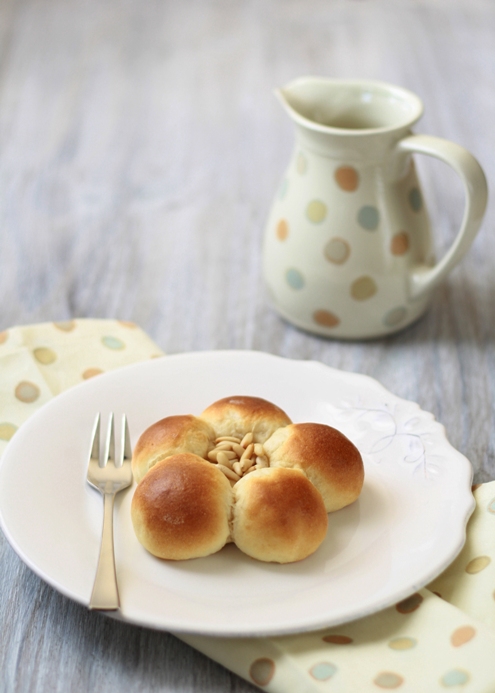
Saint John’s coca is a typical Catalonian sweetened bread eaten during the celebration of Saint John’s Eve in June. It is usually oval, but I wanted to give it a a playful twist… would you like to try some?

Continue Reading…

Never miss a post
Name: 
Your email address:*
Please enter all required fields
Correct invalid entries

Food Poetry: Bread, by Linda Pastan

Published by Friday, June 10, 2011 Permalink 0

after Levchev


“It seems to be the five stages
of yeast, not grief,
you like to write about,”
my son says,
meaning that bread
is always rising
and falling, being broken
and eaten, in my poems.

And though he is only half serious,
I want to say to him
“bread rising in the bowl
is like breath rising in the body;”
or “if you knead the dough
with perfect tenderness,
it is like gently kneading flesh
when you make love.”
Baguette . . . pita . . . pane . . .
Challah . . . naan: bread is
the universal language, translatable
on the famished tongue.

Now it is time to open
the package of yeast
and moisten it with water,
watching for its fizz,
its blind energy–proofing
it’s called, the animate proof
of life. Everything
is ready: salt, flour, oil.
Breadcrumbs are what lead
the children home.


Continue Reading…

Never miss a post
Name: 
Your email address:*
Please enter all required fields
Correct invalid entries

The 7 Lives of Bread: Pascal Auriac, master bread baker in Laguiole, a hidden corner of France

Published by Friday, May 6, 2011 Permalink 0

Dictionnaire Universel du Painpar Jean-Philippe de Tonnac

Translated from the French and adapted by Jonell Galloway

In the food world, the name Laguiole — a tiny village tucked away in the highlands of the Aveyron Aubrac region of France — is generally associated with the brilliant, one-of-a-kind, self-taught chef Michel Bras, whose restaurant here earned its third Michelin star in 1999, and is held in the highest esteem by gourmets around the world. In the world of haute cuisine, he is considered to be an exceptionally gifted chef who works like a sorcerer in his kitchen laboratory hidden in the Puech du Suquet region, turning out dishes that resemble none other, but which are quickly dished out by a long line of copycats.

So you can just imagine how the young chefs who spend time in his kitchen walk away with a lasting impression of a single man, who didn’t quite live in sync with the times. Perhaps he was a Cistercian monk in another life, using a golden ratio to secretly slip secret formulas into his culinary compositions. If you ask Michel Bras what inspired him most in his creative progress, he says: “Photography and foot racing!” One might say asceticism and contemplation.

Pascal Auriat — master bread baker in Laguiole, who once worked in Bras’ kitchens — is still under the influence of this “ascetic aesthete”. When he speaks about the years he spent at Bras, his tone rather resembles that of a religious convert who has not slipped in his ways after all these years. What he has most retained is the veritable alchemy of fermentation.

The bonds that started to germinate between restaurants and bread baking — hardly perceptible even now — are still moving in a positive direction. It’s now difficult to imagine that there really was a time in France, not so long ago, when a 3-star menu served mediocre bread, not worthy of being placed on such high tables of gastronomy. To remedy this situation, chefs such as Michel Bras, Alain Passard (L’Arpège in Paris) and Olivier Roellinger (former Maison de Bricourt in Cancale in Brittany), as well as many others, started installing small bread ovens in their kitchens and making bread in a somewhat primitive fashion.

Restaurant pastry, which has followed its own path, quite separate from grande pâtisserie, has a similar story. Although they both followed their own separate paths, they never stopped mutually nurturing and influencing each other. Will there come a day when the ovens in the laboratory-kitchens of the great gastronomic establishments will  be directly connected to bread ovens, each housing one of France’s handcrafted bread bakeries?

Another way for a chef to improve the quality of his or her bread is of course to order it from a bread baker worthy of her name. Some artisanal bread bakers, such as Jean-Luc Poujauran, have already dug a deep niche for themselves.

It was like a calling when Pascal Auriat, with a vocational training certificate in cuisine already under his belt, came to Laguiole to try to work for Bras. In 1992, Bras gave him his chance. His first job was the vegetable station, which might well be the heart of Bras’ creative “offensive”, so it was a true sign of trust on the part of Bras. After two seasons, a place opened in the team he had his heart set on: pastry and micro-bread baking. At the time, the three daily batches were “germinated” using sourdough starter made from yogurt, a recipe that Bras had perfected and that Auriat was to scrupulously replicate, while, at the same time getting acquainted with the world of pastry making, working alongside Philipe Andrieu. Andrieu later went on to Fauchon and Ladurée, where he is now Executive Pastry Chef, so Auriat didn’t learn pastry making in just any old school.

Pascal Auriat entre Michel et Sébastien Bras au Mazuc (première implantation à Laguiole)

Restaurant pastry making inevitably calls on its counterpart. Pascal Auriat felt the need to perfect his training, so he left his mentor, a daring act indeed. So off he went to work with Pierre Hermé (now dubbed by Vogue as being “the Picasso of pastry making”) at Ladurée, which had just opened on the Champs-Elysées in Paris. Then a famous family of bread bakers, the Holders, bought out the noted Ladurée, started by Louis Ernest Ladurée, a former miller, in 1862.

Musical chairs: the miller Ladurée opened a pastry shop/tearoom, which was bought out over a hundred years later by a bread baker. A cook who learned to make pastry from another cook abandons the highland stoves of remote Aubrac to try his hand at small and big jobs on the Champs-Elysées. Gastronomic explorers have no bounds.

But Auriat did make his way back to Laguiole in 1999, when Bras asked him to become No. 2 pastry chef. The restaurant had just gotten its third Michelin star, and had to face up to the inundation of guests. There was no lack of work, and the horizons were unlimited. Michel and his son Sébastien were invited to open a branch in the Hokkaido Windsor hotel in Japan. Auriat packed his suitcases.

It just so happened that Eric Kayser, bread baker/fellow of the craft and today head of an empire including more than 60 bakeries spread out on all continents, also landed in the Windsor, where he opened a bread bakery. The three men met and talked about fermentation. Bras’ old yogurt only slightly interested Kayser, who advised him to use a liquid starter that he had patiently perfected. In the world of fermentation, Kayser had it all; Bras was convinced to change his ways.

When Auriat returned to his fold in the Aveyron, he started applying the “new school” methods of making sourdough bread using liquid starter. And just as every pastry chef puts his hands in the dough, his shoulder to the wheel, he left them there. He would have had to leave a starter in the refrigerator for six months, out of spite, to obtain what he was looking for, in vain, on his own: a good starter to incorporate into his tried and true kneading techniques.

Pascal set up shop on his own with Anne, whom he had met at Bras, and started perfecting his magic formulas using a starter made from wheat and rye from the Auvergne region, delivered straight from the moulins Antoine mill.

When he talks about himself, he says that the time he spent at Bras as cook, pastry chef and bread baker made him put taste above all else. One might call it bread baker’s aesthetics, expressed through taste. It could be his slogan.

It’s not often that a bread baker gets his training in the world of haute cuisine. And when it comes to Michel Bras’ kitchens, one might question whether a bread baker merits the attention of bread lovers.

Master bread baker in Laguiole, a hidden corner of France, cradle of creativity: it does sound good on a sign, doesn’t it?

Anne & Pascal Auriat
1 place Auguste Prat
12210 Laguiole
Tel : 00 33 (0) 5 65 44 31 09
Site : http://www.maison-auriat.fr/

Never miss a post
Name: 
Your email address:*
Please enter all required fields
Correct invalid entries

Passover: the “festival of the unleavened bread”

Published by Friday, April 22, 2011 Permalink 0

This article is currently being translated into English.

par Julien Darmon

Extrait du Dictionnaire Universel du Pain, publié par Bouquins, Robert Laffont

Continue Reading…

Never miss a post
Name: 
Your email address:*
Please enter all required fields
Correct invalid entries

The Revolution of French Bread Baking (part 2)

Published by Wednesday, April 20, 2011 Permalink 0

Dictionnaire Universel du Painby Jean-Philippe de Tonnac

translated and adapted by Jonell Galloway

Cliquez ici pour la version française

Franck Debieu, a guiding light in the French bread revolution?

French bread baking is quietly but surely undergoing a revolution. It is adapting to today’s changing world. And like the European Renaissance, it is, surprisingly, rediscovering its origins, its long history of tradition, and reinventing them in light of scientific discoveries and expertise, which have allowed bakers to know more about the wheat, leavening, salt and water they use to produce their works of art. They are trying to revitalize their production and sales teams. L’Etoile du Berger bakery in Sceaux, just south of Paris, is unquestionably the greatest innovator in this revitalization.

Franck Debieu, the mastermind behind l’Etoile du Berger, looks as if he just stepped out of a Fragonard painting. The mildest of manner, matched with the strictest of standards. “Matchmaking” is his obsession. This business-minded bread baker is brimming with resourcefulness. His intelligence covers all territories: from the most basic raw materials to sensitivity to the human element. This discerning approach to bread baking certainly has its place in a French society totally caught up in a phase of decomposition and recomposition. Intuitiveness, audacity, business sense: all necessary to confront the task at hand.

Continue Reading…

Never miss a post
Name: 
Your email address:*
Please enter all required fields
Correct invalid entries

David Downie: Focaccia again, Santa Margherita Ligure

Published by Tuesday, April 19, 2011 Permalink 0
by David Downie

Santa Margherita Ligure is as famous for its frescoed buildings as for its focaccia, but since you can’t eat frescos, even though they look downright edible, the focaccia is what most visitors rightly remember (and the fish and pesto and other delicacies too). Though Recco is better known for focaccia, Santa, as the locals call this seaside resort, nonetheless has two top focaccia-makers. Only an expert would notice the slight difference in the quantity of olive oil and salt, or the size of the moonscape craters on the surface (bigger in Recco). One of the two bakers here goes out of his way to make sure the dough is slightly softer in the center than it is around the edges. That’s why connoisseurs order their slices accordingly.

Good luck finding theses bakeries: Fiordiponti is on a back road, Via Ruffini, on the Portofino-end of town, near the arcaded square called Piazza Fratelli Bandiera. Pinamonti is closer to the train station, down an alley near the Lido Hotel.

You can find more great food and wine addresses for this region in my book Food Wine: Italian Riviera Genoa.

Never miss a post
Name: 
Your email address:*
Please enter all required fields
Correct invalid entries

Un boulanger ne fait pas le printemps mais y contribue (2)

Published by Friday, April 15, 2011 Permalink 0

Dictionnaire Universel du Painpar Jean-Philippe de Tonnac

Click here for English version

La révolution du Berger

La boulangerie française est en secrète révolution. Elle s’adapte à un monde qui change. Elle redécouvre avec étonnement son passé immémorial. Elle se réinvente à la lumière des expertises scientifiques qui lui font mieux connaître les blés, les ferments, le sel, l’eau avec lesquels elle travaille. Elle cherche à dynamiser ses équipes dédiées à la production et à la vente. C’est dans ce dernier secteur que l’Etoile du Berger innove résolument.

Franck Debieu, son créateur, donne l’impression de s’être échappé d’un tableau de Fragonard. Extrême douceur mariée à une exigence extrême. Les mariages, c’est son obsession. Les atouts de ce boulanger entrepreneur sont multiples. Intelligence des matières et des hommes. Sens de la boulangerie qui retrouve sa place dans une société française en totale dé/recomposition. Intuitions, audaces, sens du commerce. Il a voyagé pendant sept ans comme compagnon sur le Tour de France, puis comme expert auprès des boulangers dans le monde entier. Il a étudié différentes formes de levain, dont un levain liquide qui a fini par avoir sa préférence. Il a ouvert trois magasins à l’enseigne de l’Etoile du Berger à Sceaux, Fontenay aux Roses et Meudon, aux portes sud de la capitale, où il propose un pain qui tient les promesses qu’on avait placé dans ce compagnon boulanger.

L’Etoile désormais allumée au firmament de la boulangerie, Franck s’est attelé à cette tâche innovante et prometteuse : évaluer le potentiel exact d’une équipe de boulange(è)r(e)s – pâtissie(è)r(e)s aguerris, d’une part, d’une équipe de vendeu(r)s(es) d’autre part et imaginer entre l’une et l’autre des passerelles, des transferts, des complicités cachées. La boulangerie a commencé à se réinventer en France par les fournils, une fois libéré la force créatrice des artisans (libération des prix en 1987 et décret de la baguette de tradition française en 1993), mais elle est encore loin d’avoir traduit ces changements au niveau de la vente. Demeure une ligne Maginot entre le fournil et le magasin, traditionnellement entre le boulanger et son épouse, même si les protagonistes ont changé, les fonctions évolué.

La petite révolution de l’Etoile est donc d’inviter ceux qui produisent à vendre et ceux qui vendent à produire. Inacceptable, l’attitude du boulanger enfermé dans son fournil qui ne se soucie pas de ceux qui vont manger son pain. Inacceptable, l’attitude de la vendeuse qui annone sa leçon à propos du pain « sur levain liquide » et qui n’a jamais plongé ses mains dans l’onctueuse pétrissée durant ses longues heures de pointage. Si la vendeuse franchie les portes du fournil, enfile le tablier, inventorie les entrants de la recette dont elle ne connaît que le stade final (la « tourte du grenier », le « pavé du Berger », l’ « épeautre et graines de lin bio », le « torchon abricot », le « cœur de rêve », etc.), fait tourner le pétrin, façonne, enfourne, écoute la petite musique du ressuage, alors il y a une sorte de « déclic », une petite illumination, après quoi la vente n’aura plus jamais la même saveur. Ni le monde. Ces jours dans le fournil lui donnent des ailes. Même chose pour le mutique artisan qui montre le bout de son nez enfariné dans le magasin et découvre tout à trac ce que sont les mangeurs de pain. Bigre !

Ajoutez à ces roques, le sentiment partagé par quelques-uns dans la profession qu’il est temps de féminiser les fournils, à partir du moment où la mécanisation du process permet de solliciter musculairement les acteurs d’une manière plus yin. « Féminiser les fournils | masculiniser la vente » pourrait être le devise d’un Berger qui cherche à favoriser toutes les mobilités et partant, of course, la c.r.é.a.t.i.v.i.t.é.

Sabrina Tesan, responsable d’une équipe de vente et actuellement en formation pour passer son CAP de pâtissière : « Plus que tout, c’est de vivre ce rapport à la matière qui me donne du plaisir. » Stéphanie Jiménez King, responsable des ventes : « L’Etoile du Berger m’a permis de vivre une énorme évolution en commençant en tant qu’apprentie pour devenir responsable des ventes. L’Etoile n’est pas pour moi qu’une boulangerie de haute qualité. Elle est une école de la vie. » Mathieu Taillasson, responsable de site : « Le fait d’avoir suivi une formation en management m’a beaucoup apporté dans la gestion des relations humaines. » David Johanet, responsable pour les trois sites : « Le fait de devenir responsable boulanger de l’ensemble des sites m’a permis de développer mes compétences et ma capacité d’ouverture pour mieux écouter mes collaborateurs et ainsi mieux les épauler. J’ai aussi développé mon écoute pour comprendre les attentes des autres secteurs comme la vente, ce qui nous permet de mieux gérer l’organisation et l’humain. »

La réussite de Franck Debieu ne se qualifie pas seulement en terme de chiffre d’affaire. D’une manière qui saute aux yeux lorsqu’on découvre l’une de ses boulangeries, le pain fait chez lui des heureux de deux sortes : ceux qui le dégustent | ceux qui le font & le vendent. Un mariage, donc, entre le phalanstère et la libre entreprise, le muscle et le cœur, l’acidité (du levain) et la douceur.

Never miss a post
Name: 
Your email address:*
Please enter all required fields
Correct invalid entries

Book Review: Jean-Philippe de Tonnac’s “Dictionnaire Universel du Pain” or Universal Dictionary of Bread

Published by Wednesday, April 13, 2011 Permalink 0

by Jonell Galloway

Jean-Philippe de Tonnac, contributor to The Rambling Epicure, has written more than 20 books on subjects as varied as Umberto Eco, anorexia and, in October 2010, his masterpiece, the Dictionnaire Universel du Pain, or “Universal Dictionary of  Bread,” a veritable encyclopedia about every facet of  bread from all corners of the earth. The dictionary — not yet translated into English — covers the history of bread, as well as anthropological, symbolic, emotional, sexual, agricultural, botanical aspects . . . well, absolutely everything you might want to know about bread, literally from crop to crust (to borrow Dan Lepard‘s term), with every technical step in the process of bread baking covered in minute detail.

Continue Reading…

Never miss a post
Name: 
Your email address:*
Please enter all required fields
Correct invalid entries

Listen to Jean-Philippe de Tonnac talk about bread on France Inter radio

Published by Wednesday, April 13, 2011 Permalink 0

by Jonell Galloway

Click here to listen to the show.

Continue Reading…

Never miss a post
Name: 
Your email address:*
Please enter all required fields
Correct invalid entries

UA-21892701-1