Food Art: Square deviled eggs, food photography by SandeeA

Published by Wednesday, August 24, 2011 Permalink 0

These photos are by SandeeA, author of the column Food Play, and who runs a site called here. SandeeA is never lacking ideas when it comes to playful, fun recipes. Click recipe to find the deviled eggs for this square Recipe: Classic Deviled Eggs. It would be a great recipe to get your kids in the kitchen!


Never miss a post
Name: 
Your email address:*
Please enter all required fields
Correct invalid entries

Food News Daily: August 23, 2011

Published by Tuesday, August 23, 2011 Permalink 0

Mainstream Anglo Media and Press

The wonderful chef, restaurateur, and leader o...

Alice Waters, founder of American Slow Food Movement & Owner of Chez Panisse, which Turns 40 Today


Happy 40th Birthday Chez Panisse: Alice Waters’ Chez Panisse built on simple success, San Francisco Chronicle

Fish kill cleanup a smelly job after Louisiana paper mill spill, Reuters

Japanese cuisine is loaded with anti-oxidants, vitamins and minerals, The Times of India

Preaching a Healthy Diet in the Deep-Fried Delta, The New York Times

Continue Reading…

Never miss a post
Name: 
Your email address:*
Please enter all required fields
Correct invalid entries

Sauce for Thought: Fish-flavored Funk for your Sauces – from the sunny parts of the world

Published by Tuesday, August 23, 2011 Permalink 0

by Alice DeLuca

In the early 1990’s we camped at Maleakahana State Park on the windward coast of Oahu Hawai’i. In the heat of the day I came upon a Hawaiian man who was busy reaching in to an ironwood tree to hang up a plastic grocery bag half-filled with something heavy, soft and squishy.  It looked like what it was, a bag of guts, and I was somewhat apprehensive. He saw me watching him and offered politely that the bag’s contents included fish guts, salt, and chilies, and that after a few days of hanging there in the sun, rotting, the liquid would be drained off to use as sauce. I must have wrinkled up my nose, because he quickly expressed his opinion that only a Hawaiian would appreciate this sauce. He was hanging the bag in the tree to protect it from animals that would eat the rotting contents, which would ruin his planned feast. I regret not speaking with him about how he would use his sauce, but that opportunity is now lost in the mists of time.

Continue Reading…

Never miss a post
Name: 
Your email address:*
Please enter all required fields
Correct invalid entries

Rosa’s Musings: Swiss Sausage Salad, An Unforgettable Food Experience

Published by Monday, August 22, 2011 Permalink 0

by Rosa Mayland

This year, unlike all preceding years, I decided that I’d serve a Swiss menu for our National Day as I believe there is no better way to feel close to your roots than by cooking the foods that are a part of your identity. I also had the urge to share a traditional and summery Swiss recipe with you.

The date marks the death of the first German Emperor from the house of the Hapsburgs, the independence of Switzerland from the Austrian rulers, the alliance of the rural communes Schwytz, Uri and Unterwalden (central Alps) with a view to protecting themselves from outside attackers or anyone attempting to subject them, and the creation of the Federal Charter of 1291, a pact which ensured free trade and peace on the important mountain merchant routes.

Continue Reading…

Never miss a post
Name: 
Your email address:*
Please enter all required fields
Correct invalid entries

French Food Quote: Daily Food Quote, August 22, 2011

Published by Monday, August 22, 2011 Permalink 0

by Jonell Galloway

Thus it is Gastronomy, to tell the truth, which motivates the farmers, fineyardists, fishermen, hunters, and the great family of cooks, no matter under what names or qualifications they may disguise their part in the preparation of foods.–Jean-Anthelme Brillat-Savarin (1755-1826)
The Physiology of Taste (1825)


Continue Reading…

Never miss a post
Name: 
Your email address:*
Please enter all required fields
Correct invalid entries

Food News Daily: August 22, 2011

Published by Monday, August 22, 2011 Permalink 0

Mainstream Anglo Media and Press

Dan Lepard’s sweet potato brownies recipe, The Guardian

Bill Clinton’s Life as a Vegan, NPR

The Minimalist: Easy Ratatouille, The New York Times

Britain develops a taste for goat, The Independent

A Southern Italian revolution continues to sweep across Australia’s wine landscape, The Australian

Market Watch: Indian Blood Freestone peaches are diamonds in the fuzz, Los Angeles Times

We All Scream for Gelato: High-End Italian Ice Cream Spreads to London and Other European Cities, The Wall Street Journal

Rustic summer vegetable casserole, Los Angeles Times

Chez Panisse’s wines – a list that matches a legacy, San Francisco Chronicle

Best of the Anglo Food and Travel Blogs and Sites

Apricot and pistachio frangipane tart, What’s For Lunch Honey

David’s Discoveries: A great bistro in Burgundy — L’Auberge de Jack, Milly Lamartine, Gadling

Alternative Press/Sites

Thomas Keller’s Grilled Cheese Recipe, Men’s Health

Peach recipes, Kentucky

Hardwick, Vt.—The Town that Food Saved, Organic Connections

What to do with summer fruits, Slow Food Ireland

World

Peach and Cinnamon Chutney, Ko Rasoi

Simply Brilliant (Asian food), Eating Asia

Japan to refrain from claiming safety of Japanese foods, Mainchi News

How to prepare a Korean meal at home, Zenkimchi Korean Food Journal

Purple Pixie Eggplants – Sabich, An Israeli Street Food Sandwich, Food Wanderings

Main Street Eat (Vietnamese street food), Sticky Rice

Never miss a post
Name: 
Your email address:*
Please enter all required fields
Correct invalid entries

Food Art: Brocade Swiss roll, food photography by SandeeA

Published by Thursday, August 18, 2011 Permalink 0

These photos are by SandeeA, author of the column Food Play, and who runs a site called La Receta de la Felicidad. SandeeA is never lacking ideas when it comes to playful, fun recipes. Click here to find the recipe for this Brocade Swiss Roll. It would be a great recipe for having some fun with your kids in the kitchen!


Never miss a post
Name: 
Your email address:*
Please enter all required fields
Correct invalid entries

Switzerland: Tomatoes and Swiss Chard, and it’s in Season!

Published by Tuesday, August 16, 2011 Permalink 0

by Jonell Galloway

Swiss chard, along with kale, mustard greens and collard greens, is one of several leafy green vegetables often referred to as “greens”. It is a tall leafy green vegetable with a thick, crunchy stalk that comes in white, red or yellow with wide fan-like green leaves.

The Swiss variety tends to have whitish stems not dissimilar to green celery but wider and somewhat fan-shaped, while the varieties found in North America can be red, purpose or yellow. Some say chard is second only to spinach in terms of nutrients, and it is certainly full of fiber and phytonutrients.

When choosing chard, make sure the leaves are not wilted and the stems look fresh and crisp. If it looks limp in any way, pass it up.

It is one of the few vegetables that probably shouldn’t be eaten raw, due to its high acid content.

Although it is referred to as “Swiss” chard, it isn’t actually native to Switzerland. It is a Mediterranean vegetable. Already in the fourth century B.C., Aristotle wrote about “chard”, the common name used in the Mediterranean region. It probably got its name from a vegetable that it resembles, the cardoon. It is thought that the French confused the two and ended up calling them both “charde”.

In modern times, the French call Swiss chard blettes, the Swiss call them côtes de bettes, and, funnily enough, the English-speaking world has kept the name closest to the original used in ancient times: chard.


Swiss chard (Beta vulgaris) with variously col...


Its actual homeland lies farther south, in the Mediterranean region; in fact, the Greek philosopher Aristotle wrote about chard in the fourth century B.C. This is not surprising given the fact that the ancient Greeks, and later the Romans, honored chard for its medicinal properties. Chard got its common name from another Mediterranean vegetable, cardoon, a celery-like plant with thick stalks that resemble those of chard. The French got the two confused and called them both “carde.”

Swiss chard is in season for a good deal of the year in Switzerland, but this recipe takes advantage of summer to use some of those divine tomatoes that embellish the farmers markets.

In winter, it can be mixed with potatoes to make a lovely purée or soup.

Recipe

Tomatoes and Swiss Chard

Ingredients

Click here for recipe measurement converter

1 Tbsp. cooking oil

1 kg Swiss chard

500 g ripe tomatoes

1 tsp. sea salt
Pepper to taste
  1. Heat oil to medium low in a Dutch oven.
  2. In the meantime, bring a large soup pan of water to boil.
  3. Scrape any mud or black spots off Swiss chard. Wash carefully.
  4. Cut stems into 2 cm long chunks.
  5. Add Swiss chard to warm oil.
  6. Sautée for 2 minutes, stirring all the time.
  7. Wash tomatoes.
  8. Drop tomatoes into boiling water for 30 seconds or until skin starts to crack.
  9. Remove tomatoes from boiling water, and run under cold water, carefully removing the skins with fingers.
  10. Squeeze to remove seeds or scrape out seeds with end of a knife.
  11. Chop finely.
  12. Add tomatoes to Swiss chard. Mix well.
  13. Add sea salt and pepper to taste. Continue mixing.
  14. Turn heat down to low and cover Dutch oven. Cook slowly for 20 to 40 minutes, depending on whether you prefer it crunchy or less crunchy.
  15. Serve hot.

Suggestion: For a livelier version, add garlic and garam masala.

Suggestion: To make this in to a vegetarian meal, add borlotti, cannellini beans  or garbanzo beans and sprinkle with grated cheese.

Related articles

Happy 99th Birthday, Julia Child!

Published by Monday, August 15, 2011 Permalink 0

by Julia Child

Julia Child would have turned 99 today.

Julia Child brought French food to post-war America. When her husband Paul was posted to Paris, she studied at L’Ecole du Cordon Bleu, and went on to form her own cooking school with fellow students Mastering the Art of French Cooking and Louisette Bertholle. The threesome went on to write the 2-volume classic Coq au Vin , which covered all the basic techniques and dishes of classic French cuisine.


And indeed she proved to be right. It is only now, 60 years later, that cooking has established itself as gastronomy, and only when referring to a few great American chefs.

This is Foodista’s list of their favorite Julia recipes.

Coq au Vin

Rooster cooked in red wine is a classic Burgundian dish made with red wine, mushrooms, onions, bacon and herbs.

Duck a l’Orange

Vichyssoise is actually the base of almost all French soups. This simple base — made of potatoes, leeks, and salt — is elaborated on in countless ways to make an endless variety of soup. When served cold in summer and cream is added, it is referred to as Vichyssoise.

Boeuf Bourguignon

Ratatouille brings all the flavors of the Southern sun together: red ripe tomatoes, eggplant, zucchini, bell peppers, garlic, onions and Provençal herbs. Today there are many other versions, many of them even in the oven, but this is the classic recipe.

Upside-Down Martini

The problem with duck is always the same: the fat spews all over the place and it is difficult to digest. The acid of the orange in this classic French dish helps digest the fat, and makes it tasty too. This is a favorite Julia Child recipe.

Custard Apple Tart

Boeuf Bourguignon is a fancy version of our classic beef stew. What makes it different is that it is cooked in red wine, and pearl onions and mushroom caps are added to it.

Plum Clafoutis

Not surprising that Julia loved Martinis. She added vermouth to just about any sauce she could work it in to.

Sabayon

Not all French pies are made with custard, but you often find this version in Normandy, the land of cream and butter. It can be served either cold or warm.

Lessons from Julia Child

Clafoutis can be made with many different fruits, but plus and cherries are all-time French favorites. This tart has a custard-like consistency, but also contains ground almonds, giving it a salty edge.

Sabayon is a a cousin of the light, egg-based Italian dessert zabaglione. It is light and custard-like, and a standard in French as well as British cuisine.

Never miss a post
Name: 
Your email address:*
Please enter all required fields
Correct invalid entries

Food Play: How to make Homemade Butter

Published by Monday, August 15, 2011 Permalink 0

por SandeeA

Versión origínale en español

Kids in the Kitchen

Nowadays we’ve forgotten where food actually comes from. Some people find it difficult to believe olives were “born” with pits, because they’ve only eaten the pitted ones out of cans, and others have never known fresh milk or milk straight from the cow; they’ve only had milk from a U.H.T. Tetra Brik carton.

So what about pulling some magic in the kitchen and showing your kids how cream becomes butter? You will get a delicious homemade butter, full of flavour, with 65%  fat, as compared to commercial butters, which commonly have up to 80% fat and zero flavour to boot.

So switch on the music on, and let’s shake it! Who said you cannot play with food?


Mantequilla casera 4

Recipe

Homemade Butter

Click here for recipe converter

Preparation time: 4-5 min
Cooking time: 0 min
Total: 4-5 min
Yield: 40 gr butter (2 portions)

Difficulty: My 3-year-old son can do it

Ingredients

100 ml heavy cream, very cold (minimum 35% fat)
A small jar with lid

Preparation

1. Put cream in the jar and close lid.

Mantequilla casera 2

2. Turn the music on.

3. Shake it, shake it. About two minutes later, you will notice that the cream is starting to thicken. Take a rest.

Mantequilla casera 2

4. Keep shaking shaking (it will take a couple more minutes). Suddenly, the cream will start to divide into a solid part (butter) and a liquid part (buttermilk) You did it! Press butter and knead it a litte bit to eliminate exceeding buttermilk, and clean it under clean water. You can keep both buttermilk and butter in the refrigerator for a few days.

Mantequilla casera 3

Note 1: You can do the same thing using a food processor, but it won’t be as much fun! Click here to watch a video showing how to make homemade butter using a food processor.

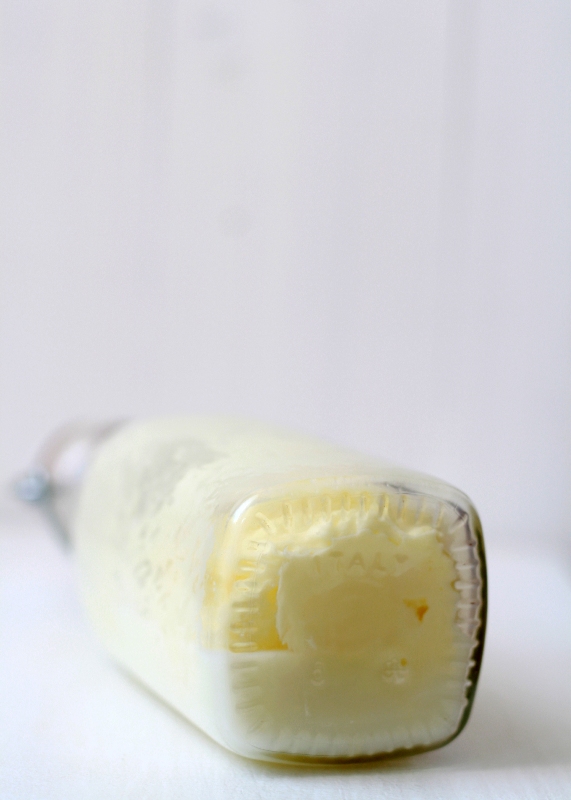
Note 2: The bottle shown in the pics is not the ideal recipient for making butter…when butter becomes solid, it is really hard to get the butter out of it.

Note 3:  The time indicated on the recipe is for an adult. Kids have less strengh and cannot mantain constant movement, so it will take them longer to actually get butter.


As seen at Cultured Butter


Related articles
Never miss a post
Name: 
Your email address:*
Please enter all required fields
Correct invalid entries

UA-21892701-1