David Downie: Artful Parisian Pastry: Paris Past, Part 1

Published by Monday, June 17, 2013 Permalink 0

David Downie: Artful Parisian Pastry: Paris Past, Part 1

by David Downie

What do the glories of ancient Greece and imperial Rome, baroque Naples and pre-revolutionary “Let-them-eat-cake” France have in common with contemporary Paris?

Easy: artful pastry.
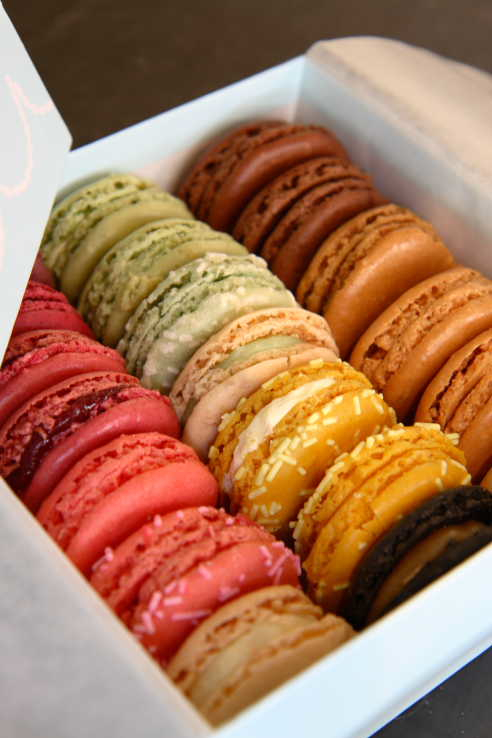


Toss out a euro coin nowadays and it will probably land on a Paris pâtisserie whose chef is bent on titillating customers’ taste buds while dazzling eyes and lightening wallets. White chocolate roses crown red powdered-sugar lips. Fruit still-lifes à la Caravaggio top praline plinths. Dark chocolate treasure chests enclose luscious layer cakes, and bras are not of silk but of purest chocolat.

Training in artistic Parisian pastry making is also in vogue: ever since the renowned École Grégoire-Ferrandi cooking school began partnering with mega-star Pierre Hermé, the chef Vogue has dubbed “the Picasso of pastry”, the “Haute Pâtisserie” concept has ruled Paris tastes.

“The fine arts number five,” wrote Marie-Antoine Carême in the late 18th century, “painting, sculpture, poetry, music and architecture, the principal branch of which is pastry.”

Ever the tongue-in-cheek wit, not for nothing Carême was known as “the king of chefs and the chef of kings”. His claim to pastry fame was the invention of Pièces Montées—precursors of today’s tiered wedding cakes. Remember Tony Curtis and Marilyn Monroe in Some Like it Hot? Carême pièces were big enough to hide a man, like the cakes machine gun-toting Mafiosi burst from in gangster movies.

Continue Reading…

Never miss a post
Name: 
Your email address:*
Please enter all required fields
Correct invalid entries

Foraging and Post-Neolithic Cooking: Antonio’s Wild Spinach Salad Recipe, by Jane Le Besque

Published by Sunday, June 16, 2013 Permalink 0

Foraging and Post-Neolithic Cooking: Antonio’s Wild Spinach Salad Recipe, by Jane Le Besque

Antonio’s Wild Spinach Salad Recipe

Jane and Antonio’s recipe is based on foraging and what they imagine post-neolithic cooking to be, foraging and all, but with a modern twist, i.e. the olive oil.


Continue Reading…

Never miss a post
Name: 
Your email address:*
Please enter all required fields
Correct invalid entries

Switzerland: Swiss-style Knepfle Pasta

Published by Thursday, June 13, 2013 Permalink 0

by Jonell Galloway

Switzerland: Swiss-style Knepfle Pasta

Knepfle is originally from Alsace in France, but it is also eaten in Switzerland, in particular in the Jura region, which borders Alsace.

You can buy them at the supermarket, but they’re much better when you make them at  home.

Swiss-style Knepfle Recipe

Ingredients

3 1/3 to 4 1/10th cups unbleached white flour
3 eggs
2 cups milk
About 1/2 cup water
3 large pinches of salt
1 oz. butter
Large pan of water for boiling knepfles
Coarse sieve with large holes

Instructions

  1. Put eggs into a bowl. Add milk, water and a pinch of salt. Beat with wire whip.
  2. Little by little, use wire whip to add flour until a heavy dough is formed. The dough should fall naturally off the whip.
  3. Let dough rest for 30 to 60 min.
  4. When time is almost up, bring  large saucepan of water to boil. Add 2 pinches of salt.
  5. Heat an oven dish large enough to hold all the knepfles.
  6. NOTE: The hard part: Real pros push the dough through a coarse sieve, but this can be a bit tricky. If this is your first time making knepfles, I suggest that you drop the dough by teaspoons the first time, and try using a sieve the next time. Make sure you have a sieve with large holes before trying this.
  7. Leave water to boil gently and start dropping teaspoons of dough into water, in several goes.
  8. Let knepfles poach until they rise to the surface. This should take about 15 minutes.
  9. Use a slotted spoon to remove them. Do this carefully so they don’t fall apart. Drain well. Place in heated oven dish.
  10. Do this in steps, until all the dough is used up.
  11. To serve, over medium to medium high heat, melt butter in a frying pan (butter should be sizzling).
  12. When hot, add dry knepfles and brown, carefully turning them from time to time. Cook until browned, about 15 minutes.
  13. Serving: There are many ways to serve knepfles: plain, with cream or bacon bits, or with other sauces.


Never miss a post
Name: 
Your email address:*
Please enter all required fields
Correct invalid entries

Food Quote: Nelson Mandela on Food

Published by Wednesday, June 12, 2013 Permalink 0

by Jonell Galloway

Nelson Mandela on Food

I was not born with a hunger to be free. I was born free. Free in every way that I could know. Free to run in the fields near my mother’s hut, free to swim in the clear stream that ran through my village, free to roast mealies [corn] under the stars … It was only when I learnt that my boyhood freedom was an illusion … that I began to hunger for it.–Nelson Mandela

Photo courtesy of The Guardian

has provided “the backdrop and occasionally the primary cause for momentous personal and political events in the life of Nelson Mandela.” In his autobiography, he took an innovative approach to history and showed that a great man’s life can be measured out in mouthfuls, both bitter and sweet. With this title, the reader can cook and taste Nelson Mandela’s journey from the corn grinding stone of his boyhood through wedding cakes and curries to prison hunger strikes, presidential banquets and ultimately into a dotage marked by the sweetest of just desserts. Tales told in sandwiches, sugar and samoosas speak eloquently of intellectual awakenings, emotional longings and always the struggle for racial equality. He was always motivated by hunger, either longing for food he couldn’t have, or depriving himself of food in the name of freedom.

“Only the truly food obsessed would read such a statement and consider the stomach from whence it came, but I did and the result is a gastro-political biography entitled Hunger for Freedom, the story of food in the life of Nelson Mandela,” he told Ana Trapedo of The Guardian.

When in prison, he wrote to former wife Winnie: “How I long for amasi (traditional South African fermented milk), thick and sour! You know darling there is one respect in which I dwarf all my contemporaries or at least about which I can confidently claim to be second to none – healthy appetite,” he told Trapedo.


Never miss a post
Name: 
Your email address:*
Please enter all required fields
Correct invalid entries

Switzerland: Best Meat Restaurants and Steakhouses in Geneva

Published by Tuesday, June 11, 2013 Permalink 0

Switzerland: Best Meat Restaurants and Steakhouses in Geneva


Au Carnivore, French cuisine, 30 place du Bourg-de-Four, 1204 Geneva. Tel. (+41) 022 311 87 58, open 7 days a week.

L’Auberge au Renfort de Sézegnin, French cuisine, 19, route du Creux-du-Loup, 1285 Sézegnin (Athenaz). Tel. (+41) 022 756 12 36.

Bistrot du Boucher, French cuisine, 15, avenue Pictet-de-Rochement, 1207 Geneva. Tel. (+41) 022 736 56 36. Closed Wednesday lunch, Saturday lunch and Sunday.

La Broche, French cuisine, 36, rue du Stand, 1204 Geneva. Tel. (+41) 022 321 22 60. Closed Saturday lunch and Sunday dinner.

Restaurant Café de Paris, French cuisine, 26 rue du Mont-Blanc, 1201 Geneva. Tel. (+41) 022 732 84 50. Open 7 days a week, non-stop from 11 a.m. to 11 p.m.

Restaurant/Café de l’Ecu, French cuisine, 65, route de Rougemont, 1286 Soral. Tel. (+41) 022 756 33 50. Open 7 days a week, non-stop from  8 a.m. to 12 a.m.

L’Entrecôte Couronnée, 5, rue des Pâquis, 1201 Geneva. Tel. (+41) 022 732 84 45.

L’Entrecôte Saint-Jean, French cuisine, 79 boulevard Carl-Vogt, 1205 Geneva. Tel. (+41) 022 321 99 41, Closed Saturday lunch,, Sunday, and Monday.


Never miss a post
Name: 
Your email address:*
Please enter all required fields
Correct invalid entries

Indian Curry Through Foreign Eyes, Part 1: Hannah Glasse’s 18th-century Curry Recipe

Published by Sunday, June 9, 2013 Permalink 0

Indian Curry Through Foreign Eyes, Part 1: Hannah Glasse’s 18th-century Curry Recipe

by Laura Kelley

I have long been fascinated by concepts of “I and other”, or the many ways we separate what is familiar (self) from what is not familiar (non-self). By defining what is not self, we are in fact defining self. One can hear small children do this when misclassified by gender; most adamantly declare that they are not members of the opposite sex. “I and other” are also evident in beautiful symbolic ways when considering the movement of ideas and beliefs through societies. The newly introduced idea is at first foreign, complete with unfamiliar trappings. As the idea flows through society and is adopted, the foreign elements are shed and replaced by the familiar.

Depictions of Buddha: Caucasian and Asian, by Laura Kelley at //www.silkroadgourmet.com/hannah-glasse-curry/

Depictions of Buddha: Caucasian and Asian

One place to see this is operation is at the Boston Museum of Fine Arts, which houses an expansive collection of Asian art. As Buddhism moves out of India and across Asia, first to the west and then the east, early iconography clearly depicts Buddha as Caucasian (Gandahara style), even when the work is from the Himalayas, Burma or Western China. As time passes, and Buddhist ideas are adopted across the east, however, religious iconography begins to depict a wide variety of races and ethnicities. Noses become smaller, epicanthic lids are added as the face changes from Caucasian to Asian. Expressions usually remain contemplative and serene, but the varying shapes of the faces are evidence of the triumph of the ideas across space and time.

The “I and other” concept is also of interest in historical cookery, especially when one group is attempting to recreate the cuisine of another. I’ve been looking at early recipes for Indian curry written by non-Indians. So far, I have a small collection of English and American recipes from the 18th and 19th centuries that show curry powders and recipes developing from recipes that merely reminiscent as Indian in the eighteenth century to those that are nearly indistinguishable from modern recipes broken out by geographical region by the end of the nineteenth. The earliest amongst them (so far) is a recipe from Hannah Glasse’s The Art of Cookery made Plain and Easy, first published in 1747.

The Art of Cookery, 1774, photo by Laura Kelley

The Art of Cookery, 1774

Continue Reading…

Never miss a post
Name: 
Your email address:*
Please enter all required fields
Correct invalid entries

Culinary Travel: Jonell Takes a Jaunt to Petite France in Strasbourg, a photo essay

Published by Thursday, June 6, 2013 Permalink 0


Culinary Travel: Jonell Takes a Jaunt to Petite France in Strasbourg

Husband Peter and I recently took a jaunt to Strasbourg with our German “family”, the Joerchels, to eat in a cozy little bistro in the heart of Petite France, the canal district of Strasbourg. Here’s a sample of the architecture and atmosphere of Petite France.


Never miss a post
Name: 
Your email address:*
Please enter all required fields
Correct invalid entries

Culinary Travel: Jonell Eats her Way through Mannheim, Germany

Published by Sunday, June 2, 2013 Permalink 0

Culinary Travel: Jonell Galloway Eats her Way through Mannheim, Germany

Photos from my culinary travels in Mannheim, Germany. Mannheim is not known for its cuisine, but it is known for its white asparagus, just like in Alsace. So we took a jaunt to the farmers market and bought the choicest spears from a vendor who sells only white asparagus. The Mannheim cheesecake we bought in the market is the best I’ve ever eaten.

Never miss a post
Name: 
Your email address:*
Please enter all required fields
Correct invalid entries

Switzerland: Geneva Restaurant Suggestions

Published by Sunday, June 2, 2013 Permalink 0


//


by

Jardins de Brunswick (in front of Le Richemond), rue Adémar-Fabri 7, 1201 Geneva. +41 022 731 60 16. Open 07H15 to 22H00 Mon. thru Wed, 07H15 to 24H00 Thurs. and Fri., and 10H00 to 24h00 on Saturday. Closed Sundays. info@cottagecafe.ch, www.cottagecafe.ch

When you have to meet someone near the quai du Mont-Blanc or in the Pâquis neighborhood, this is a great stopoff if you don’t have the pocketbook for the more upscale Richemond and Beau-Rivage venues right behind it. Plus, it is in a beautiful setting, right smack in the middle of the Brunswick gardens.

It’s nice in both summer and winter. The terrace is spectacular, of course, and you even get glimpses of jet d’eau from time time. Inside, it’s cozy and funky.

Breakfast includes birchermuësli, homemade jams and freshly squeezed juices. They have a daily lunch menu, serve pastries in the afternoon, and tapas starting at 18h00.

There is a selection of good quality local wines by the glass or bottle, along with some wines from other places.

Quirinale

Rue de la Rôtisserie 6, 1204 Geneva. +41 022 748 48 48

I’ve only had the truffle pizza, which is the house specialty, but I have been dreaming of it ever since.

Emmanuel de Savoie is part owner I hear.

Great central location, chic and full of jetsetters, and a little pricey if you eat a 3-course meal with wine. They do have lunch specials however, and that truffle pizza . . .

La Terrazza

Route de Florissant 51, 1206 Geneva. +41 022 345 56 00. Open for lunch and dinner. Closed Saturday and Sunday.

I discovered this almost hidden Swiss-style café-restaurant many years ago on my treks back and forth to the Beaulieu clinique.

Mr. Borella started as waiter at the Lion d’Or during its golden age. He later set out on his own and has been in this same location for about 25 years. Mrs. Borella cooks and Mr. Borella serves. They are from the Dolomites, so they cook hardy, traditional dishes, as well as some well turned-out Swiss classics.

The price is about as right as you can get, and they buy all their ingredients from local producers. The tomatoes taste like tomatoes and the salads, well they come straight from Chapuis.

Nologo Restaurant

Rue de Fribourg 11, 1201 Geneva. +41 022 901 03 33. Open Mon. thru Fri. lunch and dinner, Sat. dinner only. Closed Sundays. resto@nologo.ch, www.nologo.ch

This is Japanese food like you eat in Japan, not adapted for Western tastes. Wonderful mixtures of unusual flavors and ingredients like you’d never find in your regular, standardized-menu sushi bars.

Don’t count on them being friendly, just think about what’s on your plate. Tiny space so reserve well ahead.

Never miss a post
Name: 
Your email address:*
Please enter all required fields
Correct invalid entries

Switzerland: Swiss Food: Rhubarb Cream Recipe

Published by Monday, May 27, 2013 Permalink 0

by Jonell Galloway

Cherry-Rhubarb Fool

When you talk about rhubarb cream in Switzerland, you mean rhubarb cream, not pudding or custard. This naughty dessert is one of the easiest rhubarb desserts around, and is so thoroughly Swiss.

Recipe for Rhubarb Cream

Ingredients

Photo courtesy of Robin Stewart


1 lb. / 500 g rhubarb
3/4 cup / 200 g cane sugar
 2 egg yolks
 Cinnamon or lemon juice, according to which taste you prefer
3/4 cup / 0.2 l whipping cream

Directions

  1. Scrape or cut off any hard outer surface of rhubarb.
  2. Dice rhubarb and put into saucepan. Add sugar. Cover with water. Cook until tender but firm, 5 to 10 minutes.
  3. While rhubarb is cooking, beat the yolks until smooth.
  4. Run cooked rhubarb through food processor or chinois to purée.
  5. Add hot rhubarb purée to beaten egg yolks. Beat until thoroughly blended and eggs start to cool.
  6. Mix in cinnamon or lemon juice. Set aside to cool.
  7. Beat whipping cream. When it starts to form hard peaks, fold in cooled rhubarb and egg mixture.
  8. Cool in refrigerator, either in individual serving dishes or in a large bowl.
  9. Serve cool.


Never miss a post
Name: 
Your email address:*
Please enter all required fields
Correct invalid entries

UA-21892701-1