Is it only the mouth and belly which are injured by hunger and thirst? Men’s minds are also injured by them.–Mencius, c. 300 BC
Mencius, c. 300 BC, was a Chinese philosopher who was arguably the most famous Confucian after Confucius himself. He encouraged “generosity, self-sacrifice, humility, receptiveness to instruction, as well as to powers associated with these qualities.”
God cannot appear before a starving man except in the form of bread.–Mahatma Gandhi, 1947
Mohandas Karamchand Gandhi (2 October 1869 – 30 January 1948) was the pre-eminent political and ideological leader of India during the Indian independence movement. A pioneer of satyagraha, or resistance to tyranny through mass civil disobedience, Gandhi led India to independence and inspired movements for civil rights and freedom across the world.
Nigel Slater’s classic salsa verde recipe, The Guardian
Is Junk Food Really Cheaper?, The New York Times
Small Factories Take Root in Africa, Wall Street Journal
For Rosh Hashanah, honey, you have options, Los Angeles Times
A new generation of student cooks?, Is the accepted wisdom about students being uninterested in cooking still accurate or is it a myth kept alive by those who graduated years or decades ago?, The Guardian
Asian snack time is all the time, The Seattle Times
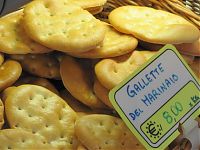
Everyone knows about the focaccia of Genoa and the Italian Riviera. But who remembers the region’s hardtack?
Sea biscuits: those hard, dry crackers that sailors would take with them on long journeys, because normal bread got moldy within days?
In Italian, sea biscuits are called “gallette.” The same word is used for the surf-worn, flattened stones you find on beaches. That’s because sea biscuits look very much like those stones, with pock marks.
There used to be hundreds of bakeries up and down the coast of Italy, and in America too, that baked sea biscuits. Now only a handful continue the tradition, most of them in Liguria, and only one makes gallette in the old-fashioned way, meaning the way they were made in the nineteenth and early twentieth centuries.
A hungry stomach cannot hear.–Jean de La Fontaine, 1679
Jean de La Fontaine was the most famous French fabulist and one of the most widely read French poets of the 17th century. He is known above all for his fables, which provided a model for subsequent fabulists across Europe and numerous alternative versions in France and in French regional languages.
In eating, a third of the stomach should be filled with food, a third with drink, and the rest left empty.—Babylonian Talmud, c. 500
The Talmud is a central text of mainstream Judaism. It takes the form of a record of rabbinic discussions pertaining to Jewish law, ethics, philosophy, customs and history.
Whatsoever was the father of a disease, an ill diet was the mother.–George Herbert, 1651
George Herbert was an English poet and orator, as well as an Anglican priest. Throughout his life, he wrote religious poems characterized by a precision of language and an ingenious use of imagery or conceits that was favored by the metaphysical school of poets. Some of Herbert‘s poems have endured as hymns, including “King of Glory, King of Peace” (Praise), “Let All the World in Every Corner Sing” (Antiphon) and “Teach me, my God and King” (The Elixir).
The Rambling Epicure has a new baby sister site where you can follow international food news and trends as they happen. It’s rather like a Twitter feed, but with more than 140 characters and photos to liven it up. It’s Jonell’s little blah blah mini-blog.
See you there!
Click here to check it out.
Related articles
Recipe: Roasted Pumpkin Flan, A Recipe from Carmen Gonzalez
New York Times: Pop-up Restaurants in London, Up and Coming Chefs Cook in Apartment or Warehouse
Recipe: Frita, or Sweet Pepper and Tomato Compote
Obese and non-obese have different brain responses to junk food photos, says new study
The Atlantic Life on Antibiotic Resistance and the Case for Organic Poultry and Meat

 by Simón de Swaan