I launched The Rambling Epicure e-zine, this website, nearly ten years ago as a literary culinary electronic magazine with a host of well-known food writers and photographers, all of whom are still active members of the related Facebook groups Culinary Travel and Mastering the Art of Food Writing. Editing and publishing this on my own required an incredible amount of gratifying work and because I was busy with my personal projects, I have left it semi-dormant for the last year or two. Today, I would like to relaunch it in a different form as part of an effort to encourage conversation about food, cooking, and writing.
My primary goal is for The Rambling Epicure to become a wellspring of enlightening epicurean essays and culinary fiction. We all have captivating personal and family tales about what we cooked and what we ate through many generations, during good times and bad. These memories are part of our food culture—and our food heritage—and should be an effective way to transmit our experiences and values beyond our front doors.
But my ambitions are greater than just memoir: I’m also interested in publishing articles and essays related to historical research in the field of gastronomy and in reviews of food books.
I would like to make this a cooperative effort that opens the door for us to share our potential as cooks, diners, and writers. Together, we will create a literary culinary site unlike any other, with information and stories that can be passed down to future generations.
Etre le dindon de la farce. / To fall victim to dupery.
Une dinde. / A stupid, pretentious woman.
Anthelme Brillat-Savarin, perhaps France’s best-known gastronomic writer, said that the turkey was certainly one of the most beautiful gifts the New World had given to the Old. “…the fattest, and if not the most delicate, at least, the tastiest of all domesticated birds.” It’s not often that the New World gets such compliments from discerning French epicures.
Turkeys were originally called poules d’Inde, “Indian hens,” in France, because they were thought to have come from India, which they later learned was Mexico. The French were not the only ones to get the name wrong. In Hebrew a turkey is a tarnagol hodu, meaning literally “Indian chicken;” in Russian indiuk, Polish indyk and Yiddish indik.
There is some controversy over who brought turkeys to Europe. Columbus probably brought brought them back in the early sixteenth century, since records show that King Ferdinand had ordered that every ship to bring back ten turkeys before the Spanish explorer Cortés set out in 1519. In any case, by 1548, they were the rage in France. In 1549, Catherine de Medicis served 70 “Indian hens” and 7 “Indian roosters” at a banquet held in honor of the Bishop of Paris.
French aristocrats were accustomed to eating all sorts of feathered creatures, including chewy storks, herons, peacocks, swans, cranes and cormorants, so it wasn’t surprising that they fell in love with the less-chewy turkeys, and that in 1570, Charles IX and Elizabeth of Austria thought turkey noble enough to serve at their wedding feast.
By the seventeenth century, the French were raising turkeys as if they were their own and most cookbooks included turkey recipes. French chefs weren’t lacking in ideas: they made stews and ragouts; they larded, roasted and glazed it; they stuffed it and made it into soups and pâtés.
Marie-Antonin Carême preferred the wings, which he deboned, then stuffed with chicken and truffles. Alexander Dumas, in his Dictionary of Cuisine, included 27 recipes. Turkeys were well established in the Hexagon.
Christmas dinners usually meant lots of mouths to feed, so turkey, being the largest of the winged creatures available, eventually became the dish of choice for Christmas feasts. By the nineteenth century, it became customary to stuff the Christmas turkey with chestnuts, and the tradition continues today.
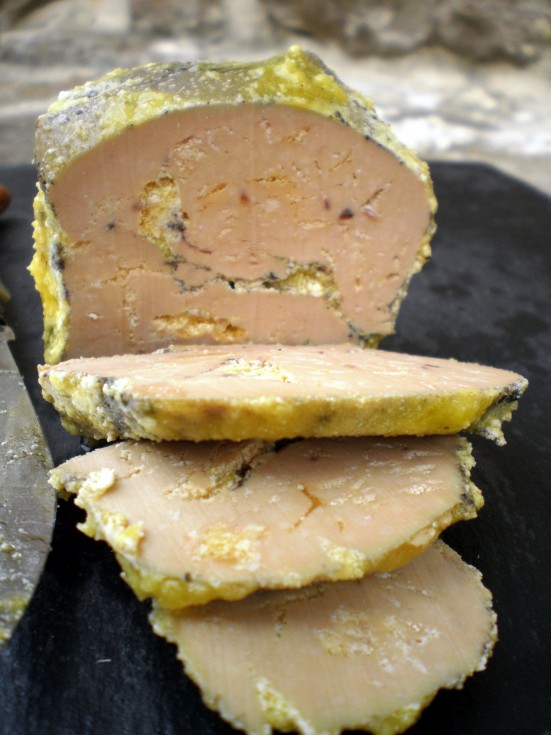
The French eat 90% of the foie gras they make themselves. That’s how much they like it, but they didn’t invent it. Although the Egyptians might have force-fed their birds, we’re not sure that they ate foie gras. The Greeks probably did, since the 4th-century Greek poet Archestratus wrote about it in his Gastronomy. The liver is the soul of the goose, he said.
Foie gras is made using a process called gavage, which consists of force-feeding ducks or geese through a feeding tube to fatten them. The Romans stuffed dried figs down their throats. In Latin, the word for liver even comes from fig, ficus. Scipio Metellus, a Roman chef, had the idea of soaking still warm livers in honey and milk to swell them even more before cooking.
Apart from the region of Béarn in the southwest, this practice disappeared in medieval France, coming back to life in the southwest and Alsace during the Renaissance.
French foie gras is made by force-feeding corn to geese and ducks, and still, occasionally, figs, which swells the livers.
Goose foie gras has traditionally been the most cherished because it is fattier, but it cannot be produced year round. Duck liver is less fatty, and can be produced year round and industrially, meeting the ever-increasing demand.
The fattened liver can be made into terrine, pâté, mousse, parfait, and a host of other things, and, in more recent times, there is a trend of cutting fresh foie gras into thin slices and pan-searing it. It can be eaten fresh or preserved in glass jars, and can be seasoned with truffles, port, Armagnac or Sauternes. Southwesterners prefer a simple, less perfumed foie gras, while Alsacians like to add flavor.
When purchasing, there are legal distinctions in names that indicate the purity and therefore determine the price:
Foie gras entier means that it contains the actual lobes of the liver. The only legally allowed addition is truffles. As it’s solid, you cut it with a knife, just like you do extra-tender beef filet.
Foie gras consists of pieces of liver that are put back together and pressed.
Bloc de foie gras is reconstituted liver combined with other ingredients, but containing at least 50% foie gras for goose, and 30% for duck .
Parfaits are preparations containing 75% foie gras and made by mechanical means, to which regular, unfattened liver is added.
Médaillon or pâte de foie de canard or d’oie contains 50% duck or goose foie gras or bloc de foie gras in the middle, surrounded by forcemeat.
Galantine is a butcher’s mixture of meats and other forcemeats, with no defined percentage of foie gras.
Mousse contains 50% foie gras mixed with forcemeat, giving it the texture of foie gras.
Terrine is pure foie gras pressed into pâté shape.
Forcemeat can consist of one or several ingredients, including pork, veal or chicken fat; pork or chicken liver; scraps from deveining; poaching fat; eggs; milk; lactoproteins; flour, and starch.
Foie gras comes in a jar, plastic package or can or fresh from the butcher. When purchasing, be aware of the different cooking preparations, since the temperature at which it is cooked and the method of cooking change the flavor and shelf-life. Generally speaking, fresh is better.
It is important to make sure you are being sold what you ask for in both restaurants and shops. As a consumer, you have a legal right.
The French don’t eat foie gras every day. Traditionally, it is for special occasions and holiday meals, especially Christmas and New Year’s celebrations.
Their 50th birthdays in sight, the acclaimed travel and food writer David Downie, and his wife, the photographer Alison Harris, decided that trekking from Paris to Spain, would be just the thing. They are based in Paris, so the Way of St. James, for a millennium one of the world’s most celebrated pilgrimage routes, was right at their back door. Neither Alison nor David is religious — the classical pilgrimage experience was not what they were seeking. What were they seeking? Renewal, changed perspectives. Perhaps to test themselves, over 72 days and 1100 km of — at times — very rough terrain. And thereby hangs a tale.
Paris to the Pyrenees: A Skeptic Pilgrim Walks the Way of St. James, launches this week. Scroll to the end to see book tour information. Permission to post on TRE the superb photos from the book was granted by Alison Harris.
ELATIA HARRIS: There has been a lot in the news lately on pilgrimage, however one understands the phenomenon. People who do it talk about needing to lose their routine and find themselves. Most set out alone, meeting others en route. You and Alison started together.
DAVID DOWNIE: Our choice to walk together happened organically. I had planned to do this on my own. Alison came along to keep me out of trouble. If you ask her, she’s likely to say it was her idea about 25 years ago, when she suggested we do something similar.
EH: Readers cannot but wonder how they would hold up, in these circumstances. I pictured a long leisurely walk through a French countryside movie. Cows, chateaux…oh, perhaps a few mildly strenuous stints. I was so wrong. This was a test of all your combined resources. It would be for any couple. 72 days of togetherness and real physical hardship. And you had already spent years collaborating on your books.
DD: Like some old couples, we have merged in mind and spirit — if such a thing exists — while remaining very different people, and very pig-headedly independent. So, while we were together on the pilgrimage, we were often apart both in our mental spheres and physically. Alison stopped constantly, ran ahead, took detours, disappeared, got lost—often, though not always, in pursuit of a photograph. She probably walked twice as many miles as I did. By the end of the pilgrimage, my regard for her had only deepened. I can’t speak for her, of course.
Cuisine is when things taste like themselves.–Curnonsky
Maurice Edmond Sailland, better known by his pen-name Curnonsky, and dubbed the Prince of Gastronomy, was the most celebrated writer on gastronomy in France in the 20th century. He wrote or ghost-wrote over 65 books and enormous numbers of newspaper columns, included his most famous book, La France Gastronomique: Guide Des Merveilles Culinaires Et Des Bonnes Auberges Fran Aises (Gastronomic France: Guide to Culinary Marvels and Good French Inns).
A chief maxim in dining with comfort is to have what you want when you want it.—Thomas Walker, The Original, 1835
Thomas Walkerwas a police magistrate and author. On 20 May 1835 he began publishing The Original, and continued it weekly until the following 2 Dec. It is a collection of his thoughts on many subjects, intended to raise “the national tone in whatever concerns us socially or individually,” but his admirable papers on health and gastronomy form the chief attraction of the work.
The art of using up leftovers is not to be considered as the summit of culinary achievement.–Larousse Gastronomique
The Larousse Gastronomique is an encyclopedia of gastronomy. The majority of the book is devoted to French cuisine, and contains recipes for French dishes as well as detailed, illustrated explanations of cooking techniques.
The further I travel in search of the ideal slimming method the more I am convinced that food is one of the oldest and greatest comforters… a secret return to the womb…–Roy Andries de Groot
Baron Roy Andries de Groot was a British-born American culinary writer and wine critic. He was born in London, the son of a Dutch artist and a French noblewoman. During the 1930s, de Groot worked as a news and feature writer, film writer, and director. When World War II broke out, he joined the British Ministry of Information and worked for the BBC, where, during The Blitz of London, he suffered eye injuries that would leave him totally blind within 20 years.
XIII: It is heresy to insist that we must not mix wines: a man’s palate can grow numb and react dully to even the best bottle after the third glass from it.–Anthelme Brillat-Savarin, from The Physiology of Taste
Jean Anthelme Brillat-Savarin was a French lawyer and politician who gained fame as an epicure and gastronome. Many consider him the best food critic ever. His 8-volume, famous work, Physiologie du goût (The Physiology of Taste), was published in December 1825, two months before his death.