Thoughts on Jamie Schler’s latest HuffPost article: You are What You Eat: a Food Blogger’s Dilemma

Published by Friday, March 16, 2012 Permalink 0

by Jonell Galloway

Jamie Schler‘s latest article on the The Huffington Post, “You are What You Eat: a Food Blogger’s Dilemma,” is a must-read for any serious food blogger.

You might ask, “what is a serious food blogger?” One who has 2 million followers, one who gets a zillion hits a month, one with a goal in mind, such as a book or television show, or is it someone one who encourages healthy eating, who is interested in educating the public and sees it as almost a civic duty? That is a really good question in today’s topsy-turvy world, where famous is not necessarily good or good for you, and on the Internet, anything goes.

Image courtesy of CoffeeMuffins.com


Continue Reading…

Never miss a post
Name: 
Your email address:*
Please enter all required fields
Correct invalid entries

Newfangled Food Vocabulary: Food Stalking

Published by Monday, March 12, 2012 Permalink 0

“The act of observing the tables around you at a restaurant and ordering what the other diners are eating.”Urban Dictionary

I’m a true food stalker when I eat in a new restaurant and gawk at what each diner around me is eating before ordering myself.


Related articles
Never miss a post
Name: 
Your email address:*
Please enter all required fields
Correct invalid entries

Food Alert: Adulterated Olive Oil Common These Days

Published by Monday, March 5, 2012 Permalink 0

The Romans were known for bringing in olives from all over the Empire to quench their thirst for olive oil. Today, it’s the entire world that can’t get enough olive oil, so this Natural News article about the increase in adulterated olive oil is not really surprising. The article is especially good because it tells you what signs to look for.

Click here to read the entire review of Tom Mueller’s book Extra Virginity: The Sublime and Scandalous World of Olive Oil.

English: virgin oil of aceitunas (IMPERIA) Fra...


Continue Reading…

Never miss a post
Name: 
Your email address:*
Please enter all required fields
Correct invalid entries

Europain 2012 starts Tomorrow March 3 in Paris

Published by Friday, March 2, 2012 Permalink 0

The Europain bread trade show, which starts on March 3rd every second year, starts tomorrow, March 3, 2012. It runs until March 7.

Food Art: Bread Pot, by SandeeA


This year’s show includes large sections for artisanal bread making, a smaller one for industrial bread baking, a pastry making section, as well as a new SuccessFood section, dedicated to creative catering and restaurant remakes. Click here for an overview of the various sections.

Click here for a list of the various events going on throughout the show.

It is located at Paris Nord Villepinte outside Paris, France. To get there from Paris, take the RER B commuter train from the Gare du Nord in the direction of “Aéroport Charles de Gaulle,” and get off at the station “Parc des Expositions.”  From Roissy Charles-de-Gaulle airport, take the RER B, and get off at “Parc des Expositions.”

Never miss a post
Name: 
Your email address:*
Please enter all required fields
Correct invalid entries

Feeding the World using Fossil Fuels vs. Without

Published by Friday, March 2, 2012 Permalink 0

A film by Marija Jacimovic and Benoit Detalle

[youtube http://youtu.be/WvyV_idFAZA nolink]


Never miss a post
Name: 
Your email address:*
Please enter all required fields
Correct invalid entries

The Rambling Epicure is Looking for International Culinary Ambassadors

Published by Thursday, March 1, 2012 Permalink 0

As a global real-food site, we regularly seek to widen our coverage. We already cover at least 20 countries and have articles in 6 languages (always translated into our common language, English). Our ambitious aim is to have Culinary Ambassadors from countries all over the globe.

If you’re a food writer, blogger or photographer and you’re interested in working with our team, I suggest you read closely our aim and purpose and browse through our tabs and categories to see if you think you fit in. Your job would be to cover both traditional and new food and wine trends in your country.

Click on word scramble to see details. The Rambling Epicure Voices and our Food/wine Coverage


If you’re interested, please contact us by clicking the blue Contact Us button at the top right of our site.

We hope to hear from you!

Jonell Galloway, Editor, and The Rambling Epicure Voices

Never miss a post
Name: 
Your email address:*
Please enter all required fields
Correct invalid entries

Food Network Star Anne Thornton Fired for Allegedly Plagiarizing Recipes

Published by Saturday, February 18, 2012 Permalink 0
reports in Foodista that the popular Anne Thornton, who hosted the Dessert First recipe show on the Food Network, has allegedly been fired for plagiarizing recipes.
English: Logo for Food Network


Related articles
Never miss a post
Name: 
Your email address:*
Please enter all required fields
Correct invalid entries

New EU Labeling for Organic Wines

Published by Thursday, February 16, 2012 Permalink 0

by Jonell Galloway

On February 8, 2012, the EU organic farming committee passed new rules regarding the labeling of organic or “biologique” wines. The rules become effective as of the 2012 grape harvest.


Organic wine producers will be required to label their wine as being organic and labels must be marked with the EU’s organic logo as well as the code number of the certifier, but must continue to follow existing rules regarding wine labeling.

Rules for wine obtained using organic raisins already exist, they do not cover wine making practices, covering the entire production process, from raisin to wine.

Sorbic acid and desulfurication will not be allowed. “The level of sulfites in organic wine must be at least 30-50 mg per liter lower than their conventional equivalent and the general wine-making rules defined in the Wine CMO regulation will also apply. As well as these wine-making practices, ‘organic wine’ must of course also be produced using organic grapes,” says the European Commission.

Wine is the only sector to be covered by EU rules regarding organic agriculture.


Never miss a post
Name: 
Your email address:*
Please enter all required fields
Correct invalid entries

Is Focaccia Pizza’s Rival?

Published by Thursday, February 16, 2012 Permalink 0

by Diana Zahuranic

“It’s the most dangerous competitor of pizza,” said the president of Recco’s Consorzio near Genova. What could possibly pose a risk to the hallowed Italian dish? The risk lies in a similar bread known as focaccia, an olive-oily, salt-crunchy, inch-thick fluffy white dough often cut into squares in the piazza’s panetteria, or bakery. Tomato sauce and ciliegini cherry tomatoes, may be dropped on top, as well as anchovies, thin potato slices with rosemary sprigs, zucchini, eggplant, olives and tomato – basically any ingredient that goes on a pizza sits comfortably on its fluffy focaccia pillow, too. And like pizza, mozzarella cheese is basically a given.


If focaccia is pizza’s most serious contender, then Focaccia di Recco is the Achilles of this battle – but Recco’s focaccia has no weak spot.

I went with my class from the University of Gastronomic Sciences, a Slow Food-founded school based in Piemonte, Italy, to the 150-year old Ristorante Vitturin. The owner applied for the IGP label for his focaccia, and is now waiting for it to pass. If the bread earns this Indicazione di Geografica Protetta, or Protected Geographic Indication, that will make it the first restaurant product with that label. Naples’ pizza likely regrets not applying for one every time a new “Napoletano style” pizzeria erects its greasy walls in small suburbs and big cities. If it gains the IGP label, then that’s Point One for Focaccia di Recco.

We walked down a flight of steps into a moodier section of the restaurant and the kitchen, open with a line of windows framing the working chefs who flip paper-thin focaccia dough in the air and mix potions of ingredients to create pestos and sauces. The bustle of a restaurant kitchen was unapparent, non-existent, at 2:30 in the afternoon. The chef had time to show us how to make Focaccia di Recco.

Three long tables were set up in a U at the end of the room, set with dough, flour and long, thin rolling pins that were more like sticks. The chef was cheerful and energetic and even a bit cheeky to the very sincere Consorzio leader/ restaurant owner, who explained to us why the Focaccia di Recco deserved the IGP label.

“We use a farina di forza,” he explained. This “flour of strength” is 100% Manitoba flour, its forza derived from the high gluten content. The chef let us feel the fine, fine flour. He began to roll out soft, warm piles of dough very quickly into a thin layer on the table.

“The cheese must be this kind,” he said, showing us the Formaggio fresco latte ligurie tracciato. It was a big, white, squishy brick. The chef laid out the first layer over the tray, and then pinched off chunks with his hands of this fresh goat’s cheese from Liguria and plopped them evenly onto the pie.

“We’ve used the same recipe since 1800,” said the owner. The recipe is also written on the brochure of the restaurant (although the cheese is described as crescenza, an Italian-style Philadelphia cream cheese, because few people will ever get their hands on the crucial ligurie tracciato cheese). We were pinching off moist bits of this rich, creamy cheese and popping them into our mouths as we watched the chef toss his next piece of dough high into the air until it was so thin it was transparent.

Formaggio fresco di latte ligurie tracciato

The chef gently laid the fragile dough over the cheesy bottom layer. Some cheese chunks broke through, which would burst through in an exquisite, oily sizzle when in the oven. He drizzled it with extra virgin olive oil, cut off the excess dough in one deft motion using the rolling pin, and smashed the leftovers into another dough ball. “We don’t waste anything,” he said. In fact, we ate hand-rolled corkscrew-shaped pasta later, called trofie or trofiette, made out of that very dough ball.

The focaccia was carefully cooked on hot coals, the traditional method, especially for us. When it was ready, it was sent up to the ground level by a veritable focaccia carousel – a large wheel with level platforms where focaccia was placed, sent up, up, up and lifted off by the waiter to be served, pizza-style, at the table. The place is known as the “restaurant of the wheel.”

The cheesy Focaccia di Recco was crunchy in all the right places, soft and gooey where you wanted it, and underlined by the wholesome nuttiness and vegetal taste of the extra virgin olive oil. My preference was the Focaccia di Recco covered in zesty, herby, house-made pesto. Interestingly, they proudly deemed this una ricetta nuova, a new recipe. Tradition runs strong in Italy, where changes are tested slowly and considered seriously.
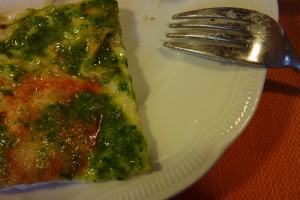
The pesto version of focaccia

Perhaps this answers the questionable “difference” between a focaccia and pizza. Focaccia is often thicker, and it is sometimes sold as “pizza a taglio,” “pizza by the slice,” even though everyone knows it is focaccia. In Italy, pizza is never one slice – it is a pie per person. And in Recco, the focaccia is thin and served on a round dish, one per person. These qualifications bring it dangerously close to pizza. When I asked the question, I was told that the ingredients in the dough are different than that of pizza dough.

And so it seems that pizza will remain pizza, focaccia will remain focaccia, and they will continue to be sold alongside one another for a long, long time as they always have. Don’t worry, pizza. Focaccia isn’t out to get you. Just don’t set up shop in Recco.

Related articles

Never miss a post
Name: 
Your email address:*
Please enter all required fields
Correct invalid entries

Chocolate News: iPhone application, 6-ton chocolate bar, chocolate as medicine, chocolate myths debunked

Published by Tuesday, February 14, 2012 Permalink 0

by Jonell Galloway

At the New York Botanical Garden, the Medicine Hunter takes a close look at the tree that can help boost your mood, heart health and brain power in the video Chocolate as Medicine.

Continue Reading…

Never miss a post
Name: 
Your email address:*
Please enter all required fields
Correct invalid entries

UA-21892701-1