Jonell Galloway: The many colors of summer tomatoes

Published by Monday, July 18, 2011 Permalink 0

by Jonell Galloway

Red, yellow, green, and orange tomatoes now available in Lake Geneva region

Tomato season is well under way, and here are a few suggestions for using them.

How to choose a tomato

Remember you can’t judge a tomato by its cover. By that I mean, the best tomatoes may well be the ugliest. They have not been sorted to meet some regulation as to size, shape and color. They can even be marked “Geneva,” “Lausanne” or “Vevey”, and never have had a root in the earth. Tomatoes can be grown hydroponically just about anywhere, so the fact that it’s marked with a local name is not absolute assurance that it will be full of flavor like a summer tomato should be and that it has been grown using traditional methods.

There are a lot of resellers in farmers markets, and then there are direct producers. Don’t hesitate to ask the vendors in your farmers market if they grew their tomatoes in a field or if they were grown hydroponically or in a greenhouse (often referred to as sous tunnel or en serre). “Field” tomatoes are obviously likely to have more taste.

The best way to be sure is of course to grow them yourself, but we do not all have the possibility, of course.

The appearance is just one factor. Smell is just as important. A natural, ripe tomato smells fragrant when you put it to your nose. A small tomato can have as much taste as a big one. Tomatoes should be soft, but not blemished or split open. If they are hard and are not aromatic, they are probably not field tomatoes.

A tomato can have hard black “calluses” on it, but that has no effect on its flavor. Simply trim them off.

In general the darker the color, the stronger the taste and the more acidic. Yellow and orange tomatoes are sweet, rather like fruit. Red tomatoes have more pizzazz. The darker, purplish ones are strong-flavored and not to everyone’s taste.

Green tomatoes tend to be more acidic. Most people prefer them cooked rather than raw, but this is a matter of taste.

How to eat a summer tomato

There are million ways to eat tomatoes, but ripe summer tomatoes need very little.

My favorite way of eating them is simply with salt and pepper, and perhaps a drizzle of olive oil. A beautiful addition to any summer lunch is a large plate of sliced tomatoes of different colors, served in this way. It is always a hit, both aesthetically and as a dish.

Tomatoes are also good grilled over the coals. For this, choose medium-size tomatoes, so they won’t fall through the grille. Simply cut them in half and grill for about 3 minutes on each side. This intensifies the flavor, giving it what the French call a confit flavor. What it really does is evaporate most of the water, leaving behind the most flavorful part, the flesh. The natural sugar in the tomato also caramelizes, making it taste sweet rather than acidic.

Tomatoes, courgette (zucchini), and aubergines (eggplant) — the classic Mediterranean vegetables — are all in season at about the same time. There are endless recipes one can think up, but one of my favorite is to mix finely diced tomatoes, zucchini and chopped onions marinated in a generous helping of vinaigrette made with Balsamic vinegar, Chardonnay vinegar and olive oil.

And then there’s the all-time favorite: mozzarella served with tomatoes and fresh basil. This too can be livened up by using tomatoes of different colors.

This article was originally published by Geneva Lunch.

Never miss a post
Name: 
Your email address:*
Please enter all required fields
Correct invalid entries

Do you know this painting? Well, here’s the recipe

Published by Friday, July 1, 2011 Permalink 0

by Miriam Garcia

Do you know this painting?

Photography by courtesy of Wikimedia Commons

Its formal name is Arrangement in Grey and Black: The Artist’s Mother, but it is commonly known as Whistler’s Mother. Its creator, American artist James McNeill Whistler, happens to be one of my (many) favorite painters. In August 1995, while on vacation in London, I stumbled upon a little book with this painting grazing its front cover. It was Whistler’s mother’s cookbook, with the recipes collected by Anna McNeill Whistler (1804-1881) through the years. The recipes are recreated and annotated for the modern cook, but included the endearing original writing of Mrs. Whistler, with all its own spelling and punctuation errors. Go figure, a book that coupled two of my most serious addictions, cooking and painting. I had to buy it.

Whistler’s mother’s recipes were among a collection of books and letters that were bequeathed by Whistler’s sister-in-law to the University of Glasgow after his death. Whistler lived in Europe most of his working life. Mrs. Whistler led quite a remarkable life herself for a 19th-century housewife; she went from the United States, via Russia and sudden widowhood at a young age, to London with her son, where she recorded in her diaries visits to the Whistler household from such artists as Algernon Swinburne and Dante Gabriel Rossetti. The book’s fascinating account of the Whistler household in America, Russia and Britain offers a unique and delightful glimpse into 19th-century family life and cooking. The recipes are simple and transmit the flavors and aromas of good home cooking.

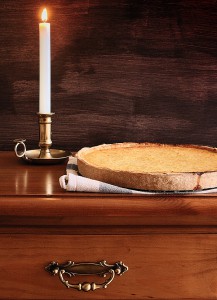
As a token of that age and to bring to the pressed 21st century some 19th century calm and simplicity, I have chosen to replicate a recipe of her apple pudding, called Marlborough pudding.

RECIPE

Apple Marlborough Pudding

Ingredients:

1 sheet of store-bought or homemade puff pastry or shortcrust
5 medium-sized cooking apples
1 lemon, juice and peel

200g (1 cup) sugar
5 medium eggs

200ml (4/5 cup) whipping cream
50ml (1/5 cup) whole milk

Click here for metric recipe converter

Method:

  1. Preheat the oven to 180°C if convection type, to 160°C if radiation.
  2. Prepare the pudding base: butter and flour a 30-cm (12inch) pie mold. Roll the crust, transfer to the mold and press to set. Trim the excess off the edges. Bake the crust blind for 10-15 minutes. Then take out of the oven and let cool a bit. Lower the oven temperature 20°C.
  3. Prepare the filling. Peel and core the apples, sprinkle them with lemon juice to prevent them from browning. Put them in a bowl, cover and microwave them 3-4 minutes, until tender.
  4. Transfer the apples to a food processor, add the rest of the ingredients: lemon juice and peel, sugar, cream, milk and eggs. Process to the desired “chunkiness”.
  5. Pour the mixture on the pie crust (this amount yields a large pie and a small cup of filling left) to the brim, then bake 1 hour. Watch it during the last stages to prevent it from excessive browning; lower the temperature if needed. After that baking time, take the pudding out and let cool completely.


I personally loved this Marlborough pudding. I love any dessert with apple though (well, except roast apples). It is lemony, creamy, light and only slightly crunchy. And as rustic and homely as I expected. Accompany it with a strong tea and open a snuff box for you to feel exactly like Whistler. And the next time you see this painting I’m sure you will remember that this lady baked delicious pies for her family.

Sources:
“Whistler’s mother and the West Coast”, BBC website
Whistler’s Mother Cook Book, Margaret McDonald

The Scottish Roots site says:

This unconventional portrait of a grey-garbed matron, commonly known as “Whistler’s Mother,” patiently sitting for her artistic son became an American icon and an emblem of motherhood. The subject of the painting, Anna Matilda McNeill Whistler, was born in North Carolina in 1804 to a middle class family of Scots descent.

Anna led a remarkable life for a 19th-century housewife; moving from the United States, via Tsarist Russia and sudden widowhood at a young age, to London with her son “Jemsie,” where she recorded in her diaries visits to the Whistler household from such literary and artistic luminaries as Algernon Swinburne and Dante Gabriel Rossetti. A traditional woman with a strong sense of morality, Anna Whistler upheld the conventional family values of the time, turning a blind eye to her artistic son’s bohemian amorous involvements in favour of encouraging his genius.

Widowed in 1849, she wore mourning for the rest of her life.

The book’s fascinating account of the Whistler household in America, Russia and Britain offers a rare and delightful glimpse into 19th-century family life and cooking. The recipes are simple and transmit the flavors and aromas of good home cooking.

Never miss a post
Name: 
Your email address:*
Please enter all required fields
Correct invalid entries

Rosa’s Musings: My Swiss Grandmother’s Cooking: the Deep Roots, Bonds and Nostalgia of Food

Published by Tuesday, June 28, 2011 Permalink 0

by Rosa Mayland

My Swiss Grandmother and Her Glorious Cuisine

“As a grandmother of six, I believe that it is crucial that we make time to pass on our recipes, cooking and growing skills and other crafts to our grandchildren.”— Darina Allen, president of Slow Food Ireland

Grandmothers link us to our culinary heritage

In our modern world, most women choose or have to work, and countless couples don’t have the time or energy to become kitchen bees. Many people prefer buying prepackaged food and don’t see any point in spending their free time preparing homemade snacks. The majority of 21st-century grandmothers hail from a generation of females who cut themselves off from old traditions, therefore nowadays, very few kids are lucky enough to have grandmothers* who cook or enjoy cooking, and who are able to share their family’s culinary legacy with their grandchildren.

Continue Reading…

Never miss a post
Name: 
Your email address:*
Please enter all required fields
Correct invalid entries

Food Play: Saint John’s Coca, a Catalan specialty

Published by Monday, June 27, 2011 Permalink 0

by SandeeA

Para leer la versión en español, pinche aquí

Food Play: Saint John's Coca, a Catalan specialty. Food Play, by SandeeA. The Rambling Epicure. Editor, Jonell Galloway.

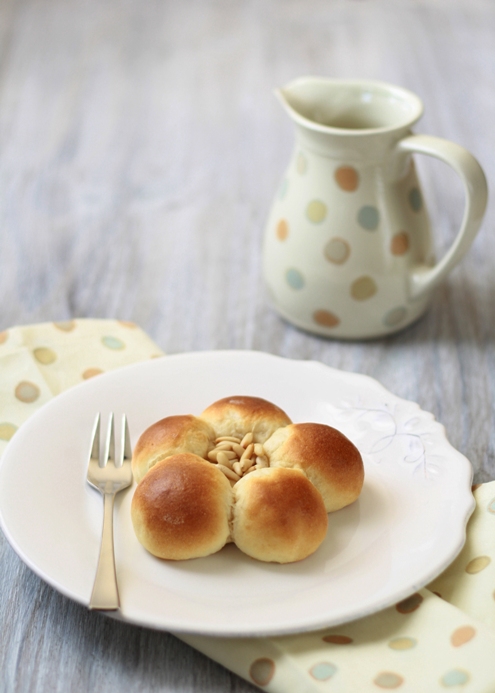
Saint John’s coca is a typical Catalonian sweetened bread eaten during the celebration of Saint John’s Eve in June. It is usually oval, but I wanted to give it a a playful twist… would you like to try some?

Continue Reading…

Never miss a post
Name: 
Your email address:*
Please enter all required fields
Correct invalid entries

Food Play: Coca de San Juan, especialidad de Catalunya

Published by Tuesday, June 21, 2011 Permalink 0

por SandeeA

Click here to read English version

Coca de San Juan. La receta de la felicidad

La coca de San Juan es un dulce típico de Cataluña para celebrar la Noche de San Juan, que se celebra del 23 al 24 de Junio. La forma típica es de una coca ovalada, pero yo he querido darle un toque diferente… te animas a probarla?

Continue Reading…

Never miss a post
Name: 
Your email address:*
Please enter all required fields
Correct invalid entries

DESTINATION DESSERT: From America to France

Published by Wednesday, June 15, 2011 Permalink 0

by Jamie Schler

MON PETIT CHOU: A Love Affair with the Perfect Treat

Chou: cabbage

Chou: cream puff, a type of pastry

Chou: cute

Chouchou: teacher’s pet

Mon petit chou: my little sweetheart, darling

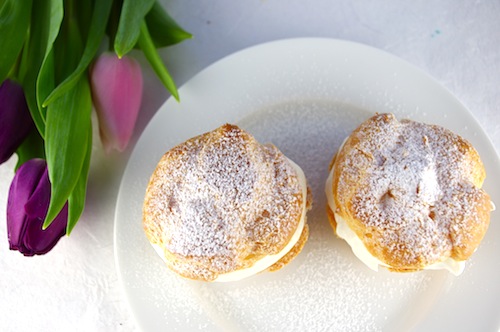
It’s funny how one single food ties my old, American childhood to my new adult life in France. This one food, the perfect choux, was a favorite, one my father would make, light and airy, crispy and golden on the outside, so ethereal on the inside. He would shape them into perfect, saucer-sized rounds, bake them until they were puffed up into pillows and lovingly fill each one with thick, creamy pudding, chocolate, vanilla or pistachio. The almost flavorless choux puff was the perfect casing for the flavorful filling, tempering the sweetness and adding texture to the smooth creaminess of the pudding, and quickly became my most loved sweet treat of all that my father baked for us. My dear old dad passed away a mere two months before I married my French sweetheart (mon petit chou) and as I prepared to join my soon-to-be husband, I pulled the carefully clipped recipe off the refrigerator in my parents’ house, my childhood home, where it had been taped for decades, words and image now faded with time and handling, and tucked it lovingly and ever so carefully amongst my few worldly possessions in my suitcase and carried it with me across the ocean to France.

Continue Reading…

Never miss a post
Name: 
Your email address:*
Please enter all required fields
Correct invalid entries

Cocina Transcontinental: Fresas asadas con balsámico

Published by Thursday, May 26, 2011 Permalink 0

Fresas asadas con balsámico, receta inspirada por Three to One

por Tricia Martin y SandeeA

Click here for English

Ingredientes

2 libras de fresas (aproximadamente 1 Kg.
6 cucharadas de azúcar moreno
3 cucharadas de vinagre balsámico
1-2 cucharaditas de té de sal marina en escamas

Instrucciones

Precalienta el horno a 250º F (120ºC).

Mezcla las fresas, el azúcar y el vinagre.

Coloca la mezcla sobre una bandeja de horno, y hornea una hora y media aproximadamente.

Sabrás que están listas cuando tu casa se inunde con el increíble aroma de las fresas asadas.

Saca del horno, espolvorea con la sal, y sírvelas templadas con una bola de helado de vainilla, crème fraîche, o chocolate en trocitos.

En Cualquier caso, están fantásticas solas!

Never miss a post
Name: 
Your email address:*
Please enter all required fields
Correct invalid entries

Cross-Continental Cooking: Slow-Roasted Strawberries

Published by Wednesday, May 25, 2011 Permalink 0

by Tricia Martin and SandeeA

Para leer la versión en español, pinche aquí

My partner SandeeACocina and I partner on a recipe once a month.

This month, we wanted to go with something a little sweeter than usual. Strawberries are in season both in the U.S. and Spain, so it only made sense to use strawberries. Every May I look forward to tasting that perfect jeweled basket of aromatic, sweet strawberries and I couldn’t be more thrilled to find a friend across the Atlantic who revels in some of these same simple pleasures of life. So strawberries it is this month.

We keep the recipes we make each month a “secret” from each other until the very last moment. We don’t see what the other has done until the day before we post. We then swap recipes — Sandee translates into Spanish and I create the photo montages of our pictures — it’s great teamwork!

This month we were both surprised and delighted with the hot/cold aspect of our recipes. The roasted strawberries are hot, messy, and sexy. Sandee’s ice bowl with sangria is cold, composed, and has a lovely surprise finish.

I was inspired to try roasted strawberries when a blog post over at Tricia Martin, by Dimity Jones, popped into my inbox. I was totally seduced by the simplicity of the recipe and the idea of roasting a spring fruit (not even a vegetable) — I tend to save cooking methods like roasting for fall and winter time foods — but am so glad I broke out of that box.

The Balsamic complimented the sweetness of the berries, further intensifying their naturally bright color. The brown sugar did its job of creating the most amazing caramelized strawberry ooze that just begged to be scraped from the pan and licked from the fork.

And the smell — the smell! — of these babies cooking is absolutely intoxicating. My apartment was literally as fragrant as strawberry fields forever as they sizzled on their hot little pan, eeking out beautiful dark red juices and creating one of the best strawberry desserts I’ve had in a long while.

I ate them straight from the pan! I promise I tried to put them on a plate, but alas, the forks in the photo do not lie: I ate this directly from the pan and I would have had all my friends do the same if they had been around, rather like when you share a fondue. The berries would however be smashing over some crumbly short bread, a Southern-style biscuit or with a dollop of crème fraiche.

Three to One

Recipe

Slow-Roasted Strawberries

Recipe inspired by Tricia Martin

Ingredients

Click here for metric recipe converter

2 pounds strawberries
6 tablespoons dark brown sugar
3 tablespoons balsamic vinegar
1-2 teaspoons flaky sea salt

Instructions

Preheat the oven to 250 degrees F. Toss the strawberries, brown sugar, and balsamic vinegar to coat. Pour onto a baking sheet and bake for 1.5 hours. You’ll know when they are getting near done, your house will fill with the most amazing smell of strawberries. When finished, take the pan out of the oven and sprinkle with the sea salt, serve warm with an optional scoop of creme fraiche, vanilla ice cream, or chopped dark chocolate. However, they really are fantastic on their own.

Never miss a post
Name: 
Your email address:*
Please enter all required fields
Correct invalid entries

Mediterranean Food Connection: Cocas à la Frita

Published by Friday, May 6, 2011 Permalink 0

Recette de Christophe Certain

Click here for English version

Les cocas à la frita recette facile en images, chaussons de pâte brisée fourrés d’oignons, tomates et poivrons revenus

Voilà ma recette de cocas, testée à de nombreuses reprises ; elle est infaillible, même si elle n’est pas traditionnelle.

Ne pas mettre trop de farce (2 C.A.S.) sinon les cocas risquent d’exploser à la cuisson.

Si vous utilisez de la frita, veillez à ce qu’elle ne soit pas trop liquide pour les mêmes raisons. Otez le jus s’il y en a. Le blanc d’oeuf permet de bien stabiliser la fermeture de la pâte à la cuisson, le jaune d’avoir une belle couleur dorée.

La recette traditionnelle de la pâte à coca se compose de 50% farine, 50% saindoux, avec un peu de sel. Comme ça vous pourrez comparer !

Continue Reading…

Never miss a post
Name: 
Your email address:*
Please enter all required fields
Correct invalid entries

David Downie: Feature Article on Emilia in The Italy Issue of this Month’s Bon Appetit magazine.

Published by Thursday, April 28, 2011 Permalink 0

by David Downie, France/Italy correspondent for The Rambling Epicure

Never a dull moment: I’m packing to leave Paris to go on book tour for Paris, Paris: Journey into the City of Light and Quiet Corners of Rome…and my lead feature for the May issue of Bon Appetit has already hit the stands… and the Internet. Here‘s an excerpt from The Italy Issue, as they are calling it. The story has many parts, with addresses and recipes listed separately.

The photo that doesn’t appear in the story: yours truly making tortellini at the big annual Sagra del Tortellino festival in Castelfranco-Emilia, near Bologna.

Buon appetito! Or perhaps it should be Bon Appetit?

Never miss a post
Name: 
Your email address:*
Please enter all required fields
Correct invalid entries

UA-21892701-1