Switzerland: Tomatoes and Swiss Chard, and it’s in Season!

Published by Tuesday, August 16, 2011 Permalink 0

by Jonell Galloway

Swiss chard, along with kale, mustard greens and collard greens, is one of several leafy green vegetables often referred to as “greens”. It is a tall leafy green vegetable with a thick, crunchy stalk that comes in white, red or yellow with wide fan-like green leaves.

The Swiss variety tends to have whitish stems not dissimilar to green celery but wider and somewhat fan-shaped, while the varieties found in North America can be red, purpose or yellow. Some say chard is second only to spinach in terms of nutrients, and it is certainly full of fiber and phytonutrients.

When choosing chard, make sure the leaves are not wilted and the stems look fresh and crisp. If it looks limp in any way, pass it up.

It is one of the few vegetables that probably shouldn’t be eaten raw, due to its high acid content.

Although it is referred to as “Swiss” chard, it isn’t actually native to Switzerland. It is a Mediterranean vegetable. Already in the fourth century B.C., Aristotle wrote about “chard”, the common name used in the Mediterranean region. It probably got its name from a vegetable that it resembles, the cardoon. It is thought that the French confused the two and ended up calling them both “charde”.

In modern times, the French call Swiss chard blettes, the Swiss call them côtes de bettes, and, funnily enough, the English-speaking world has kept the name closest to the original used in ancient times: chard.


Swiss chard (Beta vulgaris) with variously col...


Its actual homeland lies farther south, in the Mediterranean region; in fact, the Greek philosopher Aristotle wrote about chard in the fourth century B.C. This is not surprising given the fact that the ancient Greeks, and later the Romans, honored chard for its medicinal properties. Chard got its common name from another Mediterranean vegetable, cardoon, a celery-like plant with thick stalks that resemble those of chard. The French got the two confused and called them both “carde.”

Swiss chard is in season for a good deal of the year in Switzerland, but this recipe takes advantage of summer to use some of those divine tomatoes that embellish the farmers markets.

In winter, it can be mixed with potatoes to make a lovely purée or soup.

Recipe

Tomatoes and Swiss Chard

Ingredients

Click here for recipe measurement converter

1 Tbsp. cooking oil

1 kg Swiss chard

500 g ripe tomatoes

1 tsp. sea salt
Pepper to taste
  1. Heat oil to medium low in a Dutch oven.
  2. In the meantime, bring a large soup pan of water to boil.
  3. Scrape any mud or black spots off Swiss chard. Wash carefully.
  4. Cut stems into 2 cm long chunks.
  5. Add Swiss chard to warm oil.
  6. Sautée for 2 minutes, stirring all the time.
  7. Wash tomatoes.
  8. Drop tomatoes into boiling water for 30 seconds or until skin starts to crack.
  9. Remove tomatoes from boiling water, and run under cold water, carefully removing the skins with fingers.
  10. Squeeze to remove seeds or scrape out seeds with end of a knife.
  11. Chop finely.
  12. Add tomatoes to Swiss chard. Mix well.
  13. Add sea salt and pepper to taste. Continue mixing.
  14. Turn heat down to low and cover Dutch oven. Cook slowly for 20 to 40 minutes, depending on whether you prefer it crunchy or less crunchy.
  15. Serve hot.

Suggestion: For a livelier version, add garlic and garam masala.

Suggestion: To make this in to a vegetarian meal, add borlotti, cannellini beans  or garbanzo beans and sprinkle with grated cheese.

Related articles

Happy 99th Birthday, Julia Child!

Published by Monday, August 15, 2011 Permalink 0

by Julia Child

Julia Child would have turned 99 today.

Julia Child brought French food to post-war America. When her husband Paul was posted to Paris, she studied at L’Ecole du Cordon Bleu, and went on to form her own cooking school with fellow students Mastering the Art of French Cooking and Louisette Bertholle. The threesome went on to write the 2-volume classic Coq au Vin , which covered all the basic techniques and dishes of classic French cuisine.


And indeed she proved to be right. It is only now, 60 years later, that cooking has established itself as gastronomy, and only when referring to a few great American chefs.

This is Foodista’s list of their favorite Julia recipes.

Coq au Vin

Rooster cooked in red wine is a classic Burgundian dish made with red wine, mushrooms, onions, bacon and herbs.

Duck a l’Orange

Vichyssoise is actually the base of almost all French soups. This simple base — made of potatoes, leeks, and salt — is elaborated on in countless ways to make an endless variety of soup. When served cold in summer and cream is added, it is referred to as Vichyssoise.

Boeuf Bourguignon

Ratatouille brings all the flavors of the Southern sun together: red ripe tomatoes, eggplant, zucchini, bell peppers, garlic, onions and Provençal herbs. Today there are many other versions, many of them even in the oven, but this is the classic recipe.

Upside-Down Martini

The problem with duck is always the same: the fat spews all over the place and it is difficult to digest. The acid of the orange in this classic French dish helps digest the fat, and makes it tasty too. This is a favorite Julia Child recipe.

Custard Apple Tart

Boeuf Bourguignon is a fancy version of our classic beef stew. What makes it different is that it is cooked in red wine, and pearl onions and mushroom caps are added to it.

Plum Clafoutis

Not surprising that Julia loved Martinis. She added vermouth to just about any sauce she could work it in to.

Sabayon

Not all French pies are made with custard, but you often find this version in Normandy, the land of cream and butter. It can be served either cold or warm.

Lessons from Julia Child

Clafoutis can be made with many different fruits, but plus and cherries are all-time French favorites. This tart has a custard-like consistency, but also contains ground almonds, giving it a salty edge.

Sabayon is a a cousin of the light, egg-based Italian dessert zabaglione. It is light and custard-like, and a standard in French as well as British cuisine.

Never miss a post
Name: 
Your email address:*
Please enter all required fields
Correct invalid entries

Food Art: Puff Pastry Salad, food photography by SandeeA

Published by Monday, August 15, 2011 Permalink 0

These photos are by SandeeA, author of the column Food Play, and who runs a site called . SandeeA is never lacking ideas when it comes to playful, fun recipes. Click here to find the recipe for this salad in a puff pastry. It would be a great recipe to get your kids in the kitchen!


Never miss a post
Name: 
Your email address:*
Please enter all required fields
Correct invalid entries

How to build a recipe: a video by Grant Achatz, chef of Alinea

Published by Wednesday, August 10, 2011 Permalink 0

by Jonell Galloway

I always say to build a recipe you have to know how to think with your tastebuds. Here’s a video with a thorough explanation of the process by one of the best in the world: Grant Achatz, chef at Alinea in Chicago, Illinois, in the U.S. He approaches it in an intuitive, yet logical manner. I strongly advise up-and-coming chefs to watch this. It holds lessons for life.

Click here to watch video.

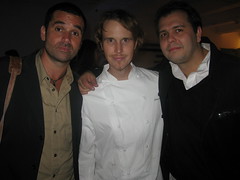
Dan Dunne, Grant Achatz, Simon Ford

Image courtesy of Caroline. Grant Achatz in center.

Related articles

  • Famous Spanish Restaurant El Bulli Shuts, for Now
  • Spanish chef Ferran Adria shuts El Bulli restaurant
  • Famed el Bulli eatery closes doors in Spain
Never miss a post
Name: 
Your email address:*
Please enter all required fields
Correct invalid entries

Food Art: Chocolate Popcorn, food photography by SandeeA

Published by Tuesday, August 9, 2011 Permalink 0

These photos are by SandeeA, author of the column Food Play, and who runs a site called La Receta de la Felicidad. SandeeA is never lacking ideas when it comes to playful, fun recipes. Click Scrumptious Jelly-Filled Fruits – Sandee A.’s Strawberry Bananas are a Fruity Way to Feed Friends
to find the recipe for this chocolate popcorn. It would be a great recipe to get your kids in the kitchen!

Never miss a post
Name: 
Your email address:*
Please enter all required fields
Correct invalid entries

Food Art: Soba Noodles, A Zen Perspective

Published by Monday, August 8, 2011 Permalink 0

 “Preparing food is not about yourself and others. It is about everything!”
– Shunryu Suzuki


Click here for more pictures and a recipe for “Cold Soba Noodle Salad“.

Never miss a post
Name: 
Your email address:*
Please enter all required fields
Correct invalid entries

Switzerland: Pan-fried Sérac Cheese & Potato Salad Recipe

Published by Friday, August 5, 2011 Permalink 0

Spontaneous Cuisine, by Jonell Galloway

Swiss Sérac cheese, a fresh cow’s milk cheese made with whey

Whey cheese is produced when the curds are separated from the whey to make cheese. Ricotta is also a whey cheese, but unlike Sérac, it is often made with sheep’s milk. As a result, you can use your local cheesemonger’s Sérac in most recipes that call for ricotta.

Photo courtesy of FribourgRegion tourist office.

Photo courtesy of Fribourg Region tourist office.


Sérac is made in most regions of Switzerland, and each region has its own version. Some regions smoke it; others flavor it with herbs, spices or pepper.

Sérac cheese is soft and creamy in texture, so it is easy to spread it on bread to make a healthy sandwich or snack, but Sérac is not only a snack cheese. It can also be used to make healthy, quick meals, such as the recipe below. In the summertime, I often use it like mozzarella, with tomatoes and basil or other Italian-inspired recipes.

It is a great way of teaching your children to eat healthy snacks. Top it with fresh fruit to make a healthy, low-fat dessert, or use it for between-meal snacks on chunky whole-grain bread.

Since it is a fresh milk cheese, it does not keep, and should be eaten shortly after purchasing. Because it is made from fresh milk whey, it is also naturally low in fat. In Switzerland, it would have about a 3.8% fat content, the same as milk.

Continue Reading…

Never miss a post
Name: 
Your email address:*
Please enter all required fields
Correct invalid entries

Switzerland: Spontaneous Cuisine: Fresh fruit croûte

Published by Friday, August 5, 2011 Permalink 0

by Jonell Galloway

Cheese Croûtes, a Perfect Winter Snack

Anyone who’s every traveled or skied in Switzerland knows we love croûte. Every ski station restaurant offers a wide range of croûtes. But what exactly is a croûte, you might ask.

A classic cheese croûte from the Refuge de Chesery

Literally, the word means “crust,” but in practice the dish is usually made with day-old bread, onto which a wide array of foodstuff can be placed. The classic croûtes are layers of toasted bread in a shallow baking dish, covered with any combination of ham, bacon, egg, cheese, tomatoes, etc., but never leaving out the cheese.

For these savory dishes, the bread is cut into slices about 1 cm thick and placed in a buttered shallow baking dish. The bread is browned on both sides in the oven, and then slightly dampened with a little white wine or water. Thin slices of a fatty, hard cheese, such as Gruyère or Emmental, are then distributed evenly over the toast, pepper is added (and other ingredients if desired), and the composition is popped back into the oven until the cheese melts and turns brown.

Because of the oven and the hot cheese, winter croûtes are certainly not appropriate for getting your kids in the kitchen, so I’ve come up with this summer version.

Continue Reading…

Never miss a post
Name: 
Your email address:*
Please enter all required fields
Correct invalid entries

Cross-Continental Cuisine / Cocina Transcontinental: Paté al cava y sangría de jengibre

Published by Tuesday, July 26, 2011 Permalink 0

por SandeeA y Tricia Martin

Click here to read English version

Pate al cava / Giger sangria
Me pasé toda la infancia soñando con probar la comida de la que hablaban en los libros… me parecía tan exótica y apetecible! Los emparedados, los pasteles de carne y manzana, la cerveza de jengibre de los libros de Enyd Blyton, … y quién no ha soñado con comerse uno (o dos) jabalíes con Astérix y Obélix… y ya puestos darles unos mamporros a esos “malditos romanos” y decirle al pescadero del pueblo galo que su pescado no está fresco para que se organice una buena :P?

Este mes el ingrediente elegido para nuestro Cross-Continental Cooking project fue el cava… y gracias a este proyecto conjunto que tengo con Tricia de Eating is Art voy a poder preparar mi propia cerveza de jengibre, simplemente mezclando sirope de jengibre con agua con gas… De los sueños gastronómicos infantiles ya solo me queda pendiente la pelea a besugazos (o pangazos, según como esté la economía :P) No dejéis de visitar la receta de Tricia: sangría de cava que, como todas las anteriores, está traducida al español. Además Tricia se ha embarcado en un nuevo proyecto: su propio estudio fotográfico Studio Tricia Martin. No dejéis de visitarlo, os dejará sin palabras… En cuanto a mi receta, tenéis que probarla, de verdad, y no volveréis a comprar uno de esos “blocs de foie” con ingredientes dudosos por los que te piden un riñón

Pate al cava / Ginger sangria

Continue Reading…

Never miss a post
Name: 
Your email address:*
Please enter all required fields
Correct invalid entries

Destination Dessert: Sweet Focaccia with Strawberries and Dark Chocolate Ganache

Published by Monday, July 18, 2011 Permalink 0

by Jamie Schler

STARTING OVER – Step 1

Like the beat beat beat of the tom-tom
When the jungle shadows fall
Like the tick tick tock of the stately clock
As it stands against the wall
Like the drip drip drip of the raindrops
When the summer shower is through
So a voice within me keeps repeating you, you, you

Night and day, you are the one
Only you beneath the moon or under the sun
Whether near to me, or far
Its no matter darling where you are
I think of you
–Cole Porter


“Life is an adventure,” she said, no trace of cliché on her lips. He scooted down a little lower, snuggling deeper into his corner of the sofa. His eyes searched out her own, slightly pleading, slightly mocking, filled with the desire to believe her once again. She had just returned from Germany and stepped off of the airplane into a new life, one of risk and a daring adventure, one of complete togetherness. They were tossing caution to the wind in their great desire to grab at happiness and contentment, something so rare these days. And from here on out they would be together each and every day, all day and into the night.

Continue Reading…

Never miss a post
Name: 
Your email address:*
Please enter all required fields
Correct invalid entries

UA-21892701-1