Mindful Eating: Getting your Kids into the Kitchen: Fresh Fruit Smoothies

Published by Sunday, June 30, 2013 Permalink 0


//

Jonell Galloway, Editor, The Rambling EpicureMindful Eating: Getting your Kids into the Kitchen: Fresh Fruit Smoothies

Getting your Children Interested in Food

From the archives

For younger children, one of the easiest ways of introducing them to the kitchen is to tempt them with a sweet, fruit smoothie.

Smoothies are easy and can be made all year, changing
the flavor according to what fruits are in season.

So as to avoid adding sugar, it’s best to choose a fruit that is very ripe and sweet, and, of course, one that your child likes. Letting your child choose the fruit is also a way of teaching him or her how to shop for fresh fruit, and explain why you don’t buy strawberries from Chile at Christmas. Local fruit is not only fresher and therefore has more vitamins, but it is also nicer on the purse.

Bananas are good all year, and can be mixed with different fruits in the summer. There are endless combinations that change with the seasons.

At the moment, strawberries, melons, peaches, and raspberries are already available in the Geneva region or from nearby France or Italy. Indian mangoes make a divine smoothie, similar to an Indian lassi, and always a favorite for children. The buttery, honey-flavored yellow kiwis from New Zealand have a very short season, but are not as acidic as the green ones, and have just come on the market.

Take a look at what’s in season before you go to the market.

Continue Reading…

Never miss a post
Name: 
Your email address:*
Please enter all required fields
Correct invalid entries

Foraging and Post-Neolithic Cooking: Antonio’s Wild Spinach Salad Recipe, by Jane Le Besque

Published by Sunday, June 16, 2013 Permalink 0

Foraging and Post-Neolithic Cooking: Antonio’s Wild Spinach Salad Recipe, by Jane Le Besque

Antonio’s Wild Spinach Salad Recipe

Jane and Antonio’s recipe is based on foraging and what they imagine post-neolithic cooking to be, foraging and all, but with a modern twist, i.e. the olive oil.


Continue Reading…

Never miss a post
Name: 
Your email address:*
Please enter all required fields
Correct invalid entries

Food Art: Rolling in the Beets, food photography by SandeeA

Published by Friday, June 14, 2013 Permalink 0

Food Art: Rolling in the Beets, food photography by SandeeA

SandeeA does original, exciting food photography, always in a playful manner. A woman of many talents, she is also author of our Food Play column. She writes in both English and Spanish and runs the popular food blog La Receta de la Felicidad, where you can find the recipes for these beautiful creations.

Continue Reading…

Never miss a post
Name: 
Your email address:*
Please enter all required fields
Correct invalid entries

Switzerland: Swiss-style Knepfle Pasta

Published by Thursday, June 13, 2013 Permalink 0

by Jonell Galloway

Switzerland: Swiss-style Knepfle Pasta

Knepfle is originally from Alsace in France, but it is also eaten in Switzerland, in particular in the Jura region, which borders Alsace.

You can buy them at the supermarket, but they’re much better when you make them at  home.

Swiss-style Knepfle Recipe

Ingredients

3 1/3 to 4 1/10th cups unbleached white flour
3 eggs
2 cups milk
About 1/2 cup water
3 large pinches of salt
1 oz. butter
Large pan of water for boiling knepfles
Coarse sieve with large holes

Instructions

  1. Put eggs into a bowl. Add milk, water and a pinch of salt. Beat with wire whip.
  2. Little by little, use wire whip to add flour until a heavy dough is formed. The dough should fall naturally off the whip.
  3. Let dough rest for 30 to 60 min.
  4. When time is almost up, bring  large saucepan of water to boil. Add 2 pinches of salt.
  5. Heat an oven dish large enough to hold all the knepfles.
  6. NOTE: The hard part: Real pros push the dough through a coarse sieve, but this can be a bit tricky. If this is your first time making knepfles, I suggest that you drop the dough by teaspoons the first time, and try using a sieve the next time. Make sure you have a sieve with large holes before trying this.
  7. Leave water to boil gently and start dropping teaspoons of dough into water, in several goes.
  8. Let knepfles poach until they rise to the surface. This should take about 15 minutes.
  9. Use a slotted spoon to remove them. Do this carefully so they don’t fall apart. Drain well. Place in heated oven dish.
  10. Do this in steps, until all the dough is used up.
  11. To serve, over medium to medium high heat, melt butter in a frying pan (butter should be sizzling).
  12. When hot, add dry knepfles and brown, carefully turning them from time to time. Cook until browned, about 15 minutes.
  13. Serving: There are many ways to serve knepfles: plain, with cream or bacon bits, or with other sauces.


Never miss a post
Name: 
Your email address:*
Please enter all required fields
Correct invalid entries

Food Quote: Nelson Mandela on Food

Published by Wednesday, June 12, 2013 Permalink 0

by Jonell Galloway

Nelson Mandela on Food

I was not born with a hunger to be free. I was born free. Free in every way that I could know. Free to run in the fields near my mother’s hut, free to swim in the clear stream that ran through my village, free to roast mealies [corn] under the stars … It was only when I learnt that my boyhood freedom was an illusion … that I began to hunger for it.–Nelson Mandela

Photo courtesy of The Guardian

has provided “the backdrop and occasionally the primary cause for momentous personal and political events in the life of Nelson Mandela.” In his autobiography, he took an innovative approach to history and showed that a great man’s life can be measured out in mouthfuls, both bitter and sweet. With this title, the reader can cook and taste Nelson Mandela’s journey from the corn grinding stone of his boyhood through wedding cakes and curries to prison hunger strikes, presidential banquets and ultimately into a dotage marked by the sweetest of just desserts. Tales told in sandwiches, sugar and samoosas speak eloquently of intellectual awakenings, emotional longings and always the struggle for racial equality. He was always motivated by hunger, either longing for food he couldn’t have, or depriving himself of food in the name of freedom.

“Only the truly food obsessed would read such a statement and consider the stomach from whence it came, but I did and the result is a gastro-political biography entitled Hunger for Freedom, the story of food in the life of Nelson Mandela,” he told Ana Trapedo of The Guardian.

When in prison, he wrote to former wife Winnie: “How I long for amasi (traditional South African fermented milk), thick and sour! You know darling there is one respect in which I dwarf all my contemporaries or at least about which I can confidently claim to be second to none – healthy appetite,” he told Trapedo.


Never miss a post
Name: 
Your email address:*
Please enter all required fields
Correct invalid entries

Simple Sustenance: Summer Indulgence — Cardamom-Infused Mango Milkshake

Published by Monday, June 10, 2013 Permalink 0


Profile photo, Renu Chhabra, Simple Sustenance (C) ALL RIGHTS RESERVED.by Renu Chhabra

Ponder well on this point: the pleasant hours of our life are all connected by a more or less tangible link, with some memory of the table.–Charles Pierre Monselet

Mango milkshake by Renu Chhabra, all rights reserved (R)

Summer afternoon and a glass of cold milkshake! Mango milkshake. Something I am always ready for. Why wouldn’t I be? It brings back memories of my childhood — fun and comforting memories.

Growing up in India, summer meant boxes of mangoes showing up in our house throughout the season. Not just one or two varieties, but several of them. Different sizes, tastes, and textures to relish, and we all had our own favorite.

 Mango for mango milkshake by Renu Chhabra, all rights reserved (R)

It was the summer fruit to indulge in — messy but syrupy sweet and wonderfully juicy. Most of all, it was fun to sit around the table; and enjoy this tropical fruit and celebrate the season.

 Mango for mango milkshake by Renu Chhabra, all rights reserved (R)

And with such abundance pouring in, we were treated with mango ice cream, mango custard, mango salad, and not to forget mango milkshake, the simplest of all for warm summer days. Simple because it can be put together in no time.

Its creamy texture and sunshine yellow color always lifts my spirits. Simply said, it’s a happy reminder of my childhood. Little moments that enable us to travel miles away!

 Mango and milk for mango milkshake by Renu Chhabra, all rights reserved (R)

I have accented the mango shake with cardamom in this recipe. Cardamom, as I call the soul of Indian desserts. Just a hint of it makes the recipe sing fragrant notes. A little goes a long way; otherwise it gets bitter. Like we say, “Too much of a good thing can be bad.”

I used honey as sweetener, but you can use sugar or agave to taste. The amount will also depend on the sweetness of the mango.

Mango milkshake by Renu Chhabra, all rights reserved (R)

Continue Reading…

Never miss a post
Name: 
Your email address:*
Please enter all required fields
Correct invalid entries

Indian Curry Through Foreign Eyes, Part 1: Hannah Glasse’s 18th-century Curry Recipe

Published by Sunday, June 9, 2013 Permalink 0

Indian Curry Through Foreign Eyes, Part 1: Hannah Glasse’s 18th-century Curry Recipe

by Laura Kelley

I have long been fascinated by concepts of “I and other”, or the many ways we separate what is familiar (self) from what is not familiar (non-self). By defining what is not self, we are in fact defining self. One can hear small children do this when misclassified by gender; most adamantly declare that they are not members of the opposite sex. “I and other” are also evident in beautiful symbolic ways when considering the movement of ideas and beliefs through societies. The newly introduced idea is at first foreign, complete with unfamiliar trappings. As the idea flows through society and is adopted, the foreign elements are shed and replaced by the familiar.

Depictions of Buddha: Caucasian and Asian, by Laura Kelley at //www.silkroadgourmet.com/hannah-glasse-curry/

Depictions of Buddha: Caucasian and Asian

One place to see this is operation is at the Boston Museum of Fine Arts, which houses an expansive collection of Asian art. As Buddhism moves out of India and across Asia, first to the west and then the east, early iconography clearly depicts Buddha as Caucasian (Gandahara style), even when the work is from the Himalayas, Burma or Western China. As time passes, and Buddhist ideas are adopted across the east, however, religious iconography begins to depict a wide variety of races and ethnicities. Noses become smaller, epicanthic lids are added as the face changes from Caucasian to Asian. Expressions usually remain contemplative and serene, but the varying shapes of the faces are evidence of the triumph of the ideas across space and time.

The “I and other” concept is also of interest in historical cookery, especially when one group is attempting to recreate the cuisine of another. I’ve been looking at early recipes for Indian curry written by non-Indians. So far, I have a small collection of English and American recipes from the 18th and 19th centuries that show curry powders and recipes developing from recipes that merely reminiscent as Indian in the eighteenth century to those that are nearly indistinguishable from modern recipes broken out by geographical region by the end of the nineteenth. The earliest amongst them (so far) is a recipe from Hannah Glasse’s The Art of Cookery made Plain and Easy, first published in 1747.

The Art of Cookery, 1774, photo by Laura Kelley

The Art of Cookery, 1774

Continue Reading…

Never miss a post
Name: 
Your email address:*
Please enter all required fields
Correct invalid entries

Apollonia Poilâne and the Making of the Paris Poilâne Bread “Empire”

Published by Saturday, June 1, 2013 Permalink 0

by Jonell Galloway

Did the French Bread Revolution start with Poilâne Bread?

The familiar French word for friend, “copain,” means “to share bread with each other.”–Apollonia Poilâne, now head of the Poilâne bread “empire”

A humble baker called Pierre Poilâne started a bakery on the rue du Cherche-Midi in Paris in 1932. The 6th arrondissement was not a chic neighborhood at the time; penniless artists lived there, and often paid Poilâne in paintings. We might ask, did the French Bread Revolution start here at 8 rue du Cherche-Midi?

Poilâne used stoneground, unprocessed, whole-grain flour and sourdough starter, baking his bread in a wood oven — then unheard of in Paris, the capital of the baguette. It was unfashionable to eat anything other than white bread. This way of thinking was further reinforced by WWII, during which the French had no choice but to eat heavy, dark bread. He continued making it nonetheless, says France Today, and today, Apollonia Poilâne, Pierre’s granddaughter, runs the bakery.

Until 2007, she studied at Harvard and ran the bakery at the same time, having her personal supply of bread sent to her every week in Boston.

Note the elegant “P” carved into the top of each loaf.


This now-classic Poilâne loaf has a hard, crusty outside and a firm, dense crumb on the inside. It can keep be eaten fresh for up to 5 days after baking, after which it can be toasted.
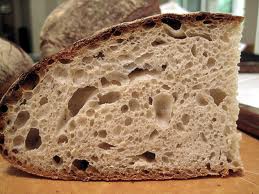
Inside Pain Poilane bread creative common license http://www.thefreshloaf.com/keyword/pointeacalliere


Pain Poilâne or miche, meaning “round loaf,” weighs in at around 2 kg / 4.4 lb. The recipe is secret, and it is not a whole-grain bread in the traditional sense of the word. Environmentally correct, pesticide-free varieties of wheat are grown and stored. They are then stone-ground, thus preserving the wheat germ. Stone grinding makes it possible to eliminate any coarse bran that might contain impurities.

Poilâne flour is what is called in French farine biseor wheatmeal — a brown flour intermediate between white flour and wholemeal flour — which maintains a higher nutritional value than white flour. Levain or sourdough starter and salt from the salterns of Guérande, a swamp of salt water in Brittany.

Pierre brought this type of bread with him from his native Normandy, where loaves were large and round, in the style of what the French now call “country bread.” Today, it is distributed all over the world.
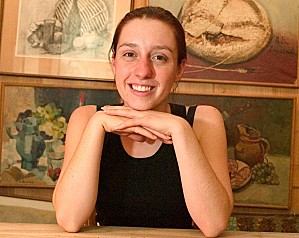
Apollonia Poilâne, current owner of Poilâne bread bakeries


Pierre’s sons Lionel and Max took over the bakery in 1970. Just like Apollonia, they had learned bread baking by working right alongside their father, and continued the tradition of the original round loaf marked with the signature “P.” They eventually took separate paths, with Lionel keeping the original bakery started by his father, and Max going off on his own to start a bakery under his own name, Max Poilâne. In Paris, people have long discussions over which of the brothers makes/made the better bread, since both have continued to bake their father’s signature recipe.

Lionel Poilâne is better known outside France, since he grew the original family business, making it into an international name. This growth was made possible by his excellent teaching skills and his embracing of modern developments in the industry, such as the use of machine kneading, while at the same time maintaining his father’s philosophy of each baker following and taking responsibility for his or her loaves from start to finish. He referred to his concept as “retro-innovation.”

Lionel and his wife died when their helicopter, piloted by Lionel, crashed in 2002, leaving behind daughters Athena and Apollonia, the latter who is now following in her father’s footsteps. She started running the bakery on graduation from high school.

In this video, Martha Stewart visits the Poilâne bakery in Paris and learns about the bread making process in an interview with 22-year-old Apollonia Poilâne when she was still at Harvard. Click here to watch the video interview of Apollonia by Martha Stewart herself.


Martha Stewart

The offiical Poilâne site lists a number of recipes, for making and using some of the Poilâne bread and pastries.


Poilâne Bakeries

8 rue du Cherche-Midi, Paris 6th arrondissement
Tel. +33 (0) 1 45 48 42 59
 
49 bld de Grenelle, Paris 15th arrondissement
Tel. +33 (0) 1 45 79 11 49
Open on Sundays
 
38 rue Debelleyme, Paris 3rd arrondissement
Tel. +33 (0) 1 44 61 83 39
Open on Sundays
 
46 Elizabeth Street, London SW1W
Tel. +44 (0) 207 808 4910


To read more about the French Bread Revolution, see also (bilingual in French and English):

The Revolution of French Bread Baking (part 1), by Jean-Philippe de Tonnac

The Revolution of French Bread Baking (part 2), by Jean-Philippe de Tonnac

Book Review: Jean-Philippe de Tonnac’s “Dictionnaire Universel du Pain” or Universal Dictionary of Bread, by Jean-Philippe de Tonnac

The 7 Lives of Bread: Pascal Auriac, master bread baker in Laguiole, a hidden corner of France, by Jean-Philippe de Tonnac

Never miss a post
Name: 
Your email address:*
Please enter all required fields
Correct invalid entries

Switzerland: Swiss Food: Rhubarb Cream Recipe

Published by Monday, May 27, 2013 Permalink 0

by Jonell Galloway

Cherry-Rhubarb Fool

When you talk about rhubarb cream in Switzerland, you mean rhubarb cream, not pudding or custard. This naughty dessert is one of the easiest rhubarb desserts around, and is so thoroughly Swiss.

Recipe for Rhubarb Cream

Ingredients

Photo courtesy of Robin Stewart


1 lb. / 500 g rhubarb
3/4 cup / 200 g cane sugar
 2 egg yolks
 Cinnamon or lemon juice, according to which taste you prefer
3/4 cup / 0.2 l whipping cream

Directions

  1. Scrape or cut off any hard outer surface of rhubarb.
  2. Dice rhubarb and put into saucepan. Add sugar. Cover with water. Cook until tender but firm, 5 to 10 minutes.
  3. While rhubarb is cooking, beat the yolks until smooth.
  4. Run cooked rhubarb through food processor or chinois to purée.
  5. Add hot rhubarb purée to beaten egg yolks. Beat until thoroughly blended and eggs start to cool.
  6. Mix in cinnamon or lemon juice. Set aside to cool.
  7. Beat whipping cream. When it starts to form hard peaks, fold in cooled rhubarb and egg mixture.
  8. Cool in refrigerator, either in individual serving dishes or in a large bowl.
  9. Serve cool.


Never miss a post
Name: 
Your email address:*
Please enter all required fields
Correct invalid entries

Switzerland: Easy Egg-Free Quark Chocolate Mousse Recipe

Published by Friday, May 24, 2013 Permalink 0

by Jonell Galloway

This egg-free quark chocolate mousse recipe was developed by Maison Cupcake, but the use of quark cheese is so incredibly Swiss, I thought I should list it as a “Swiss recipe”. Next week Maison Cupcake will be developing a rhubarb mousse using quark, so keep your eye on this site.


Click here for recipe.


Never miss a post
Name: 
Your email address:*
Please enter all required fields
Correct invalid entries

UA-21892701-1