Foraging and Post-Neolithic Cooking: Antonio’s Wild Spinach Salad Recipe, by Jane Le Besque

Published by Sunday, June 16, 2013 Permalink 0

Foraging and Post-Neolithic Cooking: Antonio’s Wild Spinach Salad Recipe, by Jane Le Besque

Antonio’s Wild Spinach Salad Recipe

Jane and Antonio’s recipe is based on foraging and what they imagine post-neolithic cooking to be, foraging and all, but with a modern twist, i.e. the olive oil.


Continue Reading…

Never miss a post
Name: 
Your email address:*
Please enter all required fields
Correct invalid entries

Switzerland: Swiss-style Knepfle Pasta

Published by Thursday, June 13, 2013 Permalink 0

by Jonell Galloway

Switzerland: Swiss-style Knepfle Pasta

Knepfle is originally from Alsace in France, but it is also eaten in Switzerland, in particular in the Jura region, which borders Alsace.

You can buy them at the supermarket, but they’re much better when you make them at  home.

Swiss-style Knepfle Recipe

Ingredients

3 1/3 to 4 1/10th cups unbleached white flour
3 eggs
2 cups milk
About 1/2 cup water
3 large pinches of salt
1 oz. butter
Large pan of water for boiling knepfles
Coarse sieve with large holes

Instructions

  1. Put eggs into a bowl. Add milk, water and a pinch of salt. Beat with wire whip.
  2. Little by little, use wire whip to add flour until a heavy dough is formed. The dough should fall naturally off the whip.
  3. Let dough rest for 30 to 60 min.
  4. When time is almost up, bring  large saucepan of water to boil. Add 2 pinches of salt.
  5. Heat an oven dish large enough to hold all the knepfles.
  6. NOTE: The hard part: Real pros push the dough through a coarse sieve, but this can be a bit tricky. If this is your first time making knepfles, I suggest that you drop the dough by teaspoons the first time, and try using a sieve the next time. Make sure you have a sieve with large holes before trying this.
  7. Leave water to boil gently and start dropping teaspoons of dough into water, in several goes.
  8. Let knepfles poach until they rise to the surface. This should take about 15 minutes.
  9. Use a slotted spoon to remove them. Do this carefully so they don’t fall apart. Drain well. Place in heated oven dish.
  10. Do this in steps, until all the dough is used up.
  11. To serve, over medium to medium high heat, melt butter in a frying pan (butter should be sizzling).
  12. When hot, add dry knepfles and brown, carefully turning them from time to time. Cook until browned, about 15 minutes.
  13. Serving: There are many ways to serve knepfles: plain, with cream or bacon bits, or with other sauces.


Never miss a post
Name: 
Your email address:*
Please enter all required fields
Correct invalid entries

Indian Curry Through Foreign Eyes, Part 1: Hannah Glasse’s 18th-century Curry Recipe

Published by Sunday, June 9, 2013 Permalink 0

Indian Curry Through Foreign Eyes, Part 1: Hannah Glasse’s 18th-century Curry Recipe

by Laura Kelley

I have long been fascinated by concepts of “I and other”, or the many ways we separate what is familiar (self) from what is not familiar (non-self). By defining what is not self, we are in fact defining self. One can hear small children do this when misclassified by gender; most adamantly declare that they are not members of the opposite sex. “I and other” are also evident in beautiful symbolic ways when considering the movement of ideas and beliefs through societies. The newly introduced idea is at first foreign, complete with unfamiliar trappings. As the idea flows through society and is adopted, the foreign elements are shed and replaced by the familiar.

Depictions of Buddha: Caucasian and Asian, by Laura Kelley at //www.silkroadgourmet.com/hannah-glasse-curry/

Depictions of Buddha: Caucasian and Asian

One place to see this is operation is at the Boston Museum of Fine Arts, which houses an expansive collection of Asian art. As Buddhism moves out of India and across Asia, first to the west and then the east, early iconography clearly depicts Buddha as Caucasian (Gandahara style), even when the work is from the Himalayas, Burma or Western China. As time passes, and Buddhist ideas are adopted across the east, however, religious iconography begins to depict a wide variety of races and ethnicities. Noses become smaller, epicanthic lids are added as the face changes from Caucasian to Asian. Expressions usually remain contemplative and serene, but the varying shapes of the faces are evidence of the triumph of the ideas across space and time.

The “I and other” concept is also of interest in historical cookery, especially when one group is attempting to recreate the cuisine of another. I’ve been looking at early recipes for Indian curry written by non-Indians. So far, I have a small collection of English and American recipes from the 18th and 19th centuries that show curry powders and recipes developing from recipes that merely reminiscent as Indian in the eighteenth century to those that are nearly indistinguishable from modern recipes broken out by geographical region by the end of the nineteenth. The earliest amongst them (so far) is a recipe from Hannah Glasse’s The Art of Cookery made Plain and Easy, first published in 1747.

The Art of Cookery, 1774, photo by Laura Kelley

The Art of Cookery, 1774

Continue Reading…

Never miss a post
Name: 
Your email address:*
Please enter all required fields
Correct invalid entries

Culinary Travel: Jonell Eats her Way through Paris in June, a Photo Essay

Published by Friday, June 7, 2013 Permalink 0


There’s no better time to eat your way through Paris than in June. It is abundant with local fresh fruits and vegetables, sunshine and flowers. It’s a sensual experience that one must experience at least once in a lifetime.

This slide show gives you a glimpse of just how beautiful and sensual it is. Enjoy.


Never miss a post
Name: 
Your email address:*
Please enter all required fields
Correct invalid entries

Culinary Travel: Jonell Takes a Jaunt to Petite France in Strasbourg, a photo essay

Published by Thursday, June 6, 2013 Permalink 0


Culinary Travel: Jonell Takes a Jaunt to Petite France in Strasbourg

Husband Peter and I recently took a jaunt to Strasbourg with our German “family”, the Joerchels, to eat in a cozy little bistro in the heart of Petite France, the canal district of Strasbourg. Here’s a sample of the architecture and atmosphere of Petite France.


Never miss a post
Name: 
Your email address:*
Please enter all required fields
Correct invalid entries

Food Art: The Incredible Sensuality of a Lemon, a still life painting by Ralf Heynen

Published by Wednesday, June 5, 2013 Permalink 0


Ralf Heynen is a contemporary still life and portrait painter from the Netherlands.

The incredible twists of the lemon peel bring a particular energy to this painting. Although it appears to be simple, the lemon peel is hanging on to the pulp of the lemon itself for dear life, just by a string. Meanwhile, the lemon is staid, still, unflinching in its almost perfect roundness. It looks heavy and sure of itself as compared to the peel, which is thick and rough and “struggling” to wrench itself from the body of the fruit or “mother”.

Click here to see more of Ralf’s work.

Never miss a post
Name: 
Your email address:*
Please enter all required fields
Correct invalid entries

A Mesolithic Dinner: Food, Wine and Art by Jane Le Besque

Published by Tuesday, June 4, 2013 Permalink 0

by Jonell Galloway

A Mesolithic Dinner: Food, Wine and Art by Jane Le Besque
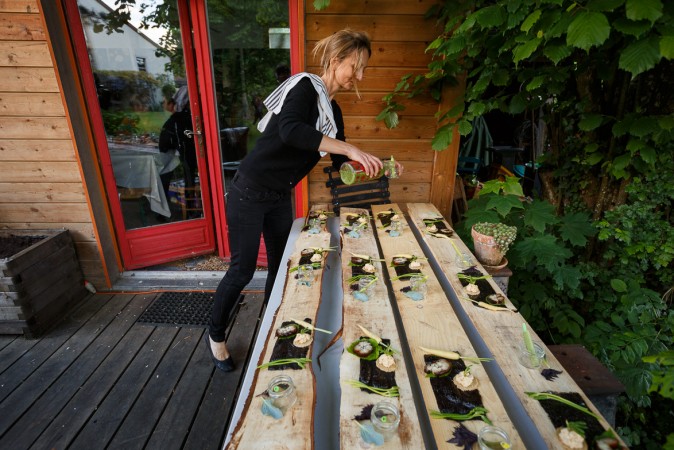
 

Jane Le Besque hosted a “mesolithic dinner” on June 30, 2013, in her home in the Pays de Gex just over the border in France, an event sponsored by Slow Food Geneva. The dinner was cooked using ancient flavor combinations and techniques, and served on split logs onto which slate plates were placed and used as plates.

What Food Did Jane Le Besque Serve at Her Mesolithic Dinner?

Although Jane’s dinner was labeled “Mesolithic”, it was indeed much more than that. She covered the evolution of food from the post-glacial hunter-gather periods, through the Mesolithic and Neolithic, and going on to the Ancient Greeks and Romans, centering on Europe.

It started with the Mesolithic era, with an assortment of coastal and lake fish, eel, root vegetables and wild greens. The meal then slipped in to the Neolithic era with galettes made from ground lentils, peas and barley, served with spit-roasted boar. The menu ended with an Iron-Age “travelers pack” of dried fruits and dried-porridge slices fried in cumin and butter. The Bronze Age brought blue cheese and butter.

Drinks consisted of mead, more often referred to as “honey wine,” more in the style of the ancient Greeks and Romans than of more ancient peoples, and beer.

What is the Mesolithic?

As a reminder, the Mesolithic Age refers to the pre-agricultural period between 10,000 and 5,000 BCE in Europe, and variations of this period in other parts of the world. The term “pre-agricultural” is key in understanding what ingredients were available. The three terms paleolithic, mesolithic and mesolithic refer to what is generally called the “Stone Age,” i.e. the post-glacial hunter-gatherer period, when humans started to use stone tools and food was gathered rather than farmed.


During the early Stone Ages or paleolithic (2.6 million years ago to around 10,000 BP), humans used some stone tools and utensils, but many tools were made from organic matter such as bone, fibers, and wood. Hunting and gathering were the chief ways of providing food. During the neolithic, starting around 10,200 BCE and ending between 4,500 to 2,000 BCE, depending on the location, we saw the beginning of farming. The mesolithic overlapped the other two ages, once again, at different times in different places. Metal tools brought these three Stone Ages to an end.
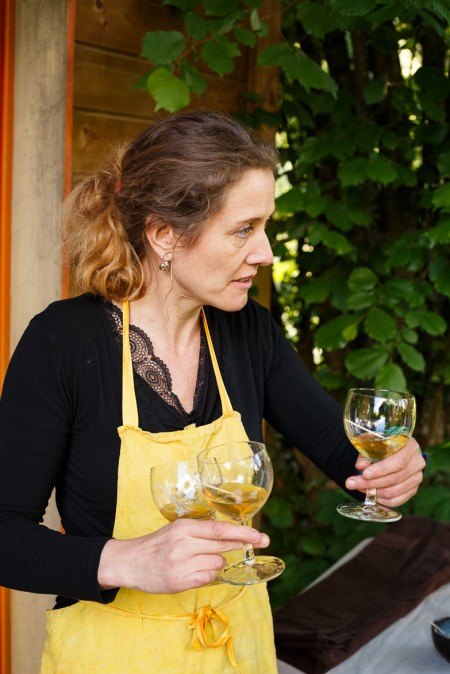
Jane Le Besque, artist and Mesolithic chef, serving mead


Early Stone Age cooking was generally on leaves or directly over the embers, although clay cookware has recently been found in China dating from 19,2000–20,000 years ago, during the ice age. Stone Age plates usually consisted of a rock or other flattish surface found in nature, such as the flattened split logs Jane used in the same manner as we use wooden tables today. Earthenware did not appear on the dinner table until much later.

What Did You Usually Eat at Mesolithic Dinners?

What did they eat? Pretty much whatever they found and killed that was edible: meat, fish, wild plants. The specifics of this depended on the location, climate and season. Meals included the day’s finds. This might consist of berries, wild greens and other wild vegetables and plants.

Meat and later fish were not an everyday affair. They were difficult to come by and difficult to preserve, depending on the location (salt was found in Romania as early as 10,000 years ago). Stone  Age people ate very little grain, since agriculture didn’t exist yet. Hazelnuts and other nuts were often roasted, and stored for winter. Wild boar was common; dairy products and cheese were on the menu, although a limited variety.

About Jane Le Besque

Jane Le Besque lives and works with her family at the foot of the French Jura, a few minutes from Geneva, in the foothills of the Jura mountains.

She was born in England and has a Breton grandfather, hence the name. Since graduating from Birmingham Art College in 1986, she continued her studies at l’Ecole des Beaux Arts in Paris. She afterwards lived and worked in Toulouse, London, and now outside Geneva.
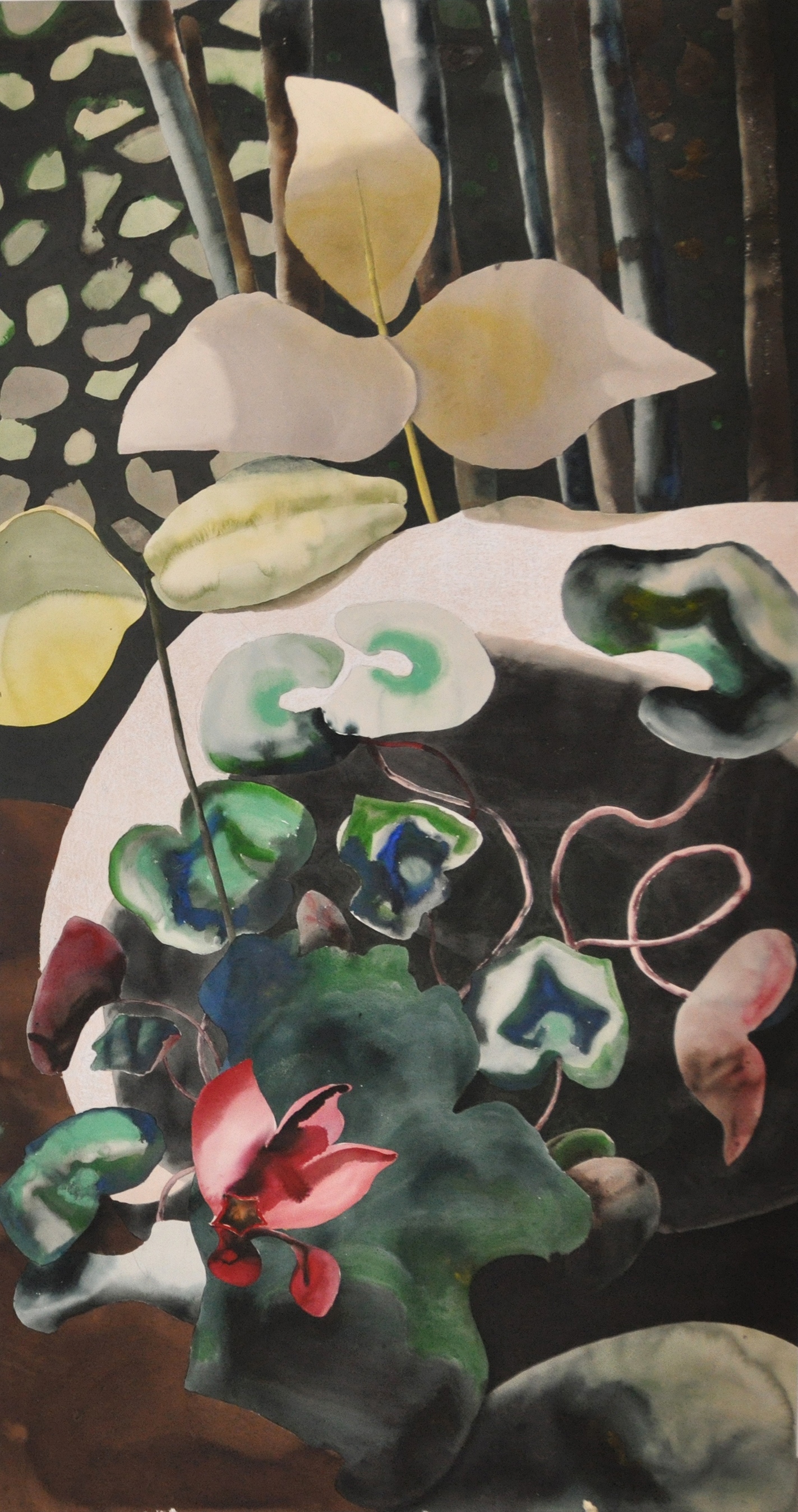


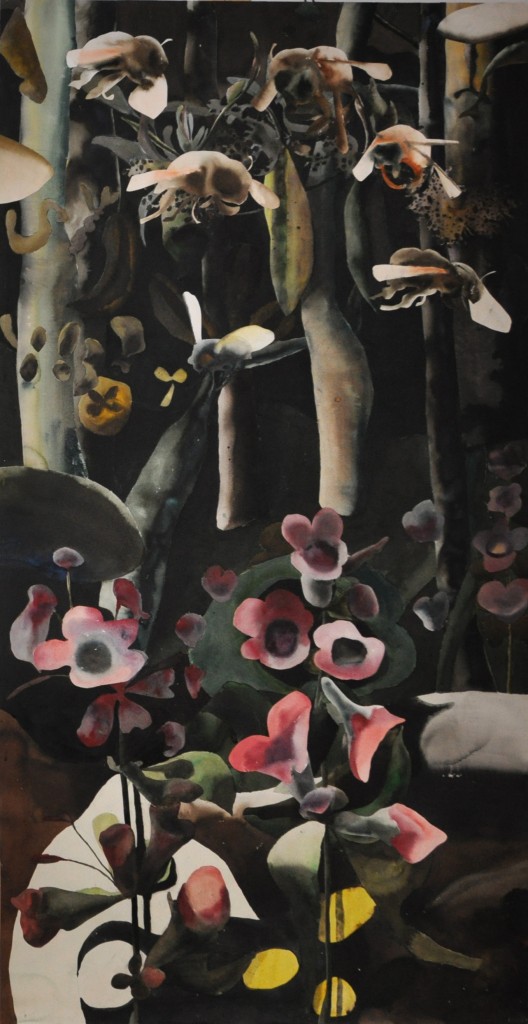
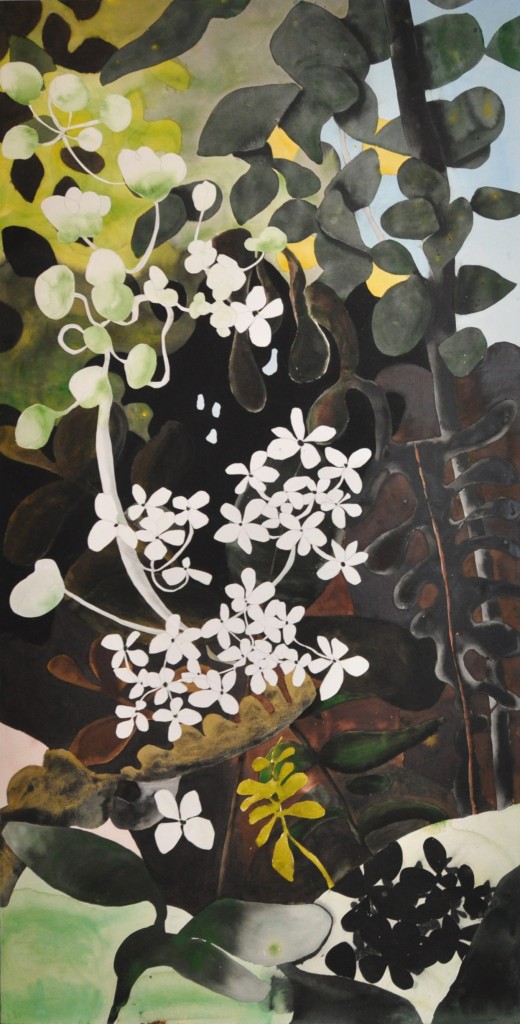
Jane has always painted. She is her happiest walking through the woods and gathering berries, mushrooms, acorns, flowers and leaves to use in her cooking and painting.

One might say Jane has been interested in mesolithic cooking even before she learned the word. As a child, she spent her time gathering the wild things she now uses in her paintings,  making dresses out of them.

Her paintings are an intense reflection of her “gatherer” spirit. The Mesolithic dinner was held in her studio, lined with her paintings of flora of all types.



Never miss a post
Name: 
Your email address:*
Please enter all required fields
Correct invalid entries

Culinary Travel: Jonell Eats her Way through Mannheim, Germany

Published by Sunday, June 2, 2013 Permalink 0

Culinary Travel: Jonell Galloway Eats her Way through Mannheim, Germany

Photos from my culinary travels in Mannheim, Germany. Mannheim is not known for its cuisine, but it is known for its white asparagus, just like in Alsace. So we took a jaunt to the farmers market and bought the choicest spears from a vendor who sells only white asparagus. The Mannheim cheesecake we bought in the market is the best I’ve ever eaten.

Never miss a post
Name: 
Your email address:*
Please enter all required fields
Correct invalid entries

Switzerland: Swiss Food: Rhubarb Cream Recipe

Published by Monday, May 27, 2013 Permalink 0

by Jonell Galloway

Cherry-Rhubarb Fool

When you talk about rhubarb cream in Switzerland, you mean rhubarb cream, not pudding or custard. This naughty dessert is one of the easiest rhubarb desserts around, and is so thoroughly Swiss.

Recipe for Rhubarb Cream

Ingredients

Photo courtesy of Robin Stewart


1 lb. / 500 g rhubarb
3/4 cup / 200 g cane sugar
 2 egg yolks
 Cinnamon or lemon juice, according to which taste you prefer
3/4 cup / 0.2 l whipping cream

Directions

  1. Scrape or cut off any hard outer surface of rhubarb.
  2. Dice rhubarb and put into saucepan. Add sugar. Cover with water. Cook until tender but firm, 5 to 10 minutes.
  3. While rhubarb is cooking, beat the yolks until smooth.
  4. Run cooked rhubarb through food processor or chinois to purée.
  5. Add hot rhubarb purée to beaten egg yolks. Beat until thoroughly blended and eggs start to cool.
  6. Mix in cinnamon or lemon juice. Set aside to cool.
  7. Beat whipping cream. When it starts to form hard peaks, fold in cooled rhubarb and egg mixture.
  8. Cool in refrigerator, either in individual serving dishes or in a large bowl.
  9. Serve cool.


Never miss a post
Name: 
Your email address:*
Please enter all required fields
Correct invalid entries

Documentary: Building a Slow Food Nation

Published by Friday, March 29, 2013 Permalink 0

by Jonell Galloway

Wendell Berry speaking in Frankfort, Indiana

Wendell Berry speaking in Frankfort, Indiana


The Atlantic‘s Corby Kummer interviews Wendell Berry, food philosopher, poet and advocate as well as farmer; Eric Schlosser, author of Fast Food Nation; Carlo Petrini, founder of Slow Food; Vandana Shiva, philosopher, environmental activist, eco feminist, and advocate in the domain of agriculture and food; and Alice Waters, American chef, restaurateur, activist, and humanitarian.

Part 1 of this movie-interview lasts 1 hour 21 minutes, but is broken up into shorter segments, consisting of interviews with the people listed above. Part 2 lasts 53 minutes.

Click here to view documentaries Building a Slow Food Nation, Part 1 and Building a Slow Food Nation, Part 2.


Never miss a post
Name: 
Your email address:*
Please enter all required fields
Correct invalid entries

UA-21892701-1