What to Eat in Switzerland: A Geneva Christmas: Cardoon Gratin Recipe

Published by Wednesday, December 19, 2012 Permalink 0

by Jonell Galloway

From the archives


Cardoon gratin is a classic Geneva Christmas dish, but only brave souls should try to prepare them because they are prickly, and the preparation can be long and tedious. Many farmers markets in Switzerland now sell them prepared sous vide, in plastic vacuum-packed packages, which is probably the best option for those who don’t get a thrill out of getting a few pricks. In any case, it is important to schedule it carefully into your meal preparations, because it is time-consuming any way you go about it.

Cardoon Gratin Recipe

Preparation of Cardoons for Gratin

  1. Throw out any hard stems and any that are wilted.
  2. Peel the cardoons by removing leaves, spines and stringy parts. The exterior will then be covered with a fuzzy layer. Use a cloth to rub stalks gently to remove fuzz.
  3. Cut stems into 8 cm (3 cm) slices. Rub with lemon, or if you intend to use them later, put slices into lemon water so they won’t turn dark.
  4. You now have two choices: you can either cook them in a white vegetable broth you’ve made ahead of time, or you can cook them in the lemon water you soaked them in.
  5. Bring to a boil and boil until tender. It should take about 30 minutes for them to become tender, but if they are larger in diameter it can take up to 2 hours, so allow plenty of time.

Recipe


All these steps can be carried out while the cardoons are cooking. There are actually several ways of doing this. You can either make a Béchamel (white) sauce and sprinkle cheese on the cardoons before you put them in the oven, or you can make a Mornay (cheese) sauce and pour it on the cooked cardoons before putting in the oven to brown. I think it’s tastier to make a Mornay sauce, and then sprinkle a bit of cheese on the top before putting it in the oven. Here’s my recipe.

Ingredients

Click here for British/American/metric recipe converter

Approximately 1 kg of cardoons
30 g of butter
1 tablespoon of flour
2.5 dl of whole milk
1 dl of cream
50 g of cheese, type Gruyère or Swiss (see photo below), grated
Lemon juice, freshly squeezed
Salt and pepper to taste
 

Emmentaler (also known as Swiss Cheese), while...


DIRECTIONS

  1. Make a Béchamel sauce, using the proportions of ingredients above.
  2. When finished and seasoned, add cream and cheese, setting aside a tablespoon of cheese. Set aside.
  3. Preheat oven to 250° C.
  4. Once cardoons are tender, drain, making sure all water is drained off.
  5. In a large bowl, mix cooked cardoons and Mornay sauce.
  6. Pour into a baking dish of the appropriate size, so that there is a layer of about 3 cm high.
  7. Sprinkle evenly with remaining grated cheese and a few knobs of butter.
  8. Put in hot oven for 15 to 20 minutes, or until golden brown.

Notes: It is important to use a hard, Swiss-type cheese. Cheddar cheese would have too strong of a taste. If you can’t find cardoons, the same recipe can be made with Swiss chard, thus eliminating the long, meticulous preparation. Simply cut them as for the cardoons and cook in chicken broth until tender, then follow the other steps in the recipe for making the gratin. Its texture is quite similar to that of cardoons.

Related articles


Never miss a post
Name: 
Your email address:*
Please enter all required fields
Correct invalid entries

Fermented Food Recipes: Oi Sobagi (Stuffed Cucumber Kimchi)

Published by Saturday, September 1, 2012 Permalink 0

Fermented Food Recipes: Oi Sobagi (Stuffed Cucumber Kimchi)

by Jonell Galloway

To add to our ongoing series on fermentation, we invite you to take a look at this stuffed cucumber kimchi, a recipe developed by Korean-American Hyosun Ro on her wonderfully rich Korean food blog Eating and Living, now called Korean Bapsang.


Never miss a post
Name: 
Your email address:*
Please enter all required fields
Correct invalid entries

Part 5: Kimchi vs. Sauerkraut – Fermenting Vegetables

Published by Wednesday, August 8, 2012 Permalink 3
cafemama / Foter / CC BY-NC-SA

Part 5 on Fermentation: Kimchi vs. Sauerkraut – Fermenting Vegetables

by Diana Zahuranec

Once again, Harold McGee’s The Science and Lore of the Kitchen comes to the rescue.

In fermented vegetables, remember that the two components that determine aroma and flavor are the salt concentration and temperature of fermentation. Those are the two main differences between kimchi and sauerkraut.

Bowl of kraut, by Diana Zahuranec for The Rambling Epicure, editor Jonell Galloway.

Bowl of kraut.


Sauerkraut, besides being cut more finely, has no other ingredients besides cabbage and brine. It ferments at 64-76 °F/18-24°C for 1 to 6 weeks. Its final salt content is 1-2%, and its final acidity level is 1-1.5%. That higher temperature for sauerkraut results in more lactic acid bacteria, giving it a tangier flavor.

Kimchi is cut into larger chunks and includes plant leaves and stems, too; and hot Korean chili pepper, garlic, and fish sauce are added for flavor. It’s fermented at a lower temperature than sauerkraut at 41-57°F/5-14°C for 1-3 weeks, with a higher salt content in the end (3%) and lower acidity (0.4-0.8%).

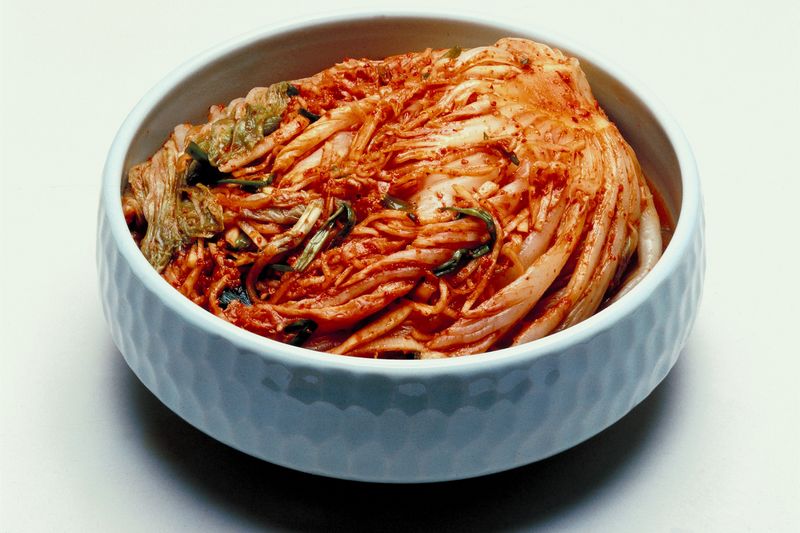
Bowl of kimchi, Part 5 on Fermentation: Kimchi vs. Sauerkraut - Fermenting Vegetables, by Diana Zahuranec for The Rambling Epicure, editor, Jonell Galloway.

Bowl of kimchi.


Never miss a post
Name:

Your email address:*

Please enter all required fields
Correct invalid entries

Never miss a post
Name: 
Your email address:*
Please enter all required fields
Correct invalid entries

Switzerland: Fresh Fruit Séré/Quark Cheese Mousse

Published by Wednesday, August 1, 2012 Permalink 0

by Jonell Galloway

In Switzerland, séré, as it is called in the French-speaking part of the country, or quark, as it is called in the German-speaking part, is a fresh cheese similar to curd cheese or cottage cheese and to ricotta, but the process of making it differs somewhat. Milk is first soured, then warmed until the desired degree of denaturation of milk proteins is met. It is then strained, so that it is smooth in consistency.

It is good eaten simply, with fresh fruit and a touch of sugar, but it can also be used for cooking.

When summer fruit is so abundant, this fresh fruit mousse makes for a different way of eating it.

You can buy either the full-fat version or a low-fat one. The full-fat version will be marked séré de crème in supermarkets; the full-fat version will be marked séré maigre or quark “maigre,” meaning low-fat. For this recipe, it’s best to buy it homemade from the cheesemonger or the full-fat version.

If séré is not available in your area, follow this easy recipe to make it yourself.

Continue Reading…

Never miss a post
Name: 
Your email address:*
Please enter all required fields
Correct invalid entries

Switzerland: Cucumber and Tarragon Salad Recipe

Published by Monday, July 16, 2012 Permalink 0

Jonell Galloway, Editor, The Rambling EpicureSwitzerland: Cucumber and Tarragon Salad Recipe

by Jonell Galloway

Spontaneous Cuisine: A Swiss Recipe

When the days are hot and sultry, few things can be as refreshing as a cold cucumber salad, especially this classic cucumber and tarragon salad. In Switzerland, we make it with sour cream and tarragon, while in France they cook the cucumbers slightly and then add crème fraîche and chives.

This salad goes perfectly with a grilled chicken breast or any white fish. It also goes perfectly with smoked or natural salmon, in which case you might want to replace the tarragon with fresh dill or dill seeds.


Continue Reading…

Never miss a post
Name: 
Your email address:*
Please enter all required fields
Correct invalid entries

Spontaneous Cuisine: Lacquered Pork Tenderloin, Roast Potatoes, Ramp/Ramson Recipe

Published by Tuesday, April 17, 2012 Permalink 0

From the archives

Lacquered Pork Tenderloin, Roast Potatoes & Ramson Recipe

by Jonell Galloway

Ramson and wild garlic leaves, as we call them in Switzerland, are in season, so now is the perfect time to make this recipe. The season doesn’t last long, so don’t tarry. If you don’t have ramson, or Allium ursinum,  in your area, try ramps or Allium tricoccum, which will produce a similar taste.

The sweetness of the lacquer and the tart acidity of the ramps give this recipe a lovely balance of opposing flavors. The roast potatoes serve as a neutral taste that makes the contrasts less shocking.


Spontaneous Cuisine: Lacquered Pork Tenderloin, Roast potatoes & Ramps Recipe

Continue Reading…

Never miss a post
Name: 
Your email address:*
Please enter all required fields
Correct invalid entries

Spontaneous Cuisine: Scallops, Green Asparagus and Strawberry Balsamic Sauce Recipe

Published by Friday, April 13, 2012 Permalink 0

by Jonell Galloway

 
From the archives
 

Spontaneous Cuisine: Scallops, Green Asparagus and Strawberry Balsamic Sauce Recipe

This is another low-fat, high-fiber meal that fits perfectly in to any weight loss plan. All these ingredients are available as of late April in Switzerland.


Continue Reading…

Never miss a post
Name: 
Your email address:*
Please enter all required fields
Correct invalid entries

Switzerland: Filet of Perch with Parsley/chive Sauce Recipe

Published by Thursday, August 25, 2011 Permalink 1


Spontaneous Cuisine, by Jonell Galloway

Traditional dish in Lake Geneva region: filet of perch with parsley, chives and butter: a recipe with a twist

Recipe

Ingredients

1 kg / 2.2 lbs of filet of perch
1.2 dl / 1/2 cup of white wine
125 g / 1 stick butter
1 large clove of garlic, finely chopped
1 1/2 teaspoons of strong mustard
2 egg yolks
Parsley, 1 large bunch
Chives, 1 large bunch
Salt and pepper to taste

Directions

  1. Preheat oven to 220°C / 425°F.
  2. Butter a baking dish that can also be used on stovetop. Add wine and garlic.
  3. Arrange filets in a baking dish. Salt and pepper.
  4. Bake for about 8 minutes or until fish is cooked but still firm. Carefully remove fish and set it aside.
  5. Use cooking juices in baking dish to make sauce. Add butter, mustard and egg yolk.
  6. Cook over very low heat, stirring constantly with a wire whip. Add parsley. Warning: If you turn the heat too high and quite stirring, you will end up with scrambled eggs instead of sauce!
  7. Arrange perch on serving plates, preferably warm. Pour sauce over fish and serve immediately.


Continue Reading…

Never miss a post
Name: 
Your email address:*
Please enter all required fields
Correct invalid entries

Switzerland: Pan-fried Sérac Cheese & Potato Salad Recipe

Published by Friday, August 5, 2011 Permalink 0

Spontaneous Cuisine, by Jonell Galloway

Swiss Sérac cheese, a fresh cow’s milk cheese made with whey

Whey cheese is produced when the curds are separated from the whey to make cheese. Ricotta is also a whey cheese, but unlike Sérac, it is often made with sheep’s milk. As a result, you can use your local cheesemonger’s Sérac in most recipes that call for ricotta.

Photo courtesy of FribourgRegion tourist office.

Photo courtesy of Fribourg Region tourist office.


Sérac is made in most regions of Switzerland, and each region has its own version. Some regions smoke it; others flavor it with herbs, spices or pepper.

Sérac cheese is soft and creamy in texture, so it is easy to spread it on bread to make a healthy sandwich or snack, but Sérac is not only a snack cheese. It can also be used to make healthy, quick meals, such as the recipe below. In the summertime, I often use it like mozzarella, with tomatoes and basil or other Italian-inspired recipes.

It is a great way of teaching your children to eat healthy snacks. Top it with fresh fruit to make a healthy, low-fat dessert, or use it for between-meal snacks on chunky whole-grain bread.

Since it is a fresh milk cheese, it does not keep, and should be eaten shortly after purchasing. Because it is made from fresh milk whey, it is also naturally low in fat. In Switzerland, it would have about a 3.8% fat content, the same as milk.

Continue Reading…

Never miss a post
Name: 
Your email address:*
Please enter all required fields
Correct invalid entries

Spontaneous Cuisine: Strawberry-Rhubarb Compote, It’s in Season!

Published by Monday, April 18, 2011 Permalink 0

by Jonell Galloway

Recipe: Strawberry-Rhubarb Compote

I always get really excited when the strawberries and rhubarb come on the market. For me it’s literally like “breaking news.” They’re really the first local fruit.


Photo courtesy of Happy Hoarfrost.

One of my favorite dishes is strawberry-rhubarb compote. It’s healthy, full of fiber and vitamins; it’s also versatile and can be used in many ways.

In addition, it’s about as easy as you can get.

Continue Reading…

Never miss a post
Name: 
Your email address:*
Please enter all required fields
Correct invalid entries

UA-21892701-1