Spontaneous Cuisine: Swiss Easy Fennel and Raclette Potato Salad Recipe

Published by Saturday, July 27, 2013 Permalink 0

Spontaneous Cuisine: Swiss Easy Fennel and Raclette Potato Salad Recipe

by Jonell Galloway


Photo courtesy of Five Prime.

Ingredients

1 large fennel
3 medium-size raclette or new potatoes

Juice of one blood orange or regular orange, if not available
Olive oil
Salt and pepper to taste
1 1/2 to 2 teaspoons Country Potato spice* OR aniseed/fennel seeds
  1. Preheat grill or broiler.
  2. Cut stalk end of fennel out, then slice thinly in the lengthwise direction.
  3. Scrub potatoes, but do not skin. Slice thinly.
  4. Spread fennel and potatoes onto a heavy roasting tin, in a single layer. Brush both sides with olive oil.
  5. Grill under broiler until nice and brown. Remove tin from oven, and use a metal spatula to turn them, taking care to still have a single layer.
  6. Put back under broiler. When cooked but not yet brown, add spices. Stir well and put back under broiler. When golden brown, remove from oven.
  7. Put mixture into a mixing bowl. Pour juice of one blood orange over mixture. Mix gently but thoroughly, so that the vegetables absorb the juice.
  8. Set aside for 5 minutes so that all the flavors blend together.
  9. Serve warm, either as a salad or side dish. It is a perfect accompaniment to grilled cod or  salmon, and why not chicken?
*Country Potato spice is readily available in Switzerland, but if you don’t have access to it, you can make your own. It’s great on oven fries, chicken breast, and all sorts of other bland dishes you just want to liven up. It is a mixture of curcuma, cumin, coriander, ground manioc, fenugreek, garlic, salt, fennel seeds, chili powder, pepper, paprika, marjoram, ginger, garlic and a touch of sugar.

Continue Reading…

Never miss a post
Name: 
Your email address:*
Please enter all required fields
Correct invalid entries

Switzerland: Valais Apricots and 10 Things You Can Do with Them

Published by Friday, July 19, 2013 Permalink 0

Switzerland: Valais Apricots and 10 Things You Can Do with ThemJonell Galloway, Spontaneous Cuisine, Mindful Eating, Slow Food, Editor of The Rambling Epicure

by Jonell Galloway

Height of season for Valais apricots, considered best in Switzerland

It is the height of the Valais apricot season, I thought it timely to offer you a few ideas for using them while they’re ripe and ready.

Choosing your apricots

apricots_valais_tree_switzerland_suisse_geneva
Photo courtesy of Ellen Wallace.

The first and most important thing is to buy tree-ripened apricots. By definition, this means local ones, since ripe apricots are soft to the touch and do not travel well.

If you plan to eat them fresh, they should be soft, but not blemished or bruised. The riper they are, the more flavorful they are.

If you are using them for cooking, the riper the better, and you can even get by with blemishes as long as they are not rotten-looking. As a general rule, the softer the sweeter.

You will often see crates of extra-ripe apricots discounted in farmers markets. Look them over, and if there are not too many black or rotting ones, they are actually the best for cooking purposes, especially for jams, cakes and sauces.

Recipe ideas for apricots

Note: With all apricot recipes, the amount of sugar used depends on the acidity of the apricots. The acidity depends on the ripeness, origin and variety. With so many factors coming into play, taste tests are indispensable and the quantity of sugar should be determined by taste, using the quantities given here as a guideline.

Continue Reading…

Never miss a post
Name: 
Your email address:*
Please enter all required fields
Correct invalid entries

Spontaneous Cuisine: Lebanese Zucchini Salad Recipe

Published by Tuesday, July 16, 2013 Permalink 0

Spontaneous Cuisine: Lebanese Zucchini Salad Recipe

by Jonell Galloway

Mezze: summer vegetables with a new twist for your picnics

What are summer vegetables for us are year-long vegetables for the Lebanese and Syrians.

Choosing your courgettes or zucchini

Zucchini should be dark green and firm to the touch. Avoid wrinkly-looking courgettes, which are not fresh.

Choose young, small ones. The taste is more delicate and sweeter. Larger older courgettes often have large seeds, and tend to be bitter.

Recipe for mezze-style courgette (zucchini) salad

This is a kid-friendly recipe.

Continue Reading…

Never miss a post
Name: 
Your email address:*
Please enter all required fields
Correct invalid entries

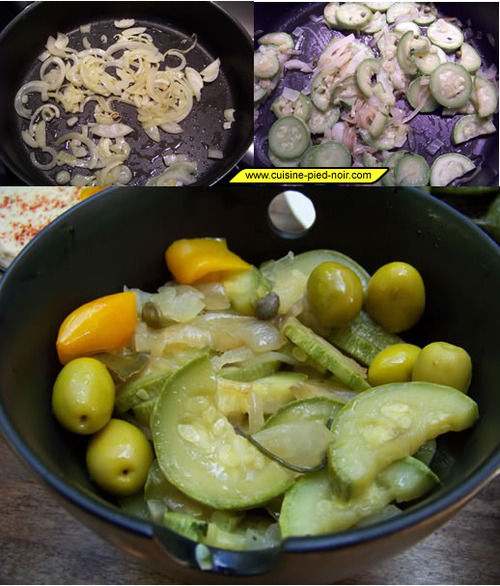
Mediterranean Food Connection: Zucchini and preserved lemon salad, a recipe by Christophe Certain

Published by Tuesday, July 9, 2013 Permalink 0


Mediterranean Food Connection: Zucchini and preserved lemon salad, a recipe by Christophe Certain

Recipe translated from the French and adapted by Jonell Galloway

This recipe is perfect for Ramadan.

Recipe

Ingredients

2 onions, chopped
4 zucchini / courgettes
1 tablespoon of capers in vinegar
1 preserved lemon (see note I posted here a month or so ago about how to make them), chopped into 3 mm / 1/8” cubes
Salt
Pepper
Olive oil or butter

Equipment

Large, deep frying pan

Instructions

  1. Heat olive oil or butter. Sautée onions.
  2. While onions are cooking, wash zucchini / courgettes. Start by cutting off ends, then cut then slice them into medium-thick slices, leaving the skin on.
  3. When onion is translucent, add zucchini / courgettes. Mix well, but gently.
  4. Let this mixture cook over low heat for about 15 minutes, until the water from zucchini / courgette has evaporated. They should remain crunchy, but if you prefer them soft, just cook them a little longer.
  5. Add capers and chopped lemon.
  6. Leave on burner for a few minutes, gently stirring, so that the zucchini / courgette will absorb the lemon flavor.
  7. This dish can be eaten warm with chicken or fish, for example, or cold, as a salad.

You can view the original recipe in French on Christophe’s website Cuisine Pied Noir.


Never miss a post
Name: 
Your email address:*
Please enter all required fields
Correct invalid entries

Switzerland: Swiss-style Knepfle Pasta

Published by Thursday, June 13, 2013 Permalink 0

by Jonell Galloway

Switzerland: Swiss-style Knepfle Pasta

Knepfle is originally from Alsace in France, but it is also eaten in Switzerland, in particular in the Jura region, which borders Alsace.

You can buy them at the supermarket, but they’re much better when you make them at  home.

Swiss-style Knepfle Recipe

Ingredients

3 1/3 to 4 1/10th cups unbleached white flour
3 eggs
2 cups milk
About 1/2 cup water
3 large pinches of salt
1 oz. butter
Large pan of water for boiling knepfles
Coarse sieve with large holes

Instructions

  1. Put eggs into a bowl. Add milk, water and a pinch of salt. Beat with wire whip.
  2. Little by little, use wire whip to add flour until a heavy dough is formed. The dough should fall naturally off the whip.
  3. Let dough rest for 30 to 60 min.
  4. When time is almost up, bring  large saucepan of water to boil. Add 2 pinches of salt.
  5. Heat an oven dish large enough to hold all the knepfles.
  6. NOTE: The hard part: Real pros push the dough through a coarse sieve, but this can be a bit tricky. If this is your first time making knepfles, I suggest that you drop the dough by teaspoons the first time, and try using a sieve the next time. Make sure you have a sieve with large holes before trying this.
  7. Leave water to boil gently and start dropping teaspoons of dough into water, in several goes.
  8. Let knepfles poach until they rise to the surface. This should take about 15 minutes.
  9. Use a slotted spoon to remove them. Do this carefully so they don’t fall apart. Drain well. Place in heated oven dish.
  10. Do this in steps, until all the dough is used up.
  11. To serve, over medium to medium high heat, melt butter in a frying pan (butter should be sizzling).
  12. When hot, add dry knepfles and brown, carefully turning them from time to time. Cook until browned, about 15 minutes.
  13. Serving: There are many ways to serve knepfles: plain, with cream or bacon bits, or with other sauces.


Never miss a post
Name: 
Your email address:*
Please enter all required fields
Correct invalid entries

Simple Sustenance: Summer Indulgence — Cardamom-Infused Mango Milkshake

Published by Monday, June 10, 2013 Permalink 0


Profile photo, Renu Chhabra, Simple Sustenance (C) ALL RIGHTS RESERVED.by Renu Chhabra

Ponder well on this point: the pleasant hours of our life are all connected by a more or less tangible link, with some memory of the table.–Charles Pierre Monselet

Mango milkshake by Renu Chhabra, all rights reserved (R)

Summer afternoon and a glass of cold milkshake! Mango milkshake. Something I am always ready for. Why wouldn’t I be? It brings back memories of my childhood — fun and comforting memories.

Growing up in India, summer meant boxes of mangoes showing up in our house throughout the season. Not just one or two varieties, but several of them. Different sizes, tastes, and textures to relish, and we all had our own favorite.

 Mango for mango milkshake by Renu Chhabra, all rights reserved (R)

It was the summer fruit to indulge in — messy but syrupy sweet and wonderfully juicy. Most of all, it was fun to sit around the table; and enjoy this tropical fruit and celebrate the season.

 Mango for mango milkshake by Renu Chhabra, all rights reserved (R)

And with such abundance pouring in, we were treated with mango ice cream, mango custard, mango salad, and not to forget mango milkshake, the simplest of all for warm summer days. Simple because it can be put together in no time.

Its creamy texture and sunshine yellow color always lifts my spirits. Simply said, it’s a happy reminder of my childhood. Little moments that enable us to travel miles away!

 Mango and milk for mango milkshake by Renu Chhabra, all rights reserved (R)

I have accented the mango shake with cardamom in this recipe. Cardamom, as I call the soul of Indian desserts. Just a hint of it makes the recipe sing fragrant notes. A little goes a long way; otherwise it gets bitter. Like we say, “Too much of a good thing can be bad.”

I used honey as sweetener, but you can use sugar or agave to taste. The amount will also depend on the sweetness of the mango.

Mango milkshake by Renu Chhabra, all rights reserved (R)

Continue Reading…

Never miss a post
Name: 
Your email address:*
Please enter all required fields
Correct invalid entries

Indian Curry Through Foreign Eyes, Part 1: Hannah Glasse’s 18th-century Curry Recipe

Published by Sunday, June 9, 2013 Permalink 0

Indian Curry Through Foreign Eyes, Part 1: Hannah Glasse’s 18th-century Curry Recipe

by Laura Kelley

I have long been fascinated by concepts of “I and other”, or the many ways we separate what is familiar (self) from what is not familiar (non-self). By defining what is not self, we are in fact defining self. One can hear small children do this when misclassified by gender; most adamantly declare that they are not members of the opposite sex. “I and other” are also evident in beautiful symbolic ways when considering the movement of ideas and beliefs through societies. The newly introduced idea is at first foreign, complete with unfamiliar trappings. As the idea flows through society and is adopted, the foreign elements are shed and replaced by the familiar.

Depictions of Buddha: Caucasian and Asian, by Laura Kelley at //www.silkroadgourmet.com/hannah-glasse-curry/

Depictions of Buddha: Caucasian and Asian

One place to see this is operation is at the Boston Museum of Fine Arts, which houses an expansive collection of Asian art. As Buddhism moves out of India and across Asia, first to the west and then the east, early iconography clearly depicts Buddha as Caucasian (Gandahara style), even when the work is from the Himalayas, Burma or Western China. As time passes, and Buddhist ideas are adopted across the east, however, religious iconography begins to depict a wide variety of races and ethnicities. Noses become smaller, epicanthic lids are added as the face changes from Caucasian to Asian. Expressions usually remain contemplative and serene, but the varying shapes of the faces are evidence of the triumph of the ideas across space and time.

The “I and other” concept is also of interest in historical cookery, especially when one group is attempting to recreate the cuisine of another. I’ve been looking at early recipes for Indian curry written by non-Indians. So far, I have a small collection of English and American recipes from the 18th and 19th centuries that show curry powders and recipes developing from recipes that merely reminiscent as Indian in the eighteenth century to those that are nearly indistinguishable from modern recipes broken out by geographical region by the end of the nineteenth. The earliest amongst them (so far) is a recipe from Hannah Glasse’s The Art of Cookery made Plain and Easy, first published in 1747.

The Art of Cookery, 1774, photo by Laura Kelley

The Art of Cookery, 1774

Continue Reading…

Never miss a post
Name: 
Your email address:*
Please enter all required fields
Correct invalid entries

Switzerland: Swiss Food: Rhubarb Cream Recipe

Published by Monday, May 27, 2013 Permalink 0

by Jonell Galloway

Cherry-Rhubarb Fool

When you talk about rhubarb cream in Switzerland, you mean rhubarb cream, not pudding or custard. This naughty dessert is one of the easiest rhubarb desserts around, and is so thoroughly Swiss.

Recipe for Rhubarb Cream

Ingredients

Photo courtesy of Robin Stewart


1 lb. / 500 g rhubarb
3/4 cup / 200 g cane sugar
 2 egg yolks
 Cinnamon or lemon juice, according to which taste you prefer
3/4 cup / 0.2 l whipping cream

Directions

  1. Scrape or cut off any hard outer surface of rhubarb.
  2. Dice rhubarb and put into saucepan. Add sugar. Cover with water. Cook until tender but firm, 5 to 10 minutes.
  3. While rhubarb is cooking, beat the yolks until smooth.
  4. Run cooked rhubarb through food processor or chinois to purée.
  5. Add hot rhubarb purée to beaten egg yolks. Beat until thoroughly blended and eggs start to cool.
  6. Mix in cinnamon or lemon juice. Set aside to cool.
  7. Beat whipping cream. When it starts to form hard peaks, fold in cooled rhubarb and egg mixture.
  8. Cool in refrigerator, either in individual serving dishes or in a large bowl.
  9. Serve cool.


Never miss a post
Name: 
Your email address:*
Please enter all required fields
Correct invalid entries

What to Eat in Switzerland: A Geneva Christmas: Longeole Sausage

Published by Friday, December 21, 2012 Permalink 0

by Jonell Galloway

From the archives

Christmas traditions in Switzerland

One should never think that everybody in Switzerland eats the same thing for Christmas dinner. With four languages and a multitude of “mini-cultures” tucked away its various mountain niches, and with a huge international population, Switzerland may well have more Christmas menus than any other country in the world.

In the French-speaking part of Switzerland, Geneva’s traditions are quite apart from the Vaud, for example, due to the late date Geneva finally decided to become part of Switzerland. Geneva traditions are often more influenced by their Savoyard and French neighbors, since they share about 100 km of border with them and only 5 km with canton Vaud.

What’s so special about a Longeole?

Many Genevois eat a sausage specific to Geneva called longeole. Every region and many villages have their own sausage recipes, but the longeole is quite apart from the others for several reasons.


Longeole sausage and potatoes cooked in
white wine, a Geneva Christmas specialty.


For one thing, it contains not only ground pork but also ground pork rind. This keeps it from drying out and gives it fuller flavor. The other, and quite major, difference is that that it is speckled with fennel seeds, probably a Savoyard influence.

Any good local butcher makes his own longeole. If not, it is advisable to find one who does. It’s Christmas, so you want to be certain it’s of good quality.

Cooking Longeole

Longeole is easy to cook, but you must allow yourself enough time. It takes longer to cook than other cooking sausages because of the addition of the pork rind, which is harder than simple ground pork.

Use a soup pot tall enough to hold your sausage. Fill with water and bring water to boil. Add a touch of salt. Drop in sausage, lower heat, and let it simmer for 2 hours 45 minutes or 3 hours. The water should be just on the verge of boiling during the whole cooking time. It is then ready to slice and eat.

Some cooks prick the Longeole with a fork before cooking, but purist that I am, I think you risk losing some of the juices, which would take away from the flavor and make the sausage less succulent in the mouth. It is also important not to let it boil, because this too will dry it out.

What do Genevois eat with Longeole?

Like everywhere, different families have different traditions, different favorites, but the most common accompaniments are potatoes cooked in white wine, lentil stew and cardoon gratin, all Geneva specialties as well.

Continue Reading…

Never miss a post
Name: 
Your email address:*
Please enter all required fields
Correct invalid entries

What to Eat in Switzerland: A Geneva Christmas: White Wine Potatoes

Published by Friday, December 21, 2012 Permalink 0

A Geneva Christmas: White Wine Potatoes Recipe

by Jonell Galloway

From the archives

English: Jet d'Eau, Geneva

In A Geneva Christmas: Longeole sausage, I think I got your mouth watering talking about longeole, or fennel seed sausage. But did you see the potatoes in the photo? That’s THE essential side dish: potatoes cooked in broth and white wine.

I translated and adapted this recipe from A la mode de chez nous, Plaisirs de la table romande, a book on cooking in French-speaking Switzerland, by M. Vidoudez and J. Grangier.

Recipe

A Geneva Christmas-white wine potatoes-Longeole-recipe-Switzerland-the rambling epicure-jonell galloway-genevalunch-traditional dish

Longeole sausage served with
potatoes cooked in white wine and broth

Ingredients

1 kg / 2.2 lbs type 2 all-purpose potatoes
Olive oil, just enough to lightly coat potatoes
1 tablespoon spelt flour (farine d’épeautre), or otherwise whole wheat
240 ml / 1 cup chicken broth
1 onion, diced
1 laurel leaf
3 whole cloves
300 ml / 1 1/4 cup dry white wine
1 bouquet garni
Fresh parsley, chopped
Salt and pepper to taste

Instructions

Fennel-flavored Longeole sausages for Christmas, made by Jacky Bula butcher in Geneva


  1. Scrub potatoes. If you really don’t like potato peels, or your potatoes have lots of black spots on them, peel them. Just remember: all the fiber and vitamins are in the peel.
  2. Chop potatoes into large cubes. Put potatoes in a large saucepan. Coat lightly with olive oil and mix well.
  3. Sautée for 2 or 3 minutes, stirring constantly.
  4. Heat broth. Pour hot broth over potatoes. Add chopped onion, laurel, cloves, salt, pepper and bouquet garni. Bring to a boil. Cover, then lower heat and let it boil gently.
  5. Cook until potatoes are soft, about 15 or 20 minutes, depending on the kind of potato and the kind of pan.
  6. While the potatoes are cooking, mix flour and olive oil in a small utility bowl, until it becomes a smooth paste. Add a couple tablespoons of the hot broth from the potatoes to paste, and beat with wire whip until smooth.
  7. Add paste to potatoes, and beat gently with a wire whip. When smooth, add white wine.
  8. Continue cooking, stirring often so that it doesn’t stick, and gently boiling until the sauce starts to thicken.
  9. Taste. Add salt and pepper if required.
  10. Sprinkle with chopped parsley when serving. Traditionally, in Geneva this is served with longeole sausage at Christmas, but it goes well with many dishes, for example a smoked cooking sausage from the canton of Vaud.

Cooking notes:  I use a Kuhn Rikon Durotherm to maintain the vitamins and decrease cooking time. This also allows you to use less liquid, which gives a more intense flavor. In this case, you would use just enough broth to cover the potatoes.

Continue Reading…

Never miss a post
Name: 
Your email address:*
Please enter all required fields
Correct invalid entries

UA-21892701-1