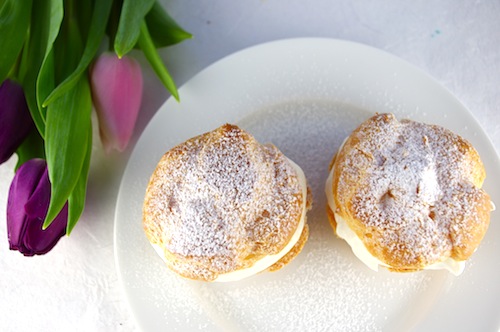
DESTINATION DESSERT: From America to France

Published by Wednesday, June 15, 2011 Permalink 0

by Jamie Schler

MON PETIT CHOU: A Love Affair with the Perfect Treat

Chou: cabbage

Chou: cream puff, a type of pastry

Chou: cute

Chouchou: teacher’s pet

Mon petit chou: my little sweetheart, darling

It’s funny how one single food ties my old, American childhood to my new adult life in France. This one food, the perfect choux, was a favorite, one my father would make, light and airy, crispy and golden on the outside, so ethereal on the inside. He would shape them into perfect, saucer-sized rounds, bake them until they were puffed up into pillows and lovingly fill each one with thick, creamy pudding, chocolate, vanilla or pistachio. The almost flavorless choux puff was the perfect casing for the flavorful filling, tempering the sweetness and adding texture to the smooth creaminess of the pudding, and quickly became my most loved sweet treat of all that my father baked for us. My dear old dad passed away a mere two months before I married my French sweetheart (mon petit chou) and as I prepared to join my soon-to-be husband, I pulled the carefully clipped recipe off the refrigerator in my parents’ house, my childhood home, where it had been taped for decades, words and image now faded with time and handling, and tucked it lovingly and ever so carefully amongst my few worldly possessions in my suitcase and carried it with me across the ocean to France.

Continue Reading…

Never miss a post
Name: 
Your email address:*
Please enter all required fields
Correct invalid entries

News flash: Russia bans raw vegetables from EU

Published by Thursday, June 2, 2011 Permalink 0

by Jonell Galloway

Reuters has just reported that Russia has banned raw vegetables from the E.U. in relation to the E. coli outbreak which seemingly started in Germany which has killed 17 people and made more than 1,500 others ill in 8 European countries. They had already banned imports of vegetables from Germany and Spain after German health authorities blamed Spanish cucumbers for the outbreak.

Spain is preparing the way for legal action over this accusation, claiming compensation for the loss of 200 millions euros (US$287 million) in a matter of a week, putting tens of thousands of people out of work and tainting the image of Spanish produce.

The Russian consumer protection agency Rospotrebnadzor, under pressure to adopt E.U. sanitary legislation, cites this case as demonstrating that the E.U. system is not efficient.

Never miss a post
Name: 
Your email address:*
Please enter all required fields
Correct invalid entries

I’m Spanish, and I DO give a darn about Spanish cucumbers!

Published by Thursday, June 2, 2011 Permalink 0

by SandeeA

Cucumber crisis and E. coli outbreak in Spain? The Spanish defense

The German health authorities finally recognized their error, albeit a week too late. After confirming the results of two out of the four laboratory tests carried out, it was announced that the variant of the Escherichia coli bacteria, commonly known as E. coli, responsible for the deaths in Germany is not the same as the one found in the Spanish cucumbers originally blamed.

What? The Spanish cucumbers are “no longer” the cause of the infection? After all the jokes that went around about them on Twitter, Facebook, and the like. And that’s not even the end of the story: the same social networks ended up condemning the entire agricultural production of a country, i.e. Spain.

But in a country like Spain, in the midst of a dire economic crisis, declaring its cucumbers and then its produce contaminated is no laughing matter, especially when such allegations are far from being proven. Almost all European countries closed the door on Spanish produce. The E.U. ordered that all imports of cucumbers, tomatoes and lettuce coming from Spain be inspected.

How is the Spanish produce industry going to recover these losses? Will it ever be compensated? After a week of being blamed for several deaths due to our cucumbers, boldly proclaimed on the front pages of newspapers around the world, it will be difficult. There is no way to repair the damage, not even the damage done by social networks, where “news” spreads as quickly as unfounded rumors.

The E.U. is now analyzing how to compensate Spanish fruit and vegetable producers for the economic losses caused by this infectious outbreak the Germans attributed to a batch of Spanish cucumbers. The worry is that there are times that nothing can compensate for a loss.

The sad thing is that the innocent Spanish cucumber was never given a chance. German officials hastily proclaimed its guilt before even giving it a fair trial.

Related articles:

“Los pepinos españoles no son los causantes de la epidemia de E.Coli en Alemania”

“La crisis del pepino”

“ Los agricultores españoles y holandeses sufren el colapso de sus exportaciones”

“La crisis del pepino cuesta a España 200 millones de euros a la semana”

“Son ya 14 los fallecidos por la crisis E.coli en Alemania”

“El gobierno afirma que no hay pruebas de que la contaminación de pepinos se haya producido en España”

“La crisis del pepino provoca pérdidas cuantiosísimas a la agricultura española”

“Bruselas recuerda que España puede pedir ayuda por el bloqueo de los pepinos”

“Los 27 barajan una reunión extraordinaria en junio sobre la crisis de los pepinos”

“Germany admits Spanish cucumbers are not to blame”

“Spain says Germany must pay for cucumber damage”

“E. coli cucumber scare”

Never miss a post
Name: 
Your email address:*
Please enter all required fields
Correct invalid entries

New International Food & Drinks Festival Ear-marked For Mojacar, Spain!

Published by Wednesday, June 1, 2011 Permalink 0

Sabor de Almeria, the brand behind a number of recent food initiatives aimed at attracting tourism to Almería Province, is to attempt its most ambitious project yet. They have today announced their intentions to launch a new and exciting International Food & Drinks Festival, to be held in Mojacar during May and June 2012. The festival is to be named Sabor de Almeria – Festival Internacional de la Alimentación y Bebidas.

Continue Reading…

Never miss a post
Name: 
Your email address:*
Please enter all required fields
Correct invalid entries

One American’s Synopsis of Chinese Food

Published by Friday, May 27, 2011 Permalink 0

by Gayle Black

In China, there are at least seven styles of cuisine. They vary according to region. While living in Jiangsu Province in the central eastern part of the country, I was mainly exposed to one, broadly defined as “spicy.”  Many of the dishes were spicy, but not extremely so for my American tongue. In northern China, the preference tends to be for noodles and dumplings, rather than rice. The bread available is very good, even when produced on a mass scale. The Chinese are excellent bakers.

In Xuzhou, where I lived for half a year, the mutton is fresh and readily available. They slice it in an artful way and bring it to the table to be enjoyed for visual beauty as well as taste. A popular form of dining is called “hot pot.”  Restaurants provide two pots of boiling water, and diners are able to cook various meats and vegetables at the table. Wonderful sauces for dipping complete the experience.

I especially enjoyed the fresh fruit available in China. The mandarin oranges were sold with stems and leaves, which kept them particularly flavorful. There were also small mangoes, which had a better texture and more delicate flavor than the larger ones most of us are familiar with.  Fruit markets were common on many streets. There were also many flavorful dishes sold by street vendors.  Of course the buyer had to be careful. I bought a good pancake with vegetable filling. I would have been hesitant to buy a meat-filled one.

In order to discover the many varieties of Chinese cooking, a traveler short on time would do best to visit Shanghai. It is a beautiful, cosmopolitan city where all manner of Chinese food and every other type of Chinese creation can be enjoyed.

Never miss a post
Name: 
Your email address:*
Please enter all required fields
Correct invalid entries

Cocina Transcontinental: Fresas asadas con balsámico

Published by Thursday, May 26, 2011 Permalink 0

Fresas asadas con balsámico, receta inspirada por Three to One

por Tricia Martin y SandeeA

Click here for English

Ingredientes

2 libras de fresas (aproximadamente 1 Kg.
6 cucharadas de azúcar moreno
3 cucharadas de vinagre balsámico
1-2 cucharaditas de té de sal marina en escamas

Instrucciones

Precalienta el horno a 250º F (120ºC).

Mezcla las fresas, el azúcar y el vinagre.

Coloca la mezcla sobre una bandeja de horno, y hornea una hora y media aproximadamente.

Sabrás que están listas cuando tu casa se inunde con el increíble aroma de las fresas asadas.

Saca del horno, espolvorea con la sal, y sírvelas templadas con una bola de helado de vainilla, crème fraîche, o chocolate en trocitos.

En Cualquier caso, están fantásticas solas!

Never miss a post
Name: 
Your email address:*
Please enter all required fields
Correct invalid entries

Cross-Continental Cooking: Slow-Roasted Strawberries

Published by Wednesday, May 25, 2011 Permalink 0

by Tricia Martin and SandeeA

Para leer la versión en español, pinche aquí

My partner SandeeACocina and I partner on a recipe once a month.

This month, we wanted to go with something a little sweeter than usual. Strawberries are in season both in the U.S. and Spain, so it only made sense to use strawberries. Every May I look forward to tasting that perfect jeweled basket of aromatic, sweet strawberries and I couldn’t be more thrilled to find a friend across the Atlantic who revels in some of these same simple pleasures of life. So strawberries it is this month.

We keep the recipes we make each month a “secret” from each other until the very last moment. We don’t see what the other has done until the day before we post. We then swap recipes — Sandee translates into Spanish and I create the photo montages of our pictures — it’s great teamwork!

This month we were both surprised and delighted with the hot/cold aspect of our recipes. The roasted strawberries are hot, messy, and sexy. Sandee’s ice bowl with sangria is cold, composed, and has a lovely surprise finish.

I was inspired to try roasted strawberries when a blog post over at Tricia Martin, by Dimity Jones, popped into my inbox. I was totally seduced by the simplicity of the recipe and the idea of roasting a spring fruit (not even a vegetable) — I tend to save cooking methods like roasting for fall and winter time foods — but am so glad I broke out of that box.

The Balsamic complimented the sweetness of the berries, further intensifying their naturally bright color. The brown sugar did its job of creating the most amazing caramelized strawberry ooze that just begged to be scraped from the pan and licked from the fork.

And the smell — the smell! — of these babies cooking is absolutely intoxicating. My apartment was literally as fragrant as strawberry fields forever as they sizzled on their hot little pan, eeking out beautiful dark red juices and creating one of the best strawberry desserts I’ve had in a long while.

I ate them straight from the pan! I promise I tried to put them on a plate, but alas, the forks in the photo do not lie: I ate this directly from the pan and I would have had all my friends do the same if they had been around, rather like when you share a fondue. The berries would however be smashing over some crumbly short bread, a Southern-style biscuit or with a dollop of crème fraiche.

Three to One

Recipe

Slow-Roasted Strawberries

Recipe inspired by Tricia Martin

Ingredients

Click here for metric recipe converter

2 pounds strawberries
6 tablespoons dark brown sugar
3 tablespoons balsamic vinegar
1-2 teaspoons flaky sea salt

Instructions

Preheat the oven to 250 degrees F. Toss the strawberries, brown sugar, and balsamic vinegar to coat. Pour onto a baking sheet and bake for 1.5 hours. You’ll know when they are getting near done, your house will fill with the most amazing smell of strawberries. When finished, take the pan out of the oven and sprinkle with the sea salt, serve warm with an optional scoop of creme fraiche, vanilla ice cream, or chopped dark chocolate. However, they really are fantastic on their own.

Never miss a post
Name: 
Your email address:*
Please enter all required fields
Correct invalid entries

The 7 Lives of Bread: Pascal Auriac, master bread baker in Laguiole, a hidden corner of France

Published by Friday, May 6, 2011 Permalink 0

Dictionnaire Universel du Painpar Jean-Philippe de Tonnac

Translated from the French and adapted by Jonell Galloway

In the food world, the name Laguiole — a tiny village tucked away in the highlands of the Aveyron Aubrac region of France — is generally associated with the brilliant, one-of-a-kind, self-taught chef Michel Bras, whose restaurant here earned its third Michelin star in 1999, and is held in the highest esteem by gourmets around the world. In the world of haute cuisine, he is considered to be an exceptionally gifted chef who works like a sorcerer in his kitchen laboratory hidden in the Puech du Suquet region, turning out dishes that resemble none other, but which are quickly dished out by a long line of copycats.

So you can just imagine how the young chefs who spend time in his kitchen walk away with a lasting impression of a single man, who didn’t quite live in sync with the times. Perhaps he was a Cistercian monk in another life, using a golden ratio to secretly slip secret formulas into his culinary compositions. If you ask Michel Bras what inspired him most in his creative progress, he says: “Photography and foot racing!” One might say asceticism and contemplation.

Pascal Auriat — master bread baker in Laguiole, who once worked in Bras’ kitchens — is still under the influence of this “ascetic aesthete”. When he speaks about the years he spent at Bras, his tone rather resembles that of a religious convert who has not slipped in his ways after all these years. What he has most retained is the veritable alchemy of fermentation.

The bonds that started to germinate between restaurants and bread baking — hardly perceptible even now — are still moving in a positive direction. It’s now difficult to imagine that there really was a time in France, not so long ago, when a 3-star menu served mediocre bread, not worthy of being placed on such high tables of gastronomy. To remedy this situation, chefs such as Michel Bras, Alain Passard (L’Arpège in Paris) and Olivier Roellinger (former Maison de Bricourt in Cancale in Brittany), as well as many others, started installing small bread ovens in their kitchens and making bread in a somewhat primitive fashion.

Restaurant pastry, which has followed its own path, quite separate from grande pâtisserie, has a similar story. Although they both followed their own separate paths, they never stopped mutually nurturing and influencing each other. Will there come a day when the ovens in the laboratory-kitchens of the great gastronomic establishments will  be directly connected to bread ovens, each housing one of France’s handcrafted bread bakeries?

Another way for a chef to improve the quality of his or her bread is of course to order it from a bread baker worthy of her name. Some artisanal bread bakers, such as Jean-Luc Poujauran, have already dug a deep niche for themselves.

It was like a calling when Pascal Auriat, with a vocational training certificate in cuisine already under his belt, came to Laguiole to try to work for Bras. In 1992, Bras gave him his chance. His first job was the vegetable station, which might well be the heart of Bras’ creative “offensive”, so it was a true sign of trust on the part of Bras. After two seasons, a place opened in the team he had his heart set on: pastry and micro-bread baking. At the time, the three daily batches were “germinated” using sourdough starter made from yogurt, a recipe that Bras had perfected and that Auriat was to scrupulously replicate, while, at the same time getting acquainted with the world of pastry making, working alongside Philipe Andrieu. Andrieu later went on to Fauchon and Ladurée, where he is now Executive Pastry Chef, so Auriat didn’t learn pastry making in just any old school.

Pascal Auriat entre Michel et Sébastien Bras au Mazuc (première implantation à Laguiole)

Restaurant pastry making inevitably calls on its counterpart. Pascal Auriat felt the need to perfect his training, so he left his mentor, a daring act indeed. So off he went to work with Pierre Hermé (now dubbed by Vogue as being “the Picasso of pastry making”) at Ladurée, which had just opened on the Champs-Elysées in Paris. Then a famous family of bread bakers, the Holders, bought out the noted Ladurée, started by Louis Ernest Ladurée, a former miller, in 1862.

Musical chairs: the miller Ladurée opened a pastry shop/tearoom, which was bought out over a hundred years later by a bread baker. A cook who learned to make pastry from another cook abandons the highland stoves of remote Aubrac to try his hand at small and big jobs on the Champs-Elysées. Gastronomic explorers have no bounds.

But Auriat did make his way back to Laguiole in 1999, when Bras asked him to become No. 2 pastry chef. The restaurant had just gotten its third Michelin star, and had to face up to the inundation of guests. There was no lack of work, and the horizons were unlimited. Michel and his son Sébastien were invited to open a branch in the Hokkaido Windsor hotel in Japan. Auriat packed his suitcases.

It just so happened that Eric Kayser, bread baker/fellow of the craft and today head of an empire including more than 60 bakeries spread out on all continents, also landed in the Windsor, where he opened a bread bakery. The three men met and talked about fermentation. Bras’ old yogurt only slightly interested Kayser, who advised him to use a liquid starter that he had patiently perfected. In the world of fermentation, Kayser had it all; Bras was convinced to change his ways.

When Auriat returned to his fold in the Aveyron, he started applying the “new school” methods of making sourdough bread using liquid starter. And just as every pastry chef puts his hands in the dough, his shoulder to the wheel, he left them there. He would have had to leave a starter in the refrigerator for six months, out of spite, to obtain what he was looking for, in vain, on his own: a good starter to incorporate into his tried and true kneading techniques.

Pascal set up shop on his own with Anne, whom he had met at Bras, and started perfecting his magic formulas using a starter made from wheat and rye from the Auvergne region, delivered straight from the moulins Antoine mill.

When he talks about himself, he says that the time he spent at Bras as cook, pastry chef and bread baker made him put taste above all else. One might call it bread baker’s aesthetics, expressed through taste. It could be his slogan.

It’s not often that a bread baker gets his training in the world of haute cuisine. And when it comes to Michel Bras’ kitchens, one might question whether a bread baker merits the attention of bread lovers.

Master bread baker in Laguiole, a hidden corner of France, cradle of creativity: it does sound good on a sign, doesn’t it?

Anne & Pascal Auriat
1 place Auguste Prat
12210 Laguiole
Tel : 00 33 (0) 5 65 44 31 09
Site : http://www.maison-auriat.fr/

Never miss a post
Name: 
Your email address:*
Please enter all required fields
Correct invalid entries

Mediterranean Food Connection: Cocas à la Frita

Published by Friday, May 6, 2011 Permalink 0

Recette de Christophe Certain

Click here for English version

Les cocas à la frita recette facile en images, chaussons de pâte brisée fourrés d’oignons, tomates et poivrons revenus

Voilà ma recette de cocas, testée à de nombreuses reprises ; elle est infaillible, même si elle n’est pas traditionnelle.

Ne pas mettre trop de farce (2 C.A.S.) sinon les cocas risquent d’exploser à la cuisson.

Si vous utilisez de la frita, veillez à ce qu’elle ne soit pas trop liquide pour les mêmes raisons. Otez le jus s’il y en a. Le blanc d’oeuf permet de bien stabiliser la fermeture de la pâte à la cuisson, le jaune d’avoir une belle couleur dorée.

La recette traditionnelle de la pâte à coca se compose de 50% farine, 50% saindoux, avec un peu de sel. Comme ça vous pourrez comparer !

Continue Reading…

Never miss a post
Name: 
Your email address:*
Please enter all required fields
Correct invalid entries

La Perle: A Pearl of a Middle Eastern Pastry Shop in the Heart of Geneva

Published by Wednesday, May 4, 2011 Permalink 0

by Jonell Galloway

A new Middle Eastern pastry shop has opened in Pâquis, right in the heart of Geneva. Their base is in Paris in the 18th arrondissement at La Rose de Tunis.

The Achech family have been making pastries for they can’t quite remember how many generations. They come from the Tunisian village of Ghomrassen, known for its pastries, thanks to the almond trees and other ingredients used in Middle Eastern pastries that thrive in its soil. It is thanks to this heritage and carefully kept-secret family recipes they have been collecting for generations that they produce the most delicate Middle Eastern pastries I have ever tasted.

Tunisian baklava, Moroccan baklava, Turkish baklava. Pure almond paste, pistachios, rose water. The perfumes of the Orient are all there, in the pastries and in the flowery, nutty wafts you experience as you stroll through the tiny shop. Pastries are stacked artistically, like pièces montées, and can be bought individually or on a catering basis for weddings, receptions, banquets, etc.

The shop is filled with Middle Easterners in their finest attire. It is classy and impeccable in every way.

They also serve mint tea…the real stuff.

Continue Reading…

Never miss a post
Name: 
Your email address:*
Please enter all required fields
Correct invalid entries

UA-21892701-1